Nitrates medication list
A nitrates medication list is a point-of-care reference that sets out the main c...

2
Last Updated: Oct 6, 2026
The multifidus lift test is a clinical assessment of lumbar multifidus function used by physiotherapists and musculoskeletal clinicians. The multifidus is a deep paraspinal stabilizer strongly associated with chronic low back pain.
To run the test, the patient lies prone and lifts one arm around 5 cm off the table. The examiner palpates the muscle beside L4/L5 and L5/S1 during that lift, then records the response as normal or abnormal.
According to research published in The Spine Journal, multifidus inhibition and atrophy are among the most consistently observed findings in patients with persistent lumbar dysfunction. This guide covers the procedure, the binary classification, result interpretation, reliability evidence, and what an abnormal result means for rehabilitation planning.
It is written for qualified clinicians who need to record the result and re-check it over a course of treatment. Most practices keep that history in an EMR for physical therapists.

The multifidus lift test (MLT) evaluates lumbar multifidus neuromuscular control with the patient prone, distinct from broader lumbar strength tests.
The patient lifts one arm about 5 cm off the table while the examiner palpates the multifidus on the opposite side at L4/L5 and L5/S1.
The result is binary. A robust, obvious contraction counts as normal, and little or no palpable contraction counts as abnormal.
There is no 0 to 5 scale. Inter-rater agreement in the validation study ran from kappa 0.75 to 0.81, with 86% to 91% raw agreement.
Pabau’s structured patient records and digital forms let physiotherapy practices capture and track MLT findings within a single auditable patient record.
The multifidus lift test assesses the ability of the lumbar multifidus to maintain segmental spinal control while the patient raises one arm. The test reads activation quality in a single deep stabilizer muscle under low load, which is a narrower question than back extension strength.
That distinction matters clinically. A patient can pass a general back extension strength test and still show poor multifidus control at the segmental level. The MLT isolates that deficit.
No imaging equipment is required. The test relies on the examiner’s trained palpatory skill and standardized positioning, which makes examiner training and documentation consistency critical.
Practices that log assessments in physiotherapy practice management software should set up a fixed result field before the first test.
The lumbar multifidus is the primary dynamic stabilizer of the lumbar spine. It runs from the sacrum to the cervical spine, but it is thickest and most biomechanically significant at the lumbar segments. There it wraps around individual vertebrae to control segmental movement rather than produce gross flexion or extension.
Three properties make it clinically unique among the spinal stabilizers.
That last point is the clinical justification for the multifidus lift test. Pain reduction alone does not confirm restored neuromuscular function. A clinician needs an objective measure, and the MLT provides one without imaging referral.
The test is indicated when a clinician suspects neuromuscular deficit at the lumbar level rather than (or in addition to) structural pathology. It is most useful as part of a broader low back pain assessment battery, not as a standalone diagnosis.
For an athlete, the test works as a checkpoint inside a graduated loading plan such as a return-to-running protocol. An abnormal result at a phase transition is a reason to hold the progression rather than advance it.
Exclusion considerations: Acute lumbar fracture, active radiculopathy with severe neurological deficit, or skin and soft tissue integrity issues over the lumbar region. Prone positioning must also be safe for the patient.
Scope-of-practice rules vary by jurisdiction. In the UK, the Chartered Society of Physiotherapy and HCPC registration frame the clinical assessment standards that apply. US physical therapists should apply APTA clinical practice guidelines.
The test is performed with the patient prone and needs no specialist equipment beyond a treatment table and a pillow. The examiner palpates beside the lumbar interspinous spaces while the patient lifts the arm on the opposite side.
Key examiner note: The MLT assesses activation quality, not gross strength. A patient can raise the arm easily while the muscle under your fingers stays soft. That combination is exactly what the test is designed to detect.
Multifidus lift test scoring uses two outcomes, not a numeric scale. The validation study behind the test (PMC3976459) asks the examiner to classify the palpated response as normal or abnormal at each level.
Published 0 to 5 grading scales for this test are not drawn from that research, so avoid recording one.
Record left and right separately at each level tested. An abnormal response on one side with a normal response on the other matters as much as an abnormal result on both. That asymmetry is the pattern lumbar injury tends to produce.
Tracking those results across sessions using outcome measurements tracking tools lets clinicians show objective change over a rehabilitation program.
An abnormal result on either side is clinically significant in a symptomatic patient. Because the outcome is binary, there is no threshold to weigh up. The finding itself is the decision point for starting targeted multifidus rehabilitation, read alongside symptom context and the rest of the assessment battery.
What a “positive” test indicates: a positive multifidus lift test is an abnormal one. The examiner feels little or no contraction during the arm lift. It points to a neuromuscular control deficit at the level assessed. On its own it diagnoses no specific pathology, but it identifies a functional deficit that guides treatment direction.
Document the interpretation alongside the result. Record the activation quality too, with a note such as “abnormal at left L4/L5, no palpable contraction, trunk rotation used to complete the lift”. That narrative sits with the recorded result and gives context to any clinician reading the record later.
The multifidus lift test and diagnostic ultrasound measure different aspects of multifidus function, and they work as complementary tools. The table below sets out what each one measures and where each one belongs in a clinical pathway.
Ultrasound is a commonly used objective measure of multifidus morphology, particularly in research settings. Describing it as the “gold standard” for all clinical contexts overstates the evidence.
Most physiotherapy practices have no access to real-time ultrasound, and the MLT provides clinically actionable information without it.
Reliability evidence for the multifidus lift test rests on one primary study (PMC3976459). It measured agreement between two examiners using Cohen’s kappa, and intra-rater reliability was never assessed in that work. No published evidence shows how consistently a single examiner reproduces the finding across sessions.
Inter-rater agreement was substantial to excellent at both levels. Kappa reached 0.75 at L4/L5 and 0.81 at L5/S1 with no hand weight, and 0.79 and 0.80 respectively when patients held one. Raw agreement between the two examiners ran from 86% to 91%, and every value was statistically significant.
The chart below sets those four figures against the kappa scale, so you can see how little the loading condition moved them.
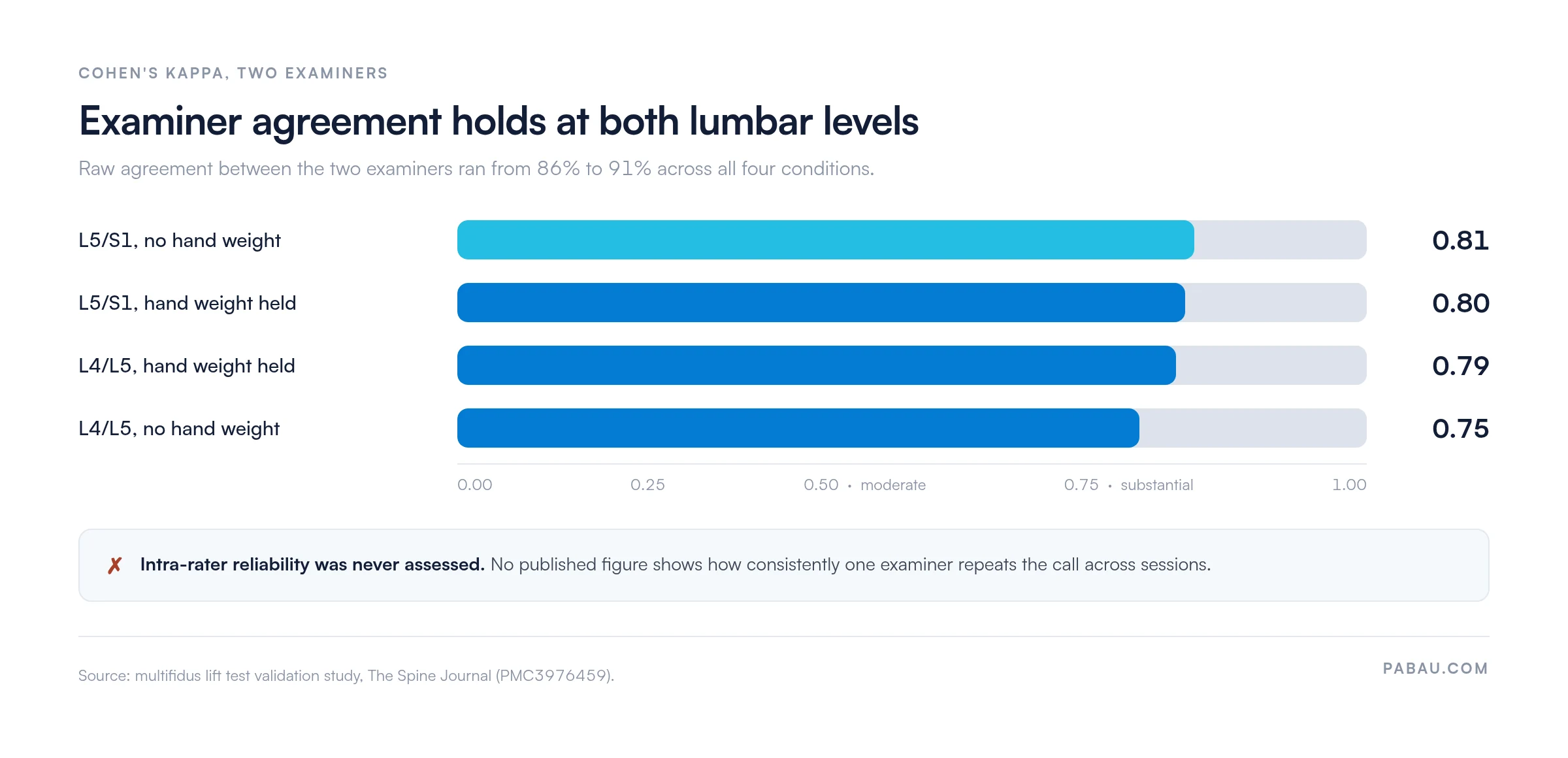
That evidence base supports the MLT as a clinical indicator at L4/L5, and supports it more weakly at L5/S1. It does not support using the test alone to diagnose, without corroborating clinical findings.
Standardize your MLT procedure across the clinical team. Document exact hand placement, arm position, verbal instructions, and the normal-versus-abnormal criteria in a shared clinical protocol. Consistency in examiner technique is the single biggest variable in inter-rater reliability. Review the protocol quarterly, and again whenever new clinicians join the team.
An abnormal multifidus lift test on either side signals that rehabilitation should include specific neuromuscular re-education before any progression to high-load exercise. General conditioning alone is insufficient when segmental control is impaired.
The goal is to restore isolated, voluntary multifidus activation before adding load. Approaches supported by clinical evidence include:
Loading can progress once retesting produces a robust, obvious contraction on both sides. Functional stabilization exercises come next, such as dead bugs, bird-dogs, and task-specific work matched to the patient’s activity goals.
Reassess with the MLT at each phase transition to confirm neuromuscular control has kept pace with load progression.
Two outcomes make the MLT a coarse progress marker. It tells you when palpable activation has returned, not how far along the patient is before that point. Pair it with a functional or symptom measure when you need finer resolution between sessions.
Document the rehabilitation pathway as part of the treatment plan, not only as an initial assessment finding. The sequence that gives the MLT its value runs from result to exercise prescription, then to reassessment and a progression decision.
A recorded MLT result is only useful if the next clinician reads it the same way you did. Palpation findings are easy to record vaguely, and a vague entry cannot be compared against the next one.
In a standard SOAP format, MLT findings sit in the Objective section alongside other physical examination data. The Assessment section then interprets that finding in the context of the full clinical picture. Keep the normal or abnormal call distinct from the interpretation of it within the same record.
A fixed normal-or-abnormal field per side and per level removes the inconsistency of free-text documentation. When every clinician in the practice uses the same form, results stay comparable across sessions and across practitioners.
Clinical governance adds a second reason to standardize. A documented MLT process, with consistent forms, examiner training records, and longitudinal outcome data, is what an inspector asks to see. The physiotherapy compliance requirements guide covers how documentation standards map to HCPC expectations.
Most physiotherapy practices record the multifidus lift test as free text in a session note. That entry is readable on the day and hard to compare three months later, because no two clinicians phrase it the same way.
Practice management software like Pabau replaces the free-text habit with a structured field. You build the MLT into a digital form with a fixed normal-or-abnormal choice per side and per level. A free-text box beside it holds the palpation note and any substitution you observed.
Because the form is attached to the patient timeline rather than a PDF, the result stays with the appointment that produced it. At the next reassessment you can see the previous call, the examiner who made it, and what changed.
That history is what turns a single palpation finding into a progress measure you can show a patient, a referrer, or an inspector.


Pabau gives physiotherapy and musculoskeletal practices structured patient records, digital assessment forms, and outcome tracking. MLT findings, rehab progress, and session notes stay connected in a single auditable system.

The multifidus lift test gives physiotherapists an accessible, equipment-free way to assess a muscle deficit that imaging alone cannot fully capture. An abnormal result identifies a neuromuscular control problem that needs targeted rehabilitation. That problem often persists long after pain resolves, which is why symptom scores alone leave the clinical picture incomplete.
The trade-off is resolution. A binary call is quick and repeatable between examiners, and it will not tell you how close a patient is to recovering activation. Run it alongside a functional measure and record both.
Standardize the procedure across your team, record the result in a fixed field, and the MLT becomes a measure you can defend. Book a demo to see how Pabau keeps physiotherapy assessment findings and rehabilitation progress in one patient record.

Screening the same patients for segmental instability? Passive lumbar extension test covers a second prone test for the lumbar spine, with its own procedure and positive finding.
Need a cervical screen to sit alongside this one? Spurling’s test walks through the positioning, the positive response, and what the result rules in.
Building governance around your assessment records? Physiotherapy compliance requirements covers HCPC standards, clinical record obligations, and what auditors look for in practice governance.
Setting up a new physiotherapy practice? Opening a physiotherapy practice covers the registration, staffing, and documentation decisions that come before the first patient.
The multifidus lift test assesses whether the lumbar multifidus contracts when a prone patient lifts the opposite arm about 5 cm off the table. The examiner palpates beside L4/L5 and L5/S1 during that lift. It measures activation quality rather than gross strength, and the response is recorded as normal or abnormal at each level.
The multifidus lift test is not scored on a numeric scale. The examiner records one of two outcomes at each level palpated. A robust, obvious contraction during the arm lift is normal, and little or no palpable contraction is abnormal. Left and right are recorded separately, and an abnormal finding on either side is clinically significant in a symptomatic patient.
Multifidus dysfunction is most commonly associated with acute lumbar injury, intervertebral disc pathology, and chronic low back pain. Research shows that multifidus atrophy occurs rapidly and ipsilaterally after a lumbar injury. That atrophy does not resolve spontaneously, even once the pain has gone. Surgical procedures at the lumbar spine also frequently impair multifidus activation.
The primary validation study reported inter-rater agreement using Cohen’s kappa rather than ICC values. Kappa reached 0.75 at L4/L5 and 0.81 at L5/S1 without a hand weight, with raw agreement between the two examiners of 86% to 91%. Intra-rater reliability was never assessed, so no published evidence covers how consistently one examiner reproduces the finding across sessions.
The multifidus lift test assesses neuromuscular activation quality through palpation. Ultrasound imaging measures muscle morphology, specifically cross-sectional area and thickness. They are complementary tools. The MLT works in any clinical setting without specialist equipment. Ultrasound is better at detecting structural atrophy, and research or specialist centers use it for real-time biofeedback.
After an abnormal multifidus lift test, rehabilitation should begin with isolated motor re-education. That means prone multifidus contractions with palpatory cueing, four-point kneeling static holds, and gradual progression to dynamic limb loading. High-load exercises such as deadlifts or heavy squats should be deferred until retesting produces a robust, obvious contraction. Exercise prescription should match the patient’s functional goals and be reviewed at each reassessment.