Stroke impact scale: Free PDF, scoring and MCID by domain
The stroke impact scale (SIS) is a 59-item questionnaire in which stroke survivo...

3
Last Updated: Oct 13, 2026

The EMI-2 is a 51-item questionnaire, scored 0 to 5 per item, that measures 14 separate motives for exercising.
Its 14 subscales sit under five themes: psychological, interpersonal, health, body-related and fitness motives.
Scoring averages the items in each subscale, so every client ends up with 14 individual motive scores.
Markland and Ingledew published the instrument in 1997, and Bangor University hosts it free for non-commercial research and clinical use.
Practice management software like Pabau files EMI-2 results in the client record, next to the treatment plan.
The exercise motivation inventory-2 is a validated 51-item questionnaire that measures 14 separate reasons people exercise.
Markland and Ingledew published it in 1997 in the British Journal of Health Psychology. Its 14 subscales sit under five themes: psychological, interpersonal, health, body-related and fitness motives.
This template gives you the full assessment, the scoring key, and guidance on reading a client’s profile. Knowing why a client exercises changes how you prescribe exercise.
The EMI-2 separates motives that tend to sustain a habit, such as enjoyment and revitalization. It scores those apart from motives that tend to fade, such as appearance and health pressures. You can then build a program around the drivers the client already has, instead of the ones you assume they have.
The full 51-item questionnaire, with the 0 to 5 rating scale and the item-to-subscale scoring key. It also covers how to read a client’s 14 subscale means and what each theme tells you.
Download templateThe exercise motivation inventory-2 is a multidimensional questionnaire that identifies and quantifies why someone takes part in physical activity. It contains 51 statements rated on a six-point scale, from 0 (not at all true for me) to 5 (very true for me). The respondent rates each statement, and the answers produce a score on each of the 14 motivational subscales.
Markland and Ingledew built the EMI-2 by revising the original Exercise Motivations Inventory. The revision added motives the first version missed, including enjoyment, challenge and social recognition. The instrument therefore works with people who do not exercise for health reasons at all. That breadth is why it suits behavior-change coaching as well as sports medicine practices.
Markland and Ingledew grouped the 14 subscales under five themes. Each subscale is scored separately, so a client can be strongly motivated by several at once. The table below names all 14 and the theme each one belongs to.
No subscale outranks another, and most clients score highly on several at once. A profile weighted toward enjoyment, challenge and revitalization points to motives that usually hold up over months. A profile weighted toward appearance, weight management and health pressures tends to fade once the event passes. Read the shape of the whole profile rather than one peak.
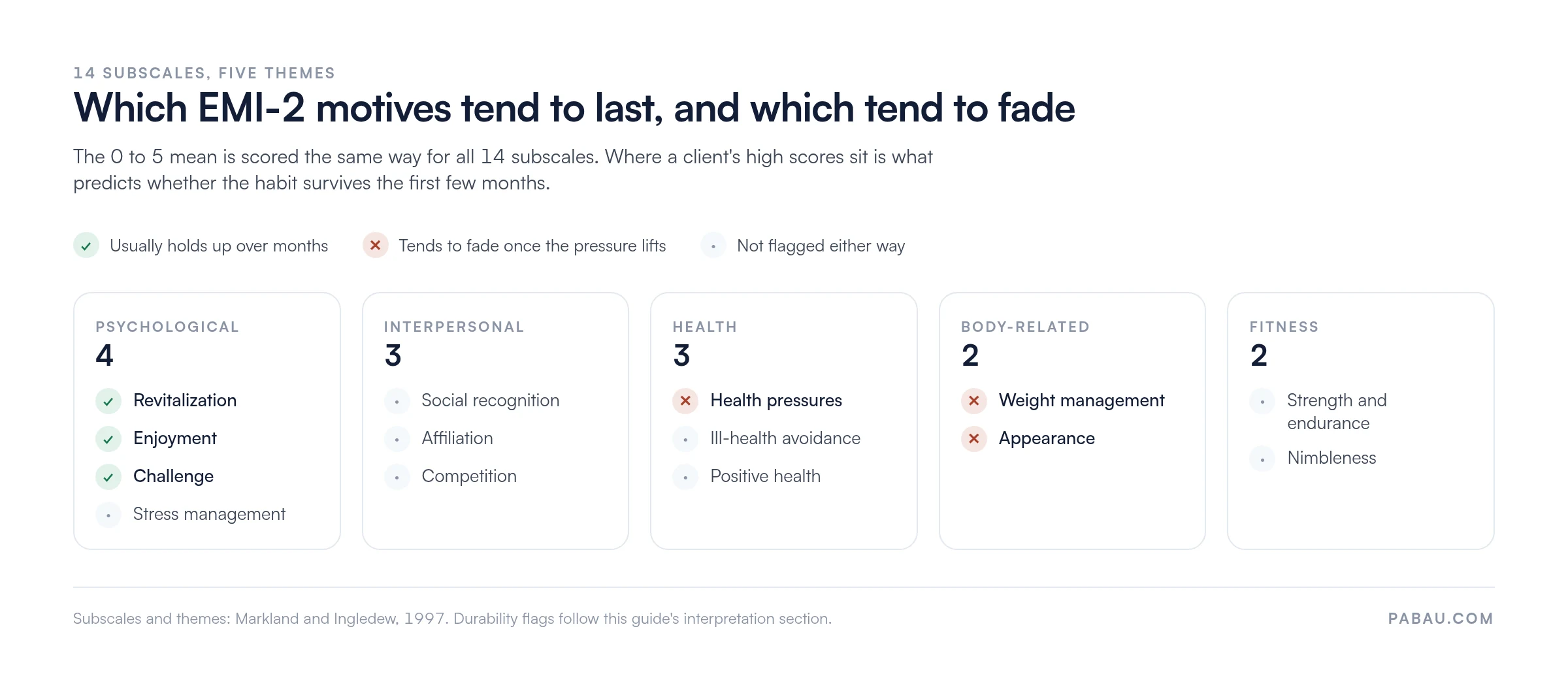
The five themes also make the profile easier to discuss with a client. Two people can both score 4 on ill-health avoidance and still need different programs. One of them also scores 4 on affiliation, and the other scores 0.
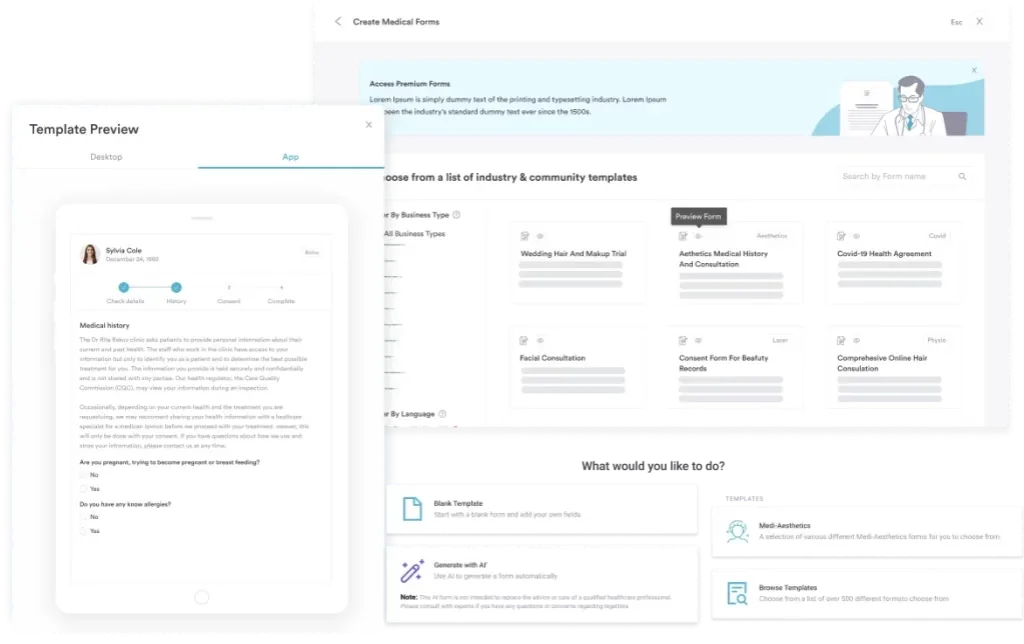
Administering the EMI-2 takes 5 to 10 minutes, and it works equally well on paper or on screen. Digital administration through physical therapy practice software removes the manual scoring step and files the result straight into the client record.
For research or a formal clinical protocol, keep the conditions consistent. Use a quiet room, the same point in the visit, and no discussion of goals beforehand. The EMI-2 is approved for non-commercial research and clinical use by Bangor University, which hosts the instrument and its translations.
Scoring turns 51 item ratings into 14 subscale means. By hand it takes 10 to 15 minutes. A digital form scores it the moment the client hits submit.
The scoring key sits in the downloadable template above. There is no cut-off for high or low motivation. Interpretation is relative to the client’s own profile, and to published norms for the population you work with.
The EMI-2 is most useful when the profile changes what you say to the client. Three worked examples show how that plays out.
High appearance, low enjoyment. This client is exercising for a result, not for the session. Keep the aesthetic goal on the table, and add an activity they would keep doing even if the result never arrived.
High positive health, low affiliation. Group classes are the wrong prescription here. Solo routines and a tracker the client can review at home fit the motives on their profile.
Health pressures standing alone. A client whose only high score is health pressures is exercising because someone told them to. Expect adherence to drop, and work on building a second motive before the pressure lifts.
Repeating the assessment is where the instrument pays off. A profile taken at intake and a second one taken three months later show whether a program moved a client toward motives that last. Storing both in the client record keeps that comparison available to whoever sees the client next.
The EMI-2 suits any practitioner whose plan depends on a client keeping up an exercise habit. It is free for non-commercial research and clinical use.
It replaces guesswork with a score. “The patient wants to get fitter” is too vague to plan around. Fourteen subscale means give you specific motives to work with.
It flags adherence risk early. Research on exercise motivation consistently links motives rooted in the activity itself to longer participation. A profile carried entirely by appearance or outside pressure is worth acting on in week one, not month six.
It makes the intervention measurable. Scores before and after a program show whether your counseling shifted the client’s motives. That beats asking them whether they feel more motivated.
It strengthens the record. A stored EMI-2 profile documents why a particular program was chosen for a particular client, which supports the decision if anyone reviews the file later.
Handing the EMI-2 out on paper leaves someone to score 51 items afterwards. That costs 10 to 15 minutes per client, and one skipped item quietly invalidates a subscale.
Practice management software like Pabau turns the EMI-2 into a digital intake form. Clients complete it on their own phone before the appointment, and required fields stop half-finished submissions. The answers then land in the client record already scored.
Because the results live in the record rather than a filing cabinet, an intake profile and a three-month profile sit side by side. Pabau’s built-in reporting tools group those scores across your caseload, so you can see which motives track with the clients who stay.

Pabau’s digital forms capture the EMI-2 before the appointment and file the scored result in the client record. Your team stops scoring by hand and starts tracking motive profiles across visits.

The EMI-2 earns its place when you act on the profile instead of filing it. A client whose top scores are appearance and health pressures needs a different conversation from one who scores highest on enjoyment and challenge.
Administer it twice. One profile tells you where a client starts. A second profile, months later, tells you whether the program you built moved them.
Keep the scores where the next clinician will see them. Book a demo to see how Pabau stores EMI-2 results in the client record and tracks them across visits.

Screening a client before the first session? Physical activity readiness questionnaire (PAR-Q) template covers the medical questions to clear before you prescribe exercise.
Building the program those motives point to? Home exercise program template gives you a structure clients can follow between appointments.
Clearing athletes for a season? Sports physical form template collects the history and screening a pre-participation exam needs.
Need a second outcome measure alongside it? QuickDASH outcome measure scores upper-limb function in 11 items.
Deciding where the assessment fits? Physical therapy specialties maps the settings and caseloads each type of practice works with.
The exercise motivation inventory-2 is a 51-item questionnaire that measures 14 separate motives for exercising. Markland and Ingledew published it in 1997 in the British Journal of Health Psychology. Its subscales run from enjoyment and challenge to appearance, weight management and nimbleness.
Clients rate all 51 items from 0 (not at all true for me) to 5 (very true for me). Add the items belonging to each subscale and divide by the number of items, which gives 14 subscale means. The scoring key is included in the downloadable template.
The four psychological subscales are stress management, revitalization, enjoyment and challenge. The three interpersonal subscales are social recognition, affiliation and competition. The three health subscales are health pressures, ill-health avoidance and positive health. Appearance and weight management cover body-related motives, while strength and endurance plus nimbleness cover fitness motives.
David Markland and David Ingledew developed the EMI-2. They published it in 1997 in the British Journal of Health Psychology, volume 2, pages 361 to 376. Bangor University hosts the questionnaire and its validated translations.
Yes, the EMI-2 is free for non-commercial research and clinical use. Commercial redistribution or modification needs permission from the copyright holders at Bangor University.
The EMI-2 does not report two totals, but its subscales map onto both kinds of motivation. Intrinsic motives come from the activity itself, such as enjoyment, challenge and revitalization. Extrinsic motives come from outside it, such as appearance, weight management and social recognition. Research links intrinsic motives to longer-lasting exercise habits.
The EMI-2 contains 51 items, each rated on a six-point scale from 0 (not at all true for me) to 5 (very true for me). Most clients finish in 5 to 10 minutes.
Use the download button near the top of this page. The template includes the 51-item questionnaire, the scoring key for all 14 subscales, and clinical instructions. The PDF is free to print or administer digitally.