Hyperbole and a Half pain scale: Every level + free template
The Hyperbole and a Half pain scale is Allie Brosh’s humorous pain chart, ...

1
Last Updated: Oct 5, 2026
The Hoehn and Yahr scale is an ordinal staging tool for Parkinson’s disease. It rates how far motor symptoms have progressed, from Stage 1 to Stage 5. Stage 1 means signs on one side of the body only. Stage 5 means the patient is wheelchair bound or bedridden unless aided.
Margaret Hoehn and Melvin Yahr published the original five-stage version in Neurology in 1967. The intermediate stages 1.5 and 2.5 were added later, and that modified version is the one most practices record today.
This guide covers both versions and the finding that separates each stage from the next. It also explains how to assign a stage at the bedside, what the reliability evidence actually supports, and how stage scores shape rehabilitation planning.
A one-page clinical form with a patient details header and a notes field. It lists every modified Hoehn and Yahr stage from 0 to 5 with its defining criterion. Print it for the bedside or attach it to the patient record.
Download template
The Hoehn and Yahr scale runs from Stage 1, signs on one side, to Stage 5, dependence on a wheelchair or bed.
The modified version adds Stages 1.5 and 2.5, giving seven rated stages plus a Stage 0 baseline for no signs of disease.
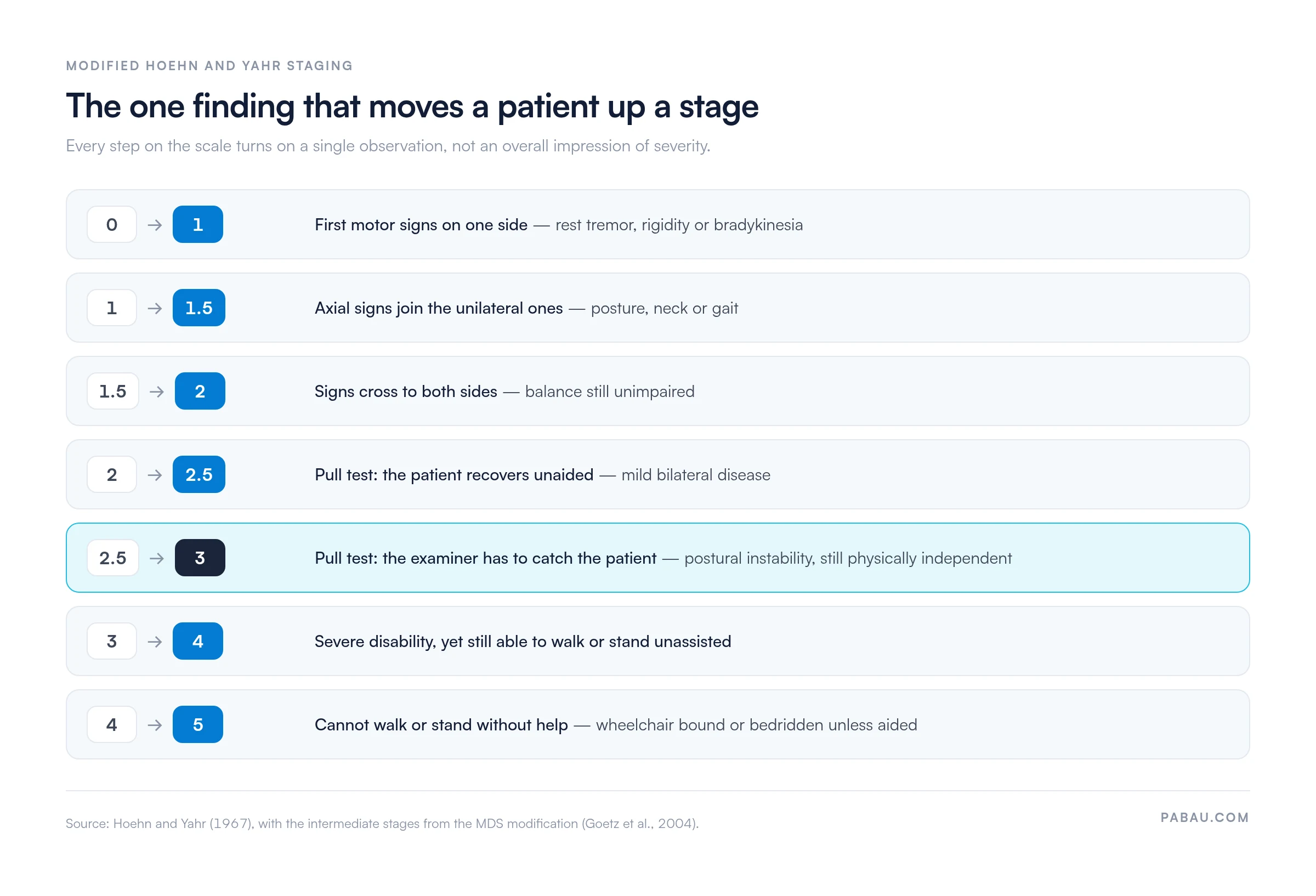
The pull test decides the middle of the scale. Recovery unaided is Stage 2.5, and needing to be caught is Stage 3.
Stage 4 means severe disability with the patient still able to walk or stand unassisted, which is what separates it from Stage 5.
Formal reliability testing of the scale is limited, so record the finding behind each stage rather than the number alone.
The Hoehn and Yahr scale is an ordinal rating tool. It describes how far Parkinson’s motor signs have spread and what they cost the patient in independence. The stages are ranked, not measured. Moving from Stage 1 to Stage 2 does not represent the same change in impairment as moving from Stage 4 to Stage 5.
Hoehn and Yahr described five stages in 1967. The intermediate stages 1.5 and 2.5 came later, to place patients who sit between the classic stages. Both versions are still in use, and the choice usually follows institutional protocol or a study’s inclusion criteria.
Staging needs nothing beyond a clinical examination, which is why it travels easily between neurology, rehabilitation, and research settings. The VA Parkinson’s Disease Research, Education and Clinical Centers use it as a common metric when they evaluate patients.
Both versions grade the same three things: whether signs are unilateral or bilateral, whether postural reflexes hold, and how much independence the patient keeps. They differ only in how finely they cut the middle of the disease course.
The American Physical Therapy Association lists the modified scale among its recommended tests and measures, and most physical therapy documentation follows suit.
The Movement Disorder Society takes a narrower line. Its 2004 task force report recommends the original form for describing patient groups, and notes that the intermediate stages have never been validated separately. So the modified version suits tracking one patient, while the original is the safer choice for reporting a cohort.
Staging runs from motor signs on one side of the body at Stage 1 to full dependence at Stage 5. Each stage names a motor picture and a functional threshold, and the two have to agree before you assign it.
The table describes each stage. What decides a score at the bedside, though, is the single observation that separates one stage from the next.
Work through five observations in order: side of involvement, axial signs, postural reflexes, gait, and independence in daily activities. The stage falls out of the answers.
Staging takes five to ten minutes and fits inside a routine neurology or physical therapy review. Repeat it the same way at every visit, or progression becomes hard to read.
Formal testing of the scale is limited. The Movement Disorder Society task force report found that direct clinimetric testing of the scale has been very limited, despite decades of routine use. Read any published agreement figure as partial evidence, not as a settled property of the scale.
The same report credits the scale’s strengths. Higher stages track with imaging evidence of dopaminergic loss, and stage correlates well with standardized measures of impairment, disability, and quality of life.
Its acknowledged weaknesses are structural. The scale mixes impairment and disability in a single number, and its steps are not linear. It also says nothing about cognition, mood, or autonomic symptoms, and it does not diagnose Parkinson’s disease.
Stage scores set the goal of rehabilitation, from prevention early on to safety and comfort later. They give neurologists, therapists, and care teams one reference point, so a stage recorded in one setting means the same thing in the next.
Staging is too coarse to show progress inside a treatment block, so pair it with a measure that moves faster. A Berg Balance Scale or Dynamic Gait Index score records change within a stage rather than between stages.
From Stage 2.5 upward, postural instability is the finding that drives injury risk. Pair the stage with a structured fall risk assessment at that point, and repeat it whenever the stage changes.
Four limitations matter when you interpret a stage score:
For a fuller picture, clinicians pair staging with the Unified Parkinson’s Disease Rating Scale or the MDS-UPDRS. Both cover non-motor domains and grade motor signs item by item, which the stage number cannot do.
Most practices capture the stage on a paper form or inside a free-text note. Comparing this visit against the last one then means reading back through the chart, and a stage a colleague recorded is easy to miss.
Practice management software like Pabau stores the staging form as structured fields on the patient record instead. Our physical therapy EMR software keeps the form, the visit history, and the treatment plan together. Last quarter’s stage is on screen at the next appointment.
Send the form ahead of the visit and the answers land in the chart rather than a scanning queue. Clinical record management then keeps the scoring history, the clinical notes, and the signed documents in one place for audit or research.

Pabau stores staging forms, visit history, and treatment plans in one patient record. Every stage score is on screen at the next appointment, without a search through scanned paperwork.

The Hoehn and Yahr scale answers one question well: how far motor disease has spread, and what it costs the patient in independence. Ask it about cognition, mood, or a four-week treatment response, and it will disappoint.
Two habits protect the score. Use the same version at every visit, and record the finding that decided the stage alongside the number. The next clinician can then tell whether the patient changed or the examiner did.
Download the template above to keep staging consistent, and add a balance measure once the stage stops moving. Book a demo to see how Pabau keeps assessment forms, scores, and visit history in one patient record.

Need a finer measure of balance? Berg Balance Scale template scores 14 tasks, so you can track change inside a single stage.
Screening an older patient for falls? Tinetti balance test template grades balance and gait together in one short assessment.
Grading gait under harder conditions? Functional Gait Assessment template adds head turns, obstacles, and narrow-base walking to a standard gait score.
Want a timed measure you can repeat every visit? 10 meter walk test gives you a gait speed figure that moves faster than a stage number.
Need a one-minute balance screen? Functional reach test measures how far a patient can reach forward before losing balance.
The original scale defines five stages. Stage 1 brings unilateral involvement with minimal disability, and stage 2 adds bilateral involvement while postural reflexes stay intact. By stage 3, postural instability appears, though the patient remains physically independent. Disability turns severe at stage 4, but the patient can still walk or stand unassisted. Stage 5 leaves the patient wheelchair-bound or bedridden unless aided.
The modified version adds Stages 1.5 and 2.5 to the original five, giving seven rated stages plus a Stage 0 baseline. Stage 1.5 covers unilateral signs with axial involvement. Stage 2.5 covers mild bilateral disease where the patient recovers unaided on the pull test. Routine practice mostly uses the modified version.
Clinicians use the stage to track progression, set rehabilitation intensity, judge fall risk, and explain prognosis to families. Neurologists and physical therapists record it at routine reviews. It also travels well between teams, because each stage rests on a stated criterion rather than a subjective impression of severity.
Stage 3 means mild to moderate bilateral disease with postural instability, confirmed when the examiner has to catch the patient on the pull test. Patients remain physically independent, though tasks take longer and work is often affected. Fall risk rises sharply here, so balance and reactive stepping work belongs in the plan.
Only to a limited degree. The Movement Disorder Society task force reported that direct clinimetric testing of the scale has been very limited, despite its wide acceptance. The task force still recommends the original form for describing patient groups. Treat it as an accepted staging tool rather than a precisely validated measure.