

Six-minute walk test: Protocol, norms, and interpretation
The six-minute walk test measures how far a patient walks on a flat, hard surface in six minutes. That distance, the 6MWD, stands in for functional exercise capacity across COPD, heart failure, and pulmonary rehabilitation. One number does the work of a much larger exercise lab, but only if the test is run identically every […]
Anterior interosseous nerve test: How to perform and interpret it
The anterior interosseous nerve test is a bedside exam for motor weakness in the anterior interosseous nerve (AIN). The AIN is a purely motor branch of the median nerve, so weakness shows up with no numbness at all. You ask the patient to form an OK sign with the thumb and index finger. A triangular […]
Pressure provocation test: Procedure, interpretation, and accuracy

The pressure provocation test is a bedside maneuver for cubital tunnel syndrome. The clinician presses directly on the ulnar nerve behind the medial epicondyle and holds for up to 60 seconds. A positive result is tingling or numbness in the ring and little fingers. Novak, Lee, Mackinnon, and Lay described the test in 1994 in […]
Gluteus medius test: How to perform and interpret results
The gluteus medius test is a clinical assessment of hip abductor strength and pelvic control under weight-bearing or manual resistance. Four tests do the work in practice. They are the Trendelenburg test, the single-leg stance test, manual muscle testing in side-lying, and the Donatelli drop leg test. Weakness here is linked to Trendelenburg gait, iliotibial […]
Resisted supination external rotation test: SLAP diagnosis guide
The resisted supination external rotation test (RSERT) is a shoulder special test used to identify superior labral anterior-posterior (SLAP) lesions and biceps tendon pathology. It loads the biceps-labral complex by resisting forearm supination and glenohumeral external rotation at the same time. Myers, Zemanovic and Andrews first described the test in the American Journal of Sports […]
Motor strength test: MRC grading and interpretation
A motor strength test grades how much force a muscle or muscle group can produce against examiner resistance. So clinicians use it to detect, localize, and monitor neuromuscular deficits in neurological, musculoskeletal, and rehabilitation settings. According to StatPearls (NIH/NCBI), grading follows the Medical Research Council (MRC) scale from 0 to 5. This guide covers how […]
Jumping rope exercise plan: 4-week beginner template
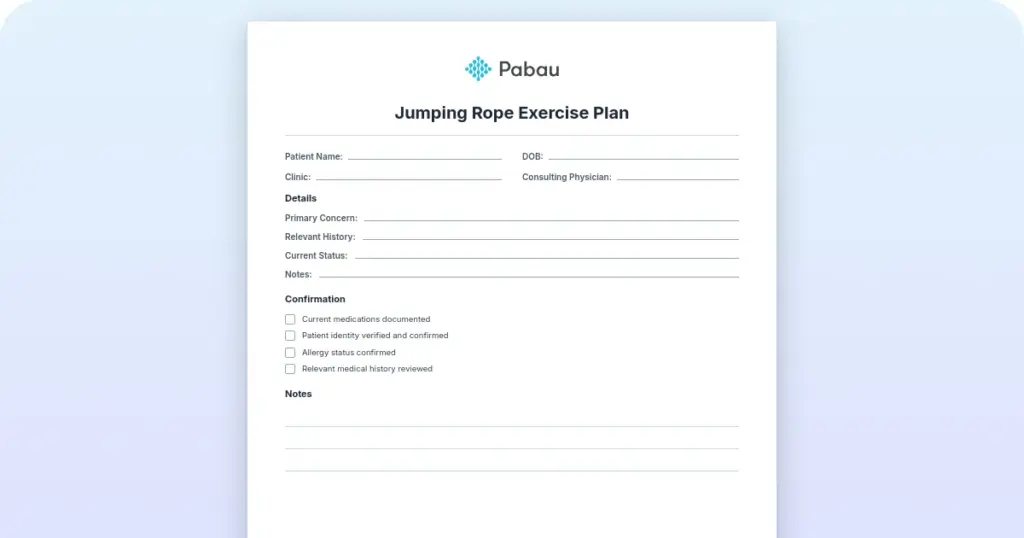
A jumping rope exercise plan is only worth printing if it tells you what to do on every training day. Plenty of them stop at a vague 15 minutes a day, and leave technique, rest and progression to you. That is where beginners usually stall. This free four-week template fills in the detail. You train […]
ICD-10 Code S42.309K: Humerus shaft fracture nonunion

ICD-10 Code S42.309K: Full description and billable status ICD-10 Code S42.309K describes an unspecified fracture of the shaft of the humerus, unspecified arm, subsequent encounter for fracture with nonunion. The FY2026 tabular carries that descriptor verbatim. According to the CDC/NCHS ICD-10-CM web tool, the code took effect on October 1, 2025 for the 2026 fiscal […]
Sweep test: How to perform, grade, and interpret knee effusion findings
The sweep test is a bedside examination technique that detects small amounts of fluid, called effusion, inside the knee joint. You displace fluid out of the medial compartment, then watch the medial side for a returning fluid wave. A wave or bulge means effusion is present, graded from 0 to 3+ by how quickly and […]
TFCC compression test: Procedure, interpretation and accuracy
The TFCC compression test is an orthopedic special test that loads the triangular fibrocartilage complex to reproduce ulnar-sided wrist pain. The examiner takes the wrist into maximum ulnar deviation and pronation, then applies axial compression through the forearm. Pain that matches the patient’s familiar symptom counts as a positive result. The test takes seconds, needs […]