Nitrates medication list
A nitrates medication list is a point-of-care reference that sets out the main c...

Last Updated: Oct 6, 2026
A 30 minute exercise plan template is a clinical form for agreeing exercise goals with a patient and recording the actions behind them. It is a planning and review document, not a workout sheet. It does not prescribe exercises, sets, reps, or rest periods.
The two-page form covers patient details, background, up to five goals with target dates, and seven actions with named owners. A support checklist and a five-row review record close it out. You agree it with the patient, then update it at each review.
Physical therapy, rehabilitation, wellness, and primary care teams use it to turn broad activity advice into goals they can measure. The 30 minute figure is the habit being tracked, since 30 minutes on five days meets the CDC’s 150-minute weekly target.
A two-page goals and actions care plan form for exercise. It records patient details, background, five goals with target dates and progress measures, seven actions with owners, a support checklist, and a five-entry review record.
Download template
The 30 minute exercise plan template is a goals and actions care plan form, not a prescriptive workout sheet.
It records up to five goals, each with its own progress measure and target date.
Seven action rows capture what happens next, who owns each step, and when it starts.
A support checklist and a five-entry review record keep the plan current between appointments.
Pabau’s digital forms and patient portal let you send, complete, and store the plan against the client record.
The template follows the shape of a care plan rather than a training program. Each block on the form asks for something you can check again at the review.
| Section of the form | What you record |
|---|---|
| Patient and plan details | Name, date of birth, record or MRN, who prepared the plan, and the dates agreed and reviewed. |
| Background | Why the plan is needed, in the patient’s own words where possible. |
| Goals 1 to 5 | The goal itself, how progress is measured, and a target date for each one. |
| Actions 1 to 7 | The step to be taken, who is responsible for it, and the start date. |
| Support in place | Written information, contact details, family or caregiver involvement, equipment, and a booked follow-up. |
| What to do if things change | Warning signs to watch for, and who the patient should contact. |
| Review record | Five dated entries covering progress, changes made, and the reviewing clinician. |
| Signatures | Patient and clinician signature lines, each with a date. |
Two details carry the documentation weight. Every goal has its own measure, so progress is recorded as evidence rather than impression. Every action has an owner, so no step sits in the plan without a name against it.

Thirty minutes on five days a week meets the CDC’s guidance of 150 minutes of moderate aerobic activity. That makes it a defensible target to write into a care plan. The weekly totals below show what each session count reaches.
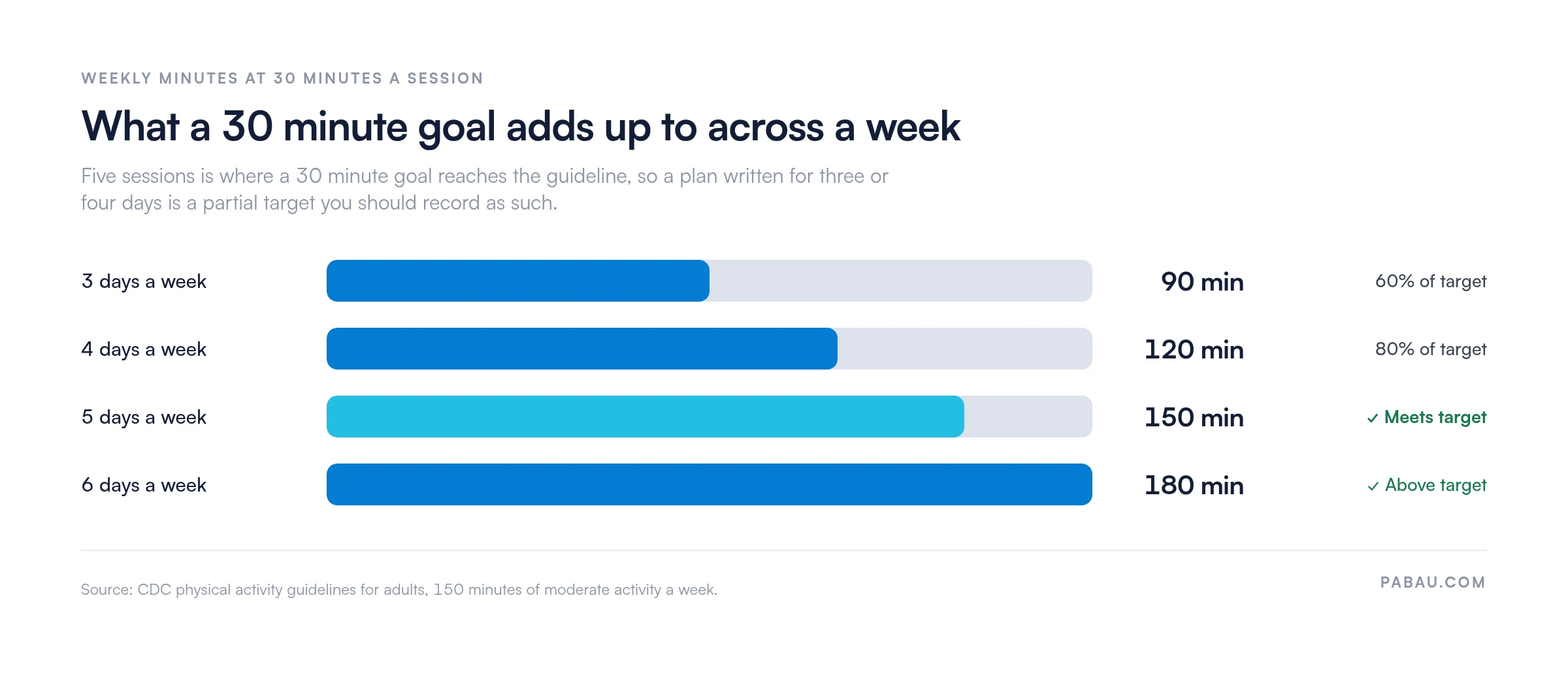
Adherence is usually where plans fail, not ambition. A patient who commits to three or four 30 minute sessions is easier to review honestly than one promising daily hour-long workouts. Setting a target the patient can hit is part of the judgment this form records.
Screen the patient before you write the target, especially after a long inactive spell or a cardiac event. An activity readiness questionnaire covers that in a single page, and the answers belong in the background box.
Work through the form in order during the appointment, with the patient answering wherever they can.
The owner column is the one practices tend to leave blank. Writing “patient” against an action is fine, but writing nothing leaves the step unassigned at the next review.
The review record holds five entries. Each takes a date, a note on progress, the changes made, and the name of the reviewing clinician.
Update the plan rather than replacing it. One form carrying five reviews shows the trajectory, which is what an insurer, a regulator, or a covering colleague needs to see.
If a goal is missed twice, change the goal or the action behind it. Adherence improves when the plan moves with the patient instead of sitting unchanged in the file.

The form carries no exercise names, sets, reps, rest periods, or warm-up and cool-down guidance. It does not split the 30 minutes into blocks, and it does not progress a load for you.
Pair it with whatever you already use to prescribe the activity itself. A written home exercise program, a supervised session plan, or a specialist referral all sit alongside this plan. The form is where the goal, the owner, and the review date live.
That division is deliberate. Exercise prescription is clinical and patient-specific, so a downloadable PDF has no business making those decisions. Goal setting and review take the same shape for every patient, which is what a form does well.
Any team that agrees activity goals and has to evidence them can use the form. It was written with physical therapy practices in mind, and it carries across to the settings below without changes.
On paper, this plan ends up as a scan in a folder. The goals are recorded, but no one can query them, and the review date depends on someone remembering to put it in the calendar.
Practice management software like Pabau rebuilds the same form as a digital form. Goals, actions, and review entries save straight to the client record, so the next clinician opens the current version rather than the last printout.
The patient portal handles distribution. Send the plan before the appointment or after it, collect the patient’s agreement, and let reminders chase the review date. Each submission stays attached to the record, so the history of the plan is one click away.

Pabau’s digital forms and patient portal let your team agree exercise goals, assign actions, and log every review against the client record. Reminders go out before the review date, so plans stay current.

Use this plan for what it does. It gives you a structure for agreeing exercise goals and evidence that you reviewed them. The clinical judgment about which exercises suit which patient stays with you.
The value shows up at the second review, not the first. A form with five dated entries tells a story that five separate notes do not.
Build it into the appointment rather than treating it as paperwork for afterwards. Book a demo to see how Pabau turns this plan into a digital form your team can send, track, and review.

Prescribing the exercises themselves? Home exercise program is the template that carries the sets, reps, and progressions this plan leaves out.
Need a progress measure you can repeat? 10 meter walk test gives you a timed score to enter at every review.
Losing patients between appointments? Patient retention in physical therapy covers what keeps a course of treatment running to its end.
Working with runners or post-injury patients? Return to running protocol shows how staged criteria turn an activity goal into a decision.
Setting goals for older adults? Strength exercises for older adults covers the twice-weekly strengthening work the guidelines ask for.
This is a two-page clinical form for agreeing exercise goals with a patient. It records goals, progress measures, target dates, actions, support, and dated reviews. Exercise prescription itself is not included.
No. The form carries no exercise names, sets, reps, rest periods, or warm-up and cool-down guidance. Use it alongside your own exercise prescription or a physical therapy referral.
The clinician and the patient complete it together during the appointment. Each action has an owner column, so a step can sit with the patient, a caregiver, or a staff member.
You set the cadence when you agree the plan, and write the date on the form. The review record holds five entries, so one form can carry several months of follow-up.
Thirty minutes on five days a week meets the CDC guidance of 150 minutes of moderate aerobic activity. Most adults also need muscle-strengthening activity on two days a week.