Cytocare consent form
Cytocare is a hyaluronic acid-based mesotherapy skin booster from Revitacare, in...

1
Last Updated: Oct 27, 2026

An Arizona cosmetology license takes 1,500 training hours at a board-licensed school, plus a written exam and a practical exam.
You qualify at 16 with two years of high school or its equivalent, or at 18 with no education requirement.
The initial license costs $60 and the two exams cost $177 together, with a $3 service fee added to every payment.
Personal licenses renew every two years on your birthday, and Arizona requires no continuing education to renew.
The license covers the epidermis only, so lasers, deeper needling and injectables answer to other Arizona regulators.
Arizona cosmetology license requirements come down to three numbers: 1,500 training hours at a board-licensed school, two exams, and one $60 fee. Once you hold the license, it renews every two years on your birthday, with no continuing education attached. The board that issues it is the Arizona Barbering and Cosmetology Board, and it now licenses barbers too.
That is the short answer. The rest of this guide covers the part the licensing pages leave out. A cosmetology or aesthetician license carries a hard boundary at the skin. Past that boundary, the Arizona Medical Board, the Arizona State Board of Nursing and the Department of Health Services take over.
If you are opening a practice rather than working in one, that boundary decides who you hire and what goes on the treatment menu.
Training hours vary sharply by license type too, as the chart below shows.
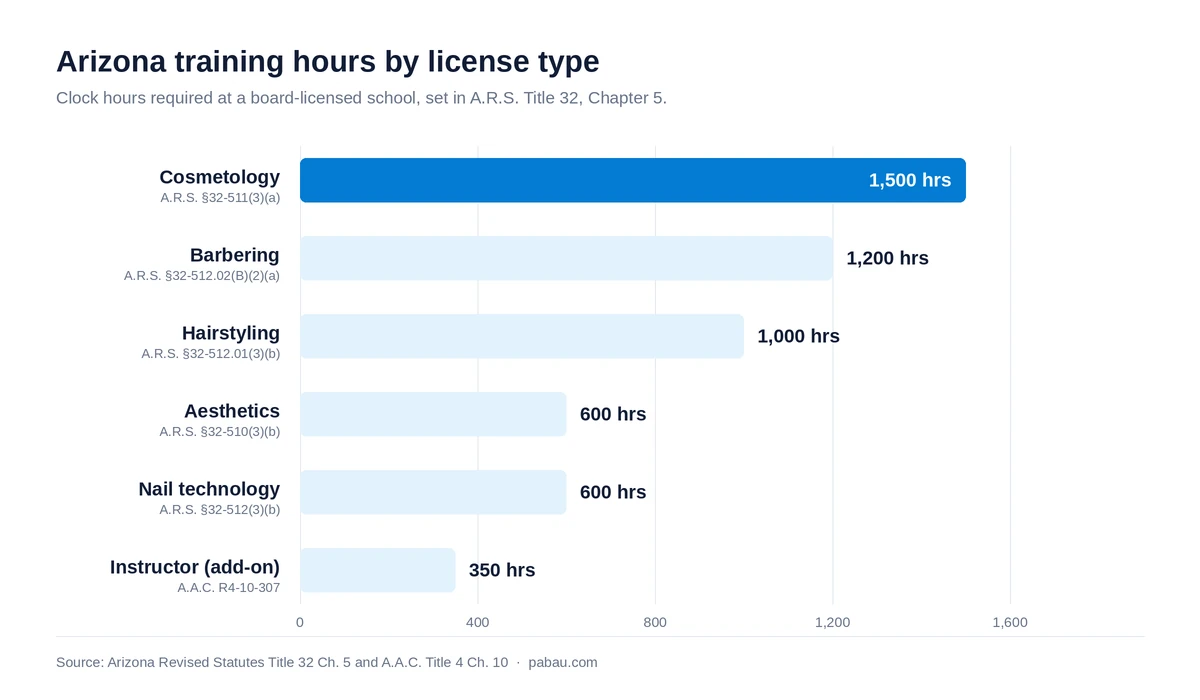
Arizona requires 1,500 clock hours at a board-licensed school, passing scores on the written and practical exams, and a $60 initial license fee. The age and education rule is identical for every license the board issues.
| License type | Training hours | Minimum age | Exams | Initial fee | Renewal fee |
|---|---|---|---|---|---|
| Cosmetology | 1,500 | 16 with two years of high school, or 18 | Written and practical | $60 | $60 |
| Aesthetics | 600 | 16 with two years of high school, or 18 | Written and practical | $60 | $60 |
| Nail technology | 600 | 16 with two years of high school, or 18 | Written and practical | $60 | $60 |
| Hairstyling | 1,000 | 16 with two years of high school, or 18 | Written and practical | $60 | $60 |
| Barbering | 1,200 | 16 with two years of high school, or 18 | Written and practical | $40 | $80 |
The hours sit in statute rather than in board policy. Cosmetology is set at A.R.S. §32-511(3)(a) and repeated in the rules at A.A.C. R4-10-308(A)(3). Aesthetics and nail technology each take 600 hours, hairstyling takes 1,000, and an instructor license takes a further 350 under R4-10-307.
Those cosmetology license requirements got shorter recently. Laws 2021, Chapter 334 cut cosmetology from 1,600 hours to 1,500 and barbering from 1,500 to 1,200, effective January 1, 2022. Aesthetics, nail technology and hairstyling were left where they were. Washington cosmetology license requirements still sit at the 1,600 hours Arizona dropped.
The age and education rule appears five times in statute, once per license, and reads the same each time. You need two years of high school or its equivalent and to be at least 16. The alternative is to be at least 18, with no education requirement at all.
A.A.C. R4-10-101(35) defines what counts as two years of high school. Ten high school credits qualify. So does a passing GED, an Affidavit of Intent for a homeschooled applicant, or simply being 18.
One agency handles cosmetology, aesthetics, nail technology, hairstyling and barbering in Arizona. Its legal name under A.R.S. §32-502(A) is the Barbering and Cosmetology Board, and it styles itself the Arizona Barbering and Cosmetology Board. Its site is bcb.az.gov.
The board exists because two older agencies were merged. HB 2029, Laws 2021, Chapter 334 combined the Arizona State Board of Cosmetology with the Arizona State Board of Barbers. The Governor approved it on May 7, 2021, and it took effect on January 1, 2022.
The board’s full authority sits in A.R.S. Title 32, Chapter 5, running from §32-501 to §32-598. The rules live in A.A.C. Title 4, Chapter 10, which is why board documents cite rule numbers beginning R4-10.
A second bill tidied up what was left. HB 2168, Laws 2024, Chapter 250 repealed the old barbering chapter outright and folded barbers into Chapter 5. It also swapped the word “salon” for “establishment” across the statute. If a form asks for your establishment license, that is the salon license under its current name.
The board itself was continued to July 1, 2034 by Laws 2026, Chapter 234. That gives anyone building a career or a practice around these rules a settled regulator for the next eight years.
The Arizona Board of Cosmetology is the old name, and it still carries most of the search traffic. The Arizona State Board of Cosmetology ran from 1958 until the 2021 merger. The Arizona State Board of Barbers ran from 1984 until the same date. Neither issues licenses now.
Schools, employers and applicants still say az board of cosmetology out of habit, and older paperwork still carries the legacy wording. The old barbering rules at 4 A.A.C. 5 are formally marked as recodified, which is the drafting term for moved rather than deleted.
Every license issued today carries the current name, Barbering and Cosmetology Board. Treat the two names as the same agency at different points in time, and search under both when you are hunting for an old record.
Getting an Arizona cosmetology license is a five-step sequence, and the training is by far the longest part of it. The process needs no lawyer or sponsor.
Step two has an alternative that few applicants know about. A.R.S. §32-511(3)(c) lets you substitute an apprenticeship approved by the US Department of Labor or the Arizona Department of Economic Security for school hours. The apprenticeship still has to include at least 250 hours of infection protection and law review.
Every license has its own apprenticeship minimum. Barbering matches cosmetology at 250 hours. Aesthetics and hairstyling need 200 hours each, and nail technology needs 150.
Step five is where most timelines slip. Four weeks of processing sits on top of your exam dates. Plan a start date with that buffer built in, not the day your last classroom hour lands.
A.R.S. §32-514(A) requires both a written and a practical examination, and neither substitutes for the other. The content comes from the National Interstate Council of State Boards of Cosmetology, known as NIC, which writes the exam bank most states share. Candidates for an Alabama cosmetology license or a Colorado cosmetology license sit the same NIC exams, delivered by PSI in both states.
Professional Credential Services, part of Virtual Inc., administers both exams in Arizona. Both are computer-based. The practical exam is offered in English or Spanish, though the instructor practical is English only.
One scheduling detail is worth knowing early. You may sit the exams before your training hours are complete, but you cannot be licensed until the hours are finished. Booking the written exam during your final term shortens the wait at the end.
Retakes are handled under A.R.S. §32-515. You only re-sit the portion you failed, and there is no cap on attempts. Both portions have to be passed within one year of your first attempt, and the fees are non-refundable each time. Candidates for a Tennessee cosmetology license get three years instead, counted from passing the initial theory exam.
An Arizona barber license takes 1,200 hours rather than 1,500, under A.R.S. §32-512.02(B)(2)(a) and A.A.C. R4-10-308(A)(9). The age and education rule is identical to cosmetology, and so is the two-exam requirement.
If you already hold a cosmetology or hairstyling license, the crossover is much shorter. A.R.S. §32-512.02(C) sets it at 200 hours. That figure used to be 350 before the 2021 reforms cut it.
The fees do not match cosmetology, which surprises people who assume one board means one price list. A barber license costs $40 initially but $80 to renew, the reverse of the $60 flat figure on the cosmetology side. Delinquent renewal for barbers runs on an incremental scale from $25 to $75.
Searches for the arizona board of barbers still land on the merged agency. The separate barber board closed in 2021, and its rules were recodified into the cosmetology chapter three years later.
A.R.S. §32-517(A) puts every personal license on a two-year cycle that ends on the licensee’s birthday. Cosmetology license renewal in Arizona is that simple. Your birthday is the deadline, every second year, for as long as you hold the license.
Your first license is the exception. It expires on your second birthday after issue, so an initial license can run noticeably short of a full two years. Check the expiry date printed on the license rather than counting 24 months forward.
The renewal window opens 60 days before expiry, and the board takes up to four weeks to process a renewal. Filing on the last day is how people end up working on a lapsed license without meaning to.
Arizona asks for no continuing education. An Arizona State Board of Cosmetology license renewal and an Arizona Barbering and Cosmetology Board license renewal are the same filing under two names. No course hours attach to either.
Miss the date and A.R.S. §32-517(C) adds a delinquent penalty on top of the renewal fee. The board can also pursue discipline for practicing on an expired license, which is a slower and more expensive problem than the fee.
Practice owners run on a different clock. Establishment licenses renew annually under A.R.S. §32-544(A), on the anniversary of first licensure. Two-year personal renewals and one-year establishment renewals rarely line up, so track them separately. Wisconsin cosmetology license requirements avoid the mismatch, with personal and establishment licenses both renewing on March 31 of odd-numbered years.
The board publishes its charged fees at bcb.az.gov, and they are lower than most licensing guides suggest. The table below is what the board actually collects, split by discipline.
| Fee | Cosmetology, aesthetics or nail technology | Barbering |
|---|---|---|
| Written exam | $100 | $100 |
| Practical exam | $77 | $77 |
| Personal license, initial | $60 | $40 |
| Personal license, renewal | $60 | $80 |
| Delinquent renewal | $30 | $25 to $75, incremental |
| Reciprocity or universal recognition | $60 | $175 |
| Establishment, initial | $110 | $110 |
| Establishment, renewal | $50 | $50 |
| Establishment, suite change | $20 | $20 |
| School, initial | $600 | $1,000 |
| School, renewal | $250 | $400 |
Three details are worth pinning down, because competing guides get them wrong.
Total exam cost is $177 for the written and practical together, paid to the testing organization rather than the board. Adding the $60 license fee puts a new cosmetologist at $237 in state-side costs, before tuition.
Eyelash technician registration sits outside the main table at $45 initially and $45 to renew, with a $30 delinquent fee.
Laws 2026, Chapter 234 amends A.R.S. §32-507 and lowers the statutory ceilings on almost every fee the board charges. Arizona’s general effective date for 2026 legislation is September 12, 2026.
| A.R.S. §32-507(A) item | Cap now | Cap from September 12, 2026 |
|---|---|---|
| Initial personal license | $100 | $80 |
| Reciprocity or universal license | $200 | $100 |
| Establishment application | $250 | $200 |
| Personal renewal, biennial | $100 | $80 |
| Personal delinquent renewal | $150 | $100 |
| Establishment renewal | $100 | $80 |
| Establishment delinquent renewal | $150 | $100 |
| School renewal | $500 | $400 |
| School delinquent renewal | $600 | $500 |
Read these as ceilings, not prices. A lower cap does not automatically reduce what the board charges, and most of the current fees already sit well under the new limits.
One published fee does not fit. The board’s $175 barber reciprocity fee is above the incoming $100 cap for a reciprocity or universal license. That fee schedule predates the amendment, so check bcb.az.gov again after September 12, 2026 before budgeting for a transfer.
An Arizona Board of Cosmetology license lookup runs through the board’s free, public license verification at bcb.az.gov. You search by name or license number and get back the license type, its number, its status and its expiry date.
Legacy searches still work the way you would expect. An Arizona State Board of Cosmetology license lookup reaches the same records as a cosmetology license lookup under the current name. The merger moved the register rather than replacing it.
For a practice owner, verification is a hiring step rather than a curiosity. Check three fields before anyone touches a client:
The board’s enforcement powers sit at A.R.S. §32-571 for actions, §32-572 for grounds and §32-574 for unlawful acts. Civil penalties are capped at $2,000. That cap is small next to the cost of losing an establishment license.
Arizona offers two separate ways to convert an out-of-state license, and they carry different conditions. Reciprocity under A.R.S. §32-513 has no residency test. Universal licensure recognition under A.R.S. §32-4302 requires you to establish Arizona residency first.
| Requirement | Reciprocity, §32-513 | Universal recognition, §32-4302 |
|---|---|---|
| Arizona residency | Not required | Required |
| Minimum time licensed elsewhere | None | At least one year |
| Infection protection and law review class | Required | Not required |
| Good standing in every state held | Evidence of the license only | Required |
| Clean disciplinary and complaint record | Not specified in statute | Required |
| Fee | $60 cosmetology, $175 barbering | $60 cosmetology, $175 barbering |
| Where the license is valid | A standard Arizona license | Arizona only, per §32-4302(F) |
Reciprocity is the lighter route. You apply, show satisfactory evidence of a license held in another state or country, and pay the fee. You also complete the board’s class on infection protection and law review. Graduates of a school in another state or country are handled through the same section.
Universal recognition asks for much more. You must hold a license at the same practice level in at least one other state, for at least a year. It has to be in good standing everywhere you hold it. The other state must have had minimum education requirements and must verify them.
You also need a clean record. A revoked license, a license surrendered under investigation, discipline elsewhere or a pending complaint each block the route. Disqualifying criminal history is assessed under A.R.S. §41-1093.04.
Two protections come with it. Section 32-4302(H) requires the agency to send the application and its reasoning to the Governor before denying it. Section 32-4302(F) confirms the license works in Arizona only.
Residency proof is the one point the board has written up. Its universal recognition policy statement, updated in January 2025, accepts any one of the following:
Any one of those establishes residency for the universal route.
Arizona enacted the compact at A.R.S. §§32-581 to 32-598, and the Cosmetology Licensure Compact is no longer dormant. Colorado became the seventh enacting state in June 2024, and the multi-state Compact Commission formed that October and has been writing rules since. Reporting in 2026 suggests the first multi-state licenses could start issuing this year, but none has yet. Until one does, an Arizona practitioner still relies on reciprocity or universal recognition, not a compact privilege.
Military licensees get a separate cushion. A.R.S. §32-4301 extends a license by 180 days for a member on federal active duty, with no late fees attached.
An Arizona cosmetology or aesthetics license stops at the epidermis. A.A.C. R4-10-112(P) tells licensees to remove only the non-living uppermost layer of skin. It bars any skin removal technique or practice that affects the dermal layer.
The establishment rule says the same thing from the other side. A.A.C. R4-10-112(O)(1)(a) requires an establishment to keep out any device, tool or chemical designed or used to pierce the dermis. Subsection (O)(2) makes one allowance, for an otherwise lawful invasive procedure performed under another regulator’s rules.
That allowance is the doorway to the medical side, and A.R.S. §32-506(1) is its statutory hinge. The cosmetology chapter does not apply to medical practitioners licensed under Title 32 where their practices treat physical or mental ailments or disease.
So the same treatment can be lawful or unlawful depending only on who performs it. Four agencies share the territory past the dermis.
| Agency | Governing statute | What it controls here |
|---|---|---|
| Arizona Medical Board | A.R.S. Title 32, Chapter 13 | Physicians, and the practice of medicine defined at §32-1401(22)(a) |
| Arizona State Board of Nursing | A.R.S. Title 32, Chapter 15 | RNs, LPNs and nurse practitioners, including medical aesthetic scope |
| Arizona Board of Osteopathic Examiners | A.R.S. Title 32, Chapter 17 | Osteopathic physicians, who may supervise laser work |
| Arizona Department of Health Services | A.R.S. §32-516 and Title 9 rules | Laser technician certification and device registration |
Aesthetics itself is defined at A.R.S. §32-501(2). Section 32-501(9) confirms that the “electrical appliances” in that definition include the lasers and IPL devices described in §32-516. That is why laser work carries its own certificate.
A licensed Arizona esthetician may perform light peels, dermaplaning, microdermabrasion and microneedling to a maximum depth under 0.5 mm. Deeper needling, cosmetic lasers and injectables sit outside the license. The table below maps each treatment to the credential and the authority behind it.
| Treatment | Licensed esthetician? | Who else may | Order or supervision | Authority |
|---|---|---|---|---|
| Microneedling under 0.5 mm | Yes | Cosmetologist, LPN, RN, APRN | None | BCB policy statement; AZBN Level I |
| Nano-needling | Yes | Cosmetologist | None | BCB policy statement |
| Microneedling 0.5 mm and above | No | RN and APRN only | Practitioner order, written consent, pain management | AZBN Level III |
| Chemical peel, light depth | Yes | Barber, cosmetologist, LPN, RN, APRN | None | BCB policy statement; AZBN Level I |
| Chemical peel, medium depth | Yes | Barber, cosmetologist, RN, APRN | Licensed independent practitioner order and informed consent | BCB policy statement; AZBN Level IIA |
| Dermaplane exfoliation and dermablading | Yes | Barber, cosmetologist, LPN, RN, APRN | None | BCB policy statement; AZBN Level I |
| Microdermabrasion, Hydrafacial, microcurrent | Yes | Cosmetologist | None | BCB policy statement |
| Laser hair removal | Only with an ADHS laser technician certificate | Health professionals under Ch. 13, 14, 15, 17 or 25 | Indirect supervision | A.R.S. §32-516; §32-3233(H) |
| Other cosmetic laser or IPL | Only with an ADHS laser technician certificate | Health professionals under Ch. 13, 14, 15, 17 or 25 | Direct supervision | A.R.S. §32-516; §32-3233(H) |
| Neuromodulators and dermal fillers | No | Health professionals with prescribing authority | Prescribing authority required | A.R.S. §32-3232; AZBN Level III |
Two documents sit behind that table, and they are worth reading in the original. The first is the board’s substantive policy statement on scope of practice for licensed aestheticians and cosmetologists, approved September 20, 2024.
It is advisory only under A.R.S. §41-1033, so treat it as the board’s stated position rather than a rule. It also carries two conditions worth noting. Licensees must work in a board-licensed establishment, and every laser, radiofrequency and IPL device must be registered with ADHS.
The second is the Arizona State Board of Nursing advisory opinion on medical aesthetic procedures, revised in January 2025. It sorts procedures into three levels.
No cosmetologist, esthetician or laser technician is marked for any Level III procedure. That is the single clearest line in Arizona’s medical aesthetic documentation.
The nursing board adds its own caveat, and it matters. It states plainly that it has no jurisdiction over care providers outside the Nurse Practice Act. For a non-nurse, the enforcing agency is the Barbering and Cosmetology Board or ADHS instead.
The two documents also disagree in one place. The board’s policy statement marks barbers as permitted for peels and dermaplaning, while the nursing opinion has no barber column at all. For barbers, the Barbering and Cosmetology Board is the authority.
Watch what the policy statement leaves out. It has no row for deep chemical peels and no row for injectables, so it neither authorizes nor prohibits either. Fall back to R4-10-112(P) on the dermal layer and A.R.S. §32-3232 on prescription agents.
Do not go looking for an Arizona Medical Board position on any of this. The medical board publishes no policy statement on microneedling, peel depth, med spas or delegation of cosmetic procedures.
Arizona has no statutory corporate-practice-of-medicine prohibition. A.R.S. §32-3230.01 expressly permits a health professional to practice in, or as an employee of, any form of business entity in the state. A non-physician can own a med spa in Arizona.
That is a genuine difference from states that force a physician-owned professional entity. It is also narrower than it first looks, because three other rules still shape the structure.
The first is the professional corporation code at A.R.S. Title 10, Chapter 20. Section 10-2213(A) says a professional corporation may render professional services only through individuals licensed in Arizona. Section 10-2213(C) confirms licensees may use other business forms unless their own licensing law forbids it.
The second is the ownership ceiling. If you do elect professional corporation status, A.R.S. §10-2220(A)(4) caps non-licensee holdings at 49 percent of the voting shares. Section 10-2220(D) makes an issuance in violation of that cap void, not merely voidable.
Section 10-2230 adds the governance half. At least half the directors must be licensed, and so must the president. The one express carve-out in the chapter is optometry at A.R.S. §32-1753, where health professionals must hold at least 51 percent.
The third rule is the one that catches injectable practices. A.R.S. §32-3232 restricts the administration of prescription medication or a prescription-only device for a cosmetic purpose. Only a health professional with prescribing authority, acting within their own scope, may administer it or supervise its administration.
Put together, an unlicensed owner in Arizona has a wide lane and a hard wall. Here is what falls on each side.
An Arizona esthetician or cosmetologist may not operate a cosmetic laser on the beauty license alone. A.R.S. §32-516 requires a separate certificate from the Arizona Department of Health Services. Only once certified as a laser technician may they use the device.
The ADHS credentials chart puts it bluntly. An esthetician on their own is a no for laser use. Physicians, osteopathic physicians, naturopathic physicians and nurse practitioners may operate and supervise, and may serve as medical director.
Training is set out at A.R.S. §32-3233(E). Certification takes 40 hours of didactic training at a department-certified program. Hair removal then needs hands-on training with the supervisor in the room for 24 hours.
Other cosmetic procedures need a further 24 hours, covering at least 10 procedures of each type. The rules at A.A.C. Title 9, Chapter 16, Article 7 took effect on January 4, 2024. They set a minimum age of 18, an exam score of at least 80 percent, and a certificate valid for one year.
Renewal is annual, and R9-16-707(A) sets the application or renewal fee at $30. A.A.C. R9-7-1438(B)(5) adds a six-month medical-director observation period for each laser technician doing hair removal.
The supervision split is the part practices get wrong most often. A.R.S. §32-3233(H) draws it in one line.
Who may supervise is fixed by A.R.S. §32-3233(D). The supervising professional must be licensed under Chapter 11 Article 2, Chapter 13, Chapter 14, Chapter 15, Chapter 17 or Chapter 25 of Title 32. That covers oral and maxillofacial surgery, medicine, naturopathic medicine, nursing, osteopathic medicine and physician assistants.
Liability spreads wider than the technician. A.R.S. §32-3233(I) exposes the supervising health professional, the employer and the registrant who owns the device to discipline for a laser technician’s errors.
The devices themselves get registered too. Lasers and IPL units must be registered with the ADHS Bureau of Radiation Control within 30 days of installation. Registration costs $47 per unit.
Arizona nurse practitioners work under full practice authority. A.R.S. §32-1601(23) gives them independent decision-making, diagnosis and prescribing authority, with rules at A.A.C. R4-19-508. The nursing board confirms Arizona requires no physician supervision or collaboration for independent nurse practitioner practice, whatever the specialty.
That produces the corollary every practice owner should write on the wall. Arizona nurse practitioners are autonomous, the nursing board says, so their scope cannot be expanded by a physician’s supervision or a physician’s order.
Supervision never widens scope. A medical director does not make an esthetician eligible to inject, and a physician’s order does not lift a laser technician into Level III work. Scope comes from the license, and supervision only sets the conditions for exercising it.
Two of the rules above are calendar problems, not legal ones. Personal licenses lapse on a birthday every second year, and establishment licenses lapse annually on a different date. Most practices track both in a spreadsheet, and the reminder only works if somebody opens it.
Practice management software like Pabau moves that tracking into the system your team already opens each morning. Each practitioner’s license type, number and expiry date sits on their staff record, so a renewal surfaces while there is still time to file it.
The scope question is a booking problem. An esthetician who may perform a light peel but not a medium-depth one still appears in your calendar as available. Service permissions restrict which treatments each practitioner can be booked for. Online booking then cannot seat someone for work their license does not cover.
The paperwork follows the same logic. Consent forms and treatment notes attach to the client timeline rather than a filing cabinet. That matters most for the medium-depth peels and laser work that need a practitioner order on file. Multi-location groups get one view across every site.
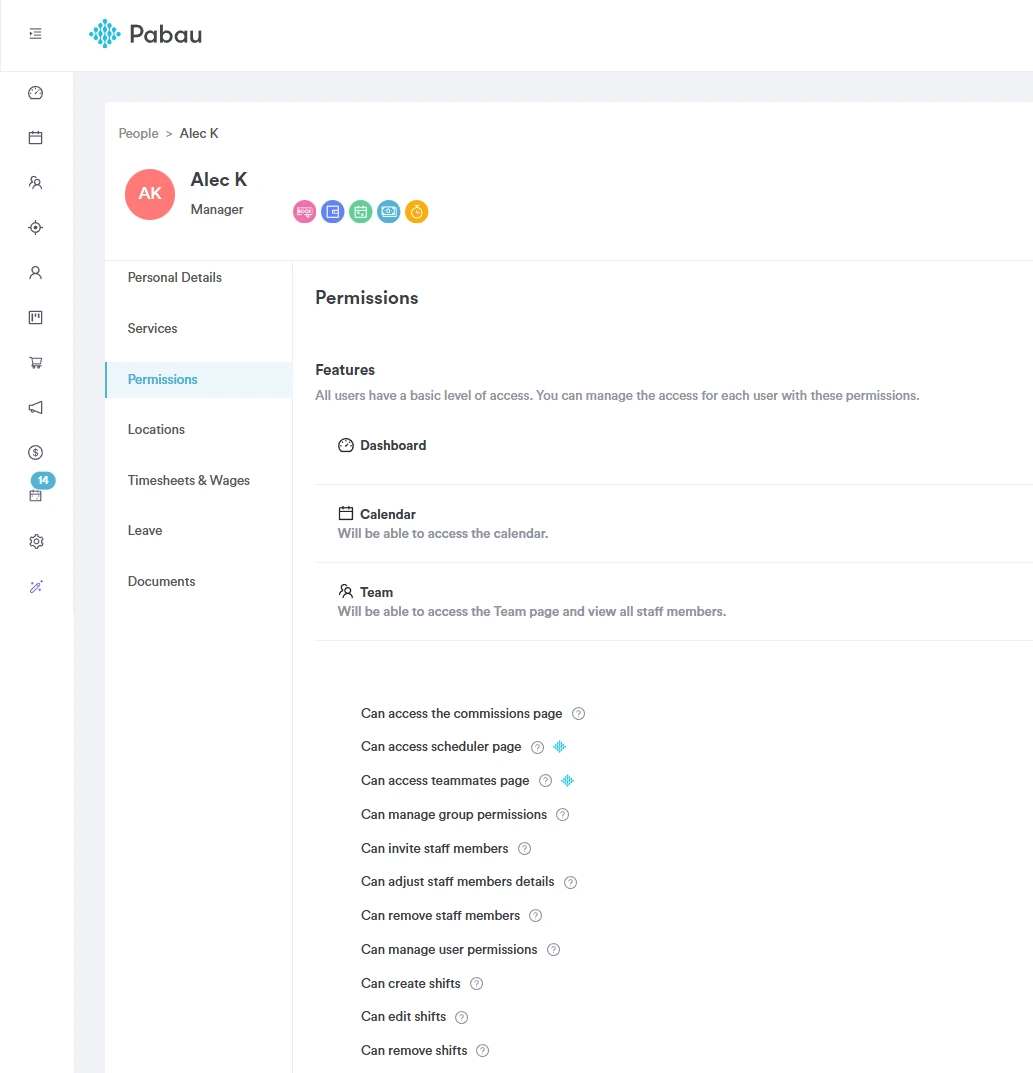

Pabau stores each practitioner’s license type, number and expiry on their staff record, and restricts which services they can be booked for. Renewals surface early, and a booking cannot land a treatment on someone whose license does not cover it.

The license itself is the cheap, predictable part of this. Fifteen hundred hours, two exams and $237 in state-side costs is a known quantity, and the renewal asks for a fee and a birthday.
The expensive mistakes happen further along. They cluster at the dermis line, where a treatment menu outgrows the licenses behind it. They cluster again at the ownership structure, where a professional corporation gets the wrong share split. Neither shows up on a fee schedule.
If you are building a practice, work backwards from the treatments you want to sell. Decide which credential each one needs, whether it demands direct or indirect supervision, and who on your payroll actually holds it. Then check the fee schedule again after September 12, 2026.
Get that mapping right on paper and the day-to-day becomes an admin job. Book a demo to see how Pabau keeps license expiry dates and treatment permissions visible across your team.

Ready to open your own location in Arizona? How to open a med spa in Arizona walks through the entity setup, staffing and launch sequence.
Hiring for the treatments in that scope table? How to hire estheticians for a med spa covers screening, credential checks and onboarding.
Adding IV drips to the menu? IV hydration business requirements in Arizona sets out the separate medical rules that service triggers.
Comparing states before you commit? Texas med spa licensing laws shows how differently a neighboring state treats ownership and delegation.
Licensed somewhere else already? North Carolina cosmetology license requirements is a useful benchmark for hours and transfer rules.
Through the board’s online portal, in the 60 days before your license expires. Personal licenses run on a two-year cycle that ends on your birthday, under A.R.S. §32-517(A). The fee is $60 for cosmetology, aesthetics or nail technology, plus a $3 service fee.
You pay a delinquent penalty on top of the fee, under A.R.S. §32-517(C). For cosmetology, aesthetics and nail technology that penalty is $30. Barbers pay an incremental $25 to $75 instead. Working on a lapsed license can also draw board discipline.
You reprint it from the licensing portal at no charge. The board emails each license as a secure PDF, and Arizona has no duplicate-license fee. The agency issues under its current name, the Barbering and Cosmetology Board.
Yes. Renewals are filed through the board’s online portal at bcb.az.gov, and the window opens 60 days before expiry. Allow up to four weeks for processing, so file early rather than on the deadline.
You search the board’s free public verification by name or license number. It returns the license type, its number, its status and its expiry date. Records from the former cosmetology and barber boards sit in the same register.
Yes, to a maximum depth under 0.5 mm. The board’s substantive policy statement of September 20, 2024 permits it for aestheticians and cosmetologists, with no practitioner order required. At 0.5 mm and above, the nursing board’s advisory opinion limits the work to RNs and APRNs.
No. Arizona has no statutory corporate-practice-of-medicine prohibition, and A.R.S. §32-3230.01 permits a health professional to practice within any form of business entity. If you elect professional corporation status, non-licensees are capped at 49 percent of the voting shares.