Cytocare consent form
Cytocare is a hyaluronic acid-based mesotherapy skin booster from Revitacare, in...

1
Last Updated: Oct 27, 2026

Arizona has no corporate practice of medicine statute, so ownership rules run through its professional corporation code instead.
A.R.S. § 10-2220 caps non-licensed shareholders at 49% of voting shares, and § 10-2230 requires a licensed president.
A physician assistant cannot practice alone here, because § 32-2531 requires a supervising or collaborating physician.
Keep the practice wholly provider-owned and § 36-402 exempts it from state facility licensing, so outside equity gets expensive.
Two 2026 bills stalled, with HB 4047 dying in committee and HB 4036 withdrawn before a vote, so Arizona still has no med spa statute.
Learning how to open a med spa in Arizona starts with one question. Who is allowed to own it? Arizona issues no med spa license, so the state shapes the market through ownership rules instead. First-time owners can start with the pick for new or solo med spas in our comparison of medical spa systems. An MD, a DO, or a nurse practitioner can own a med spa outright. A partner with no clinical license can hold equity, but no more than 49% of the voting shares.
That cap decides more than your paperwork, because it also sets whether you need a state facility license. Decide it late and your approval list gets longer, slower, and more expensive.
The steps below follow Arizona’s own order, from license to entity to open doors.
Any Arizona-licensed physician, osteopathic physician, or nurse practitioner can own a med spa here outright. A physician assistant can hold shares but cannot practice without a physician.
Registered nurses need a physician or nurse practitioner on the ownership side, and an aesthetician can only own a non-medical business.
Arizona has no standalone corporate practice of medicine statute. The restriction everyone calls the 51% rule sits in Title 10, Chapter 20, which governs professional corporations.
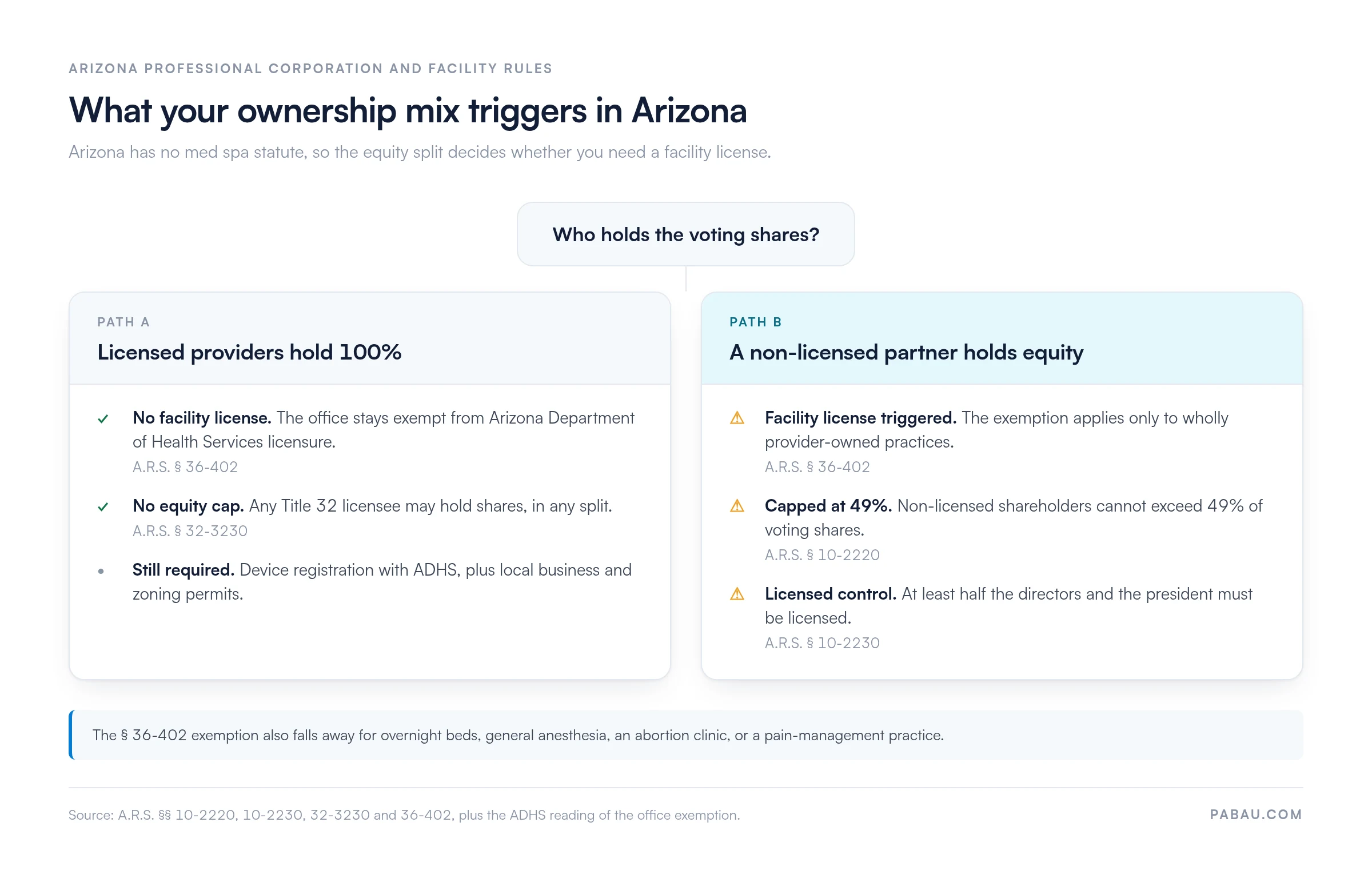
Under A.R.S. § 10-2220, shareholders who are not licensed to render the service may hold no more than 49% of the voting shares. A licensing board can prescribe a different percentage, but 49% is the default.
Section 10-2230 then adds a control test on top of the share test. At least half the directors must be licensed, and so must the president. Holding 51% of the stock is not enough on its own, because you also have to hold the board seats and the top officer role.
The entity form itself is wide open. Since September 24, 2022, A.R.S. § 32-3230 has let licensed health professionals practice through any Arizona business entity.
That change arrived with SB 1637, and it means a professional limited liability company works as well as a professional corporation.
Then comes the part that costs money. A.R.S. § 36-402 exempts a Title 32 licensee’s own office from health care institution licensure. The Arizona Department of Health Services, or ADHS, reads that exemption narrowly, applying it only where licensed providers own the practice outright.
Section 36-402 also names other ways to lose the exemption. Keeping patients overnight or treating under general anesthesia both end it, and so does running an abortion clinic or a pain management practice. So the legal 49% is also the expensive 49%.
Management services organizations are the usual route for outside capital, and Arizona med spas use them. The management company owns the premises, the equipment, the staff contracts, and the marketing. A separate provider-owned entity delivers the treatments and keeps clinical authority.
The table below puts the whole provider taxonomy in one place. These distinctions decide who may hold shares, who signs the protocols, and who may hold the needle.
The nurse practitioner row is unusual nationally, because Arizona asks for no collaborative agreement at all. Read the aesthetician row before you write a job description, since a facial and a microneedling pen sit on opposite sides of a licensing line.
Ownership eligibility also swings hard from one state to the next, and a structure that works in Phoenix can be illegal in Dallas.
Our guide to state ownership rules covers how the same question is answered elsewhere. Once ownership is settled, the licensing question gets much shorter.
No Arizona agency issues a med spa license, so the license you need is your own professional one.
The state regulates the people who treat patients, not the treatment menu they offer. No application exists for the spa itself, and what the state does track is your license, your devices, and your building.
That absence is deliberate rather than accidental. HB 4047 arrived on February 10, 2026. It would have made med spas handling prescription medicines register with the Board of Pharmacy, and it died in committee.
HB 4036 would have set compounding rules for GLP-1 medications, and it was withdrawn from committee on February 18, 2026, before any vote.
Arizona therefore still sits outside the group of states with a dedicated med spa statute. Texas med spa licensing shows what the alternative looks like, with three regulators and a formal delegation framework.
The stack is short, and it starts with the individual license. The facility layer only appears if your cap table brings in someone unlicensed.
Those numbers are build-out, devices, clinical payroll, and the month you break even. The rest of the plan is commentary on them.
According to the American Med Spa Association’s 2024 industry report, average med spa revenue sits near $1.4 million. Profit margins of 20% to 25% are a common estimate across the sector, though that figure is not in the report.
Startup budgets across the industry cluster in three bands. A lean, injectables-only practice opens on roughly $50,000 to $150,000.
Conventional med spas run $150,000 to $500,000. Add laser and body-contouring platforms and you sit at the top of that range, while premium build-outs can pass $1 million.
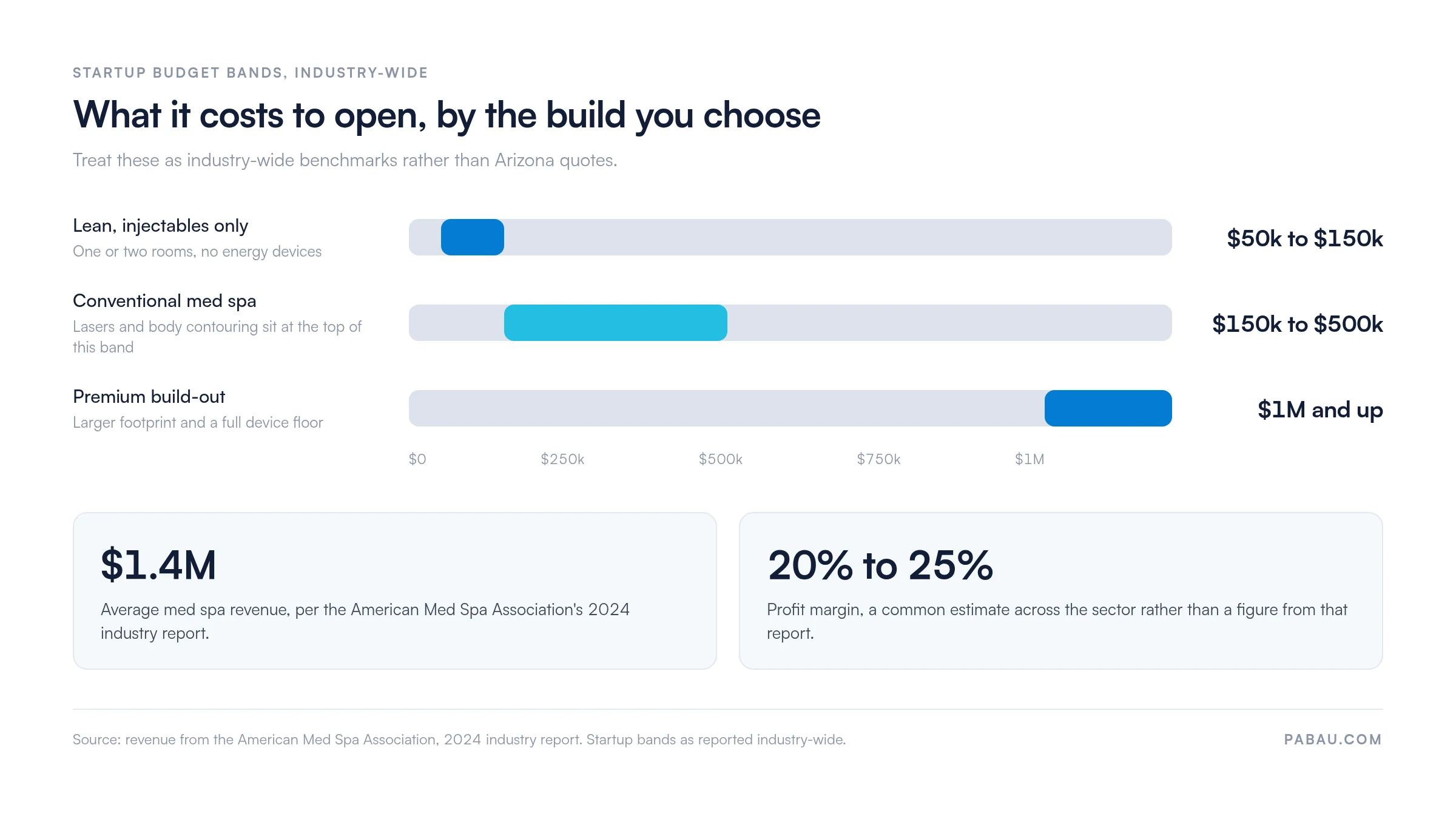
Treat those as industry-wide benchmarks rather than Arizona quotes. What is Arizona-specific is the list of line items below, and what moves each one.
The facility licensure row is the one to model twice. It reads as zero in the wholly provider-owned version of your plan, and as a funded cost in the investor version. Run both before you sign a term sheet, because the difference is not only the application fee.
Arizona names no medical director in statute, because it has no med spa statute at all. What the state requires is that medical treatment be delivered by, or supervised by, someone licensed to provide it.
Any Arizona-licensed MD or DO qualifies, whatever their specialty. Dermatology and plastic surgery are common backgrounds because they match the treatment menu, not because the law asks for them.
The director’s core job is the protocol set, which means one written standing order per treatment, plus approval of every device on the floor.
Registered nurses will do most of the treating, and the Board of Nursing draws their line precisely. Its advisory opinion on medical aesthetic procedures lets an RN administer botulinum toxin, lasers, and platelet-rich plasma (PRP). The same opinion covers microneedling deeper than 0.5 mm.
All of that happens under physician or APRN supervision. An RN never diagnoses and never sets the treatment plan, which is why a prescriber stays on your payroll.
That 0.5 mm figure is the sharpest line in Arizona aesthetics. Below it, an aesthetician or cosmetologist may work under the Board of Barbering and Cosmetology. Above it, the procedure is medical, and it needs RN or APRN licensure with supervision behind it. Build your service menu around that threshold, not around job titles.
Under A.R.S. § 32-2531, a PA with fewer than 8,000 clinical hours works under a supervision agreement with a named physician. At 8,000 hours or more, a PA may hold a collaborative practice certification with a designated collaborating physician. Neither route lets a PA run the practice alone.
Nurse practitioners sit at the other end. An APRN in Arizona diagnoses, treats, and prescribes independently, including controlled substances, under Board of Nursing regulation alone. A doctor of nursing practice holds a doctoral degree, not a separate license, so a DNP practices on the same APRN credential.
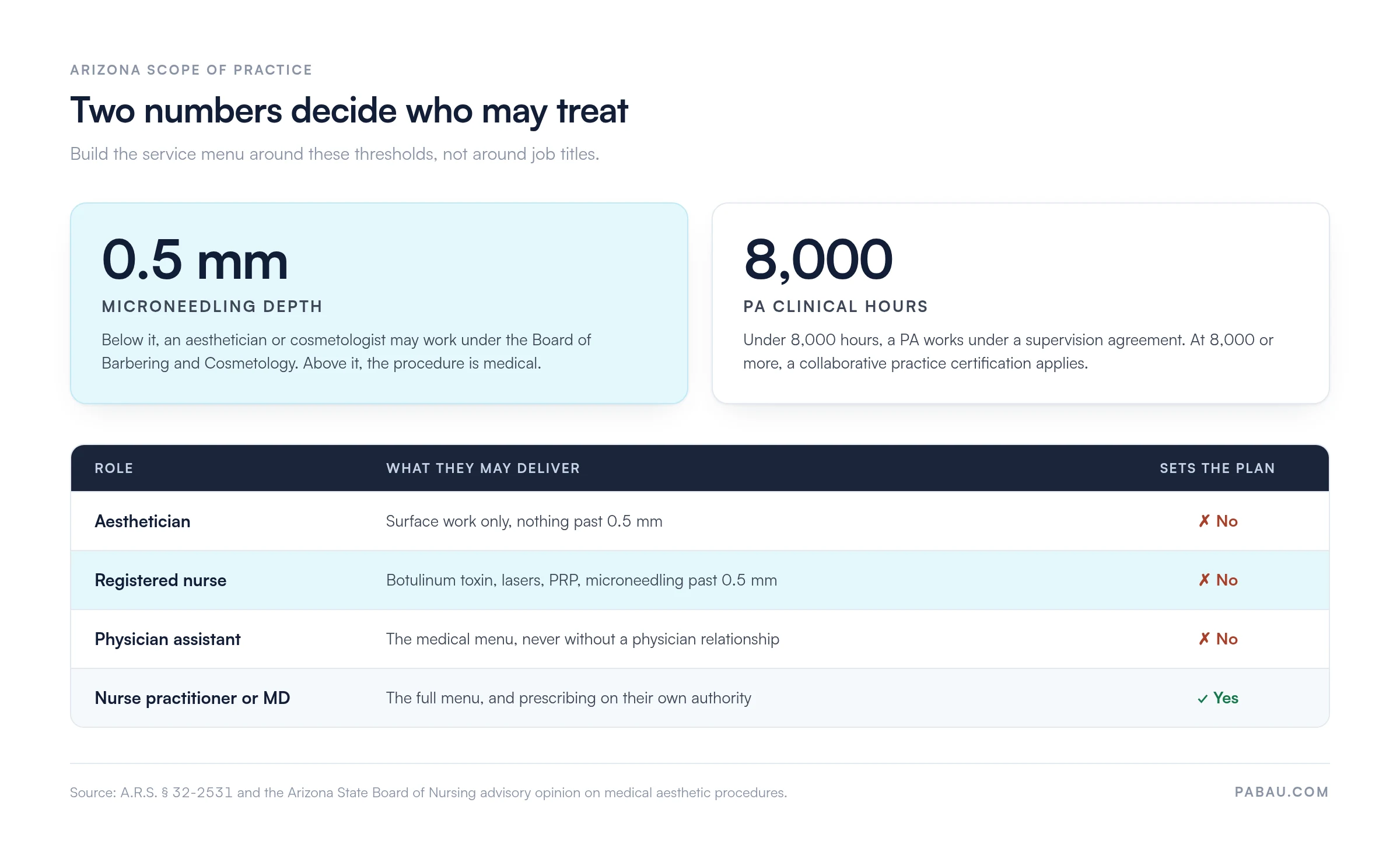
Once the team is set, the supervision structure has to be visible in your records rather than only in a binder. Our guide to med spa compliance covers what an inspector or an insurer expects to find.
Working out of order is how founders pay for approvals they could have avoided, or wait on one that could have started weeks earlier. Arizona rewards this order:
Few openings fail on a flat rejection. They slip because one step landed in the wrong order, and five patterns come up again and again:
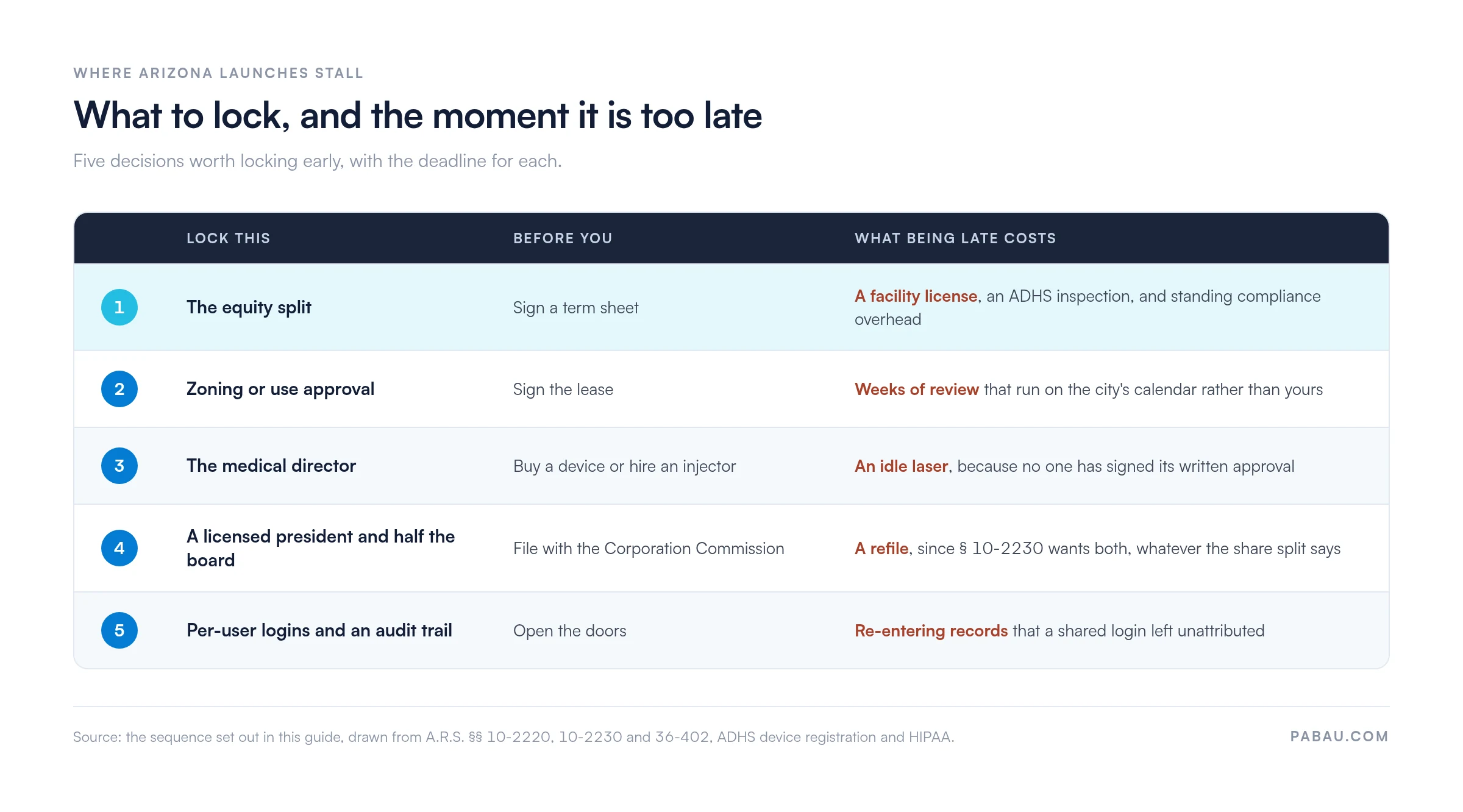
Before you open, verify two items one last time. Every owner and injector holds an active license with the right board. Each treatment on the menu has a standing order signed by your director. Those two checks cover most of what an inspector or an insurer asks about first.
Search demand starts the moment your listing goes live, which is usually weeks before you treat anyone. A Google Business Profile, a treatment-by-treatment website, and online booking cover the first ninety days better than paid ads do.
Local search is where Arizona med spas compete hardest, particularly across Phoenix, Scottsdale, and Tucson. Pages built around single treatments outrank a single services page, because that is how patients search. Add consultation booking to each one.
Deposits also do more for a new practice than discounts. A card held at booking protects the injector’s time in the weeks when your calendar is still thin. Pair that with a reminder sequence and a waitlist, so a late cancellation refills instead of emptying the day.
The booking tool you choose also becomes your patient record system, so pick it once. Our roundup of the best aesthetic clinic software compares the options on charting, consent, and payments together.
An Arizona med spa runs on a mixed roster by design. A physician or nurse practitioner carries clinical authority, registered nurses treat under supervision, and aestheticians stay below the 0.5 mm line. Spreadsheets and a shared calendar lose that structure within a month of opening.
Practice management software like Pabau holds the roster and the record in one place. Each provider gets their own column and their own permissions, so a booking can only land with someone allowed to perform it. That turns your supervision structure into a scheduling rule instead of a memo.

The documentation side matters just as much. Consent forms, treatment notes, before-and-after photos, and device batch numbers attach to the same patient timeline, with a record of who did what. When your medical director reviews protocols, the evidence is one screen rather than four filing points.
Pabau is medical spa software built for that mix of clinical and commercial work, so scheduling, charting, payments, and marketing share one patient record. Every subscription includes every feature, and structured onboarding gets the configuration right before you see patients.

Pabau gives every provider their own calendar column and permission set, so bookings match who is licensed to treat. Consent forms, treatment notes, and device records attach to the same patient timeline for your medical director to review.

Settle the cap table before you tour a single unit of retail space. In Arizona, that one decision sets whether you are an exempt provider office or a licensed health care institution. The two open on different timelines, and on different budgets.
The trade-off worth remembering is that outside money is legal here and rarely free. Bringing in a non-licensed partner is allowed up to 49%, and it hands you a facility application, an inspection, and a permanent compliance overhead. Plenty of practices decide that is worth it, and they decide it deliberately.
Once the structure is set, the work turns operational, and it stays that way. Book a demo to see how Pabau keeps multi-provider scheduling, consent, and supervision records straight from your first Arizona patient onward.

Comparing states before you commit? Who can open a medical spa sets out how ownership eligibility changes across the US, and which states block non-physician owners outright.
Wondering how a nurse fares in a stricter state? Can a nurse open a med spa in California walks through the rules that make Arizona look permissive by comparison.
Starting from the business side rather than the legal side? How to start a med spa covers the service menu, pricing, and hiring decisions that follow your structure.
Looking across the border? How to open a med spa in BC shows how a college-regulated system handles the same ownership and delegation questions.
Six years after an adult patient’s last visit, under A.R.S. § 12-2297. For a child, keep the file until three years past their 18th birthday, or six years after the last visit, whichever comes later. The duty follows you if you sell or close the practice.
Only if they hold an active Arizona license. Both medical boards license by state, and a director signs protocols for treatments given here. Check the license number on the board’s public register before you sign an agreement.
Yes, when a licensed prescriber orders them. Arizona adds no med spa rule, so the prescriber’s own scope decides it. Compounded versions are the sensitive part, because they answer to federal pharmacy rules. HB 4036 would have set state compounding rules, and it never reached a vote.
Your build-out sets the floor, and an ADHS facility application sets the ceiling when a non-licensed owner is involved. Zoning or use approval for medical space adds weeks on its own. Device registration and protocol sign-off can run in parallel, so start both the week you sign the lease.