Journal prompts for mental health
Journal prompts for mental health are guided questions that help people process ...

2
Last Updated: Oct 13, 2026

Trauma-informed care is an organization-wide operating model, not a therapy you deliver to a few clients.
The four Rs come first: realize, recognize, respond, and resist re-traumatization.
SAMHSA’s six principles are safety, trustworthiness, peer support, collaboration, empowerment, and cultural humility.
Screening tools such as the ACE questionnaire and the PCL-5 flag exposure and symptoms, but they never diagnose.
Practice management software like Pabau moves the model into intake forms, reminders, and shared records, so it survives a short-staffed week.
One printable reference covering the four Rs, SAMHSA’s six principles, and the phrases that de-escalate. It also carries the fight, flight, freeze, and fawn responses plus three screening tools. Sized for a treatment-room wall or a new-hire pack.
Download templateA trauma-informed care cheat sheet gives your team one page to reach for when a client shuts down, pushes back, or over-agrees. The model applies to every client and every touchpoint, from the booking confirmation to the discharge letter.
One assumption drives it. Treat trauma exposure as common, then design your systems around that. Get it backwards and your intake forms, waiting times, and cancellation policies quietly undo the work done in session.
The sections below give you the four Rs, the six principles, the language that de-escalates, and the screening tools worth using.
Trauma-informed care is an organization-wide approach that assumes many clients carry a trauma history, then builds that assumption into policy, environment, and staff behavior.
The trauma might come from childhood adversity, a medical procedure, bereavement, violence, or discrimination. Most of the time you will not know which.
The assumption shows up in small decisions. Intake wording is one. Notice before a schedule change is another. So is the way a receptionist greets someone who has canceled three times in a row.
A cheat sheet earns its place because the framework is easy to agree with and hard to recall mid-shift. Pin it up, and a new receptionist can check what trustworthiness asks of them before a difficult phone call.
Review one line of it at each team meeting, and the whole practice keeps a shared vocabulary.
There is a documentation angle too. An accreditor or a payer will eventually ask how you protect vulnerable clients. A written trauma-informed policy is the answer you can hand over.
The four Rs come first. They describe what your organization has to believe before the six principles can describe what it does. Skip them and the principles turn into a poster nobody acts on.
Those four assumptions are the bedrock the six principles are built on, which is easier to see laid out than described.
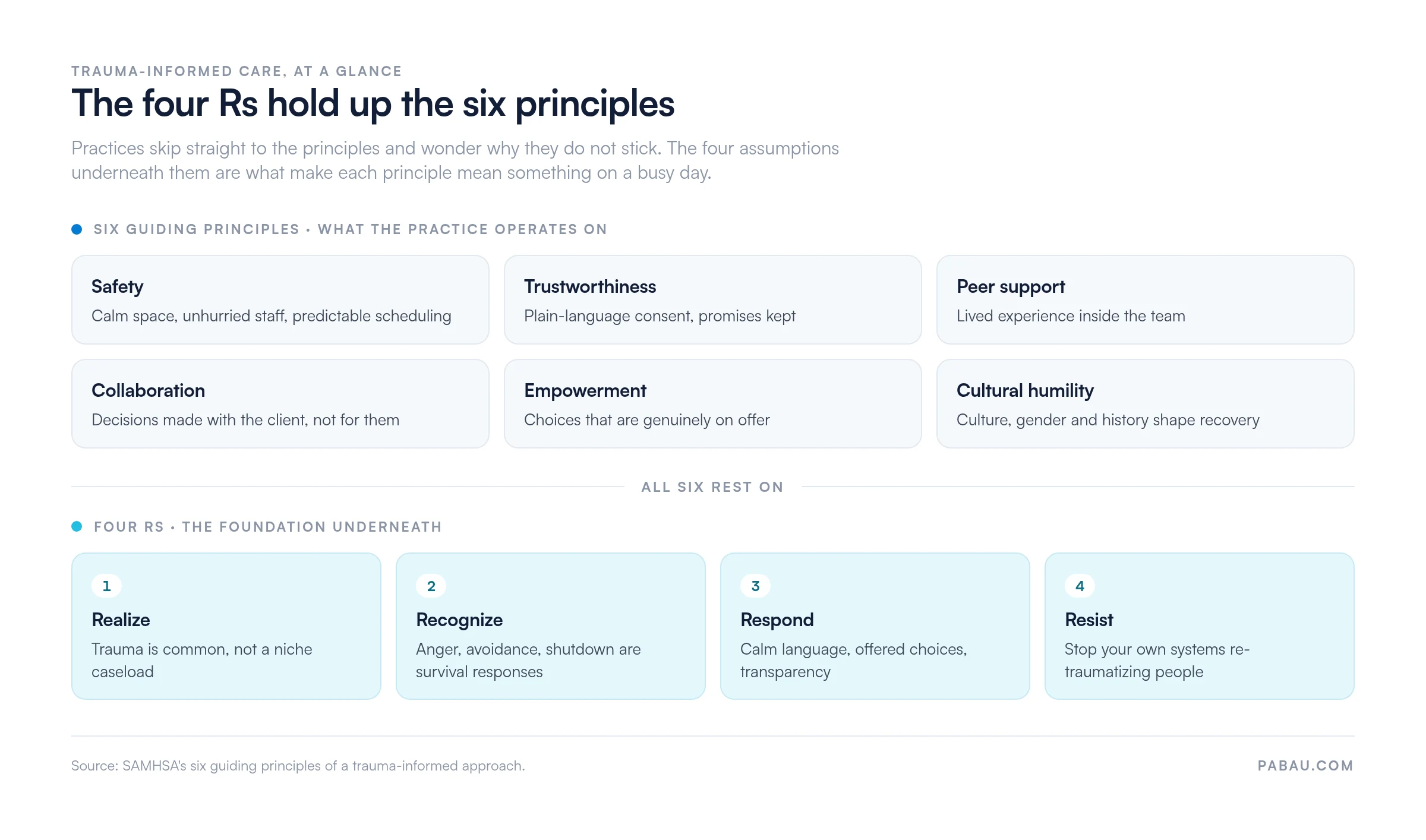
SAMHSA’s six guiding principles name the domains a practice has to work on. Here is what each one asks for once you stop reading and start booking clients.
Safety comes from the space, the staff, and the schedule. Calm lighting, accessible seating, and a private consultation room cover the first. An unhurried voice and respect for personal space cover the second. Consistent appointment times, with warning before any change, cover the third.
Say what treatment involves, what it cannot do, and where the client’s information goes. Explain consent in plain language, then follow through on what you promised. People who have been let down before read inconsistency as a warning sign, and they read it fast.
Bring lived experience into the staff room rather than the waiting-room leaflet. A peer specialist in a group session normalizes recovery in a way no clinician can match. Hiring people with their own recovery history is part of the same move.
Treat the client as a partner in their own plan. Shared decision-making and joint goal-setting lower the expert-versus-patient hierarchy that leaves people feeling managed. Ask what someone needs before you tell them what you think they need.
Offer choices you can honor. Session format, time of day, and preferred contact method are the easy ones. Name the strengths you can see alongside the symptoms, because a client who regains a sense of control is a client doing the work.
Race, culture, gender identity, and history all shape how trauma lands and how recovery happens. Intergenerational trauma from colonization, slavery, and discrimination still reaches the person in front of you. Practice cultural humility, which means admitting the parts of someone’s context you do not understand and asking about them.
These two get confused, and the confusion costs referrals. Trauma-informed care describes how the whole practice operates. Trauma-specific services are the treatments that resolve a diagnosed condition.
So every practice should be trauma-informed. Only some clients need trauma-specific treatment, and knowing the line is what makes your referral appropriate.
Trauma survivors run threat detection at a higher sensitivity than most people, so wording that passes unnoticed elsewhere can land as danger here. These de-escalation communication habits are worth drilling until they are automatic.
A client who feels threatened by your environment will fall into one of four survival responses. Read them correctly and you respond with curiosity. Read them as personality and you end up frustrated with someone who is coping.
All four kept somebody safe once. Your job is to help the client see the pattern, trace the trigger, and build another option. That starts with your own nervous system staying regulated, because theirs will track yours.
Validated screeners tell you whether trauma exposure or PTSD symptoms are present, which is how you decide who needs a referral to trauma-specific treatment.
One caution worth repeating to the whole team. A score is an indicator, never a diagnosis. A high ACE score does not mean the client has PTSD, so treat the number as the opening of a conversation rather than a verdict.
The download is only useful if it changes something. Work through these in order.
Documentation counts as a system too. Notes that record strengths and avoid pathologizing language protect the trust the six principles are there to build.
Audit one system this month. Pick a single area, such as intake forms, scheduling, or the cancellation policy. Then ask whether it embodies safety, trust, choice, collaboration, or cultural humility. If it does not, redesign it. Small changes compound into a culture.
Clinicians who sit with trauma stories take some of it home. Secondary traumatic stress, often called compassion fatigue, looks like ordinary burnout but has a specific cause: repeated exposure without enough processing or recovery time.
Picture a therapist carrying six trauma cases a week. The calendar fills up, so supervision is the first slot they drop. Three months later they are flat, short-tempered, and behind on notes. The caseload started it, and the missing supervision let it run.
Prevention has to be systemic rather than personal. Therapist burnout prevention depends on clinical supervision, peer consultation groups, caseloads that somebody has counted, and a culture where taking recovery time is normal.
Leaders owe staff the same protection from re-traumatization they promise clients.
System-level change needs intent and a budget line. One training day does not make a practice trauma-informed, so treat the rollout as an ongoing commitment with named owners.
Trauma-informed intentions usually live in people’s heads. A receptionist remembers to warn one client about a room change. A therapist remembers who cannot manage an afternoon slot. Then that person takes leave, and the client meets a completely different practice.
Practice management software like Pabau moves those intentions into the system instead. Digital intake forms let you ask sensitive questions in stages, so nobody is handed a page about abuse history at the front desk.
Automated reminders remove the surprise that triggers a threat response. Client preferences and alerts sit on the record, so whoever is covering sees them before the session starts.
The outcome is consistency. Your practice behaves the same way on a short-staffed Friday as on a quiet Tuesday. That sameness is what predictability means to a client who is watching for it.
That is also the practical argument for software built around managing a therapy practice rather than a generic calendar bolted to a spreadsheet.
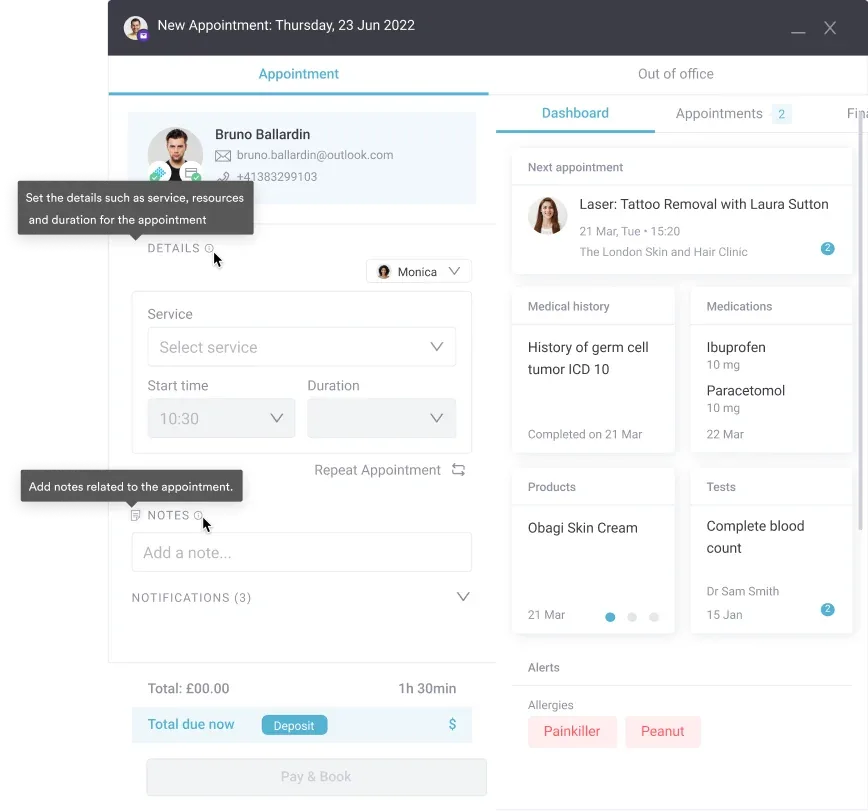

Staged intake forms, automatic appointment reminders, and shared client alerts keep your practice predictable for the people who need it most. Pabau puts the six principles into the workflow your team already uses every day.

The framework is rarely the hard part. Agreeing that clients deserve safety and choice takes one team meeting. Holding to it through a fully booked Thursday takes systems that behave the same whoever is on shift.
So pick the smallest change you can make this month and finish it properly. Rewrite one intake question. Add a line to the reminder saying what will happen at the appointment. Put supervision in the calendar and defend it. Each one removes a small threat from somebody’s day, and across a caseload that adds up.
Trauma-informed care fails when it lives in a binder and works when it lives in the workflow. Book a demo to see how Pabau handles staged intake forms, reminder wording, and shared client alerts for a trauma-informed practice.

Need a validated way to score early trauma exposure at intake? The ACE questionnaire gives you the ten-item form and the scoring guidance to go with it.
Looking for something to hand a client who freezes or dissociates? The grounding techniques worksheet collects exercises clients can use between sessions.
Want to gather a trauma history without turning intake into an interrogation? The trauma questionnaire template paces the questions and leaves room for a client to decline.
Checking whether your own team is carrying secondary traumatic stress? The compassion fatigue test gives supervisors a structured way to raise it.
Building transparent consent into group work? Group therapy informed consent covers confidentiality limits and the wording that keeps members clear on them.
No single national credential exists. SAMHSA publishes the framework, not a certificate. Universities, professional bodies, and state agencies run their own trauma-informed training courses, and accreditors review the practice rather than a badge.
Yes. Dentistry, physical therapy, aesthetics, and primary care all involve waiting, touch, undressing, or pain. Any of those can reactivate a trauma response, so the same six principles apply.
Ask about needs and preferences first, and screen for exposure rather than detail. A client does not have to narrate what happened for you to adjust the room, the pace, and the plan.
Record the score and the plan it changed, not the underlying narrative. Check your consent wording and state law on sensitive information, then keep access limited to the people delivering care.
Lower your voice, name what you notice, and offer an orienting cue such as feet on the floor or a drink of water. Give them time, then decide together whether to continue.