Patient follow up letter template
A patient follow up letter template lets your practice confirm a patient’s...

2
Last Updated: Oct 21, 2026
A surgical clearance form is the document a surgeon uses to record whether a patient is medically fit for a planned procedure.
It captures the history, medications, allergies, and risk findings behind that decision, and the clearance itself stays the physician’s call. A primary care physician or internist usually completes it and returns it to the surgical team before the cut-off date the surgeon sets.
Paper versions get lost, illegible fields slow scheduling, and missing signatures can delay a case. This guide explains what a complete form should contain and gives you a free template to adapt for your practice.
This ready-to-use form covers patient identification, the planned procedure, medical history, medications and allergies, and cardiac and anesthesia risk. It closes with a physician attestation block for the clearance status, signature, and date.
Download template
A surgical clearance form records whether a patient is medically fit for a specific planned procedure.
Complete forms capture medical history, medications, allergies, cardiac risk, and anesthesia considerations.
Clearance is the physician’s clinical decision, and the form records the findings and reasoning behind it.
HIPAA-aligned storage, access controls, and audit trails matter when handling clearance records.
Pabau, the practice management platform we build, lets patients answer clearance questions before the visit and files the answers in their record.
A surgical clearance form is a structured clinical document that a physician completes to summarize a patient’s suitability for a planned operation. It sits between the surgeon’s request and the scheduled date. It gives the surgical team a single record of the findings that matter for safe anesthesia and recovery.
Clearance and consent are separate documents. The form covers medical fitness, while the patient’s agreement to the procedure goes on an operation consent form after the surgeon explains the risks.
The surgeon’s office usually requests the form, and a primary care physician, internist, or specialist who knows the patient’s history completes it. Requirements depend on the surgeon and the facility, and anesthesia may add a separate assessment.
Some surgeons accept a medical clearance letter instead, which states the outcome in prose. Plastic and aesthetic practices often use their own surgeon or anesthesiologist for the final review.
A standard form groups its fields into identification, procedure details, clinical history, risk assessment, and attestation. Each section serves a clinical purpose for the operating team.
Record the patient’s full name, date of birth, medical record number, and insurance details. Add the planned procedure, the scheduled date, and the names of the referring and operating surgeons. Incomplete identifiers are a common cause of delays when results reach the wrong chart.
This section captures past surgeries, chronic conditions, the current medication list, and known drug and latex allergies. Reconciling medications matters most for anticoagulants and other agents that affect bleeding risk. A blood thinning medication list helps staff recognize those agents when a patient names a brand.
Many forms ask for functional capacity, prior cardiac history, and recent electrocardiogram (ECG) or laboratory results. The American Society of Anesthesiologists (ASA) Physical Status Classification is widely used to describe anesthetic risk. Cardiac risk indices such as the Revised Cardiac Risk Index are often used as clinical aids.
Neither score decides clearance on its own, so the form should record the findings alongside the physician’s reasoning. Many physicians document the visit on a history and physical form first, then carry the surgically relevant findings across.
The attestation block records the clearance status, the physician’s name, license number, date, and signature. Many practices use three outcomes: cleared, cleared with conditions, or not cleared.
The five steps below follow the order in which the form usually arrives and gets completed. Each step depends on the one before it, as the diagram shows.
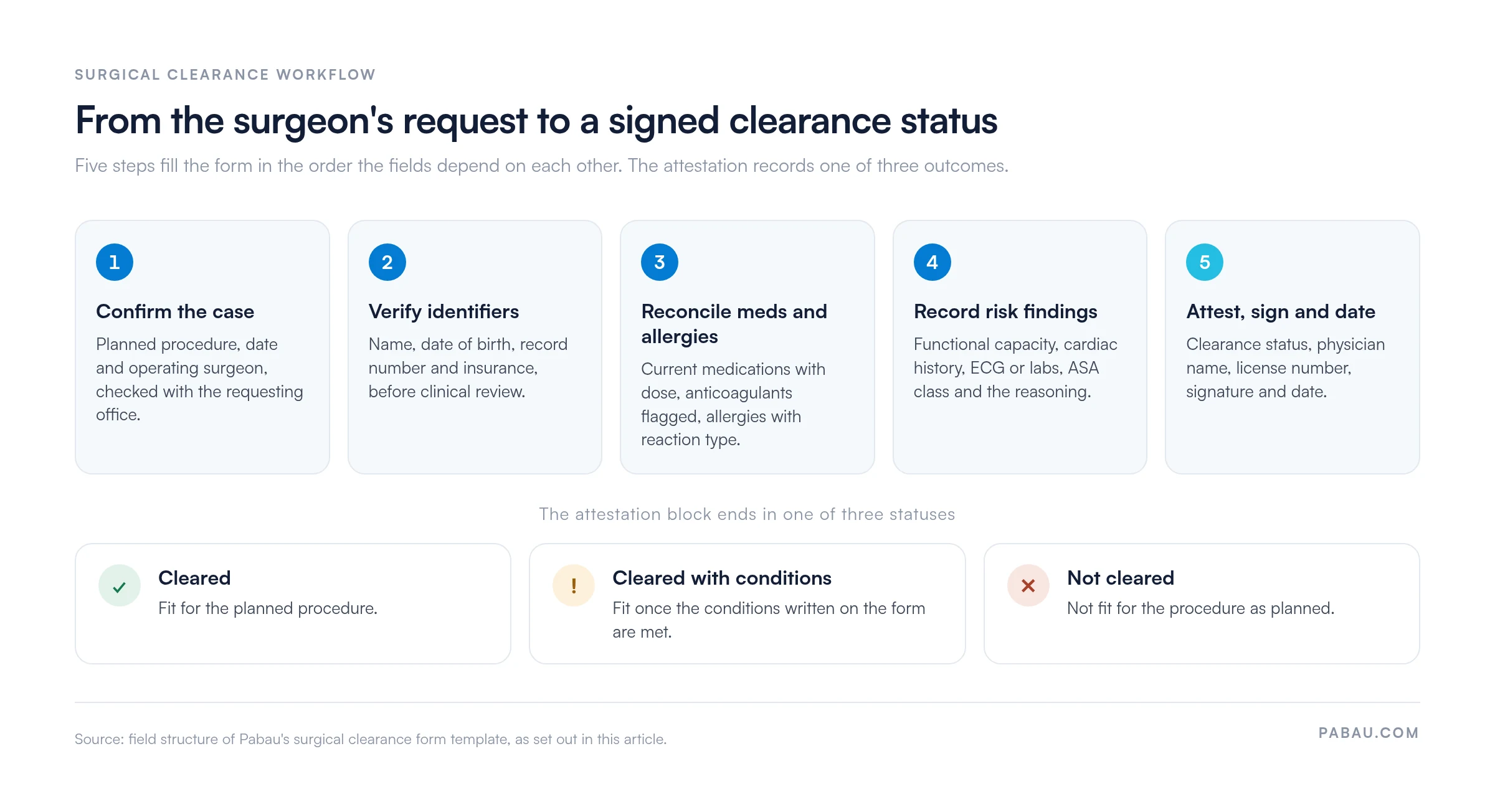
For a patient on many drugs, step three can run on a separate medication reconciliation form. The clearance form then lists only the agents that matter for surgery.
Aesthetic and plastic procedures often add screening points that a general form may not cover, such as body mass index, smoking status, and psychological readiness. The form should also state the planned anesthesia type, which can range from local to general.
Adapt the template’s wording to your practice and local policy, and review it with your medical director before first use. Confirm institutional requirements too, including how long a completed clearance stays valid, since that varies by facility. A checklist of administrative requirements for surgery keeps the clearance in step with the rest of the paperwork.
Under the HIPAA Privacy Rule, providers can share information for treatment purposes without a separate patient authorization. Other disclosures generally need a signed HIPAA authorization form. The U.S. Department of Health and Human Services HIPAA guidance sets out the rules in full.
On paper, a clearance form travels by fax or email, gets filled in by hand, and is scanned back into the chart. Each handoff is a chance for a missing signature or an unreadable medication list to push the surgery date.
Pabau builds the form once and sends the history, medication, and allergy questions to the patient before the visit. Through patient intake software, the answers file straight into the patient record. The physician then verifies them instead of transcribing them.

Care Pathways, Pabau’s pre-appointment workflow, guide the patient through each step before the visit, from medical forms to consent signatures. The practitioner sees the outstanding items as a checklist, so the team can chase an unsigned form days before surgery.

See how Pabau sends, completes, and files pre-operative documents without retyping them into the record.

Treat the template as a starting point, then tighten the two steps where a case is most likely to stall. Those are medication reconciliation and the signed attestation. Settle who owns each step before the first request arrives.
Whatever format you use, the trade-off stays the same. A longer form catches more risk, but every extra field is one more item the completing physician can leave blank. Book a demo to see how Pabau collects clearance answers before the visit and files them in the patient record.

Clearing a patient for oral surgery? Dental clearance form explains what to include when a dental clearance is requested.
Need the patient’s family history too? Family medical history form captures inherited conditions in a structured template.
Collecting consent online? E-consent form explains what to include and how to send it for signature.
Referring the patient on for review? Medical referral form template structures the handoff to a specialist.
Documenting adult consent for treatment? Medical consent form for adults gives a ready template for adult patients.
A surgical clearance form is a clinical document that summarizes a patient’s medical history, medications, allergies, and risk findings before a planned procedure. The physician uses it to document fitness for surgery.
Usually a primary care physician, internist, or referring specialist completes it at the surgeon’s request. Anesthesia may add a separate assessment.
No. Clearance documents the patient’s medical fitness, while informed consent documents the patient’s agreement to a specific procedure after discussing its risks.
Yes. The template on this page is available as a PDF. Check that your version matches your facility’s requirements before use.