Chronic kidney disease nursing care plan
A chronic kidney disease nursing care plan is a structured document that guides ...

4
Last Updated: Oct 14, 2026

An operation consent form records the patient’s voluntary agreement to surgery and proves the team obtained informed consent first.
Ten elements are required, from the exact procedure name and a tailored risk disclosure to the patient, witness, and surgeon signatures.
CMS 42 CFR §482.13(b) and Joint Commission standard RI.01.03.01 require written consent before an operative procedure, filed in the medical record.
Generic risk lists are the weak point, because the disclosure has to match the patient’s own history and the conversation that took place.
Pabau’s digital forms capture the e-signature, attach the signed consent to the patient record, and log every signature event.
An operation consent form records a patient’s voluntary agreement to a specific surgical procedure.
The signature only counts once the risks, benefits, and alternatives have been explained.
A compliant form carries ten elements. They cover patient identification, the exact procedure, risks, benefits, alternatives, anesthesia consent, and a rights acknowledgment. Signatures from the patient, the witness where required, and the attending surgeon close the document.
CMS Conditions of Participation and Joint Commission standards both require written consent before an operative procedure. This guide sets out each element, the federal and state rules behind it, and how to document the conversation properly. The free template below is ready to use.
A ready-to-use form with fields for patient demographics, procedure authorization, risks and complications, benefits, and alternatives. It also carries anesthesia consent, blood products authorization, a patient rights acknowledgment, and signature blocks for the patient, witness, and surgeon.
Download templateAn operation consent form is a formal document showing that a patient agreed, voluntarily and with full understanding, to a named surgical procedure. It is required in every surgical setting — hospitals, surgery centers, and private surgical practices.
The form is written evidence that the surgical team explained the procedure, its risks, benefits, and alternatives. It also records that the patient had the chance to ask questions and could still decline.
A signed form carries less legal weight than many surgical teams assume. It evidences the consent conversation only, and says nothing about how the operation itself was performed. A claim about technique or outcome turns on the operative record instead.
CMS and Joint Commission standards define the mandatory elements of a surgical consent form. Each one documents a specific part of the informed consent conversation.
Those ten elements group into four parts of the document, and the parts carry very different amounts of risk. Identification and signatures are usually complete. The disclosure block in the middle is the one that gets challenged.
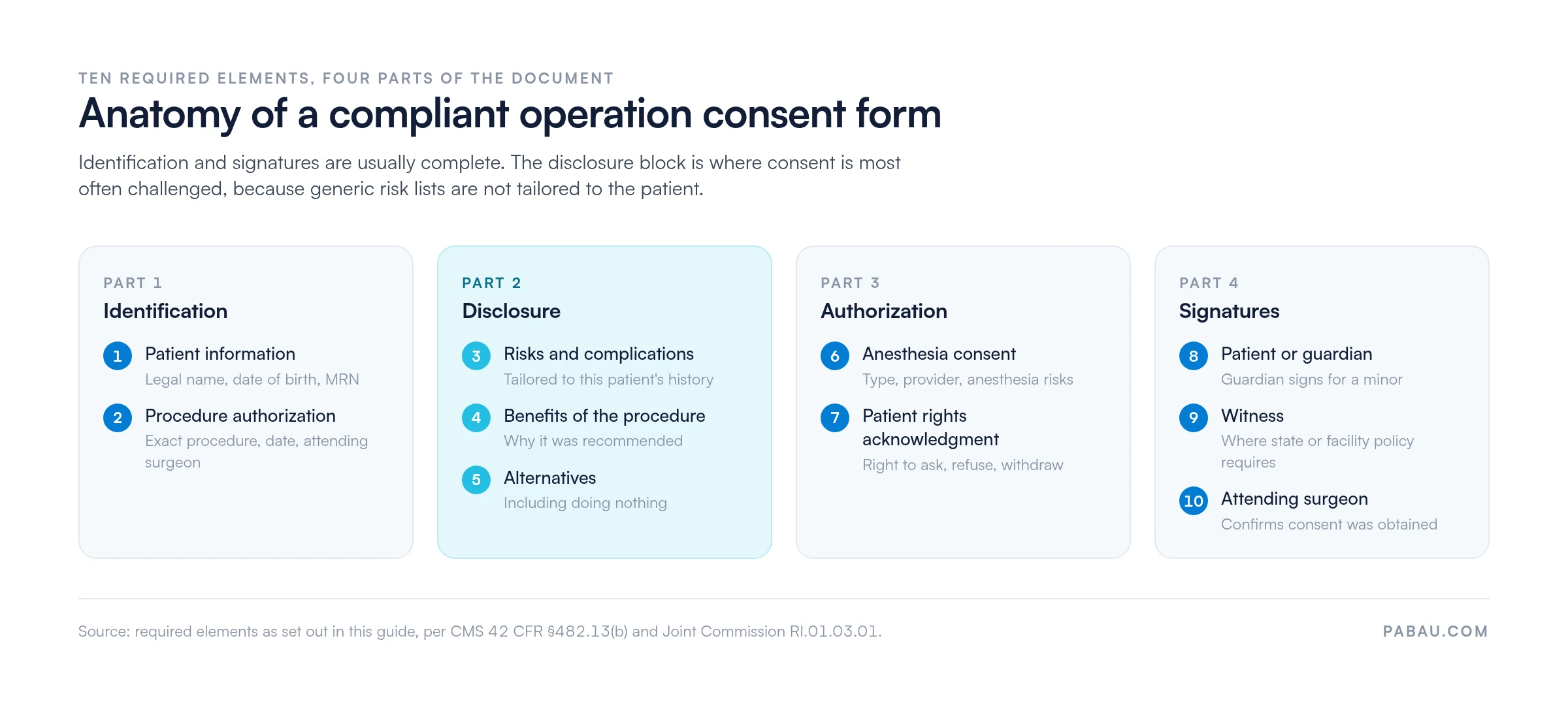
Many practices use a separate anesthesia consent form or section. Anesthesia carries its own risks, including allergic reaction, respiratory depression, and awareness during surgery, and the anesthesia provider makes that disclosure.
The anesthesia section names the type proposed, who will administer it, and the key risks. A patient may refuse or modify anesthesia consent independently of the surgical consent.
Two optional clauses cover transfusion and pathology. Some patients refuse blood products on religious grounds, and that refusal has to be documented on the form rather than agreed verbally.
Tissue removed during surgery may go to pathology, or be retained for research. The patient authorizes or declines each use.
A medical education clause lets interns, residents, or students observe or take part in the surgery. A photography clause permits recording for education, quality review, or research. Both are optional, and the patient may agree to one without the other.
In the United States, informed consent for surgery is mandated at both the federal and state levels. The primary federal standards are:
Storage matters as much as wording. A consent form that is scanned, emailed, or archived carries protected health information at every step. Secure the route it travels and the place it rests.
The informed consent process exists to protect patient autonomy. Five rights have to survive it intact:
Where the patient is a minor, a parent or legal guardian signs instead. A standing consent to treat minors covers routine care given when the guardian cannot attend, but it never replaces surgical consent.
When a patient refuses or withdraws consent, the team respects the decision and records it in writing. Surgery does not proceed without valid consent in place.
Informed consent is a conversation with a paper trail behind it. These five steps keep both halves intact:
Consent is the first document of the surgical day rather than the last. Once it is signed, the team works through the WHO surgical safety checklist before the first incision.
Paper slows every one of those five steps down. Practices that move consent onto digital patient intake forms send the document ahead of the appointment and capture the signature on any device. The signed copy then lands in the patient’s record without a filing step.

Paper consent creates work that nobody notices until a form goes missing. Practice management software like Pabau lets you build a consent form that matches your facility’s policies and your state’s requirements. You then reuse it on every case.
The workflow is short. You build the form once, then set an automated reminder that sends it 48 hours before the appointment. The patient signs by e-signature on any device.
The signed form routes straight to the patient’s record with its audit trail attached. Every signature event is logged with a timestamp, so a compliance review can trace who signed what and when. Teams managing medical forms across several surgeons get the same structure on every case.

Digital forms, e-signature capture, automatic attachment to the patient record, and a timestamped audit trail for every consent you collect.

The form is only as good as the conversation it records. What holds up under scrutiny is a risk disclosure written for that patient, plus a documented chance to ask questions before signing.
Download the template above, adapt it to your procedures and your state’s rules, then review it once a year against current clinical evidence. Consent handled properly protects the patient’s choice and the surgical team’s record at the same time.
Book a demo to see how Pabau collects, signs, and files surgical consent forms without the paper trail.

Need a consent form for non-surgical treatment? Medical consent form for adults covers general treatment authorization where no operative procedure is involved.
Handling a request for a patient’s records? HIPAA authorization form sets out how to document permission to release protected health information.
Preparing the rest of the surgical paperwork? Administrative requirements for surgery lists what a case needs on file before the day of the procedure.
An operation consent form documents the patient’s voluntary agreement to undergo surgery after being informed of its risks, benefits, and alternatives. CMS and Joint Commission standards require it, so that patient autonomy is protected and the consent conversation is recorded before the procedure.
Yes. A signed form does not waive the patient’s right to withdraw at any point before the procedure begins. If a patient withdraws, the surgical team respects that decision and documents the withdrawal in writing.
CMS Conditions of Participation 42 CFR §482.13(b) require hospitals to obtain written informed consent before an operative procedure. Joint Commission standard RI.01.03.01 sets what the consent must cover: the procedure, its risks, benefits, alternatives, and who will perform it. Standard RC.02.01.01 requires the signed form to be filed in the medical record.
Electronic consent is legally valid under the federal ESIGN Act in most US states. Some states add their own requirements for e-signature validity, such as witness presence or specific software standards. Check with your state medical board and legal counsel before you switch.
Signed consent forms are retained as part of the patient’s permanent medical record. Most state laws require surgical records to be kept for five to seven years after the procedure. Check your state law and your malpractice insurer’s terms for the period that applies to you.
The procedure does not go ahead. Document the refusal in the medical record with the date, the time, and the reason the patient gave. Discuss whether they want to reschedule or decline altogether, and involve your legal team if the patient’s decision-making capacity is in question.