Anja Dodevska

Support system worksheet: Free PDF and session guide
Download your free support system worksheet A ready-to-use assessment form for m...

1
Last Updated: Nov 9, 2026
Free PDF 2 pages, print-ready Clinician-reviewed
A strengths and weaknesses assessment is a structured self-review that records what you do well, where you need to develop, and the evidence for each. Practice owners, practice managers and clinicians use one for personal development, staff appraisals and career planning. This free two-page template covers personal and professional strengths, matching weaknesses, an action plan and a short reflection. Writing a dated example beside every point turns "I'm good at this" into a plan you can act on and check at the next review.
A two-page form with space for five personal and five professional strengths and weaknesses, each with an example. It closes with an action plan and a short reflection on what you learned.
Start from scratch, or upload this PDF or any form you already use, and Pabau's AI Form rebuilds it with tick boxes, text fields and a signature. Attach it to the treatment once, and every patient gets it on time.
AI Form rebuilds the consent, history and aftercare forms you already use. You review each one, then publish.
Patients complete forms on their phone before they arrive, so the front desk stops retyping paper.
Every signed form is versioned and attached to the treatment record, ready when you need it.
Set how long a consent stays valid. Returning patients skip forms they have already signed.
Supports HIPAA and GDPR compliance AES-256 encryption 4.8 on G2 4.7 on Capterra Trusted by 4,000+ practices worldwide

Back every strength with a recent, dated example from your work.
Describe each weakness as an observable behavior, not a personality trait.
The template splits strengths and weaknesses into personal and professional lists, then closes with an action plan.
Turn the two most important development areas into actions, each with a review date.
Use the same form for self-reviews, staff appraisals and career planning so results compare over time.
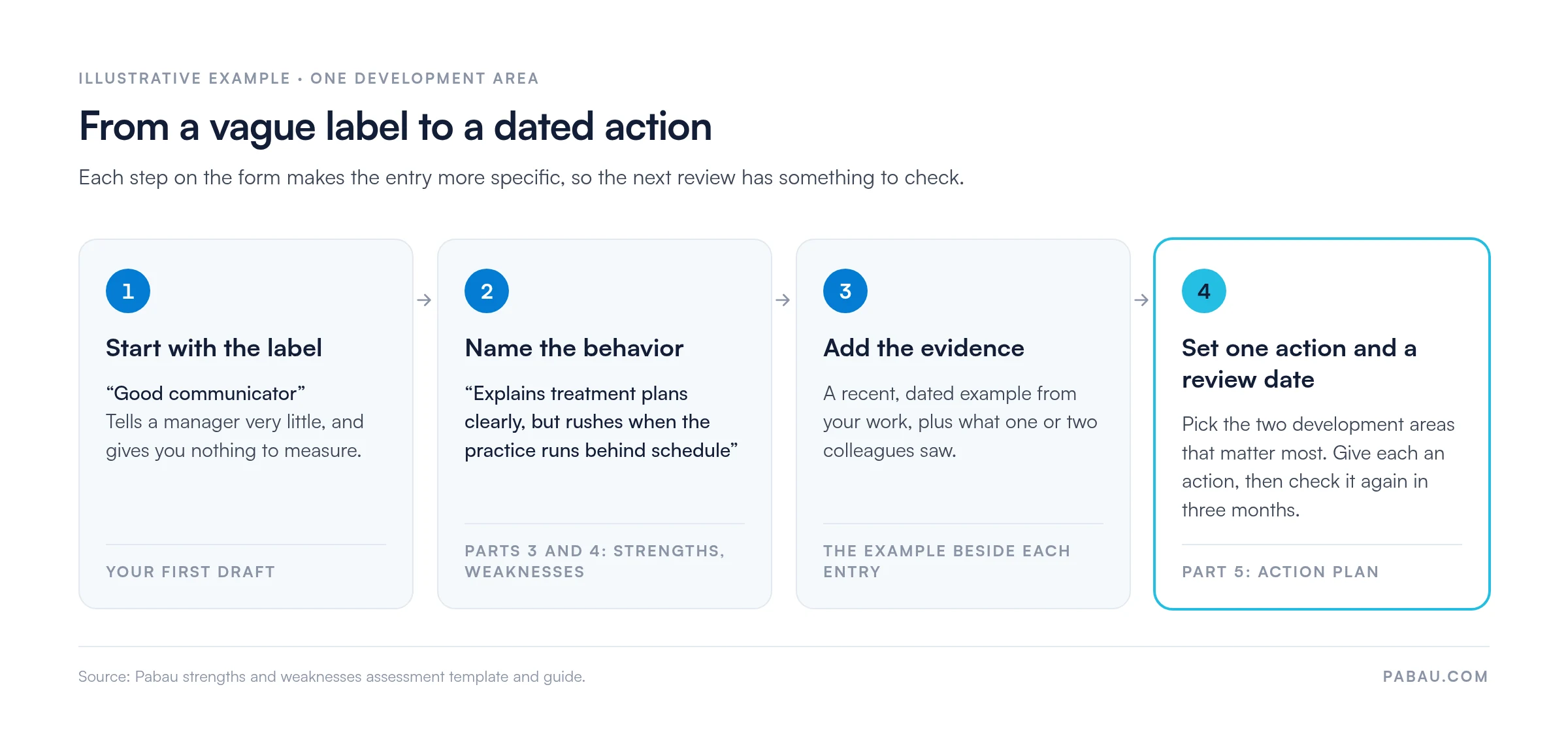
A strengths and weaknesses assessment is a personal audit in which you rate yourself, support each rating with evidence, and decide what to change. The format works because it forces specifics. “Good communicator” tells a manager very little. “Explains treatment plans clearly, but rushes when the practice runs behind schedule” gives you a development target you can measure.
In professional development, the assessment sits between an informal career conversation and a formal review. Its value lies in the reflection, so avoid turning it into a ranking exercise. Most people use it for four purposes:
Practice owners use it to decide where to invest in training. Practice managers use it to match people to roles, and clinicians use it to plan their own growth. A team gets more out of the exercise when everyone fills in the same form.
Psychology and therapy practices often adapt the same format for supervision conversations, with the supervisor adding their observations beside the clinician’s own.
Work through the template in six steps, from choosing a purpose to a short reflection. Follow them in order.
Keep the completed form with your appraisal notes so progress is visible at the next review. Bring it to your next one-on-one meeting as well, so the action plan gets a check-in before the formal review.
The flow below takes one development area from a vague label to an action you can check.
The main benefit is clarity. A written record shows what you have been doing well, which makes it easier to ask for the right responsibilities at review time.
Consistency: When every team member uses the same structure, managers can compare development needs without relying on memory.
Preparation: The completed template gives you ready-made examples for interviews, promotions and appraisal meetings.
Early warning: A weakness that shows up on two reviews in a row is a pattern. If it starts to affect patients or colleagues, a performance improvement plan sets formal targets and deadlines.
Audit the last three months before you fill in the template. Pull completed treatments, patient feedback messages and any incident reports, then note two examples for each strength you plan to list. Look for patterns rather than single events, because a repeated behavior is stronger evidence than one good day. Bring those examples to your appraisal so the conversation stays specific.
The table below shows how strengths and development areas often look in a practice. Use it as a starting point, then replace each example with a behavior you have seen yourself.
Store the completed assessment with dated examples so you can see change over time. A single review shows a snapshot, while two or three reviews show direction.
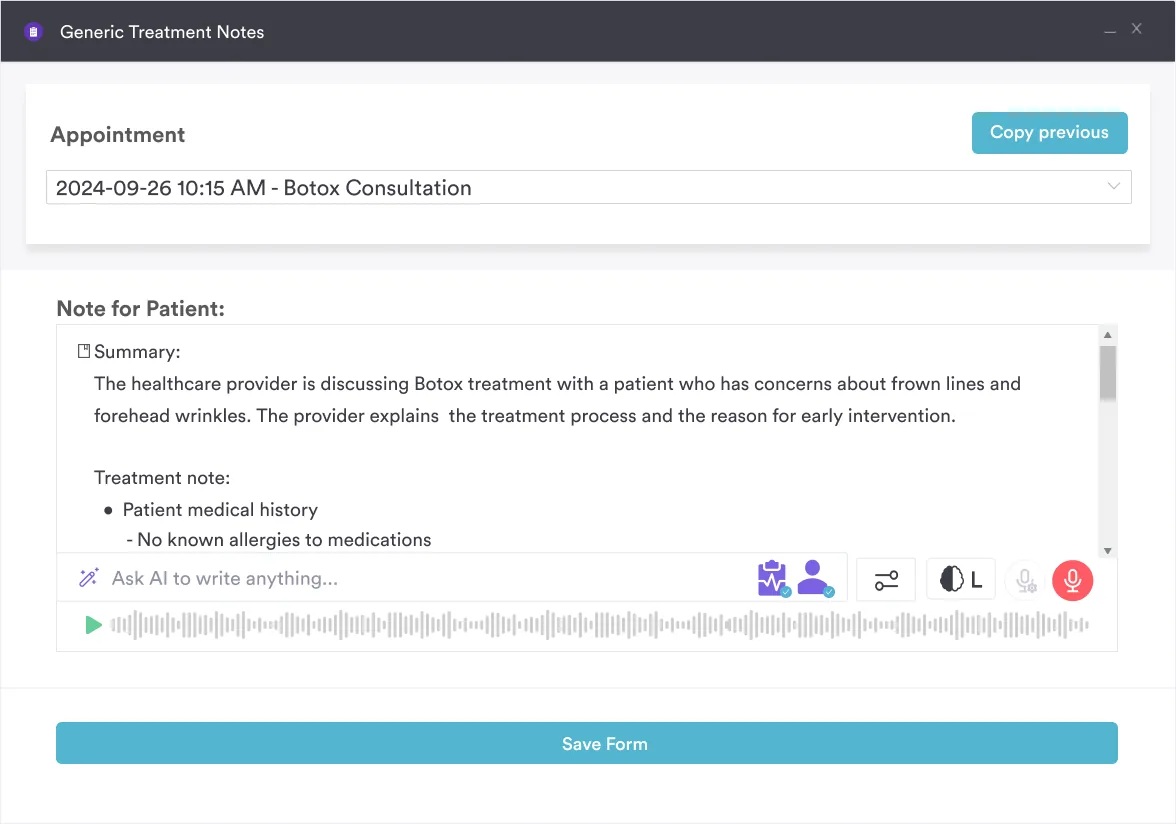
Clinical notes can double as evidence for a clinician’s own review. Pabau, the practice software we build, includes Pabau Scribe, our AI scribe for AI-assisted clinical documentation. It drafts treatment notes from the consultation, and every draft still needs checking before it goes on file.
The strengths and weaknesses assessment supports development conversations. It does not replace a regulated appraisal or revalidation process. Clinicians in the UK should follow GMC guidance on appraisal and revalidation, and nurses should check NMC requirements for their own registration.
For wider management and leadership capability frameworks, the Chartered Management Institute publishes material on development planning. Inside the practice, an annual review template gives the formal meeting its own record, with the assessment as supporting evidence.
Never use the template to diagnose a condition or to judge cognitive ability. It is a professional development tool, and it works best when it stays that way.
Without a system, review paperwork tends to scatter. The form sits in one folder and the meeting notes in another. The agreed follow-up depends on someone remembering it.
Pabau’s software for practice teams stores each staff member’s documents against their profile, from qualifications to contracts. A completed assessment can sit in the same place, ready for the next review.
Each agreed action can become a task with a name and a due date, so review dates don’t slip. Pabau’s team management tools also report hours and commission per team member. That gives the appraisal numbers to discuss alongside the self-review.

Pabau stores each team member’s documents in one place and turns agreed actions into tasks with due dates. See how it fits your team’s review cycle.

A strengths and weaknesses assessment is only as useful as its least specific line. Write each entry as a behavior with a dated example, and the form becomes a record your manager can check at the next review.
Start with the free template and pick two development areas, not ten. Review them after three months, and keep the old form beside the new one so the change is visible. Book a demo to see how Pabau keeps staff documents and review follow-ups in one place for your team.

Moving into a lead role? Leadership assessment helps managers rate their own leadership habits before a review.
Running reviews for the whole team? Employee evaluation form gives managers one consistent structure for every staff review.
Want the team’s view as well as your own? Employee engagement questionnaire collects how staff feel about their work and the practice.
Building a team that works well together? Teamwork in healthcare covers the habits that keep clinical teams coordinated.
Need a plain-English view of practice software? A plain-English guide to practice software explains the core functions practices look for.
A strengths and weaknesses assessment is a structured self-review that compares what you do well with the areas you need to develop. It relies on specific examples and is used for development planning, appraisals and career decisions.
No. It supports appraisal conversations but does not replace a regulated appraisal or revalidation process. Check the requirements set by your professional body.
Yes, the PDF is free to download from this page. Use it as a starting point and adapt the wording to your role or practice setting.
At minimum, include space for strengths and weaknesses with an example for each, feedback from others, and an action plan with a review date. This template also splits each list into personal and professional entries.