Maja Popovska

Support system worksheet: Free PDF and session guide
Download your free support system worksheet A ready-to-use assessment form for m...

1
Last Updated: Nov 9, 2026
Free PDF 2 pages, print-ready Clinician-reviewed
The hair loss Norwood scale is a seven-stage classification that grades male pattern baldness. It runs from minimal temple recession at stage 1 to a horseshoe of hair at stage 7. It follows two patterns, recession at the temples and thinning at the crown. Clinicians use the stage to record a baseline, measure change between visits and frame the treatment conversation. This guide covers what the scale measures, how to stage a patient in a consultation and where the scale stops being useful. It is written for aesthetic, dermatology and wellness practitioners.
A two-page form for staging male pattern hair loss on the Hamilton-Norwood scale. It records the stage and pattern, examination findings, blood tests, the treatment discussion and the review date.
Start from scratch, or upload this PDF or any form you already use, and Pabau's AI Form rebuilds it with tick boxes, text fields and a signature. Attach it to the treatment once, and every patient gets it on time.
AI Form rebuilds the consent, history and aftercare forms you already use. You review each one, then publish.
Patients complete forms on their phone before they arrive, so the front desk stops retyping paper.
Every signed form is versioned and attached to the treatment record, ready when you need it.
Set how long a consent stays valid. Returning patients skip forms they have already signed.
Supports HIPAA and GDPR compliance AES-256 encryption 4.8 on G2 4.7 on Capterra Trusted by 4,000+ practices worldwide

The hair loss Norwood scale grades male pattern baldness across seven stages, plus a Type A variant.
Staging is most reliable when paired with standardized photographs taken from the same four angles at every visit.
A stage does not decide treatment on its own. History, goals and medical suitability matter too.
Pabau’s practice management software keeps staging notes, intake forms and photos in one record, so visits compare cleanly.
The hair loss Norwood scale measures the pattern of androgenetic alopecia in men. It grades how far the hairline has receded and how much hair has gone from the crown. Hamilton described the pattern in 1951, and Norwood refined the classification in 1975.
The scale does not measure hair density, scalp health or the speed of loss. It tells you the current shape of the pattern, which is why it works best as part of a wider assessment. Our guide to scalp regions explains the zones these labels refer to, including the donor area at the back.
The Norwood scale runs from stage 1, with no meaningful recession, to stage 7. At stage 7, only a horseshoe of hair remains at the sides and back. Each stage has a recognizable visual pattern that clinicians can match against the patient.
Norwood also describes a stage 3 vertex pattern, where loss is mainly at the crown and frontal recession does not exceed stage 3. The diagram below shows each pattern from above, so the changes at the temples and the crown can be compared side by side.
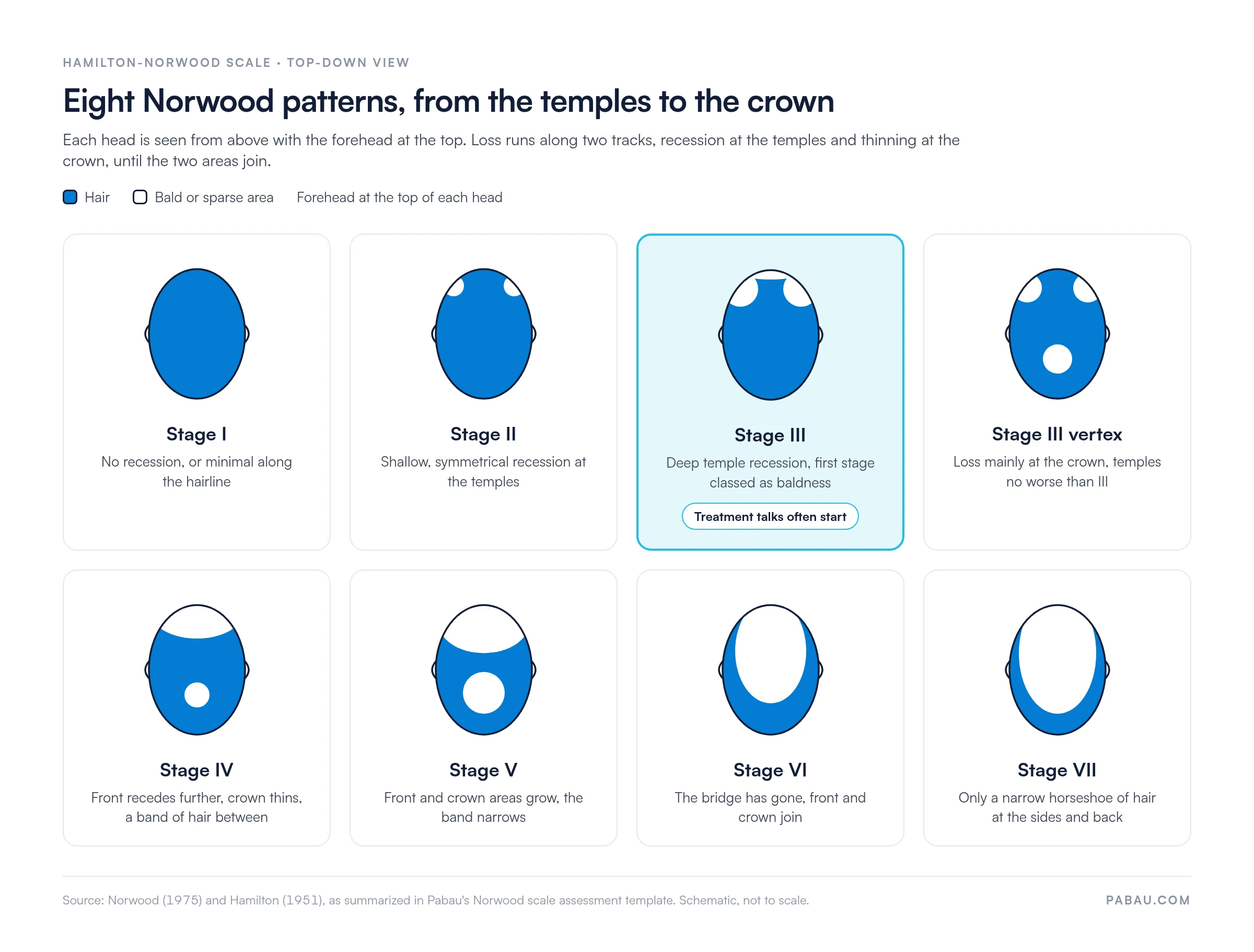
The Type A variant is a pattern where recession stays mainly at the front of the hairline, and the crown is often preserved. Note it separately on the record so the pattern is not lost in a standard stage entry. The template records these patterns as IIa through Va.
Treat the stage descriptions as guides with soft edges. Two patients at the same stage can have very different donor density, hair quality and expectations.
Work through five steps: Take the history, examine the hairline and crown, photograph the patient, assign the stage, and record it for review. Each step feeds the next, so skipping one weakens the staging.
Digital forms can capture the history in step one before the patient reaches the room. Pabau’s digital intake forms let practices send that questionnaire ahead of the visit.

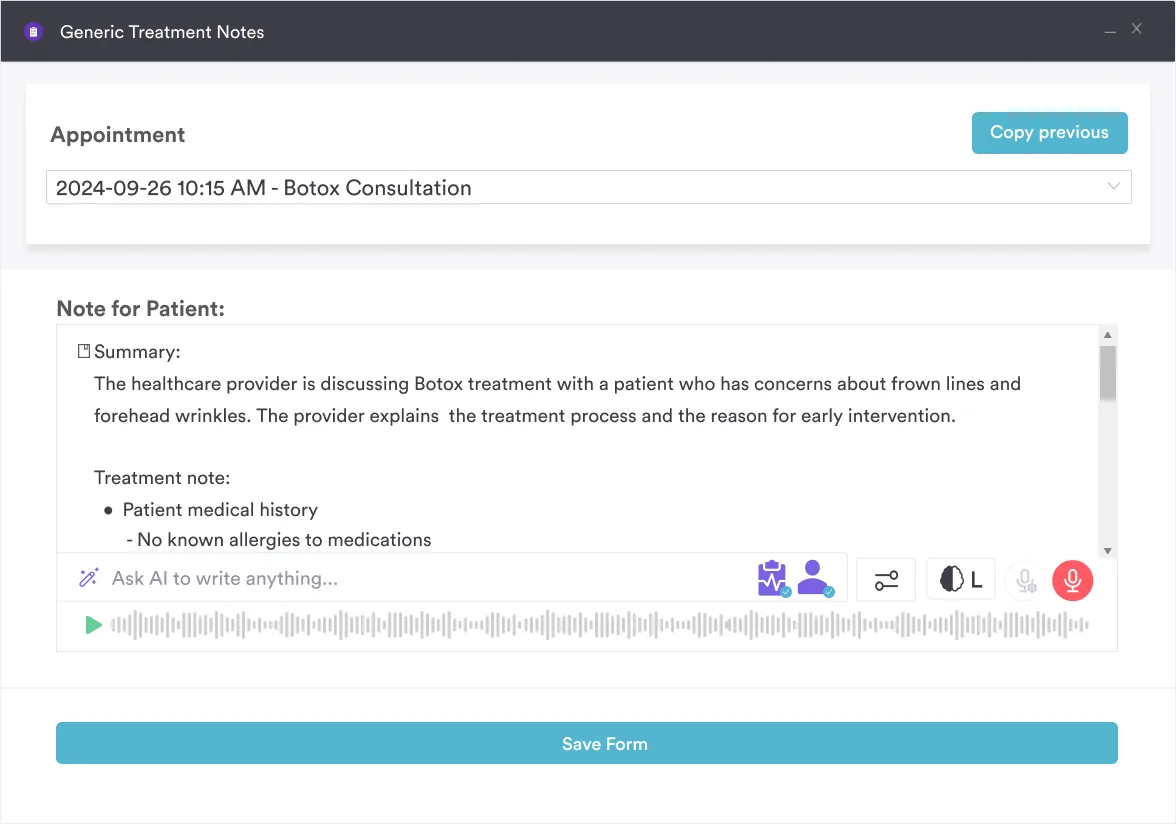
Pabau Scribe, our AI scribe, can support clinical note writing. The clinician still confirms the stage. Staging itself stays a clinical judgment made in the room.
A stage tells you where the pattern sits. Treatment depends on the patient’s goals, medical history and suitability for each option.
Topical minoxidil and oral finasteride are regulated medicines. Their availability, licensing and labeling vary by country and product, and FDA approval status differs by formulation and sex. Check the current label before advising a patient. Mayo Clinic’s overview of male pattern baldness is a useful patient-facing reference for the condition.
Surgical candidacy is commonly discussed from around stage 3, but donor density, age and realistic expectations decide suitability for each patient. Evidence for other options, such as platelet-rich plasma, is mixed, so present them as optional rather than proven.
Dermatologists, aesthetic doctors, nurse practitioners and nurse prescribers use the hair loss Norwood scale to stage male pattern baldness. Who may assess and treat depends on local scope of practice, so check the rules in your own state or jurisdiction.
Hair restoration practices use the scale to assess surgical candidacy. General aesthetic practices use it to open the conversation and refer on when needed. Teams running hair practices often look for software for hair clinics that keeps staging linked to the consultation.
A standard template makes stage records comparable between clinicians and across years. It also gives patients a consistent explanation of where they sit on the pattern.
Photograph every patient at each review in the same lighting and from the same four angles. Consistent photos make a one-stage change visible, which a verbal description rarely does.
The hair loss Norwood scale was designed for male pattern baldness, so it does not map cleanly onto women. For female pattern hair loss, clinicians usually use the Ludwig scale, which grades diffuse thinning across the crown.
The scale also misses inflammatory and diffuse causes. Telogen effluvium and alopecia areata can look similar at first, so rule them out before staging. NHS hair loss guidance sets out common causes and when to seek advice.
A single snapshot cannot show how fast loss is progressing, and inter-rater agreement is imperfect. Reviews of the scale’s validity are indexed on PubMed. Patients considering surgery also need informed consent, and a hair transplant consent form sets out the options and risks before booking.
In many practices the stage lives in a free-text note, and the photos sit in a phone’s camera roll. At the next review, the clinician compares a remembered stage with images taken in different light.
Pabau, the medical spa software we build, keeps the intake form, the photo series and the staging note in one patient record. Photos line up by date, so a one-stage change shows side by side.
The result is a stage you can defend at review and explain to the patient. Your team also stops hunting for last year’s photos before each consultation.

Pabau stores intake forms, dated photos and staging notes in one patient record, so each review compares like with like.

The hair loss Norwood scale is most useful as a shared language between clinicians and patients. Its value comes from repetition. Each review needs the same four photos, the same light and a dated stage.
Rule out other causes before you assign a stage, then weigh it alongside history, goals and donor density. That keeps the conversation grounded when a patient asks about surgery.
Book a demo to see how Pabau keeps Norwood stages, photos and treatment plans together for every hair loss consultation.

Need a structured hair restoration intake? Hair transplant intake form captures medical history, medications and hair loss classification before the consultation.
Preparing a patient for FUE? FUE consent form covers the procedure, its named risks and aftercare.
Choosing software for a hair restoration practice? Best hair transplant clinic software compares platforms that follow a patient from consultation to final growth photo.
Planning to open a hair restoration practice? How to start a hair transplant clinic walks through licensing, training and setup.
The hair loss Norwood scale has seven stages. They run from stage 1, with no significant recession, to stage 7, with only a horseshoe of hair at the sides and back. A Type A variant also exists, where recession stays mainly at the front.
A clinician assigns the stage by examining the hairline and crown under good light and comparing them with the stage descriptions. Photographs support the assessment, but an in-person examination is needed for a confirmed stage.
No, the scale was designed for male pattern baldness. Clinicians usually use the Ludwig scale for female pattern hair loss.
Surgery is commonly discussed from around stage 3, but suitability depends on donor density, age and expectations rather than the stage alone.