Maja Popovska

Support system worksheet: Free PDF and session guide
Download your free support system worksheet A ready-to-use assessment form for m...

1
Last Updated: Nov 9, 2026
Free PDF 2 pages, print-ready Clinician-reviewed
The CKD-EPI equation is the standard formula for estimating glomerular filtration rate (eGFR) from serum creatinine, age and sex. Its 2021 version drops the race term that the 2009 equation applied to Black patients. The result sets the KDIGO G1 to G5 category, which is paired with albuminuria for the full CKD stage. This free worksheet gives nephrology teams, primary care physicians and clinical staff one consistent structure for that step. Pabau, the practice software we build, can turn the same fields into a fillable digital form.
A two-page PDF that records creatinine, age and sex, applies the 2021 CKD-EPI equation, and stages CKD by eGFR and albuminuria. It also prompts a cystatin C check and a renal medication review.
Start from scratch, or upload this PDF or any form you already use, and Pabau's AI Form rebuilds it with tick boxes, text fields and a signature. Attach it to the treatment once, and every patient gets it on time.
AI Form rebuilds the consent, history and aftercare forms you already use. You review each one, then publish.
Patients complete forms on their phone before they arrive, so the front desk stops retyping paper.
Every signed form is versioned and attached to the treatment record, ready when you need it.
Set how long a consent stays valid. Returning patients skip forms they have already signed.
Supports HIPAA and GDPR compliance AES-256 encryption 4.8 on G2 4.7 on Capterra Trusted by 4,000+ practices worldwide

The 2021 CKD-EPI equation estimates eGFR from serum creatinine, age and sex, with no race term.
The 2009 version multiplied eGFR by 1.159 for Black patients, and the 2021 update removed that term.
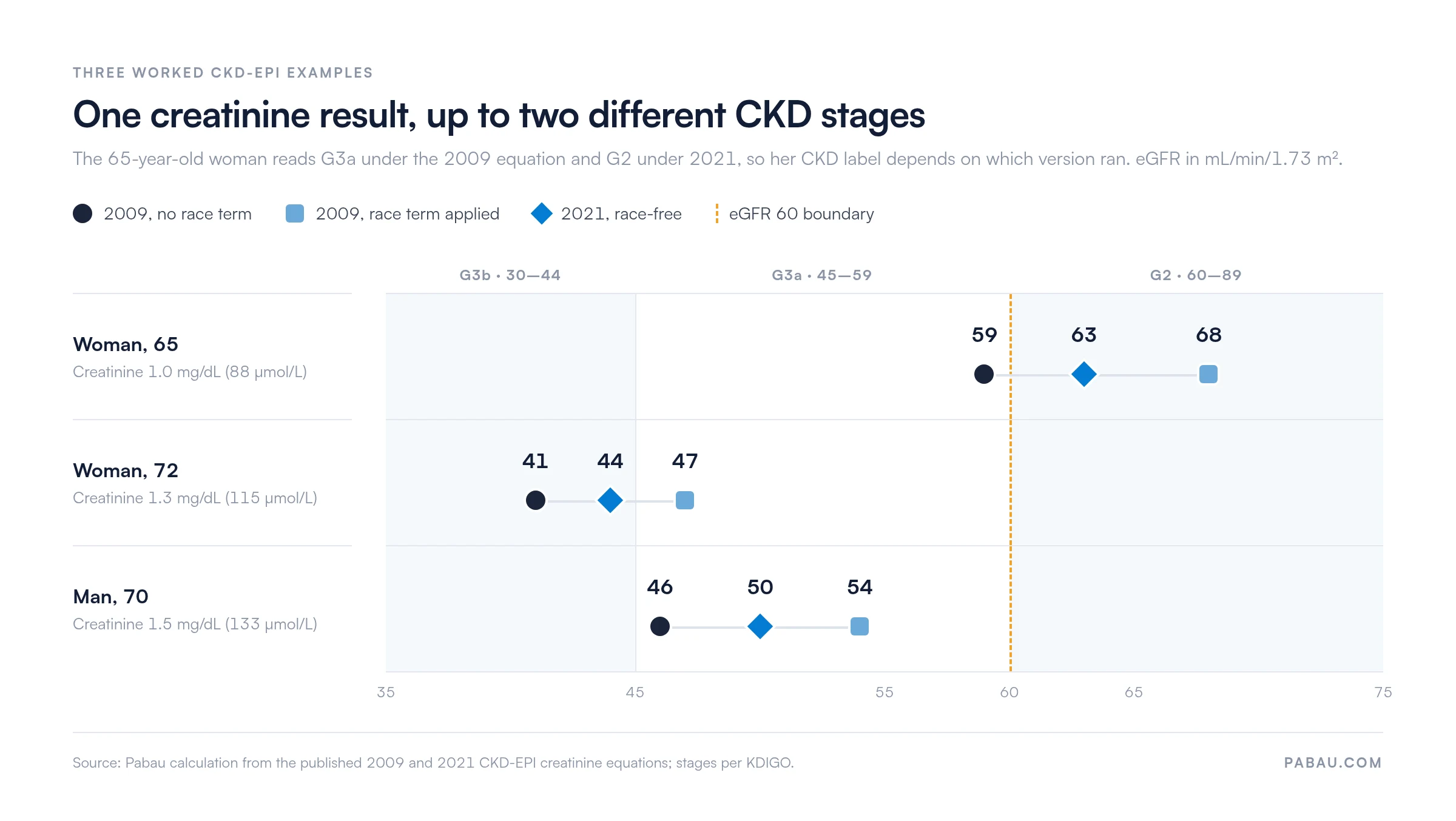
One creatinine result can land in a different KDIGO stage under each version, so record the version with every eGFR.
KDIGO counts eGFR below 60 for more than 3 months as CKD, and stages it alongside albuminuria.
Pabau can turn this worksheet into a digital form that saves each result to the patient record.
The CKD-EPI equation combines three patient inputs into one number: The estimated glomerular filtration rate. Clinicians read that number as a trend over time rather than as a single snapshot. Consistency in how it is recorded matters as much as the calculation itself.
CKD-EPI stands for the Chronic Kidney Disease Epidemiology Collaboration, the research group that published the first version in 2009. Its equations are now the standard eGFR method in most US and UK laboratories.
Each input has a specific role:
The 2021 version of the CKD-EPI equation estimates eGFR from serum creatinine, age and sex, with no race term. The race-free update was published in 2021 in a New England Journal of Medicine paper, and it is now the recommended form.
In plain terms, the equation is: eGFR = 142 x min(Scr/k, 1)^a x max(Scr/k, 1)^-1.200 x 0.9938^Age x 1.012 (if female). Here Scr is serum creatinine in mg/dL. The min term caps values below the threshold at 1, and the max term handles values above it. The constants k and a depend on sex, as shown below.
The result is reported in mL/min/1.73 m², which scales it to an average adult body surface area. That scaling lets you compare patients of different sizes on one staging table.
Creatinine must come from an assay traceable to isotope dilution mass spectrometry (IDMS) for the result to be valid. Check your lab’s method before you report the number. Creatinine usually arrives on a basic metabolic panel, and a BMP chart keeps those results together between visits.
Cystatin C offers a second marker that depends less on muscle mass. The CKD-EPI cystatin C equation uses cystatin C with age and sex, while the combined equation uses both creatinine and cystatin C.
In the 2021 NEJM validation, the combined equation was the most accurate of the three. KDIGO suggests measuring cystatin C when creatinine-based eGFR is 45 to 59 with no other marker of kidney damage. If the cystatin C-based estimate is 60 or above, CKD is not confirmed.
Clinicians often prefer cystatin C for older adults, people with low muscle mass, or patients with extremes of body composition. Creatinine can misestimate kidney function in those groups, so a second marker gives a fairer picture.
Want to see how this documentation fits your practice? Book a demo with the Pabau team.
You can calculate eGFR by hand in five steps, though many lab and EHR systems run the arithmetic automatically.
For example, take a 65-year-old woman with a serum creatinine of 1.0 mg/dL (88 µmol/L). Her creatinine ratio against k is 1.43. The calculation returns an eGFR of about 63 mL/min/1.73 m², which falls in stage G2.
The CKD-EPI equation output maps onto six eGFR categories, G1 to G5 with G3 split in two, set out in KDIGO CKD guidance.
A stage counts only when reduced eGFR persists for more than 3 months. KDIGO also grades albuminuria from a urine albumin-to-creatinine ratio (ACR). The full stage pairs both, such as G3a A2.
A G2 patient with A3 albuminuria carries more risk than a G3a patient with A1. Recording both numbers keeps that risk visible at review.
The 2021 CKD-EPI equation replaced the 2009 version by removing the race coefficient. The 2009 equation multiplied eGFR by 1.159 for Black patients, and the 2021 update drops that term for all patients.
The race term rested on self-reported race, a social category rather than a biological measure. In September 2021, the NKF-ASN Task Force recommended that US laboratories adopt the race-free equation.
Dropping the term shifts results in both directions. For Black patients, eGFR usually falls slightly, which can bring an earlier referral. For other patients, eGFR rises by a few points.
Values are eGFR in mL/min/1.73 m², calculated from the published 2009 and 2021 creatinine equations. The first patient sits either side of 60, so her CKD label depends on which version ran. That is why the worksheet records the equation version beside every result.
Health systems are still adapting EHR logic and reporting, so confirm how your system calculates eGFR before assuming the change is already live. In the UK, NICE guidance recommends the CKD-EPI creatinine equation without an ethnicity adjustment.
Use the CKD-EPI equation for most adults, because current guidance prefers it over the MDRD equation.
Check which equation a lab used before comparing results across time. For UK teams, NICE guideline NG203 covers CKD assessment and management in England.
The CKD-EPI equation assumes stable kidney function and typical muscle mass. Treat the result with caution, or confirm it with cystatin C, in these situations:
Note the reason on the worksheet whenever one of these applies. A later reader then knows why a single result was not acted on.
Use the worksheet to record every calculation in the same order, so results stay comparable across visits and clinicians. The two-page form follows the order of a review:
Audit your worksheet once a year against your lab’s equation version and the current KDIGO categories, so the form never lags behind your reporting.
If your team writes clinical notes digitally, Pabau Scribe, our AI scribe, can help structure the eGFR entry within the note.
Record who ran the calculation and when, so the stage can be checked at audit.
On paper, eGFR history is spread across lab printouts, letters and handwritten worksheets. Spotting a slide from G2 to G3a means lining them up by hand. The equation version is rarely written down at all.
Pabau’s digital forms turn this worksheet into a fillable form that saves to the patient’s record. Each entry can hold the creatinine, eGFR, stage and equation version, with who completed it and when.
The patient record then keeps every result in one place. You can compare today’s stage with the last one before the review, without chasing old paperwork. Edema and wound photos taken with Pabau’s before-and-after photo software sit on the same record.

Pabau turns your eGFR worksheet into a digital form that saves to the patient record. Each result keeps its stage, equation version and author, ready for the next review.

Pick one equation version, write it next to every result, and keep it until your lab changes method. Most eGFR confusion starts when a 2009 result sits beside a 2021 one in the same history.
Treat a single eGFR below 60 as a prompt to repeat the test. Stage only after 3 months, pair the stage with albuminuria, and confirm borderline G3a results with cystatin C.
The cost is a few extra fields per result. In return, the next clinician can trust the trend without phoning the lab. Book a demo to see how Pabau keeps eGFR worksheets, results and stages on one patient record.

Recording other kidney-related labs? Albumin blood test template gives you a ready-made form for logging serum albumin results.
Ordering creatinine and cystatin C together? Blood test lab request form standardizes the lab orders that feed your eGFR worksheet.
Working through other bedside formulas? Cardiac output equation walks through another clinical calculation step by step.
Running lab work in-house? Medical lab software shows how Pabau links lab orders and results to the patient record.
The CKD-EPI equation is a formula that estimates glomerular filtration rate (eGFR) from serum creatinine, age and sex. The current 2021 version has no race term. Clinicians use the result to detect and stage chronic kidney disease.
The 2021 equation removes the race coefficient, which multiplied eGFR by 1.159 for Black patients in 2009. It also refits the other constants, so most results shift by a few points. Record which version produced each result before comparing them.
Yes, for most adults. CKD-EPI is more accurate than MDRD when eGFR is above 60 mL/min/1.73 m², where MDRD tends to underestimate kidney function. Current KDIGO and NICE guidance both prefer CKD-EPI equations for routine reporting.
Yes. The CKD-EPI equation uses creatinine in mg/dL, so divide a µmol/L result by 88.4 first. For example, 88 µmol/L converts to about 1.0 mg/dL.
Use cystatin C when creatinine is unreliable, such as after an amputation, in severe malnutrition, or with very high muscle mass. KDIGO also suggests it to confirm CKD when creatinine-based eGFR is 45 to 59 without other kidney damage markers.
Often, but check the drug label first. Many labels still give renal doses against Cockcroft-Gault creatinine clearance, which uses body weight. For very large or very small patients, eGFR may need converting from mL/min/1.73 m² to mL/min.
No. The 2021 CKD-EPI equations were developed for adults aged 18 and over. Use a pediatric equation, such as the bedside Schwartz formula, for children and adolescents.