CRM for chiropractors: how to manage patients, bookings and marketing
A CRM for chiropractors is a patient relationship management system built around...

Last Updated: Oct 13, 2026

A leadership assessment scores competencies like decision-making, emotional intelligence, and team influence, so development stops being guesswork.
Self-assessment gives you a fast baseline, while 360-degree feedback suits promotion and succession decisions that need more than one perspective.
The assessment only pays off if a debrief and two 90-day priorities follow it, then a repeat score six months later.
This free template holds 20 rated statements scored out of 100, with four clusters that show exactly where the points were lost.
Inside you get 20 leadership statements rated from 1 to 5, grouped into decision-making, team skills, strategic thinking, and emotional intelligence. It also includes name and date fields, a scoring chart with four result bands, and a notes page for the development plan.
Download templateA leadership assessment is a structured evaluation that measures how a leader performs across defined competencies. It scores things like decision-making, emotional intelligence, communication, and influence over a team. For practice managers, owners, and team leads, it turns opinion about a leader into data you can act on.
A one-off feedback conversation tells you how a leader is doing this week. A formal leadership assessment gives you a baseline you can measure again in six months. It answers the questions that decide whether a practice can grow. Are your clinical leads ready for a bigger team? Does your best practitioner have the judgment to run a second site?
This guide covers what leadership assessments measure, which format to pick, and the mistakes that waste the effort. It also gives you a free 20-statement template you can score in about ten minutes.
A leadership assessment is a systematic instrument that measures how well a leader performs against a defined set of competencies. It goes further than a subjective opinion. You end up with structured, comparable data on effectiveness, potential, and readiness to take on more.
In healthcare settings, leadership assessments typically evaluate:
Formats run from a self-administered survey to a multi-rater 360-degree tool. Raters can include the leader, their manager, their peers, and their direct reports. The right structure depends on your practice size, your budget, and what you plan to do with the results. For wider context.
Leadership assessments move three numbers that practice owners already watch: retention, clinical quality, and growth capacity.
The same logic applies to your systems. If you have invested in practice management software, someone has to drive adoption of the scheduling, portal, and automation features you are paying for. Leadership capability is what decides whether that happens.
The turnover point is also the one you can check after the fact. An exit interview form records why each person left, and manager-related reasons tend to appear there first.
The template below scores four domains, with five rated statements in each: decision-making, team and interpersonal skills, strategic thinking, and emotional intelligence.
Weighing options under time pressure, knowing what to delegate versus handle personally, and following through on accountability once a call is made. A leader who avoids decisions – or reverses them under pushback – erodes trust faster than one who makes an imperfect call and owns it. This domain also covers conflict resolution: deciding how and when to step in when two team members disagree.
Empathy, active listening, motivation, and the ability to build psychological safety. This is often the highest-impact domain of the four: when staff can raise a concern or an idea without cost, problems surface while they are still small. It also carries the most weight in multi-clinician practices and in team management across complex clinic workflows, where a leader has to keep several different people pointed at the same goal.
Vision-setting, change management, and comfort with ambiguity. Regulation, competition, and clinical practice all keep shifting. Leaders need this domain to steer a team through change without the service wobbling.
Self-awareness, emotional regulation, and resilience. Leaders who know their own stress triggers make better decisions under pressure, which is no small thing in a busy clinical week. They also model the behavior they expect from the rest of the team.
An occupational therapy platform can store each completed scale beside the patient’s goals and session history.
Different formats suit different situations. Here is what works for healthcare teams.
The leader rates their own competencies. It is quick, cheap, and non-threatening, which makes it a realistic starting point. The limitation is optimism, because leaders consistently rate themselves higher than their teams do. Best used for a development baseline or a first round of self-reflection.
Input from the leader, their manager, their peers, and their direct reports. The multi-rater view surfaces blind spots a self-rating never will. It does need psychological safety first, since staff must trust that honesty carries no penalty. Best used with settled teams, and for promotion or succession decisions.
Identifies natural behavioral patterns, usually labeled dominant, influential, steady, and conscientious. It shows a leader their default communication style and where to flex it for different team members. Lighter touch than a competency assessment, and useful for team dynamics. Best used for team-building or a new leader’s orientation.
Focuses on what a leader already does well rather than what is missing. The positive framing encourages leaders to lean into their strengths and delegate around the rest. Best used for motivation and retention.
Rolling out a leadership assessment takes six steps. Work through them in order and most of the usual pitfalls never get a chance to appear.
Budget for the debrief, not just the survey. The hour you spend on each conversation is what converts a score into changed behavior.
Run that conversation on a set one-on-one meeting agenda so the check-in, the feedback, and the agreed actions all get captured.
Healthcare leaders are busy, so an assessment can feel like one more box to tick. These are the mistakes that make it exactly that.
Pitfall 1: treating the assessment as the finish line. The score is not the win, the development is. Plenty of practices run an assessment, file the results, and move on. Assessment without follow-up breeds cynicism and contributes to leader burnout, because leaders end up evaluated but unsupported.
Pitfall 2: skipping the psychological safety setup. If leaders suspect the results will be used punitively, they will game the form or disengage. Set the norms out loud. Results stay confidential, feedback is a gift, and development is everyone’s job.
Pitfall 3: a one-size-fits-all competency model. Generic corporate frameworks travel badly into healthcare. A clinic lead’s priorities are patient safety, staff coordination, and compliance, which look nothing like a software manager’s. Customize the competencies to your own practice.
Pitfall 4: assessing only the people who already have the title. Many practices review established managers and overlook high-potential junior staff. Early assessment and development is how you keep that talent and build succession depth.
The template is a 20-statement rating form, scored out of 100. Here is how to run it in five operational steps.
The cluster scores matter more than the total, and this is where most people stop too early. Two leaders can both land on 72 and need opposite development plans. One is strong on strategy and loses points on conflict and feedback. The other is the reverse. A single number hides that completely.
The template suits practice leaders, managers, and HR staff in these settings:
A form does four things an informal conversation cannot, whatever the leader’s score turns out to be.
There is also a practical benefit: the template is ready to use. You can assess a team lead this week instead of spending a quarter scoping a leadership program.
Most practices assess a leader once and then lose the thread. The scores go in a folder, the 90-day priorities are never revisited, and the next review starts from whoever remembers more.
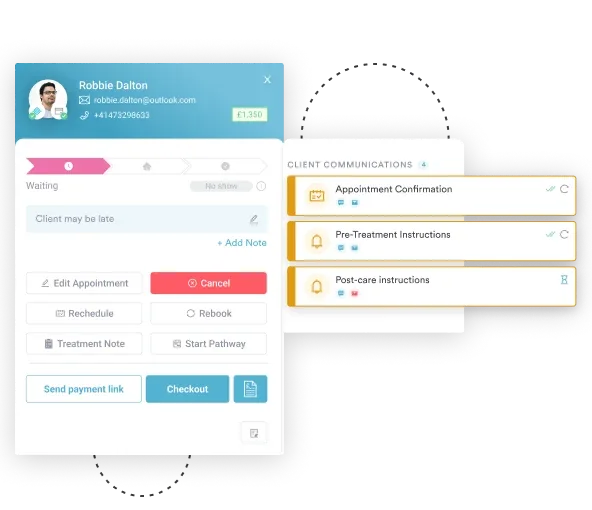
Practice management software like Pabau closes that loop from the operations side. Team management in Pabau keeps each practitioner’s schedule, targets, and performance in one place. A development conversation then runs on numbers rather than impressions, which makes the 90-day priorities easy to check.
It also buys your leads the time to hold the conversation at all. Confirmations, reminders, and follow-ups send themselves, so nobody spends the morning chasing them.
Every subscription includes every feature, so team management and reporting are not something you unlock later. Onboarding is structured, so your managers are pulling their own performance reports within the first weeks.

Pabau automates the scheduling, reminders, and reporting your managers spend their week on. That frees leadership time for development conversations, and gives you performance data for every practitioner in one place.

A leadership assessment is worth the hour only if something changes afterward. The scoring is the cheap part. The debrief and the two priorities are where the return actually sits.
So start small rather than launching a program. Run the template on yourself or one team lead this week, and read the four cluster scores rather than the total. Then book the six-month re-assessment before you file the form. One leader who improves how they handle conflict will change more for your team than a full framework nobody revisits.
Book a demo to see how Pabau’s team management and automation give your leaders the data and the time to develop their people.

Could a nurse practitioner lead your practice? Nurse practitioner as medical director explains how state law, not clinical skill, decides who can hold that title.
Hiring your next LPN? LPN interview questions are written for the person doing the hiring, not the candidate.
Wondering if a non-compete will hold? Physician non-compete agreements are void in at least 14 states, so check where your contract stands.
A leadership assessment is a structured tool that measures a leader’s competencies, behavioral style, and development needs. The leader, and often their team, rates performance across defined competencies such as emotional intelligence, decision-making, and team influence. The results are compiled and discussed in a development conversation that ends with specific improvement goals.
There are four main types. A self-assessment has the leader rate themselves. A 360-degree assessment collects ratings from the leader, their manager, peers, and direct reports. DISC and other behavioral style tools identify communication patterns. Strength-based assessments focus on what a leader already does well.
Weigh your goal, your timeline, your team size, and your budget. A self-assessment takes about 30 minutes and gives you a quick baseline. A 360-degree cycle takes around four weeks and suits high-stakes decisions such as promotion or succession, where one perspective is not enough.
Most leadership assessments measure four domains. Self-management covers emotional regulation and self-awareness. Interpersonal effectiveness covers empathy and communication. Team leadership covers delegation, motivation, and accountability. Strategic thinking covers vision, change management, and adaptability.
A 360-degree assessment collects feedback from several sources: the leader, their manager, their peers, and their direct reports. Each rater evaluates the leader independently. That multi-perspective view surfaces the blind spots a single-rater assessment misses, which is why it suits promotion and succession decisions.
The results become a targeted development plan. The leader and their manager review the scores together and pick one or two priority areas. They then agree specific behaviors to practice over 90 days, such as holding weekly one-to-ones or asking for feedback more often. Progress is re-assessed in six to twelve months.
A self-assessment is when a leader rates their own competencies across defined dimensions. It is quick and cheap, which makes it a good entry point. Self-ratings do tend to be more optimistic than how others see the same leader. Treat one as a starting point rather than the only source of feedback.