Panama shift schedule: Free 2-2-3 template
The Panama shift schedule is a 2-2-3 rotation that keeps a practice staffed arou...

1
Last Updated: Oct 6, 2026
An employee engagement questionnaire is a structured survey that measures how committed, motivated, and connected your staff feel to their work, colleagues, and organization. In a healthcare practice, staff engagement shapes patient experience, retention, and compliance. That makes it one of the few staff metrics a practice manager can act on directly.
A satisfaction survey asks whether people are happy. An engagement questionnaire goes after the drivers underneath. It asks whether your team feels valued, has a clear route to progress, and trusts their manager. It also asks whether they recognize the practice’s stated values in daily decisions. Team management software centralizes staff records, but the questionnaire is a standalone tool that gives staff a voice and gives you something specific to fix.
Below you get the six question categories every healthcare questionnaire should cover. There is design guidance, administration advice, and a free template you can adapt today. You also get an honest read on benchmarks. The NHS scores engagement out of 10, not as a percentage, and the national average barely moves from year to year.
Thirty ready-to-use questions covering job satisfaction, manager effectiveness, culture and values, career development, recognition, and wellbeing. Customize the wording, scale format, and anonymity settings to match your practice. Administration instructions and score calculation guidance are included.
Download template
An employee engagement questionnaire measures commitment, motivation, and alignment, which a satisfaction survey never reaches.
Healthcare engagement scores are closely linked to patient safety, staff retention, and CQC inspection readiness.
Effective questionnaires cover six core areas: job satisfaction, manager effectiveness, culture, career growth, recognition, and wellbeing.
The NHS Staff Survey scores engagement from 0 to 10, so a percentage threshold quoted elsewhere is the wrong scale.
Download Pabau’s free template to start measuring staff engagement in your practice today.
Staff engagement carries regulatory weight in healthcare. The Care Quality Commission (CQC) evaluates staff wellbeing and engagement as part of its registration assessment. Practices with poor engagement see higher turnover, which breaks clinical continuity and raises the risk of poor patient outcomes.
NHS Employers publishes guidance alongside the annual NHS Staff Survey. Engaged staff report better psychological safety, lower burnout, and stronger commitment to clinical excellence.
For independent practices, the operational stakes are just as high. Replacing a departing practitioner is commonly estimated to cost between 50% and 200% of that person’s annual salary. That figure covers recruitment, onboarding, and lost productivity.
Burnout in healthcare remains one of the leading reasons staff resign. It is also preventable, provided managers have structured feedback about what is driving the pressure.
An engagement questionnaire produces that feedback in a form you can act on. It tells your team their voice counts, and it gives you evidence to improve retention, compliance, and patient care.
Leading engagement surveys such as Gallup Q12, Culture Amp, and Qualtrics all structure their questions around five to seven drivers. The six categories below cover those drivers and add the wellbeing questions that healthcare shift patterns demand.
Staff need to feel their work is valued and has purpose. Sample questions on a 5-point agree or disagree scale: “I have the tools and resources to do my job effectively.” “My role allows me to use my skills and strengths.” “I understand how my work contributes to patient care.”
The direct manager relationship is the single strongest predictor of staff engagement. Ask whether the manager gives clear feedback, supports development, and creates psychological safety. Sample: “My manager provides me with constructive feedback.” ACAS employment guidance stresses that feedback on management quality has to be anonymous to be honest.
Where the scores here come back low, a structured leadership assessment gives you a second read on the same relationship from the manager’s side.
Do staff see the practice’s stated values in how it actually operates? Sample questions: “Our practice values are reflected in daily decisions” and “I feel part of a cohesive team.”
Progression matters more in healthcare than in most sectors, because development pathways drive retention directly. Ask: “I have opportunities for professional development” and “My manager discusses my career goals.”
Staff need their contributions acknowledged. Cover formal recognition (“I am fairly compensated for my role”) and informal recognition (“My manager recognizes my contributions”).
Healthcare shift patterns create demands that a generic survey misses. Address workload, on-call burdens, and support for wellbeing. Sample: “I am able to maintain a healthy work-life balance” and “The practice supports my mental health and wellbeing.”
A well-designed survey balances depth against brevity. Long surveys suffer low completion rates, and short ones miss drivers you needed to see. Aim for 20 to 30 questions on a 5-point Likert scale, plus three to five open-ended questions for qualitative detail.
Asking for feedback and then sitting on it destroys trust faster than never asking. Once responses are in, calculate scores by question and by theme. Anything scoring below 3 on a 5-point scale signals risk. Share the findings with your leadership team and build action plans for the top three priorities.
Then tell staff what you heard and what will change. Automated workflows can carry the follow-up, assigning manager training, wellbeing initiatives, or development support to named owners with deadlines. Close the loop within four to eight weeks, while the survey is still fresh in everyone’s mind.
Keeping those actions in the same practice management software that holds your rotas and staff records stops them from living in one manager’s inbox. The next survey cycle then has a record to measure against.
What counts as a good engagement score? The first thing to get right is the scale. The NHS Staff Survey scores its staff engagement theme from 0 to 10, not as a percentage. The “above 70%” thresholds quoted around the web are measuring something else.
On that 0 to 10 scale, the national average was 6.85 in 2024 and 6.75 in 2025. Across five years it has stayed inside a 0.14-point band, as the chart below shows.
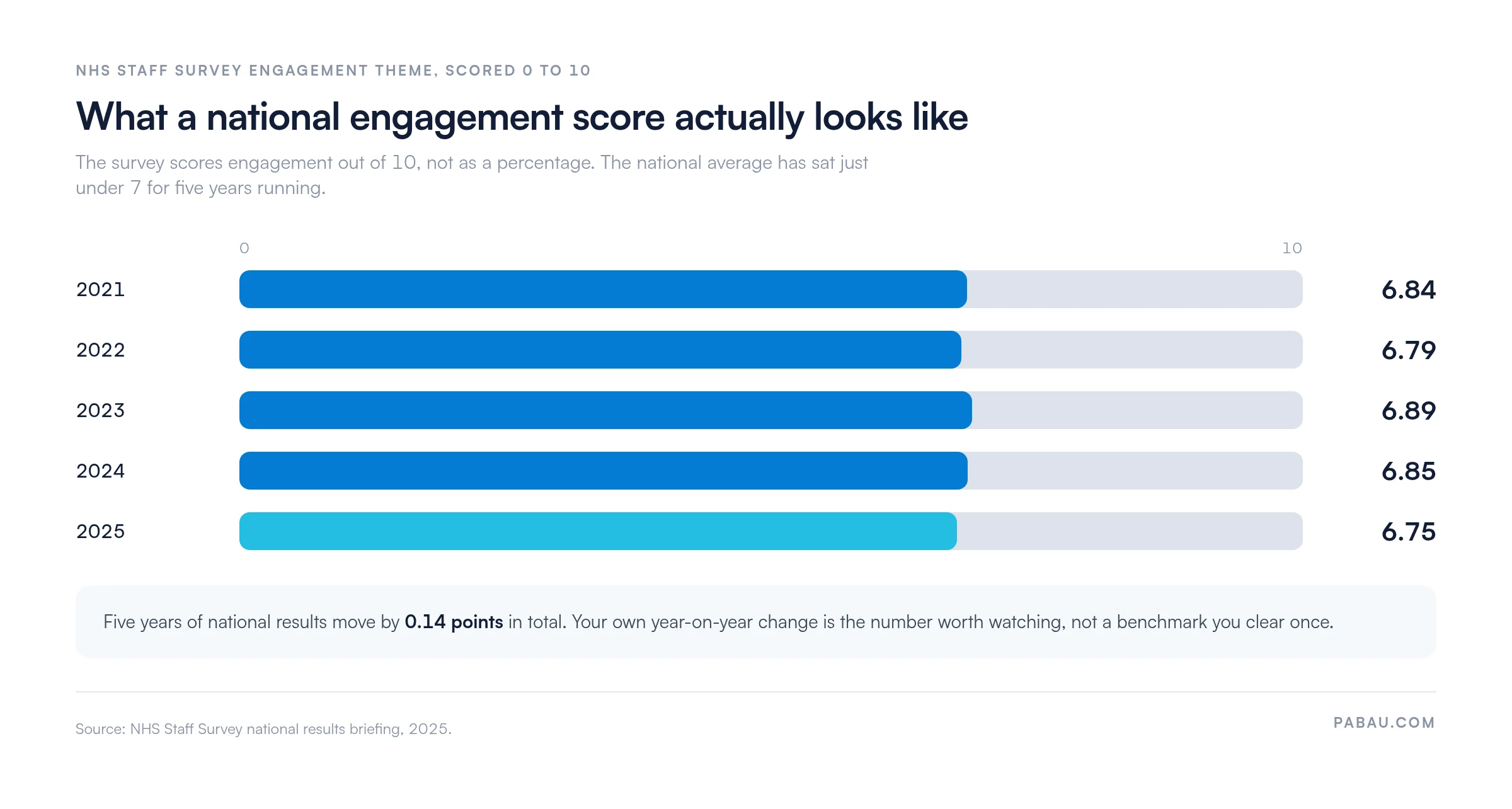
Those figures come from NHS trusts, so an independent practice cannot read them as its own target. CIPD guidance makes a similar point about engagement generally. The score matters for what it predicts about retention and quality of care, not as a pass mark.
If this is your first survey, set a baseline instead of chasing an industry average. Year-on-year movement in your own score is the number worth reporting to your leadership team.
A pulse survey is short and frequent: five to fifteen questions, run quarterly or every two months. A full engagement questionnaire is deeper, at 25 to 35 questions once a year. Run both. The annual survey gives you diagnostic depth, and the pulse tells you whether your action plans are working.
The file holds 30 core questions grouped by category, administration instructions, scoring guidance, and a sample data-collection workflow. Every question uses a 5-point Likert scale that converts easily to agree or disagree, or to yes or no. You can deliver it through Google Forms, Typeform, or your practice’s internal channels.
Adapt it before you send it. Cut any question that does not apply, such as multi-location consistency at a single-site practice. Add two or three questions tied to your own values or current priorities. Keep all six categories in place, so you still capture the full range of engagement drivers.
If you run more than one site, send the identical questionnaire everywhere and compare scores by location. That comparison usually shows the difference is management, not geography, which tells you where to put your support first.
Timing, anonymity, and communication drive both response rates and honesty. Run the survey outside your peak clinical periods, so staff are not answering it while overwhelmed. Frame it clearly as an effort to improve working conditions, never as a compliance exercise or an assessment of individuals.
Set a deadline of about two weeks and send two reminders. An 80% response rate or better keeps the data representative. Below 60%, treat the results as incomplete and say so when you report them.
Protect anonymity at the tool level, not by promise. Switch off IP tracking, remove any login requirement that could identify a respondent, and collect no data beyond the survey answers. A form that never asks for a name or an employee ID keeps you on the right side of GDPR by default.
In most practices the survey lives in one place and the response lives somewhere else. Results sit in a spreadsheet and the action plan sits in a manager’s notes. The rota that caused the low wellbeing scores sits in a third system. By the next survey cycle, nobody can say which change was actually made.
Pabau is practice management software that holds staff records, rotas, and internal communication in one place. You can see who is carrying the late shifts and who has missed a development conversation this year. You can also see which site is short-staffed week after week. That context turns a low wellbeing score into a specific rota decision.
Automated workflows then keep the follow-up honest. Each action from the survey gets an owner and a deadline, and reminders go out without a manager chasing them. When you report back to staff four weeks later, you can name what changed rather than repeating the plan.

Pabau keeps staff records, rotas, and internal communication in one system, so every action from your engagement survey has a named owner and a deadline. Your next survey cycle then has a record to measure against.

The questionnaire is the easy part. What decides whether it was worth running is the four weeks afterwards, when staff find out whether anything moved.
So set the bar accordingly. Download the template and cut it to fit your practice. Run it only if you are prepared to publish three actions and a date against each one. A survey you cannot follow through on costs you more trust than it buys.
Score it against your own baseline rather than a national figure, and expect movement in tenths rather than whole points. Book a demo to see how Pabau keeps engagement actions, rotas, and staff records in one place between survey cycles.

Ready to turn survey findings into individual conversations? Annual review template gives you a structure for the one-to-ones that follow an engagement survey.
Manager effectiveness scoring low? Performance improvement plan sets out how to agree measurable actions and a review date with a team member.
Need a better way to close the loop with staff? Staff messaging platform for practice management covers how to keep updates visible to everyone rather than buried in email.
Handling a difficult conduct or performance issue? Employee counseling form documents the conversation properly, which protects both the manager and the team member.
The terms are used interchangeably. A questionnaire is a structured set of written questions, and a survey is the exercise of sending it out. “Questionnaire” is more common in healthcare and research, while “survey” dominates in commercial settings. Both measure the same thing.
For most practices, 25 to 35 questions is the target. Fewer than 20 risks missing important drivers, and more than 50 causes response fatigue and lower completion rates. Pabau’s template includes 30 questions grouped across six categories, plus optional open-ended questions for qualitative feedback.
Yes. Anonymous responses produce far more honest feedback, especially on sensitive topics such as manager effectiveness and psychological safety. Use a neutral third-party form tool to guarantee anonymity, and never require login credentials or employee IDs.
The Gallup Q12 is a 12-question engagement survey developed by Gallup. It measures job satisfaction, role clarity, resources, manager quality, and development opportunities. It is proprietary and carries a licensing cost, while Pabau’s free template covers the same engagement dimensions at no cost.
Run the full questionnaire annually to establish trends over time. Supplement it with quarterly pulse surveys of five to ten questions. Those track progress on specific actions, or catch the effect of a new manager or a staffing restructure.
Identify the three lowest-scoring categories and read what staff wrote in the open-ended responses. Build targeted action plans with clear ownership and timelines. Communicate the findings to all staff within four weeks and update them monthly. Without visible follow-through, the next scores will be lower.