Healthcare workforce planning: a practical guide for practice leaders
Healthcare workforce planning is the structured process of matching clinical cap...

Last Updated: Oct 13, 2026

Teamwork in healthcare is a structured effort by clinicians in different roles to reach shared patient goals.
The Joint Commission ranks communication failures among the leading root causes of the sentinel events it reviews.
TeamSTEPPS rests on team structure and teaches four skills: communication, leadership, situation monitoring, and mutual support.
The coordination layer is where a task gets assigned, seen, and tracked, and it decides whether routines survive a busy day.
Practice management software like Pabau holds that layer, so handoffs and follow-up tasks stop depending on memory.
Teamwork in healthcare decides how much of each clinician’s competence reaches the patient. Most preventable serious harm in clinical settings traces back to coordination failures, not knowledge failures. That makes teamwork an organizational problem with organizational fixes.
Below you’ll find what the term means clinically, the evidence on why it changes outcomes, and the frameworks that improve it. A later section covers the coordination layer every one of those routines quietly depends on.
Teamwork in healthcare is the structured, coordinated effort of physicians, nurses, pharmacists, and allied health professionals working toward shared patient goals. Roles are defined, communication is deliberate, and every task has a named owner. A group of clinicians who happen to share a building does not qualify.
That definition is narrower than the everyday sense of the word, and deliberately so. Goodwill between colleagues does not name a task owner or fix a handoff format.
The wrong person misses a critical update. A handoff loses a key detail. A team member spots a risk and does not feel able to raise it.
According to a peer-reviewed review of clinical team effectiveness, teamwork reduces medical errors, improves patient outcomes, and raises staff satisfaction. Its core dimensions are communication, leadership, role clarity, situation monitoring, and mutual support. Each dimension is a measurable, trainable competency rather than a soft skill.
Teamwork matters because a broken handoff cancels out individual competence. No amount of clinical skill in one person survives a message that never arrives.
The stakes rise with the complexity of the case. One patient with several comorbidities may see a primary care physician, a specialist, a pharmacist, a physical therapist, and a nurse in one care episode. Without coordination, those five interactions risk working at cross-purposes.
The Joint Commission ranks communication failures among the leading root causes of the sentinel events it reviews. Sentinel events are the deaths and permanent harm the commission reviews, so this is the severe end of the coordination problem.
So why is teamwork important when every clinician on the team is individually competent? Because competence does not transfer between people on its own. The patient meets the whole team, not the best member of it.
Teamwork also shapes the working life of every person delivering care. Clinician burnout runs substantially lower in teams with high psychological safety and mutual support. Staff who feel part of a functioning team report higher job satisfaction and stay in their roles longer.
What is the main advantage of effective teamwork in a practice? Fewer preventable failures, and the benefit lands on both sides of the appointment. Patient outcomes and staff outcomes are both measurable.
Well-coordinated teams produce faster diagnosis, fewer repeat investigations, and lower preventable readmission rates. All three trace back to teams that share information well. Care plans get followed through because the next clinician knows what the last one decided.
Care quality improves when every member of a team can open the relevant records, knows their own responsibilities, and follows a predictable handoff process. Continuity is the visible result. Patients who meet a coherent team understand their treatment better and follow it more reliably.
Nursing teamwork is where the staff benefit shows up first. Nurses absorb most of the coordination load on a ward or a treatment floor, so mutual support changes their day before it changes anyone else’s.
Teams with strong mutual support and psychological safety report lower rates of burnout. A nurse has to be able to flag a concern without fear of reprisal, and a physician has to be willing to hear it. Those two habits are what make clinical work sustainable.
Shared accountability also means no individual carries the full cognitive load of a complex case alone. Peer learning accelerates for the same reason. A pharmacist flags a drug interaction. A physical therapist identifies a fall risk the physician had not considered.
Team performance comes down to specific, trainable dimensions rather than vague notions of good culture. Communication and teamwork get treated as one idea. The research keeps pulling them apart into named components.
Communication in healthcare teams works when it follows a fixed structure that every member uses for handoffs, escalations, and updates. Verbal updates during a busy shift, corridor handoffs, and memory-based information transfer all introduce error.
SBAR, short for situation, background, assessment, and recommendation, is the most widely used of those protocols. SBAR gives any team member a reliable structure for escalating a concern or completing a handoff, whatever their seniority.
Guidance from the Agency for Healthcare Research and Quality, known as AHRQ, names three practices as core to high-reliability teams. Those are SBAR, closed-loop communication, and the CUS technique, short for concerned, uncomfortable, safety issue.
Give CUS a decision rule, or it stays a slogan. When a team member says those three words, the response has to change the plan or the concern moves up.
Escalation goes to the next-level clinician immediately, not at the next scheduled handoff. Writing that rule down turns communication from a stated value into a protocol staff can follow.
Psychological safety is the shared belief that a team is safe for interpersonal risk-taking. In clinical terms, a junior nurse can tell a senior physician that something looks wrong without fearing professional consequences.
Research by Amy Edmondson at Harvard Business School found that teams with high psychological safety report more errors but suffer fewer serious ones. Problems surface early and get corrected before they escalate.
Leaders build that safety through consistent behavior. They listen to concerns, thank the staff who raise them, and visibly act on what they hear.
Role ambiguity is a common cause of clinical error, and among the cheapest to fix. When nobody is clearly responsible for monitoring a patient’s medication or chasing a test result, that is the task that gets dropped. Two people each assumed the other had it covered.
Clinical leaders who define roles out loud, brief teams before complex cases, and debrief afterward create accountability without blame. A leader’s job is not to centralize every decision. A leader makes sure each team member knows their scope and has the information to act within it.
A multidisciplinary team brings physicians, nurses, pharmacists, therapists, and social workers around one patient. Each of them contributes knowledge no single clinician could replicate.
Interprofessional collaboration describes professionals from separate disciplines running coordinated care instead of parallel care. A multidisciplinary team, or MDT, is the standing group that does it. Collaboration in nursing usually carries the most weight in that group, because nursing teams hold the thread between every other discipline.
The AMA Journal of Ethics notes that diverse, well-coordinated teams outperform individual clinicians on complex cases. Those teams pool distinct knowledge bases through structured collaboration instead of leaning on one expert’s judgment. Inclusive participation is what turns a group of professionals into a functioning MDT.
Shared decision-making extends that collaboration to the patient. When MDT members align on a treatment direction and say so clearly, patients hear consistent information and can make informed choices about their care.
Evidence-based frameworks give teams a shared language and a practical structure for collaboration. Two are especially well-established in healthcare settings.
TeamSTEPPS, short for Team Strategies and Tools to Enhance Performance and Patient Safety, was developed jointly by AHRQ and the US Department of Defense. Team structure is its foundation. TeamSTEPPS sets out who is on the team, what each person is licensed to do, and who owns which task.
Four teachable skills sit on that foundation. The four skills are communication, leadership, situation monitoring, and mutual support, and each comes with its own tools, training modules, and measurable behaviors. The diagram below separates the base from the four skills a training program can move.
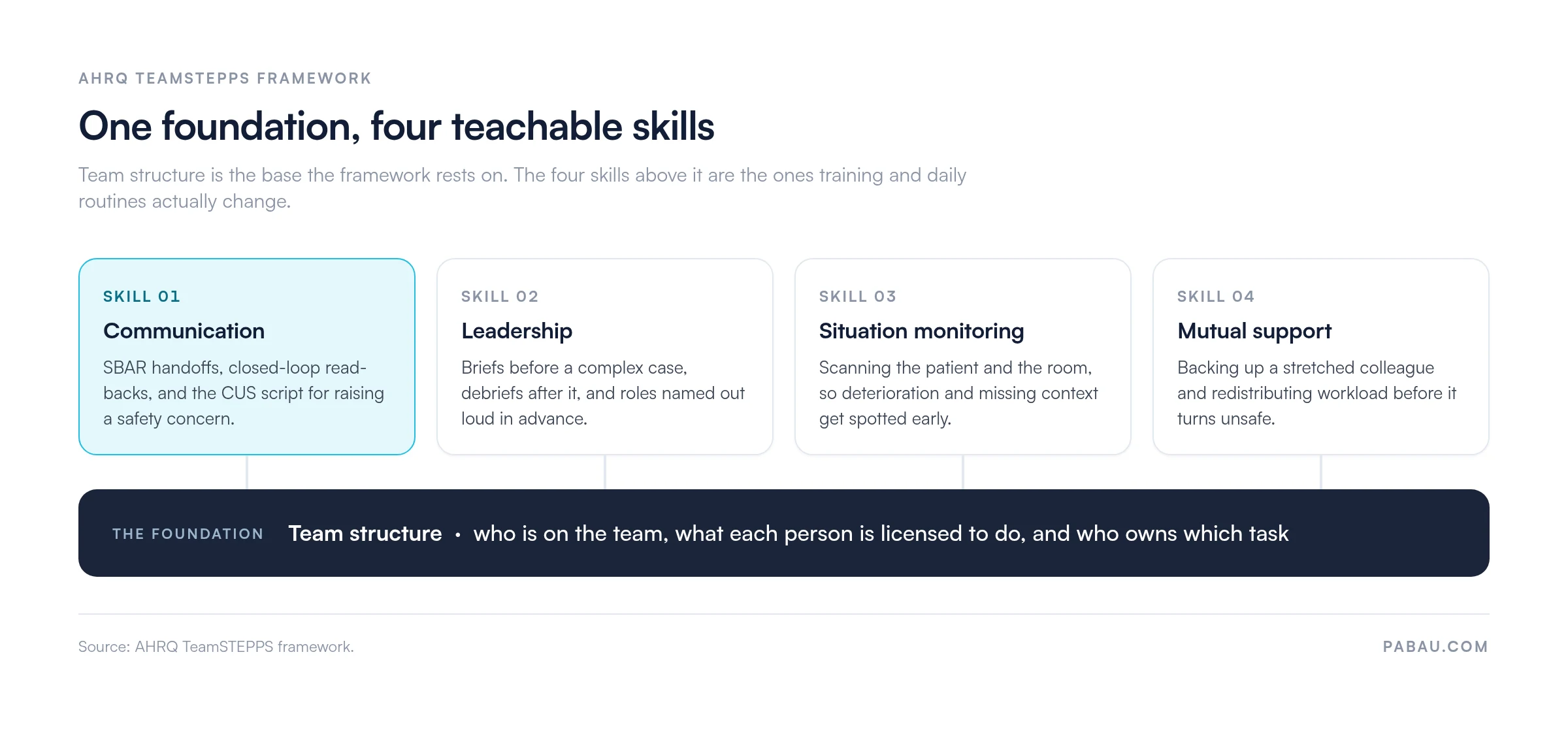
The framework is built for implementation at the unit or department level, not as a one-time training event. Practices that hold on to their TeamSTEPPS gains embed its language into daily work through huddles, briefings, and debrief routines.
The most common barriers are hierarchical culture, unclear role boundaries, understaffing, technology friction, and the absence of a debrief routine. Knowing what good teamwork looks like will not help while those obstacles hold.
Most examples of poor teamwork in healthcare look mundane rather than dramatic. A patient moves between two practitioners at a shift change, and the second one hears about a new allergy verbally. Nobody writes it down. The allergy surfaces three weeks later, at the next appointment, when the patient repeats it.
Each barrier has a matching fix. Hierarchical culture needs leadership behavior to change. Role ambiguity needs explicit briefing structures. Technology friction needs systems that support clinical workflows instead of interrupting them.
Five recurring routines carry most of the improvement: daily huddles, SBAR handoffs, open feedback, unit-level TeamSTEPPS, and post-event debriefs. Each one is a habit rather than a training event.
Run your first TeamSTEPPS huddle before your highest-volume session of the week. Ask three questions. What do we know about each patient today? What are the risks? Who is responsible for what? That 10-minute conversation, repeated daily, does more for team coordination than any annual training day.
Measure teamwork with three sets of data: patient outcomes, staff experience, and process metrics such as handoff accuracy. Without a baseline, nobody can tell whether a teamwork intervention moved the numbers.
Patient feedback adds the view from the other side of the appointment. A patient who got conflicting advice from two clinicians in one visit will say so, if you ask. Asking systematically is what catches those moments before they turn into complaints.
The coordination layer is where a task gets assigned, seen, and tracked, and it decides whether a teamwork routine survives a busy day. Every framework above assumes that layer exists.
TeamSTEPPS, SBAR, and huddles tell a team how to coordinate. None of them say where the coordination gets recorded. Team-based care breaks at that point far more often than it breaks on goodwill.
In practices we onboard, the tasks that go missing are almost never the clinical ones. They are the follow-up call, the recall, the results chase, and the form nobody logged as sent.
Take one post-treatment follow-up call and run it down both paths. The diagram below shows what changes at each of the four steps.
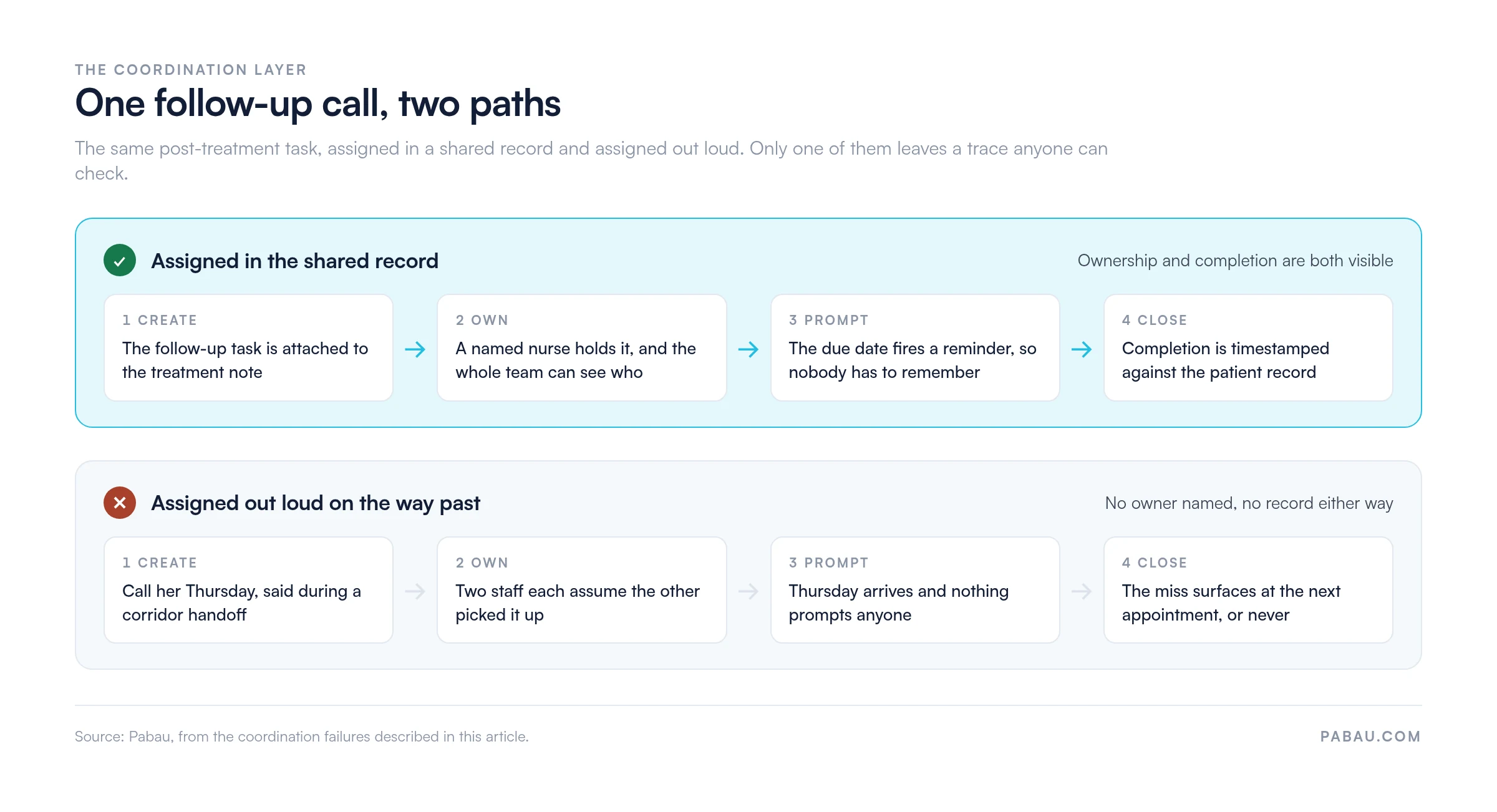
Both nurses meant to make the call, so effort is not what separates the two paths. Only one version of the task can be checked afterward, and only one prompts someone before the patient notices.
Practice management software like Pabau holds the coordination layer, replacing verbal handoffs and paper trails with a shared record, assigned tasks, and tracked completion.
When every team member sees the same patient record, the same day’s schedule, and the same task list, the information asymmetry behind coordination failures shrinks. Pabau GO, our iOS app, is the practice management app clinicians carry between rooms. A schedule change reaches them there, without a walk back to reception.
Pabau’s team management tools show who is doing what, in which room, and for which patient. That visibility lets a practice manager move work around before a stretched schedule turns into a safety risk. Digital intake forms put what a patient submits before the appointment in front of everyone who needs it.
Automated workflows trigger follow-up tasks, recall reminders, and post-treatment instructions without depending on anyone’s memory. Work assigned in Pabau is timestamped and trackable. A timestamp removes the most common excuse for a dropped task, which is that nobody knew it was theirs.
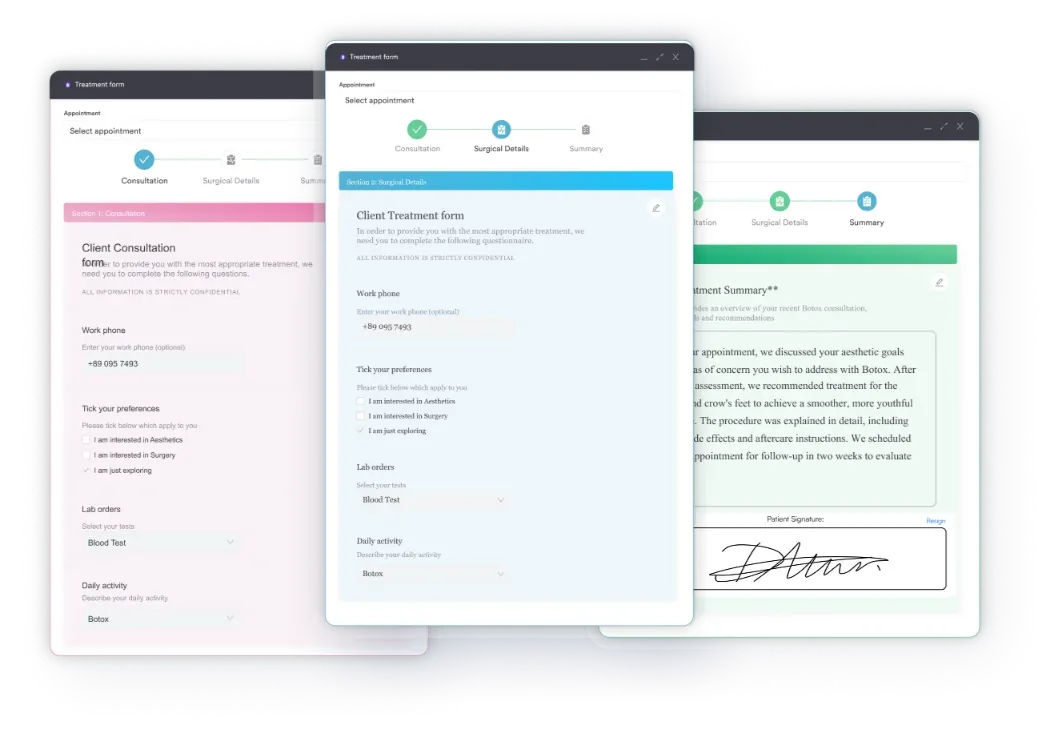
For multi-location practices the coordination problem is sharper. Centralized records that any authorized team member can open, from any site, make distributed teamwork workable rather than aspirational. Every Pabau subscription includes those tools, so a two-room practice gets the same coordination layer as a 10-site group.

Pabau gives your team shared access to patient records, digital forms, and automated workflows. Coordination happens in the system instead of in corridor conversations.

The evidence on teamwork in healthcare all points one way. Well-coordinated teams produce better patient outcomes, fewer adverse events, and lower rates of clinician burnout. Closing the distance between knowing that and doing it consistently takes structure.
Pick one routine and start there. A daily huddle or a standard SBAR handoff will change more in 90 days than a training day nobody repeats. Measure a baseline first, or you’ll have no way to tell whether it worked.
Then give that routine somewhere to live. A huddle decision that never reaches the coordination layer is a decision the next shift can’t see.
The trade-off worth remembering is that every routine costs time on a busy day, which is exactly when it earns its keep. Book a demo to see how Pabau keeps your team’s records, tasks, and handoffs in one place.

Want a practical framework for reducing clinician burnout? Burnout in healthcare covers the systemic causes and the interventions practice leaders can apply.
Tired of coordination happening in corridor conversations? Staff messaging platform for practice management explains how in-system messaging keeps updates attached to the patient record.
Need your huddles and debriefs to leave a record? Meeting notes template gives you a structure for capturing decisions, owners, and follow-up actions.
Teamwork in healthcare is the coordinated effort of clinicians and staff in different roles, including physicians, nurses, pharmacists, and allied health professionals. They work toward shared patient goals through structured communication, defined responsibilities, and mutual support.
Teamwork in healthcare reduces medical errors, prevents adverse events caused by communication failures, and improves patient outcomes across clinical specialties. Teamwork also reduces clinician burnout by distributing cognitive load and creating mutual accountability.
Patients in well-coordinated care teams get fewer diagnostic errors, more consistent treatment plans, and better information at handoffs. Research links effective teamwork to lower adverse event rates and fewer preventable readmissions.
TeamSTEPPS is an evidence-based framework developed by AHRQ and the US Department of Defense. Team structure is its foundation. The four teachable skills built on it are communication, leadership, situation monitoring, and mutual support. Each comes with practical tools such as SBAR, CUS, and briefing routines.
The most common barriers are hierarchical culture that suppresses open communication, unclear role boundaries, and understaffing. Technology that fragments information rather than sharing it and the absence of debrief routines also hold teams back.
SBAR stands for situation, background, assessment, and recommendation. SBAR is a structured communication tool that gives any team member a reliable framework for handoffs, escalations, and patient updates. The fixed order reduces the information loss common in unstructured verbal communication.
The clearest everyday examples of teamwork in healthcare are the pre-procedure huddle and the SBAR handoff. In a huddle, the team names the patient, the risks, and who owns which task before the case starts. An SBAR handoff passes situation, background, assessment, and recommendation to the next clinician in a fixed order.
Teamwork carries three well-documented downsides: diffusion of responsibility, groupthink, and slower decisions under hierarchy or time pressure. Structured tools counteract each one. Named task ownership fixes responsibility, the CUS technique gives dissent a script, and SBAR keeps escalation fast.