Journal prompts for mental health
Journal prompts for mental health are guided questions that help people process ...

2
Last Updated: Oct 13, 2026

Reframing is a CBT technique that helps a client replace an unhelpful automatic thought with a more balanced alternative.
This downloadable worksheet is deliberately simple. It pairs each initial negative thought with the reframed version the client writes underneath.
The two-page PDF holds up to seven thought pairs, a name and date header, and one open notes box.
There is no rating scale and no evidence column, so the questioning that produces a reframe happens in conversation with you.
Practice management software like Pabau lets you send the same pairs as a digital form and file responses in the client record.
A two-page printable worksheet that pairs seven initial negative thoughts with the reframed version of each. There is also a header for the client, clinician, and date, plus an open notes box.
Download templateNegative thinking patterns sit underneath a lot of anxiety, depression, and low self-esteem. A reframing negative thoughts worksheet gives a client one place to write the thought and the replacement they land on.
This worksheet keeps the format deliberately tight. Seven initial thoughts, seven reframes, one notes box, and nothing else to fill in. So the value comes from the conversation you run around it rather than the columns on the page.
Here’s exactly what the PDF contains, how to work a thought pair, and how to file the finished sheet in the client’s record.
Reframing is a core cognitive behavioral therapy (CBT) technique. It helps a person question an unhelpful thought and replace it with a more balanced one. A client arrives with “I’m a complete failure because I made one mistake.” Reframing asks what the evidence is, and what a fairer reading of that day would be.
The technique itself has a familiar shape. You catch the automatic thought and test it against what happened. Then you name the thinking error behind it and land on an alternative the client can believe. Most of that work is talk, and it leaves no paper trail unless you capture it.
The worksheet records the two ends of that process: the thought the client arrived with, and the reframe they left with. Keeping the form to those two lines means clients rarely abandon it halfway, which matters for homework completion.
The download is a two-page PDF with three parts. A short header, seven matched pairs of write-in boxes, and one open notes box at the end.
There is no rating scale, no evidence-for and evidence-against column, and no field for labeling the distortion. If you want those, they belong in your progress note or in the additional notes box.
The PDF is a print-and-write form rather than a fillable one, so clients need a pen or a digital version. Practice management software like Pabau can carry the same pair structure as a digital intake form, which drops the answers straight into the client record.
Fill the header, then work one pair at a time. The worksheet holds up to seven pairs, but a first session rarely needs more than one or two.
For group work, project a blank sheet and fill one pair together before members write their own. Because there are no scales or columns to explain, most groups start writing within a couple of minutes.
A cognitive distortion is a thinking error, a habitual way of reading a situation that amplifies negative emotion. Naming the distortion is what moves a client from the first box to the second, so it is worth having the common ones to hand.
The National Institute of Mental Health (NIMH) ties distorted thinking to the way anxiety and depression keep going. This worksheet has no field for the distortion label, so write it in the notes box or your session note. A thinking traps worksheet gives clients a dedicated place to practice spotting them.
These three examples show what a finished pair looks like. The first and last columns are what the client writes on the worksheet. The middle column is your clinical read, and it stays in the notes box or the session note.
Read the two thought columns together and the shift is obvious. What the sheet cannot show is the questioning that produced it, so capture that separately. Pabau Scribe, our AI scribe, drafts the session note while you talk, and it stores alongside the client’s clinical record.
A two-field worksheet earns its place through how it is introduced. The Beck Institute teaches a simple order for written CBT exercises. Complete one collaboratively in session first, then assign the rest as homework.
Therapists can hand out the printed PDF or send the digital equivalent through mental health EMR software. Clients then complete pairs at home, and the answers arrive already attached to the right chart.
Clinicians reasonably ask when a simple reframing sheet beats a full thought record. The answer turns on how much structure the client still needs. This table compares the four tools most often used alongside each other.
Start with a thought record when a client cannot yet name their own thoughts. Move to this reframing sheet once they can, because its blank pairs assume the noticing is already handled.
When the presenting problem is behavior rather than thought content, a functional behavior assessment maps the antecedents first. And where challenging a thought only feeds rumination, a guided imagery script makes safer homework.
A completed sheet carries the client’s name, your name, and a date, which makes it part of the clinical record. Treat it the way you treat any other clinical document.
Paper sheets create the usual problem. They get scanned late, filed under the wrong date, or left in a folder nobody can find when a colleague covers for you.
Most practices send this worksheet home as a printout and hope it comes back. The sheet then has to be scanned, renamed, and attached to the right client before anyone can compare it with last month’s.
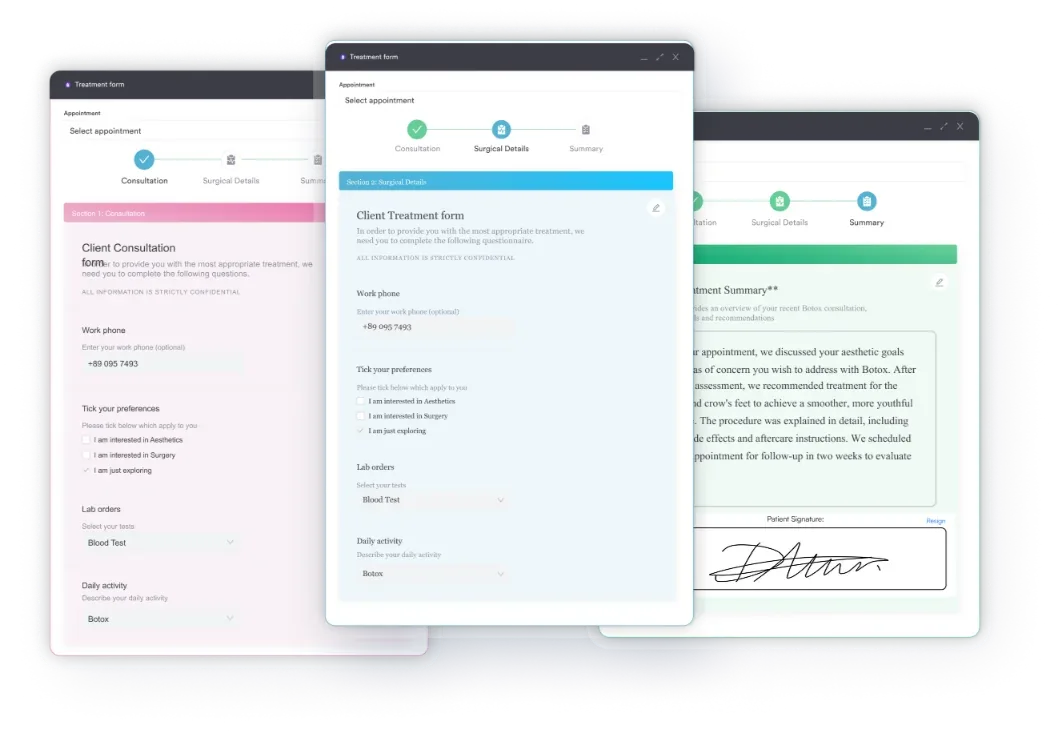
With Pabau’s psychology practice software, you rebuild the same seven pairs once as a digital form. Clients open it in the patient portal, type their thought and their reframe, and submit. The response lands in the chart already dated and attributed, so nothing waits on a scanner.
Because every submission sits in the same client record, you can open three months of pairs side by side before a session. That turns a stack of loose worksheets into a record you can review with the client in front of you.

Pabau’s digital forms and patient portal let therapists deliver reframing worksheets between sessions, then store every completed pair in the client record for review.

This worksheet won’t do the therapy for you. It gives the client two boxes and expects you to supply the questioning that gets them from the first to the second.
That is the trade worth remembering. A minimal form gets completed far more often than a seven-column thought record, but it records only the outcome. Your note has to carry the reasoning, the distortion, and the distress ratings, or that detail is gone by the next appointment.
Print it, use pair one in your next session, and decide from there whether a digital version would serve your caseload better. Book a demo to see how Pabau delivers worksheets and keeps every completed one in the client’s record.

Need a lighter starting point for a client who cannot name their thoughts yet? The thought record worksheet builds the noticing habit this sheet assumes is already in place.
Working out what sets the thought off in the first place? The identifying triggers worksheet maps the internal and external cues behind a recurring negative thought.
Want the values side of the work as well as the cognitive side? The ACT bullseye worksheet gives clients a way to check how closely their actions match what matters to them.
Running reframing exercises with a group? group therapy informed consent explains what to include, covering confidentiality limits, group rules, and client boundaries.
Assessing behavior in children or adolescents? Aberrant Behavior Checklist template screens emotional and developmental concerns in children and adolescents aged 6 to 18.
Reframing is a CBT technique where a client questions an unhelpful thought and replaces it with a more balanced one. Changing the thought lowers the emotional charge attached to it.
The PDF has a header for name, mental health professional, and date, then seven pairs of boxes labeled initial negative thought and reframed thought. Page two ends with an additional notes box. There is no rating scale and no evidence column.
There is no set timeline. Many clients report that change is gradual and builds over several weeks of consistent practice, alongside the rest of therapy. Deeper change takes months, as reframing becomes something they do without the sheet.
Yes, though this one is thin on its own. The form has no prompts between the two boxes. A client working alone tends to jump to a slogan rather than a reframe they believe. Pair it with periodic check-ins.
Use the additional notes box on page two, or your progress note. Naming the distortion is clinically useful, so capture it somewhere even though the form leaves it out.
Use a thought record first to build awareness of thoughts and emotions over time. Move to this reframing sheet once the client can identify a thought unaided and is ready to challenge it.