Antipsychotic medication list
An antipsychotic medication list is a structured reference that organizes psychi...

2
Last Updated: Oct 13, 2026

A guided imagery script is a set of prompts you read aloud to walk a patient through relaxation, visualization, and grounding.
Induction, visualization journey, and grounding return are the three parts, and together they run about 8 to 15 minutes.
Pacing, tone, and room setup decide whether the script lands, and pediatric or trauma-informed delivery needs extra screening first.
Screen for psychosis, dissociation, and untreated trauma before you start, because guided imagery is contraindicated in all three.
Recording each session in your practice management system keeps care continuous, supports billing, and makes progress measurable.
The PDF carries the full script to read aloud, with pacing and tone cues marked for each of the three parts. Separate variants cover anxiety, sleep onset, chronic pain, children, and CBT sessions.
Download templateA guided imagery script is a set of prompts a clinician reads aloud to lead a patient through a calming visualization. It works as an adjunct in therapy, medical, and wellness settings, and it takes 8 to 15 minutes to deliver.
This template gives you the script itself, plus the facilitator notes that decide how well it lands. Pacing, tone, contraindication screening, and the variants for anxiety, sleep, pain, children, and CBT are all covered.
Below you’ll find the three-part structure with timings, the evidence behind it, and the safety screening to do first. There’s also a documentation template for recording each session in your practice management system.
A guided imagery script is a written sequence of prompts that guides a patient into deep relaxation through mental pictures. It moves attention through sights, sounds, and sensations, which triggers the relaxation response and lowers heart rate and muscle tension.
Clinical psychology research links guided imagery to parasympathetic activation, the body’s rest-and-digest state. That makes it useful across anxiety management, insomnia, chronic pain, PTSD recovery, and pre-operative stress in hospitals.
The advantage over a recorded meditation is that you can adjust the script to the patient in front of you. A therapist treating health anxiety might build the imagery around body sensations and safety. A pain specialist might focus on turning the sensation of pain down.
Every guided imagery session follows the same three parts: induction, visualization journey, and grounding return. The order matters, because a patient who is pulled out of a deep visualization too fast can feel disoriented.
The induction prepares body and mind for the visualization. Use a calm, even voice at 40 to 60 words per minute, slower than ordinary speech. Open with body awareness and progressive relaxation.
“Notice your feet resting on the ground. Feel the support beneath you. As you breathe in through your nose, feel your belly expand.”
Guide attention through the major muscle groups, from shoulders to legs, inviting a release of tension on each exhale. Repeat the grounding cues as you go: “You are safe. You are here. You are supported.”
Once the patient is relaxed, guide them through a vivid multi-sensory journey. A forest walk, a beach, or a healing sanctuary all work well. Engage every sense you can.
“Notice the soft light filtering through the trees. Hear the leaves rustling. Feel the warm breeze on your skin. Smell the fresh earth after rain.”
The journey should stay safe and restorative, with no sudden shifts or unexpected content. Leave natural pauses, because silence lets the patient deepen their own imagery. For anxiety work, add mastery cues. For pain, use imagery of warmth reaching the sore area.
Bring the patient back to full awareness gently, counting from one to five. Each number adds a little more alertness.
“One, feeling the chair beneath you. Two, noticing the sounds around you. Three, deepening your breath. Four, wiggling your fingers and toes. Five, opening your eyes when you’re ready.”
Allow 30 seconds for the patient to reorient, then check in with a simple question. Record the session and anything you observed in the client record while it is fresh.
Here is the whole arc at a glance, with the timings to plan a session around.
One script covers five common uses, as long as you change the imagery and the length. Pick the variant that matches the presenting problem.
Guided imagery fits any setting where relaxation, anxiety reduction, or pain relief supports the treatment plan. The delivery is the same in a psychology practice as it is on a hospital ward, though the documentation differs.
The benefits split into two groups. There is what the patient gets in the room, and what your practice gets from having it documented.
Guided imagery works as a clinical adjunct rather than a standalone treatment, and peer-reviewed research supports that role. The American Psychological Association recognizes it as an evidence-based relaxation technique.
Safety note: guided imagery is contraindicated in active psychosis, untreated dissociative disorders, and complex PTSD without specialist trauma training. Screen for trauma history before the first session.
Guided imagery is a billable clinical service, so it needs a note like any other intervention. Recording it creates continuity for the next clinician, supports treatment planning, and gives you an audit trail for claims.
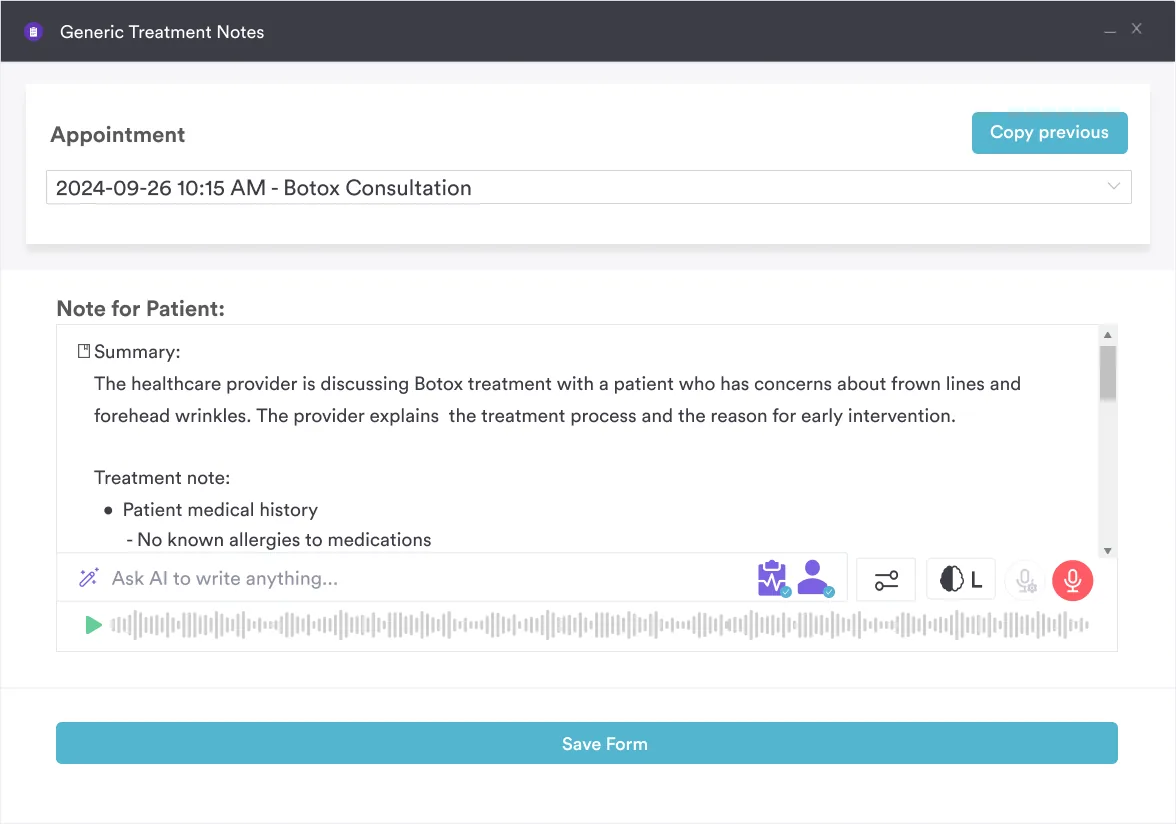
Practice management software like Pabau stores the note against the appointment it belongs to. An AI medical scribe can draft it from what you said in the room. A mental health EMR then keeps it in the fields therapy notes actually need.
Session date and duration: Record the date and the total length, for example a 10-minute session for sleep-onset anxiety.
Indication: Note why you delivered it, such as elevated anxiety around sleep onset within a CBT protocol.
Script variant used: Record which variant you chose and any changes you made, such as beach imagery at the patient’s request.
Patient response: Write what you saw and what the patient reported. Slower breathing, less muscle tension, and an anxiety rating falling from 7/10 to 4/10 all belong here.
Plan: Note the next step, such as a recording to practice at home and a sleep review in two weeks.
Building this as a reusable form in your digital forms tool standardizes what everyone records. Progress then reads as a trend rather than a pile of free text.
Free-text notes are the usual home for a guided imagery session, and sometimes it goes unrecorded. Nothing in the record then shows which variant you used or how the patient responded. That makes the work hard to bill and harder to evaluate.
Pabau puts the session note in the same client file as the appointment, the consent, and the intake form. Pabau Scribe drafts the note from the session, so you are not typing it up later.
A custom form turns the documentation template above into fixed fields, and automated reminders nudge patients to practice the recording at home. Because every subscription includes every feature, none of that sits behind a higher tier.

Pabau files each guided imagery note against the client record, sends the follow-up reminder, and reports the outcome scores you collect. Your team stops rebuilding the same note in free text.

The script is the easy part. What decides whether guided imagery earns its place in your treatment plan is the screening before it and the note after it.
Start with one variant and one patient group. Deliver it the same way each time, record the response, and you will know within a handful of sessions whether it helps.
The trade-off worth remembering is time. Eight to 15 minutes spent on imagery is time not spent on something else, so let the record justify the choice. Book a demo to see how Pabau keeps session notes, follow-ups, and outcome tracking in one place.

Client who cannot bring themselves to ask for support? asking for help worksheet maps barriers, support networks, and practical steps toward asking for support.
Measuring whether therapy is working? Social Connectedness Scale gives you a scored outcome measure to sit beside session notes.
Working with an anxious child? Functional behavior assessment maps the triggers before you choose which relaxation work to try.
Curious how conditioning explains relaxation? Classical conditioning worksheet shows patients why a cue and a calm state get linked.
Need a calming exercise to send home? breathing exercises handout covers five techniques for stress, anxiety, COPD, and general wellness.
A guided imagery script is a structured set of verbal prompts a clinician reads aloud to guide a relaxation and visualization experience. It has three parts: relaxation induction, a visualization journey, and a grounding return.
A full session runs 8 to 15 minutes. That covers 2 to 3 minutes of induction, 5 to 10 minutes of visualization, and 1 to 2 minutes of grounding. A 5-minute version works for anxiety in the moment, and sleep or pain work can run to 20 minutes.
Yes. It works from around age 5, particularly for anxiety, behavioral challenges, and emotional regulation. Use shorter sessions of 5 to 10 minutes, simpler language, and imagery the child already likes. Get parental consent first.
Yes, as an adjunct. The American Psychological Association recognizes guided imagery as an evidence-based relaxation technique, and trials support its use for anxiety, chronic pain, and insomnia. It is not a standalone treatment.
It is contraindicated in active psychosis, untreated dissociative disorders, and complex PTSD without specialist trauma training. Screen every patient for trauma history and psychiatric stability first. Patients who dissociate need a trauma-informed variant with strong grounding cues.
Record the date, duration, indication, script variant, patient response, and next steps in your clinical documentation system. A standardized template keeps it consistent. Guided imagery is billable as a clinical intervention when the note shows the rationale and the response.