A pressure ulcer nursing care plan is a structured document that turns a patient’s risk score into a written plan of care. It records the NANDA-I nursing diagnosis, short- and long-term goals, the interventions you will run, and how you will evaluate them. The template below gives you all five sections, ready to fill in for one patient.
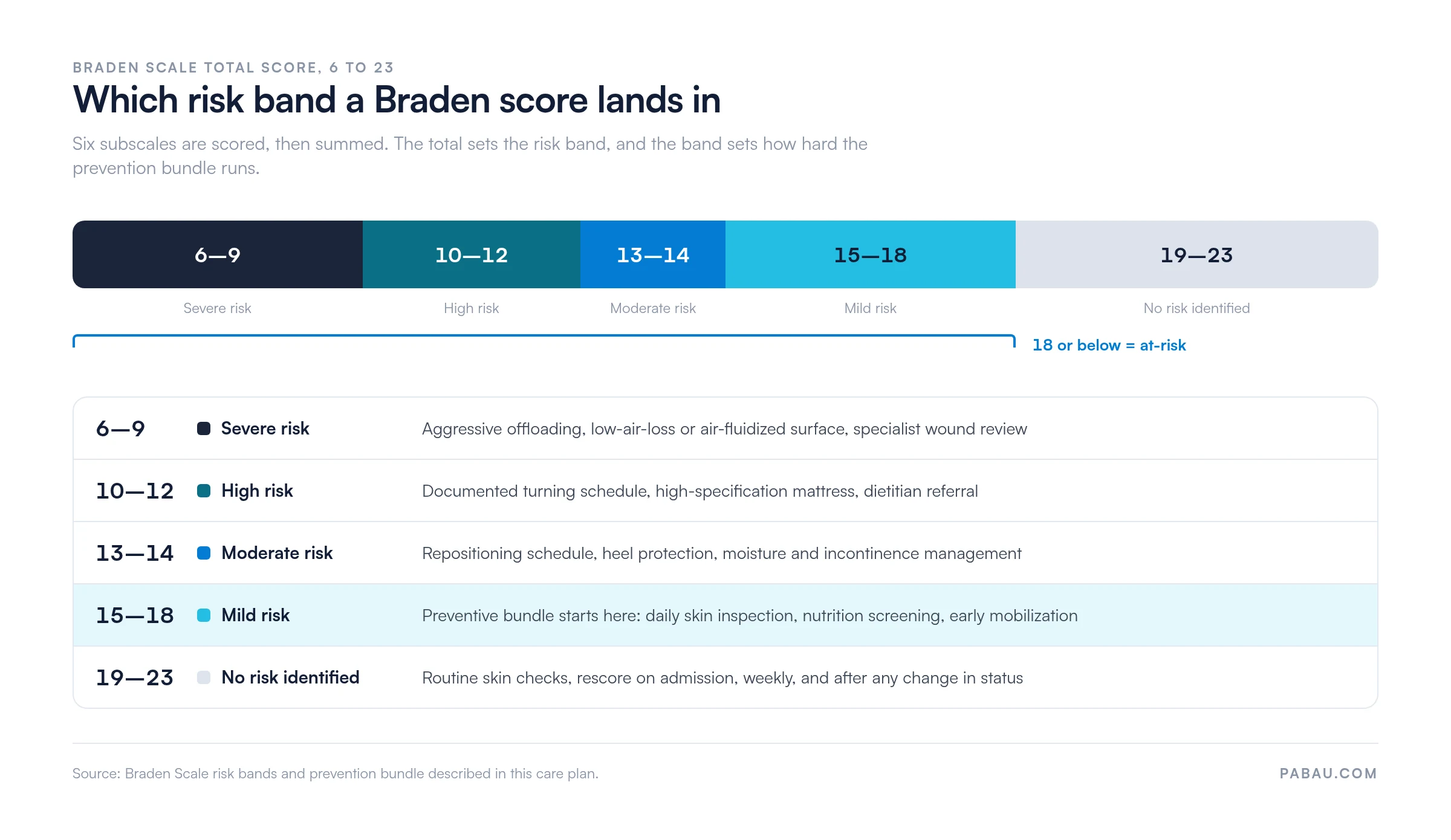
Start with the Braden Scale. A total of 18 or below flags the patient as at-risk and starts the prevention bundle. The band that score falls in sets how hard the bundle runs. If an ulcer is already there, the diagnosis becomes Impaired Skin Integrity and the plan shifts to wound healing.
Found our content helpful?
Key takeaways
A pressure ulcer nursing care plan turns the Braden Scale score into a written diagnosis, goals, interventions, and evaluation criteria.
A Braden total of 18 or below flags an at-risk patient, and the band that score falls in sets the intensity of prevention.
Impaired Skin Integrity is the diagnosis when an ulcer exists, and Risk for Impaired Skin Integrity covers at-risk patients without one.
Every intervention needs a written rationale, because that is what a quality review reads when it checks the plan.
Practice management software like Pabau keeps the risk score, the care plan, and every progress note in one client record.
Download your free pressure ulcer nursing care plan
A ready-to-use care plan covering patient assessment, Braden Scale scoring, NANDA nursing diagnoses, and short- and long-term goals. It also has space for evidence-based interventions with rationale, plus the evaluation criteria you will measure against.
A pressure ulcer nursing care plan translates NANDA-I nursing diagnoses, assessment data, and clinical evidence into a documented plan of care. It serves four critical functions: Identifying at-risk patients, documenting the nursing diagnosis, setting measurable goals, and specifying interventions with a rationale.
The term “pressure ulcer” describes tissue damage caused by prolonged pressure, friction, or shear. Synonyms include pressure injury, the term the National Pressure Injury Advisory Panel (NPIAP) adopted in 2016, plus decubitus ulcer and bedsore. The stage you document matters for reimbursement as well as for care. CMS treats stage III and stage IV hospital-acquired pressure injuries as non-reimbursable hospital-acquired conditions, which affects Medicare payment.
Pressure ulcer stages and classification
The NPIAP updated its staging system in 2016 to six categories. Which stage you document shapes the nursing diagnosis, the intensity of intervention, and the outcomes you can reasonably expect.
Stage
Clinical characteristics
Nursing focus
Stage I
Intact skin with non-blanchable redness. It can look different on darkly pigmented skin. The area may be painful, firm, soft, warmer, or cooler than the skin around it.
Prevent progression. Inspect the skin often, offload the area, and manage moisture.
Stage II
Partial thickness skin loss with exposed dermis. It presents as a shallow open ulcer, or as an intact or ruptured serum-filled blister. The wound bed is pink or red, moist, and painless.
Cleanse the wound gently. Use moisture-retentive dressings, manage pain, and watch for infection.
Stage III
Full thickness skin loss. Subcutaneous fat may be visible and undermining or tunneling is possible. Bone and muscle are not exposed.
Assess for debridement. Move to advanced dressing protocols, add nutritional support, and track wound measurements.
Stage IV
Full thickness tissue loss with exposed bone, cartilage, muscle, or tendon. Undermining, tunneling, and sinus tracts are common.
Get a specialist wound consultation. Use complex dressing protocols, prevent sepsis, and consider a surgical consult.
Unstageable
Full thickness tissue loss obscured by slough or eschar. The stage cannot be determined until the necrotic tissue is debrided.
Plan conservative debridement. Control infection, document eschar color and consistency, and reassess in series.
Deep tissue pressure injury (DTPI)
Intact or non-intact skin over an area of persistent, non-blanchable deep red, maroon, or purple discoloration. It can develop into a rapidly expanding ulcer.
Offload aggressively. Reassess often, manage pain, and escalate fast if the skin breaks.
Stage IV is the one to escalate on. Once bone is exposed, the ulcer can seed a bone infection, and the plan of care changes with it. Our osteomyelitis nursing care plan covers the diagnoses and interventions that follow.
Nursing assessment: Scoring risk with the Braden Scale
Risk stratification is the foundation of the whole plan. The Braden Scale is the gold-standard tool here, validated across hospital and long-term care settings. It scores six subscales from 1 to 4, or 1 to 3 for friction and shear, giving a total between 6 and 23.
Sensory perception: The patient’s ability to respond to pressure-related discomfort (score 1 to 4)
Moisture: How much the skin is exposed to moisture from perspiration, urine, or drainage (score 1 to 4)
Activity: Degree of physical activity, from bedfast through chairfast to ambulating (score 1 to 4)
Mobility: Ability to reposition independently, whether completely, somewhat, or not limited (score 1 to 4)
Nutrition: Usual food intake pattern, from adequate through probably inadequate to very limited (score 1 to 4)
Friction and shear: Exposure to friction and shear forces during repositioning and transfers (score 1 to 3)
The total also sorts patients into five bands, and each band calls for a different intensity of prevention. A total of 15 to 18 is mild risk, and 13 to 14 is moderate. A score of 10 to 12 is high risk, and 9 or below is severe. A total of 19 to 23 means no risk identified on this admission.
A score of 18 sits in the mild-risk band, and the prevention bundle still starts there. The bands come from the risk thresholds described in this care plan.
Lower scores on any subscale mean higher risk, so read the subscales and not just the total. Score the scale on admission, weekly, and whenever the patient’s status changes.
NANDA nursing diagnoses for pressure ulcers
The NANDA-I taxonomy gives you the diagnostic language for the plan. Choose the diagnosis from your patient’s Braden score, their current skin integrity, and the clinical picture in front of you.
Impaired Skin Integrity (00046): The primary diagnosis when a pressure ulcer already exists. Use it when partial- or full-thickness skin loss is documented.
Risk for Impaired Skin Integrity (00047): Use this when the Braden score shows at-risk status but no ulcer has formed. It drives the preventive interventions.
Impaired Tissue Integrity (00044): Use this when the ulcer extends into subcutaneous tissue or deeper structures.
Acute Pain (00132) or Chronic Pain (00133): Use one of these when the patient reports pain at the ulcer site or during wound care.
Risk for Infection (00004): Applies to stage III and stage IV ulcers, or to any wound that could be colonized by bacteria.
Link every diagnosis to specific assessment data: The Braden subscale scores and what the skin inspection found. That evidence trail is what a quality review follows when it checks whether the plan was justified.
Impaired skin integrity: A worked example
Here is the same structure filled in for one patient. The diagnosis is Impaired Skin Integrity related to prolonged pressure, evidenced by a stage II ulcer on the sacrum measuring 3cm by 2cm.
Care plan element
Clinical example
Nursing diagnosis statement
Impaired Skin Integrity r/t prolonged pressure AEB stage II pressure ulcer, sacrum, 3cm x 2cm, serum-filled, with non-blanching erythema surrounding it
Short-term goal (48 to 72 hrs)
Ulcer will not progress beyond stage II. Surrounding erythema will not extend more than 1cm. Pain will stay at or below 3/10 during wound care.
Long-term goal (2 to 4 wks)
Ulcer will show a 10% size reduction. Granulation tissue will appear. Patient will verbalize an understanding of prevention strategies.
Nursing intervention with rationale
Reposition every 2 hours on a turning schedule recorded in the plan. Rationale: Reduces sustained pressure on bony prominences and improves tissue perfusion. Individualize the frequency to skin tolerance and support surface, per NPIAP 2019 guidelines.
Evaluation criteria
Ulcer measurements stable or improving. No new pressure ulcers developing. Patient reports pain relief. Wound culture negative where infection is suspected.
Store the completed plan in digital clinical records rather than a loose printout. Then it stays in the patient chart, where the next shift can find it.
Pabau’s client record holds the care plan next to a timeline of scheduled tasks, so the next dressing change is never guesswork.
Nursing goals and expected outcomes
Measurable goals anchor the plan to something you can observe. Short-term goals cover 48 to 72 hours and focus on preventing progression and controlling pain. Long-term goals cover 2 to 4 weeks and center on healing and patient education.
The patient’s Braden Scale score will improve by 2 points or more through nutritional support and better mobility.
The existing ulcer will not progress to a higher stage, and no new ulcers will develop.
Pain related to the ulcer will fall to 2/10 or lower within 7 days of starting the dressing protocol.
The wound will show measurable healing within 2 weeks: A 10% size reduction, or granulation tissue appearing.
The patient and their primary caregiver will name two prevention strategies before discharge.
The patient will maintain a protein intake of 1.2 to 1.5g per kilogram per day to support healing.
Write the evaluation line at the same time as the goal, or you will not be able to tell whether it was met. The evaluation nursing care plan shows how to word that step.
Nursing interventions for pressure ulcer management
Interventions are where the plan does its work. The bundle runs repositioning, offloading, wound care, nutrition, and infection prevention at the same time, not one after the other.
Repositioning and turning schedules: Set a documented turning schedule, typically every 2 hours for immobilized patients. Adjust it to skin tolerance and the support surface in use. Use body pillows, foam wedges, or an alternating pressure mattress to take load off the affected area. Record the times you turned the patient, not only the schedule you planned. Structured patient intake forms keep those entries comparable from shift to shift.
Pressure-relieving devices: Deploy high-specification foam mattresses, gel overlays, low-air-loss beds, or other advanced support surfaces. Match the surface to the risk band and to what the facility has available.
Wound cleansing and dressing: Clean the ulcer with sterile normal saline. Select the dressing from the wound type, the exudate level, and the healing phase, whether that is hydrocolloid, foam, alginate, or negative pressure therapy. Reassess the wound at every change.
Nutritional support: Refer to a dietitian and aim for 1.2 to 1.5g of protein per kilogram per day. Add vitamin C, 500 to 1,000mg daily, and zinc where the patient is deficient. Malnutrition delays healing, and the imbalanced nutrition care plan covers that diagnosis in full.
Moisture and incontinence management: Use absorbent pads or briefs and change them promptly after an episode. Urine and stool on the skin speed up breakdown.
Skin inspection and documentation: Inspect the skin daily. Measure and photograph the ulcer with a consistent technique. Record the stage, location, size, color, exudate, odor, and the condition of the surrounding skin.
Pain management: Give analgesia 30 to 60 minutes before wound care where it is needed. Add comfort measures such as positioning, cool compresses, and distraction.
Infection control: Watch for increased warmth, purulent drainage, fever, and foul odor. Obtain a wound culture where you suspect infection, and apply topical antimicrobials per protocol.
Prevention strategies for at-risk patients
Preventing an ulcer costs far less than healing one, in nursing hours and in patient harm. Run the same prevention bundle for every patient the Braden Scale flags as at-risk.
Early mobilization: Encourage movement and weight-bearing as soon as it is medically safe. Bring physical therapy in early to restore activity levels.
Skin inspection protocol: Check the skin visually on admission and daily after that. Pay particular attention to bony prominences: The heels, coccyx, sacrum, hips, elbows, shoulders, and back of the head.
Offloading surfaces: Deploy pressure-reducing surfaces such as foam, gel, or air-fluidized beds for every at-risk patient. Place heel protectors or pillows under the heels and ankles to lift them clear.
Nutrition screening and intervention: Assess nutritional status on admission and refer to a dietitian where risk is present. Confirm the patient is getting enough protein and micronutrients.
Moisture barriers: Apply protective creams or ointments to areas exposed to friction and moisture. Manage incontinence actively to keep urine and stool off the skin.
Staff education and accountability: Train every care team member on prevention. Set peer accountability and a small set of quality metrics the team can actually see.
Family and caregiver teaching: Show patients and families how to reposition, inspect skin, and support nutrition. Tell them exactly which skin changes should bring them to a nurse.
Documenting the prevention bundle matters as much as running it. A facility reporting against CMS quality measures needs a record of turning schedules and completed risk assessments, not just a policy saying they happen.
How to fill out the plan in five steps
The downloadable template is a structured form, ready to adapt to one patient. These five steps take you from a blank form to a plan you can hand over at the end of a shift.
Complete the Braden Scale assessment: Score all six subscales on admission and weekly, then record the total. If the total is 18 or below, flag the patient as at-risk and open the “Risk for Impaired Skin Integrity” plan. If a stage I to IV ulcer is already present, go to step 2.
Perform a detailed wound assessment: Record the stage, the exact anatomical location, and the dimensions in centimeters. Document the wound bed color, the exudate character and amount, and the condition of the surrounding skin. Note any undermining or tunneling, and take reference photographs to your facility’s protocol.
Select the NANDA nursing diagnoses: Choose the primary diagnosis from the Braden score and the wound assessment. Add secondary diagnoses where pain, infection risk, or mobility problems are present. Write each statement using the “r/t” and “AEB” format so it points back at your findings.
Set short- and long-term goals: Write SMART goals that fit the patient’s clinical status and the expected length of stay. Short-term goals usually span 48 to 72 hours. Long-term goals run 2 to 4 weeks, or to discharge.
Implement interventions with a written rationale: Run the bundled interventions from this guide. Record each one in the patient record: The turn times, the dressing changes, the nutritional input, and the skin inspection findings. Note the rationale beside each, and read the plan back at every handover.
Adapt the wording and the intervention frequency to your patient population and your facility’s protocols. Review the plan every 48 to 72 hours, and update the goals and interventions from what the wound is actually doing.
Adapting the plan for elderly and long-term care residents
Elderly and long-term care residents carry compounded risk: Fragile skin, reduced mobility, comorbidities, and declining nutrition, often all at once. Six adjustments make the plan fit this group.
Adjusted Braden thresholds: Use the 18-or-below cutoff for general populations. For patients over 85, or those with multiple comorbidities, consider a cutoff of 16 or below. The lower threshold catches more of the patients at genuine risk.
Skin fragility management: Elderly skin thins and loses elasticity. Avoid aggressive friction during transfers and hygiene, and use gentle, non-adhesive dressings to prevent further trauma.
Comorbidity-specific adjustments: Diabetes, renal failure, and vascular disease all impair healing. Intensify nutritional support and offloading, and coordinate with primary care on glucose and perfusion.
Cognitive impairment considerations: Patients with dementia or delirium may not report pressure discomfort. Increase inspection frequency and rely on what you can see, such as erythema or skin breakdown.
Enhanced nutritional intervention: Poor appetite and swallowing difficulty are common. Work with speech pathology and a dietitian on food consistency, and consider oral supplements or enteral feeding.
Family-centered education: Families often help with repositioning and hygiene in long-term care. Keep the teaching short and concrete, because simple instructions get followed and long ones do not.
How Pabau keeps a care plan current across every shift
On paper, a pressure ulcer care plan goes stale fast. The Braden score sits in one folder, the turning chart on a clipboard by the bed, and the wound photos on somebody’s phone. Nobody can see the whole plan at once.
Practice management software like Pabau puts them in one client record. You build the care plan as a digital form. The risk score, the diagnosis, the goals, and the interventions then sit against the patient.
Before-and-after photos attach to the same record, so wound measurements and images stay together. Reassessments append to the chart rather than replacing it, which means you can see how the ulcer moved over four weeks.
The practical win is at handover. The nurse coming on shift opens the record and reads the current plan, the last turn time, and what the last skin check found. There is no folder to hunt for, and no plan to rebuild from memory.
Keep every care plan current across shifts
Digital forms and one shared client record keep the risk score, the plan, and the wound photos together. Your team reads the current plan at handover instead of rebuilding it.
The care plan earns its keep when it gets specific. A plan naming the Braden score, the ulcer’s measurements, and the chosen turning interval will hold up at handover. One that says “reposition regularly” will not.
Download the template, fill it in against one patient, and see where your own documentation runs thin. The trade-off worth remembering is that prevention costs a turning schedule and a nutrition referral, while a stage IV ulcer costs months.
Book a demo to see how Pabau keeps a care plan, its wound photos, and its progress notes in one client record.
Continue your research
Managing a stroke patient on bed rest?CVA nursing care plan covers the mobility and skin integrity diagnoses that come with hemiplegia.
Worried about clots as well as skin?DVT nursing care plan covers the other risk immobility brings, with its own assessment and interventions.
Need the plan to survive handover?Bedside shift report gives you a structure for passing the current plan to the next nurse.
Documenting wound progress over weeks?Clinical progress notes keep each reassessment in a format you can compare side by side.
Frequently asked questions
What is a pressure ulcer nursing care plan?
A pressure ulcer nursing care plan is a structured document covering patient assessment, the NANDA-I nursing diagnosis, and measurable goals. It also records the evidence-based interventions you will run, each with its rationale, plus the criteria you will evaluate against.
What does a Braden Scale score of 18 mean?
A Braden Scale total of 18 sits in the mild-risk band, so the patient is at-risk and the prevention bundle starts. The bands run 15 to 18 for mild risk and 13 to 14 for moderate. A total of 10 to 12 is high risk, and 9 or below is severe. At-risk patients need repositioning, a pressure-relieving surface, nutritional support, and a skin inspection protocol.
What is the primary NANDA diagnosis for an existing pressure ulcer?
Impaired Skin Integrity (NANDA-I code 00046) is the primary diagnosis when a pressure ulcer already exists. It is written as “Impaired Skin Integrity related to [etiology] as evidenced by [ulcer stage, size, and clinical findings].” Secondary diagnoses may include Impaired Tissue Integrity, Acute Pain, or Risk for Infection, depending on wound depth and symptoms.
How often should patients at risk for pressure ulcers be repositioned?
Individualize the repositioning frequency to the patient’s skin tolerance, the support surface, and the Braden subscale scores. A common guideline is every 2 hours for bedfast immobile patients. Some tolerate longer intervals on a high-specification mattress. NPIAP 2019 guidelines favor clinical judgment over a rigid schedule, adjusted from skin inspection findings and patient comfort.
What protein intake is recommended for pressure ulcer wound healing?
Patients with pressure ulcers typically need 1.2 to 1.5g of protein per kilogram of body weight daily to support healing. The target may be higher for older adults or for those with significant wounds. Ask a registered dietitian to individualize it and to address barriers to intake, such as swallowing difficulty, poor appetite, or cost.
What is the difference between a decubitus ulcer and a pressure injury?
Decubitus ulcer is the historical term for pressure injury. The NPIAP adopted “pressure injury” in 2016 to cover damage from pressure, shear, and friction, not weight-bearing pressure alone. The staging system, the assessment tools, and the interventions are unchanged. Only the terminology moved on.