Obagi Blue Peel Radiance: Consent form and aftercare guide
An Obagi Blue Peel Radiance consent form records that your patient understood a ...

4
Last Updated: Sep 29, 2026
Punch excision is a minor procedure that removes a small cylinder of skin with a circular punch instrument. Practices use it for ice pick scars, small lesions and cysts. Recovery depends heavily on what patients do at home, so every patient should leave with written aftercare instructions.
Our free aftercare template covers wound care, activity restrictions and warning signs. Aftercare delivery software helps your team send it the same way every time.
A patient-facing sheet covering wound care, activity restrictions and the warning signs that mean a call to your practice. Walk patients through it before they leave the treatment room.
Download template
Punch excision removes a small circle of skin with a circular tool.
Ice pick scars are one common indication for punch excision, alongside small lesions and cysts.
Punch excision wounds are often closed with sutures, depending on punch size, so aftercare covers stitches only when they’re placed.
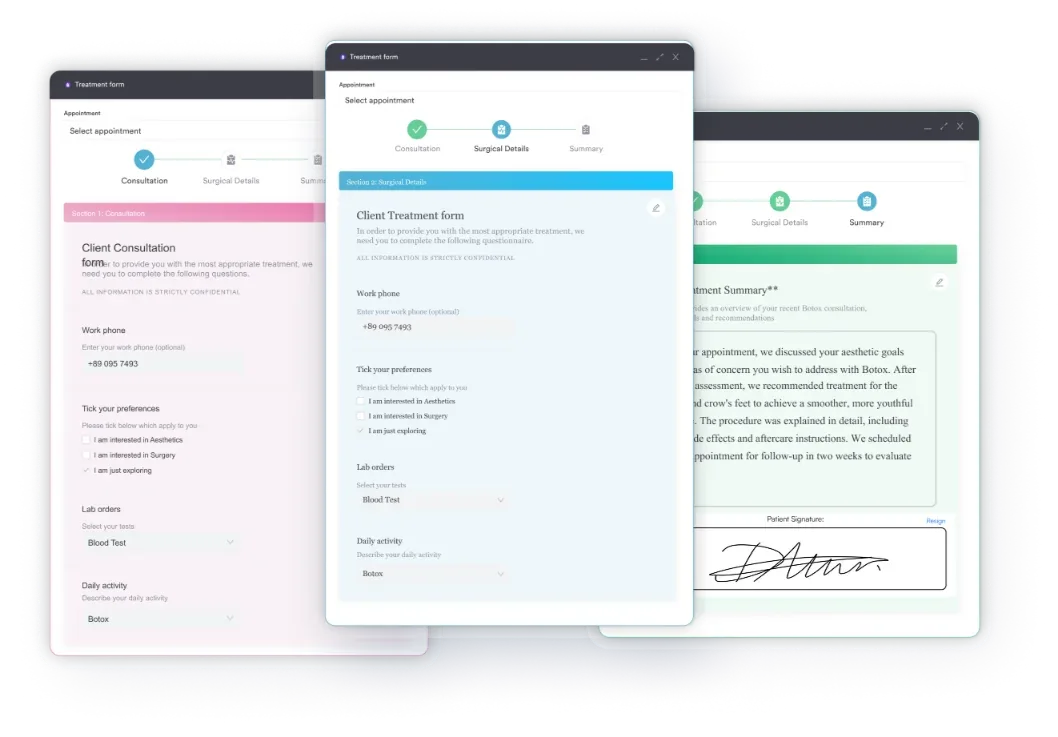
Digital forms let practices send aftercare instructions and record delivery.
Punch excision uses a sterile, circular instrument, often called a dermal punch, to cut a defined circle through the skin. Clinicians use it when a lesion or scar needs tissue removed rather than reshaped. The steps below follow the usual sequence in most practices.
The wound is small, so many practices perform the procedure in a treatment room. Results depend on the lesion, the patient and technique, so set expectations before the procedure rather than after it. Record that conversation on a signed dermatology consent form before you start.
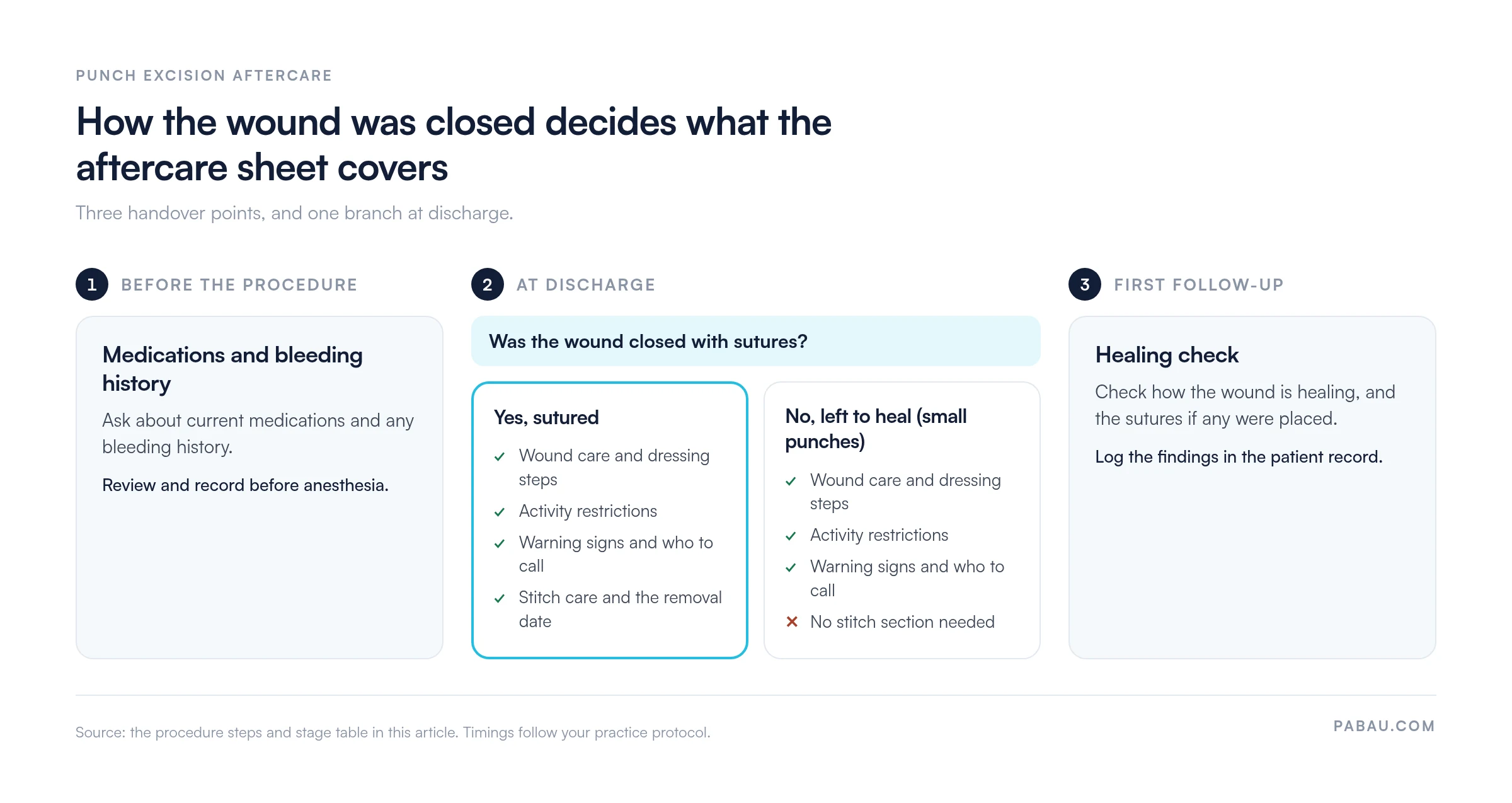
How the wound was closed decides what the aftercare sheet needs to cover. A sutured wound needs a stitch section and a removal date, while a small open wound does not.
The Punch Excision Aftercare Instructions template covers wound care, activity restrictions and warning signs. It is a patient-facing document, so it works best when the clinician walks through it rather than handing it over unread.
Sending the document through digital forms means every patient receives the same version, and you can check what was sent later.
Aftercare starts before the punch touches the skin and ends at the first follow-up. The table below maps what to cover and what to record at each of those three points.
Where the excision removes a cyst rather than a scar, the cyst removal aftercare instructions follow the same three stages for that wound.
Many practices still print the aftercare sheet, or retype the same email after every appointment. Neither leaves a reliable note of which version the patient got, or whether anyone explained it.
Pabau is all-in-one software for aesthetic practices, and its digital forms can send the aftercare sheet straight after the appointment. The patient signs to confirm they received it, and the signed copy is saved to their Client record.
Your team stops chasing paper, and the first follow-up starts with the right notes on screen. If a patient calls about a warning sign, whoever answers can see exactly what they were told.

Pabau’s digital forms send punch excision aftercare to every patient automatically and store the signed copy against their record. Your team keeps one consistent version and a clear trail of what each patient received.

A punch excision takes minutes, but the result is decided over the following days at home. The sheet only works if it matches the wound in front of you, so tailor the stitch section before the patient leaves.
Pick one way to deliver the template, use it for every patient, and record the handover each time. That consistency is what protects the patient and your practice if healing goes wrong. Book a demo to see how Pabau sends aftercare automatically and keeps a signed record of every handover.

Removing a cyst instead? Cyst removal aftercare instructions gives patients a matching sheet for wound care after cyst excision.
Need consent before the punch? Dermatology consent form records risks and expectations before any skin procedure.
Treating acne scarring? Acne treatment consent covers consent for the acne treatments that often come before scar work.
Patients on isotretinoin? Accutane aftercare instructions sets out skin care guidance for patients on isotretinoin.
Offering cryotherapy for lesions? CryoPen treatment template covers consent, protocol and aftercare for another common lesion treatment.
Removal timing depends on the body site and how the wound was closed, so follow your practice protocol. Write the removal date on the aftercare sheet before the patient leaves.
Usually yes, once the window in your protocol has passed. The aftercare sheet should state when the dressing can get wet and how to dry the area.
Most punch excisions leave a small scar, and how it heals varies by patient and site. Set that expectation before the procedure and record it at consent.
Spreading redness, increasing pain, swelling, discharge, bleeding that won’t stop or a fever all need a call. List the signs your protocol uses on the sheet.
Give them one named contact for practice hours and a clear after-hours route. Confirm both verbally and in writing before discharge.