Mental health self-care checklist
A mental health self-care checklist is a structured daily tool for tracking the ...

5
Last Updated: Oct 20, 2026

A personal psychology test measures psychological traits, mental health indicators, and personality characteristics to guide clinical treatment planning.
The Big Five (OCEAN) framework is the most validated model for clinical assessment. Use it to establish baseline personality patterns before intervention.
Clinicians must obtain informed consent, explain test limitations, and document results in the patient record. Tests inform diagnosis but never make it.
Practice management software like Pabau turns test administration, scoring, and documentation into a single digital workflow.
A standardized assessment tool for evaluating personality traits, cognitive characteristics, and psychological wellbeing. Includes scoring guidance and a clinical interpretation framework for mental health practitioners.
Download templateA personal psychology test is a standardized assessment tool that evaluates personality traits, cognitive abilities, emotional functioning, and psychological wellbeing. Clinicians use these tests to gather objective data about a patient’s psychological profile. That data informs diagnosis, treatment planning, and therapeutic interventions.
Unlike casual self-discovery quizzes, clinical psychology tests are grounded in research and validated across diverse populations. They give practitioner and patient a shared language for identifying patterns, strengths, and areas for growth. The results become part of the clinical record and support evidence-based treatment decisions.
According to the American Psychological Association (APA), psychological testing serves several purposes. It supports symptom tracking, differential diagnosis, treatment outcome monitoring, and predicting response to specific interventions. Mental health professionals use these assessments to move beyond intuition into measurable, repeatable evaluation.
The field uses several distinct assessment approaches, each suited to a different clinical question. Understanding the categories helps you match the right tool to the patient’s needs and treatment goals.
Open-ended responses are easier to write up when you have names for the patterns they surface. A reference guide to psychological complexes gives you descriptive labels for case formulation alongside formal diagnosis.
The Big Five, also called the Five Factor Model, is the most empirically validated personality framework in psychological research. A test built on it measures five broad dimensions of personality:
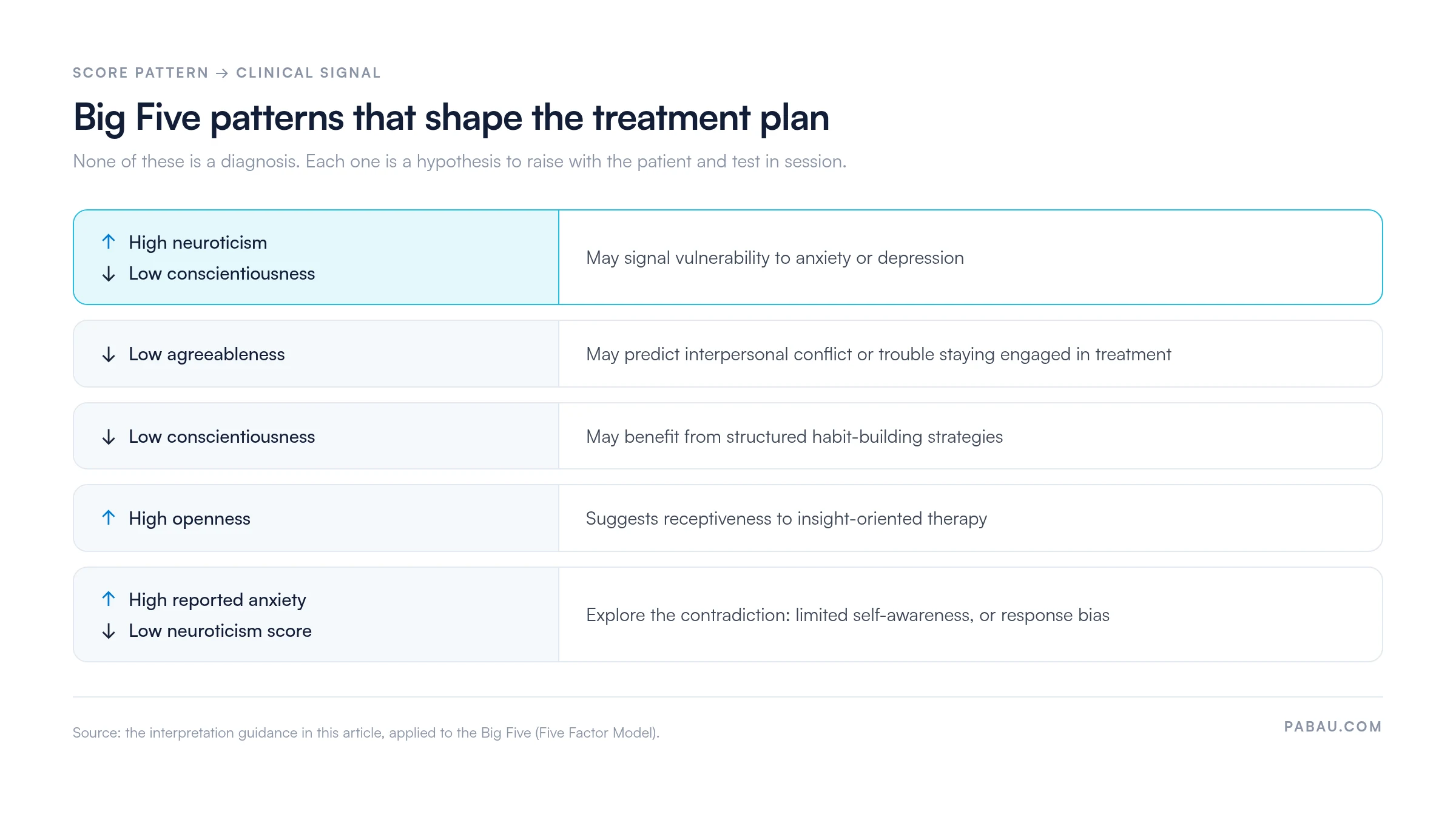
Clinicians use Big Five results to identify baseline personality patterns that may interact with presenting symptoms. High neuroticism paired with low conscientiousness may signal vulnerability to anxiety or depression. Low agreeableness may predict interpersonal conflict or difficulty staying engaged in treatment.
If you want the framework as a standalone form, the Big Five personality test template covers the same five dimensions.
Administering the test takes structure and close attention to informed consent. Most psychology practice software can host the questionnaire, capture consent, and file the score in the client record. Follow these steps to protect both accuracy and ethical compliance.
Interpretation is where assessment becomes clinically useful. Raw scores mean little without context. A few score patterns are worth acting on directly, and the visual below sets them out.
Across every profile, five habits keep interpretation honest:
Structured personality testing pays off fastest when the results sit beside the notes they inform. Software for therapy practices keeps intake, scoring, and progress notes in one client record. From there, testing speeds up treatment planning, reduces diagnostic error, and strengthens the therapeutic alliance.
Patients feel the difference too. When they see their traits reflected back in the results, they gain self-awareness and buy into the treatment plan.
The practice-level benefits are concrete:
Personality tests are powerful, but they have boundaries worth stating plainly. Tests measure self-reported traits, which social desirability bias, current mood, or cultural norms can all shift. Projective tests such as the Rorschach and TAT have weak empirical support and should not carry a diagnosis alone.
No personality test diagnoses mental illness. Diagnosis needs clinical judgment, structured diagnostic interviews, and multi-method assessment.
APA Ethics Code Standard 9.03 requires informed consent for psychological assessments in most circumstances. Communicate clearly that personality traits are not fixed, explain how the results will be used, and avoid using scores to label or stigmatize patients.
Cultural fairness matters too. Many instruments were developed and validated on Western, educated, industrialized, rich, democratic (WEIRD) samples, so interpretation has to account for the patient’s context.
Assessment often runs across three disconnected places. The questionnaire is a paper form or a PDF. Scoring happens by hand or in a spreadsheet. The interpretation then gets typed into a note that never links back to the raw answers.
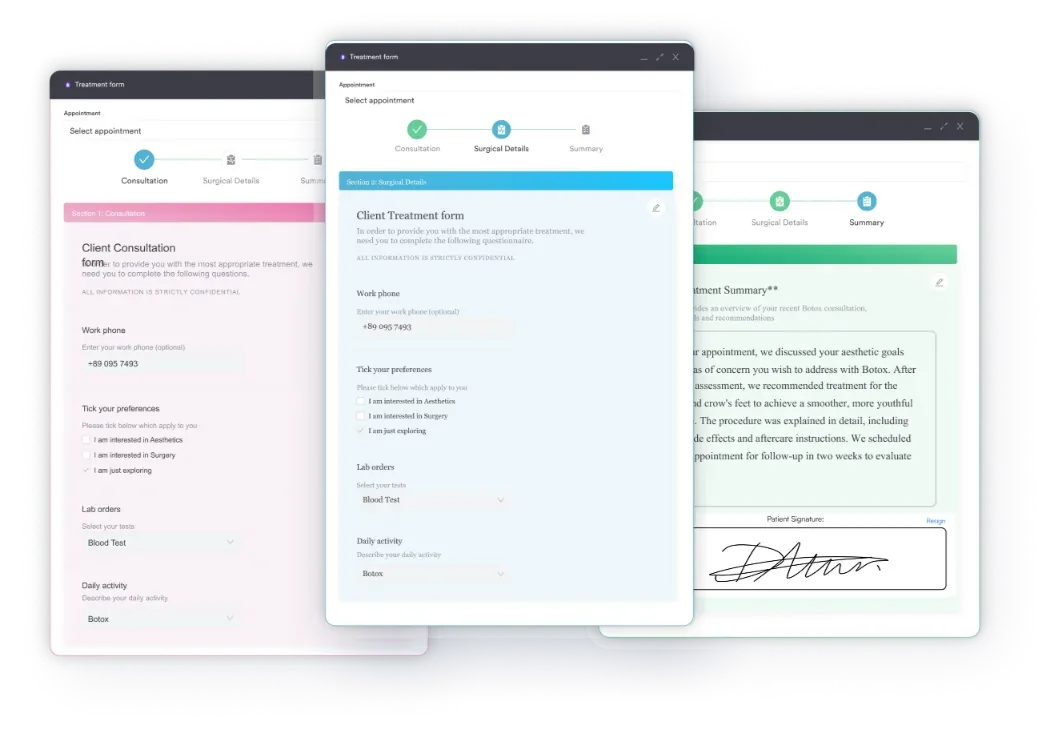
Practice management software like Pabau collapses that into one flow. Patients complete the questionnaire through online booking and the client portal before the appointment, with consent captured in the same step. The responses land in the client record, so you open the note and the answers together.
Custom digital forms let you build the item set you actually use, whether that is the Big Five or a shorter screener. Every submission is timestamped and stored against the client, which is what an ethical review or an audit asks for.
The result is less time between administering a test and using it. You spend the session interpreting results instead of chasing a form.

Pabau’s digital forms capture consent, collect responses, and file scores straight into the client record. Your team stops rekeying results and starts each session with the full picture.

A well-administered test moves clinical assessment from intuition to measurement. The Big Five gives you a defensible baseline for the personality patterns that shape treatment response, interpersonal functioning, and risk. What you do with that baseline in session is still clinical judgment.
Build the assessment into intake rather than bolting it on later. Structured digital forms and medical records software keep consent, scores, and interpretation in one place. That is what makes the results usable six months from now.
Your patients get clarity about their strengths and vulnerabilities, and you get data you can defend. Book a demo to see how Pabau keeps assessment forms, scoring, and clinical notes in one client record.

Need a validated inventory with more granularity? The 16PF questionnaire covers sixteen primary personality factors for a deeper clinical profile.
Want your consent paperwork to match the standard above? Counseling informed consent form gives you a ready-made document to sign before testing begins.
Need help writing up what the results mean? Progress notes for psychotherapy shows how to record assessment findings alongside session content.
Building assessment into a wider psychiatric workflow? Psychiatry EMR software shows how testing, prescribing, and treatment planning share one record.
A personal psychology test is a standardized assessment tool that measures personality traits, cognitive abilities, and emotional functioning. Clinicians use the results to inform treatment planning and mental health intervention.
The primary categories are self-report inventories such as the Big Five and projective tests such as the Rorschach and TAT. Behavioral assessments, cognitive tests, and structured clinical interviews make up the rest. Self-report tests are the most widely used in routine clinical care.
No. Personality tests measure traits and characteristics, and they do not diagnose disorders. Diagnosis requires clinical judgment, structured diagnostic interviews, symptom assessment, and multi-method evaluation. Tests inform a diagnosis but cannot determine it alone.
Most Big Five and self-report personality tests take 10 to 15 minutes. Some comprehensive batteries run 30 to 60 minutes. Projective tests such as the Rorschach are typically 30 to 45 minutes.
Free consumer quizzes lack rigorous validation and clinical norms. Clinician-administered tests use standardized procedures and validated scoring systems. For clinical decision-making, use psychometrically sound instruments with established reliability and validity.
Record the test name, the date administered, raw scores and percentiles, your clinical interpretation, and how the results inform treatment. Note any questions or concerns the patient raised, and link the findings to treatment goals.