GLP-1 diet plan
A GLP-1 diet plan is a structured eating framework for patients taking semagluti...

2
Last Updated: Oct 13, 2026
A psychology complex list is a structured clinical reference that maps the unconscious patterns shaping a patient’s thoughts, behaviors, and emotional responses. Carl Jung coined the term in the early 1900s. Alfred Adler went on to name the inferiority and superiority complexes, the two patterns therapists meet most often in session.
Use the list at intake to recognize which pattern a patient is presenting, then revisit it at review to see whether that pattern has shifted. This guide defines seven complexes, explains how each one forms, and sets out which therapies address it. A downloadable PDF template follows.
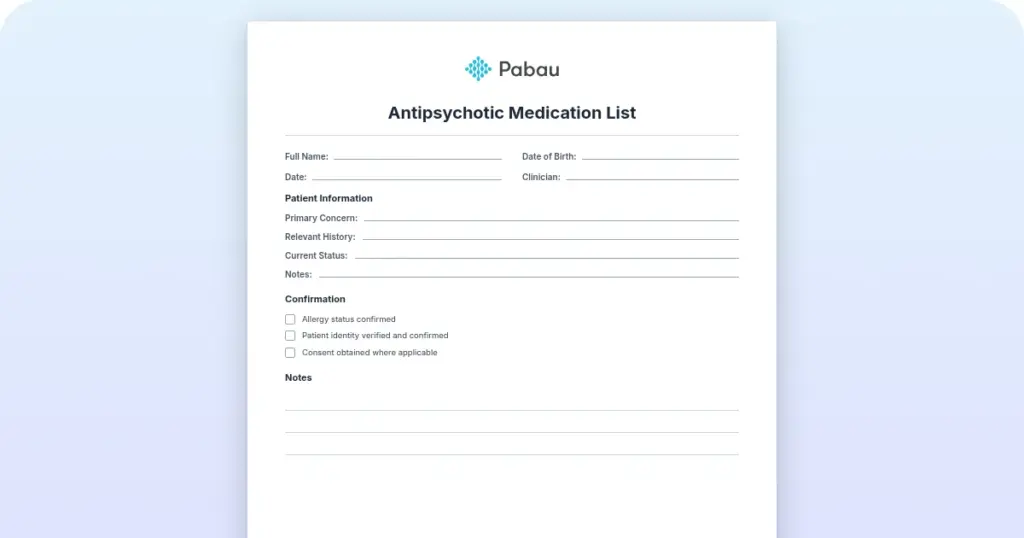
A one-page assessment sheet for mapping a patient’s presenting complex at intake and at review. It carries fields for presenting concerns, symptom severity, baseline scores, and therapeutic progress.
Download template
A psychological complex is a cluster of unconscious thoughts, emotions, and behaviors organized around one emotional theme.
Carl Jung coined the concept, Sigmund Freud named the Oedipus complex, and Alfred Adler coined the inferiority and superiority complexes.
Inferiority and superiority complexes are the two patterns therapists encounter most often in clinical practice.
Psychological complexes are not DSM-5 diagnoses, but they give you a descriptive framework for case formulation and therapeutic targets.
The PDF template structures assessment across presenting concerns, symptom severity, and baseline scores, so progress stays easy to track.
The American Psychological Association (APA) defines a psychological complex as “a group or system of related ideas or impulses that have a common emotional tone.” Those ideas exert a strong but usually unconscious influence on attitudes and behavior, and they do it below awareness. Patients often cannot articulate why they react the way they do in specific situations.
Carl Jung coined the term “complex” in analytical psychology during the early 1900s. He described complexes as autonomous elements of the unconscious mind that cluster around emotionally charged themes. Conscious thoughts can be inspected and challenged. A complex works silently instead, shaping perception and reaction until therapy makes it explicit.
Three theorists built the framework between them. Jung named the mechanism, Sigmund Freud named the Oedipus complex, and Alfred Adler coined the inferiority and superiority complexes that dominate everyday practice.
Important distinction: psychological complexes are not DSM-5 diagnostic categories. They form a descriptive framework that supports case conceptualization, but they do not replace formal diagnosis. A patient presenting with inferiority complex patterns may also carry a depression diagnosis. The complex describes the personality mechanism, while the diagnosis describes the condition.
There is no fixed, universally agreed count of psychological complexes. Jungian and psychoanalytic traditions describe dozens of named patterns. The table below covers the seven you are most likely to encounter in therapy.
That Origin column mixes two different kinds of answer, which is worth separating before you cite any of these in a note. Four of the seven were named by a specific theorist. The other three are descriptive labels that clinical language absorbed without a single author.
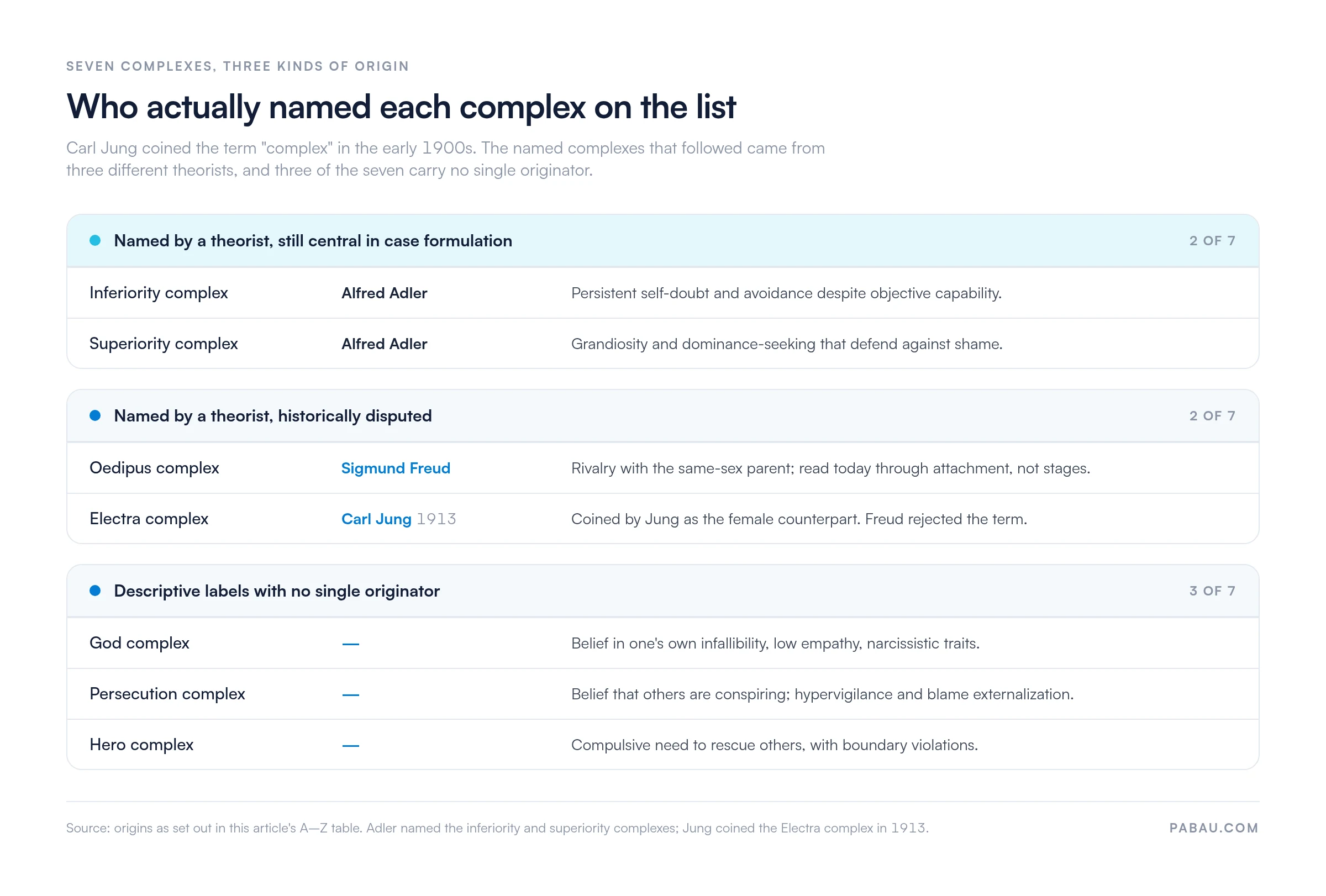
Inferiority complex is the most frequently encountered pattern in clinical practice. Patients present with persistent self-doubt despite objective competence, chronic comparison to others, and avoidance of challenges that might expose them to failure.
This is the one complex on the list with a validated instrument behind it. Pair your formulation with the Rosenberg self-esteem scale to get a repeatable score alongside the narrative. A shift over six sessions then shows up as a number rather than an impression.
Superiority complex frequently masks inferiority. Patients exhibit grandiosity, contempt for others, and a need to win every interaction. The superiority presentation often emerges as a defensive response to early shame or inadequacy.
Freud’s Oedipus complex describes unconscious rivalry with the same-sex parent and romantic idealization of the opposite-sex parent during early development. The Electra complex is the female counterpart, and it was Carl Jung who coined it in 1913. Freud himself disputed the term and rejected it in his 1931 paper on female sexuality.
Clinical stance: modern psychology reads these patterns through developmental and relational attachment frameworks rather than as universal stages. They describe patterns sometimes observed, not inevitable developmental phases. Use the lens cautiously, and one patient at a time. An attachment theory worksheet is usually the more defensible way to document the same relational material.
Psychological complexes are not inherited. They form through repeated emotional experience, trauma, or developmental patterns that organize thoughts and feelings around a central theme.
Understanding this sequence gives patients something to work with. They can trace a current reaction back to its origin and begin to interrupt the automatic pattern. Because the complex recruits familiar defenses at every stage, a defense mechanisms worksheet often surfaces the specific moves a patient makes to protect it.
Psychological complexes respond to psychotherapy that brings unconscious material into awareness and restructures the emotional tone. Naming which complex is driving the presentation is what tells you which modality to reach for first.
The list is a clinical reference and an assessment structure, not a diagnostic tool. Use it during intake to ask open questions about family dynamics, self-perception, and relational patterns. Then map the emerging complex to your case formulation.
In session, the list organizes your understanding of what the patient is describing. When someone reports persistent self-doubt, avoidance, and comparison-driven behavior, you have named the inferiority complex as the organizing mechanism. That clarity speeds up treatment planning and helps the patient recognize their own pattern.
Fill in the downloadable PDF at intake, then again at review, and compare the two. A completed sheet only earns its keep if it lives with the clinical note. Filing it there is far easier inside one therapy practice system. Practices running a dedicated mental health EMR can attach the sheet to the patient record and pull it up at the next appointment.
Three things change once the sheet is part of your standard intake pack.
Therapists across mental health practices, psychology practices, and counseling centers adapt the sheet to their own modality. Some add a section for digital intake responses; others fold the scores into an existing progress note.
The usual route is to print the sheet, complete it by hand at intake, then scan it into a folder nobody opens again. At review, the therapist is comparing a memory against a PDF nobody can find, which is how a documented baseline quietly stops being useful.
Practice management software like Pabau takes a different route. The assessment becomes a digital form the patient completes before the appointment, and the responses land straight in their record. Scores sit next to the treatment notes, so the complex you identified at intake is on screen the next time you open the file.
From there, the same record drives the follow-up. Pabau Scribe, our AI scribe, drafts the session note, and the letters tool turns your formulation into a referral or summary without retyping it. You spend the review comparing two dated scores instead of reconstructing what you thought six sessions ago.
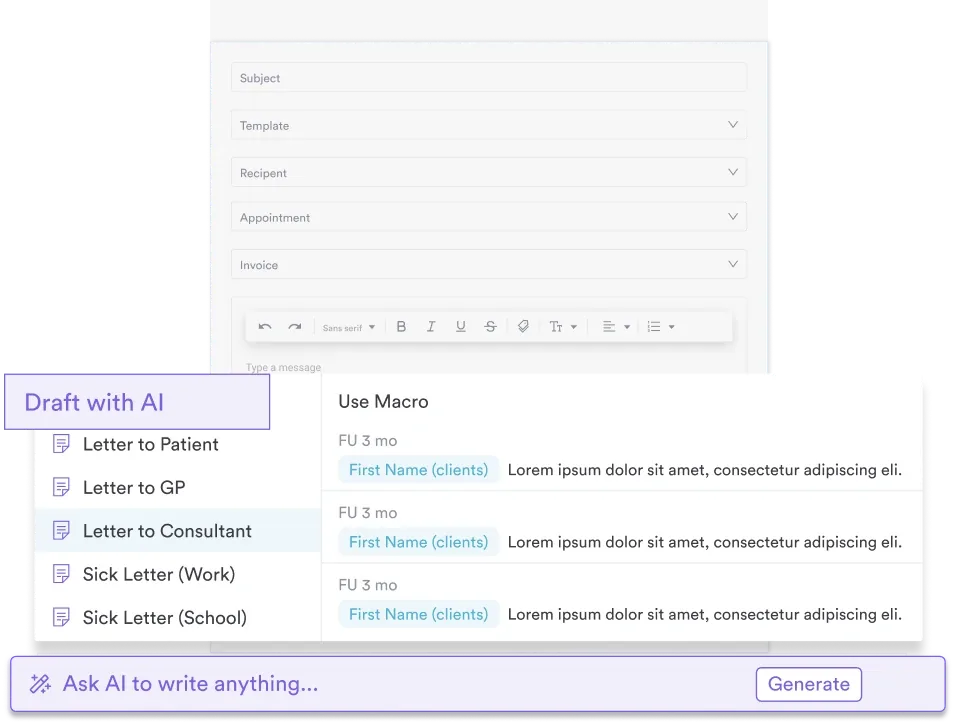

Pabau turns the psychology complex list into a digital intake form that files itself against the patient record. Scores, notes, and review comparisons stay in one place, so therapeutic progress is easy to evidence.

This list earns its place at the second reading. Name the complex at intake, write down the reason you reached it, then hold that reasoning against the patient six sessions later. A label applied once and never revisited cannot show you whether therapy is working.
So treat the download as a dated record. Complete it at intake, complete it again at review, and keep both versions where the clinical note lives. The trade-off worth remembering is that these are descriptive patterns, not diagnoses, so the sheet supports your formulation and never substitutes for one.
Book a demo to see how Pabau files intake assessments against the patient record and makes therapeutic progress straightforward to evidence.

Need the wider intake picture first? Mental health intake form gives you the history, risk, and presenting-concern sections this assessment sits inside.
Ready to turn the formulation into a plan? Psychology treatment plan template structures goals, interventions, and review dates around the pattern you identified.
Writing up the sessions that follow? Progress notes for psychotherapy shows how to record change over time without rewriting the formulation each week.
Working with an inferiority presentation? Self-esteem worksheet for adults gives patients between-session exercises that target the shame underneath.
Bringing CBT to the pattern? CBT cheat sheet sets out the distortions and techniques that interrupt an automatic complex-driven response.
A psychological complex is a cluster of related thoughts, emotions, and behaviors organized around a common emotional theme and operating largely outside conscious awareness. The APA defines it as a system of ideas with a common emotional tone. That system exerts a strong but usually unconscious influence on attitudes and behavior.
There is no fixed count. Jungian and psychoanalytic traditions describe dozens of named complexes. The most clinically relevant are inferiority, superiority, Oedipus, Electra, god, persecution, and hero complexes. Therapists recognize these as descriptive patterns rather than exhaustive categories.
Carl Jung developed the foundational concept of complexes in analytical psychology in the early 1900s. Alfred Adler coined the two terms clinicians use most, the inferiority complex and the superiority complex. Sigmund Freud contributed the Oedipus complex, and Jung named the Electra complex in 1913.
No. Psychological complexes are descriptive patterns of unconscious influence but are not DSM-5 diagnoses. A patient can have an inferiority complex and carry a major depression diagnosis. The complex describes the personality mechanism, while the diagnosis describes the clinical condition.
Yes. Psychodynamic therapy, cognitive-behavioral therapy, Jungian analysis, and somatic therapies all address complexes by bringing unconscious patterns into awareness and building new responses. Progress is traceable through clinical notes and assessment tools like the psychology complex list template.
Use it during intake to structure questions about family dynamics, self-perception, and relational patterns. Map the emerging complex to your case formulation, then track symptom severity and therapeutic progress over time. Store it in structured patient records for evidence-based review and compliance documentation.