Getting along with siblings worksheet
A getting along with siblings worksheet is a printable that helps children and t...

3
Last Updated: Oct 23, 2026

A normal review of systems records what the patient denies across 14 organ systems, in wording an auditor can follow.
CMS counts one problem-pertinent system as expanded problem-focused, 2 to 9 as detailed, and 10 or more as complete.
Since 2021, office visit codes 99202 to 99215 are selected by medical decision-making or total time, not by history.
CMS permits the phrase “all other systems reviewed and normal” once the pertinent positives and negatives are documented individually.
Pabau captures the review of systems as structured intake data, so the wording reaches the note without anyone retyping it.
The template lists all 14 organ systems with ready-to-use negative findings wording, plus primary care, psychiatry, and cardiology variants. Print it for the exam room, or paste the wording straight into your EHR.
Download templateMost reviews of systems come back clean. The patient denies everything you ask, and you type the same 60 words you typed for the last six patients.
That repetition is where documentation quality slips. Wording drifts between visits, a system quietly gets skipped, and a chart that felt thorough in the room reads thin under review.
A standing template solves most of that. Below is the wording for all 14 systems, three specialty variants, and the coding rules that changed underneath them in 2021.
A normal review of systems is a written record of symptoms the patient does not have. You ask about each organ system, the patient reports nothing abnormal, and you document that as a negative finding.
Those negatives do two jobs. First, they show you asked, which is what CMS documentation rules turn on. Second, they set a clinical baseline.
The baseline matters more than clinicians expect. When a patient returns in March reporting chest pain, a clean cardiovascular ROS from January says the symptom is new. That one detail changes both your differential and your coding.
The CMS 1995 and 1997 documentation guidelines name 14 organ systems. Each one covers a distinct set of symptoms:
Count the systems as you go. Ten or more gives you a complete review. Two to nine is detailed. A single problem-pertinent system counts as expanded problem-focused, and a problem-focused history needs no ROS at all.
Shorter formats exist as well. A 12-point review of systems still clears the 10-system threshold with less typing, which suits high-volume schedules.
Here is the wording for a complete normal ROS. Use it as written, or adjust the phrasing to match how your practice charts. The language stays neutral and does not lead the patient.
That block covers most primary care and specialty visits. Repeating it word for word across a year of charts is what draws attention in a chart audit, though. Change the opening phrase, or add the one or two findings that fit the visit in front of you.
Work down this list while the patient is still with you. Tick the systems that came back clean, and write out anything abnormal in full:
Fourteen ticks gives you a complete review. On specialty visits, go deeper on the systems your discipline lives in and keep the rest brief. Depth on the systems that matter is what a reviewer looks for.
Different settings weight the systems differently. These three variants are the ones practices ask for most.
“Patient reports no recent fever, chills, or weight loss. Denies chest pain, palpitations, or shortness of breath. No cough. No nausea, vomiting, abdominal pain, or diarrhea. No painful or frequent urination. No joint pain or muscle weakness. No headache, dizziness, or fainting. No mood changes or anxiety. No rashes or lesions. No known drug allergies.”
Practices running this at volume usually store it as a one-click phrase inside their primary care software, rather than in a separate document nobody opens.
“Patient denies suicidal or homicidal ideation. No hallucinations or delusions. Sleep pattern normal. Appetite stable. No weight changes. Mood euthymic, affect appropriate. No tremor or neurological symptoms. Cardiovascular and respiratory systems reviewed and normal. No recent infections.”
Psychiatric visits still need the medical systems covered, so keep a general panel in your psychiatry EMR alongside the mental health items.
“Patient specifically denies chest pain, pressure, or tightness at rest or with exertion. No palpitations or fainting. No shortness of breath lying flat or waking at night. No leg swelling or calf pain. No constitutional symptoms. Review of other systems unremarkable.”
A clean cardiovascular ROS pairs well with a hands-on circulation assessment when the history and the presentation do not quite agree.
It no longer picks your office visit level. Since January 2021, CMS selects codes 99213 and its neighbors in the 99202 to 99215 range by medical decision-making or total time, not by history.
The old thresholds have not disappeared, though. Visit types outside that reform still use them, as do some payers. And the clinical reason for asking never depended on the code in the first place.
Here is how the history thresholds work where they still apply:
Ten or more systems gives you a complete ROS. CMS’s 1997 guidelines let you record the pertinent positives and negatives individually, then write “all other systems reviewed and normal” for the rest. That shorthand is permitted, as long as the pertinent findings are present.
A note carrying the shorthand and nothing else is the one that fails review. The consequence surfaces later, when a clean claim turns into a denial you have to work.
It sits in the S, the subjective section of a SOAP note. Place it after the history of present illness and before the past medical history. The order below is the one billing reviewers read fastest:
Problem first, then systems. That order mirrors clinical reasoning, so a reviewer follows the note without hunting. Practices that template the ROS inside their medical records system stop retyping it altogether.
Almost every ROS problem is procedural rather than clinical. Read these five before you sign the note:
Four of those five are workflow fixes. The contradiction is the one that needs a human, so give the note a ten-second read-back before you sign.
Catching them at the chart costs you seconds. By the time the problem reaches denial management, you are reworking a claim instead of seeing a patient.
The ROS usually gets captured twice. The patient answers on paper at the front desk, then someone retypes those answers into the note during or after the visit.
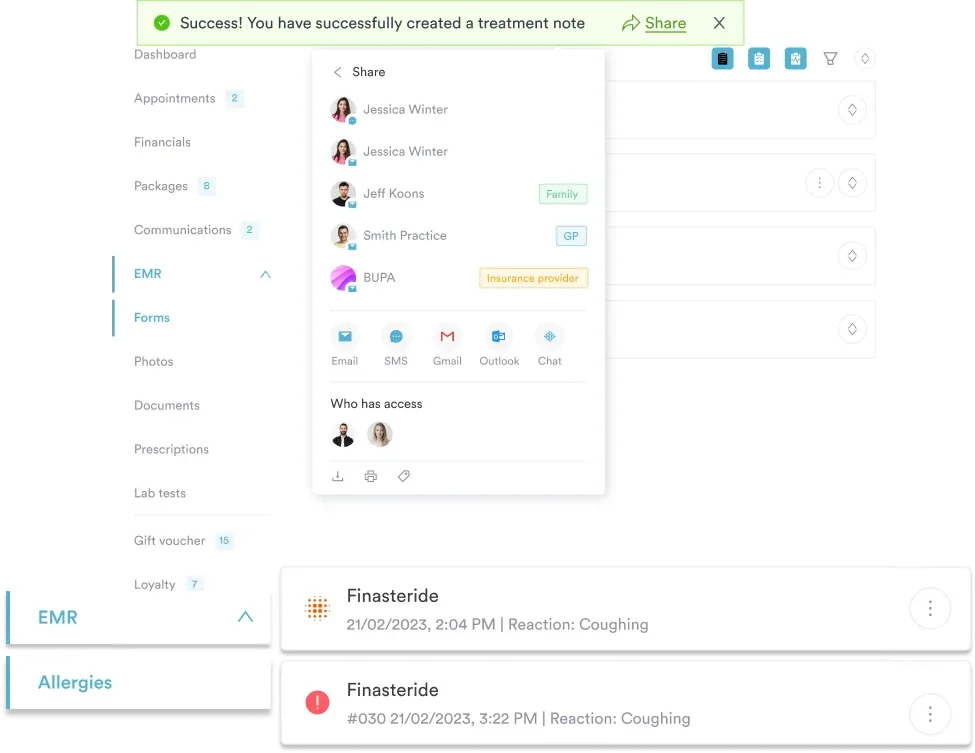
Practice management software like Pabau removes the second step. Digital intake forms collect the review of systems before the patient arrives, and the answers land straight in the client record. You open the note with the negatives already filled in.
During the appointment, Pabau Scribe, our AI scribe, writes the conversation into the note. You confirm the systems that came back clean and expand the ones that did not.
You end up with one version of the ROS, written once, stored with the appointment it belongs to. Wording stays consistent between clinicians, and nobody is retyping negatives at 7pm.

Pabau’s digital intake forms and AI scribe pull review of systems answers straight into the client record. Your team stops retyping, and the wording stays consistent across clinicians.

The wording is the easy part. Getting the same wording into every chart, every time, without anyone retyping it, is what decides whether your documentation holds up.
So pick one version of the template and put it where your team already works. Then spend the time you save on the pertinent findings. Those are the only part of the ROS a reviewer reads closely.
Doing that by hand takes discipline from every clinician on the schedule. Book a demo to see how Pabau captures the review of systems once and keeps it in the client record.

Helping a family plan an assisted living move? Checklist for moving into assisted living organizes the move into pre-move-in, move-in day, and after-move-in tasks.
Working through annual wellness visits? Annual physical exam checklist covers the examination side of the same appointment.
Caring for a patient with cholecystitis? Cholecystitis nursing care plan template addresses assessment triggers, intervention rationales, and discharge planning for cholecystitis care.
Prescribing a controlled substance long term? Controlled substance agreement template sets out patient responsibilities, drug testing consent, refill rules, and monitoring requirements.
Planning daily care for an elderly patient? Daily care plan for elderly patients covers daily routines, ADL and IADL assessments, medication tracking, and care coordination.
The ROS is what the patient tells you. The physical exam is what you find yourself. Chest pain reported during questioning belongs in the ROS. A murmur you hear through a stethoscope belongs in the exam.
No. CMS lets you review an ROS recorded at an earlier visit instead of taking it again. Note the date of the original, document anything that has changed since, and record that you reviewed it.
Yes. Ancillary staff can record it, and patients can complete it on an intake form. The clinician then has to show they reviewed it, by noting confirmation or by adding to what was recorded.
Yes. Without a hands-on examination, what the patient reports carries most of your subjective data. Document each system you asked about, because a reviewer cannot infer it from an exam finding you were unable to make.
Document why. An unresponsive or severely cognitively impaired patient makes the ROS unobtainable, and CMS accepts that when the reason sits in the note. A blank section with no explanation does not carry the same weight.