HIPAA compliant texting: What you can send patients & how to communicate securely
HIPAA compliant texting is possible when a text holds no protected health inform...

Last Updated: Oct 16, 2026
A medication do not crush list names the oral drugs that must be swallowed whole, and the reason each one is unsafe to alter. Crush the wrong tablet and a full day’s dose can hit the bloodstream in minutes. Other tablets lose the coating that shields the stomach, and some release powder a nurse should never be breathing.
Five formulation types account for almost every entry: extended-release, enteric-coated, cytotoxic, narrow therapeutic index, and sublingual or buccal. Each category below gives the marker on the label, the safer form to request, and the reason behind the restriction.
A one-page reference sheet covering 16 do-not-crush medications across five risk categories. Each row gives the strength, formulation type, reason not to crush, safe alternatives and pharmacist approval status. Blank rows are included for your own formulary additions.
Download template
Extended-release medications (ER, XR, SR, XL, LA, CD) must never be crushed. Crushing dumps the whole dose at once instead of releasing it over hours, which risks toxicity.
Enteric coatings shield the stomach, or hold a drug back until it reaches the intestine. Crushing removes that protection, so the drug either irritates the stomach or stops working.
Narrow therapeutic index is not the same as do not crush. Digoxin and warfarin tablets are crushed routinely, while phenytoin’s extended-release capsule is not.
A published list is a starting point, and the package insert settles the individual case. Check each medication before administration, then call the pharmacist when a patient cannot swallow it whole.
Most do-not-crush medications have a safer form: a liquid, a dispersible tablet, a transdermal patch, or a sprinkle capsule. Request it from the pharmacy or the prescriber.
A medication do not crush list is a clinical safety reference that names the oral medications unsafe to crush. Each entry carries the pharmacological reason behind the restriction.
Nurses, pharmacists, and caregivers treat it as a bedside check before a dose leaves the cart. It earns its place with patients who have dysphagia, an enteral feeding tube, or cognitive impairment.
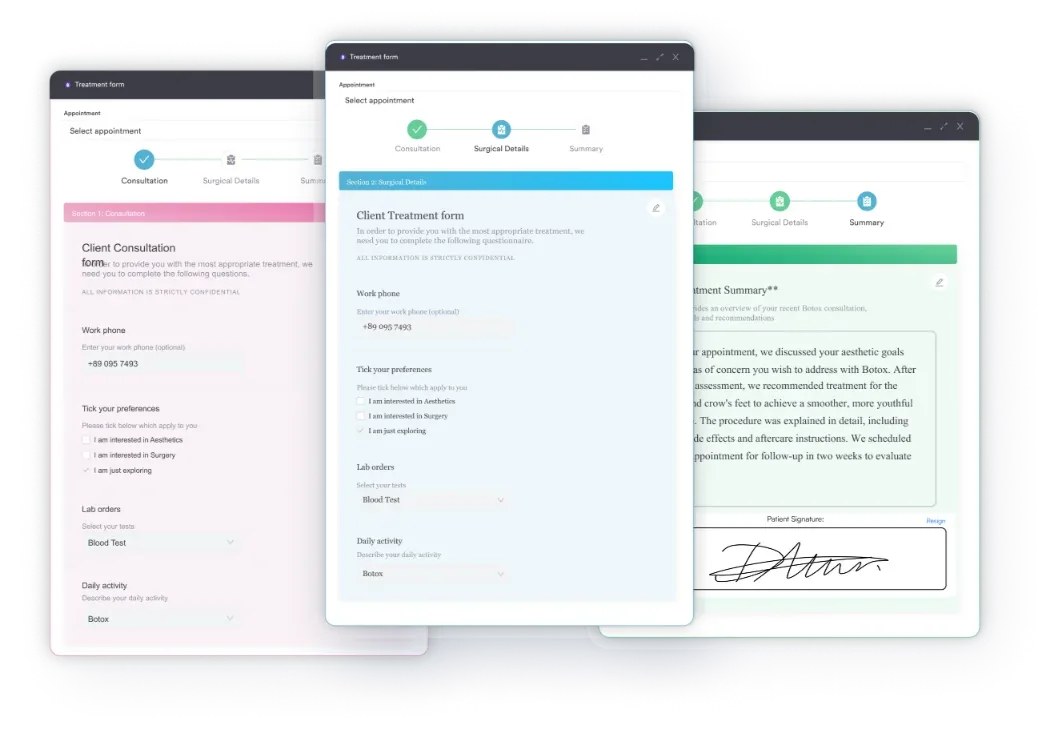
Most teams keep a printed copy at the medication cart and another in the patient’s file. Screening digitally gets the warning in front of staff earlier. Digital intake forms can record swallowing difficulty at admission, so the flag reaches the medication record ahead of the first dose.
Every entry traces back to one of five clinical hazards. Knowing which one applies tells you what to ask the pharmacy for.
Those five hazards map onto five formulation types, and each one leaves a marker on the packaging. The table below pairs the marker with the safer form to request.
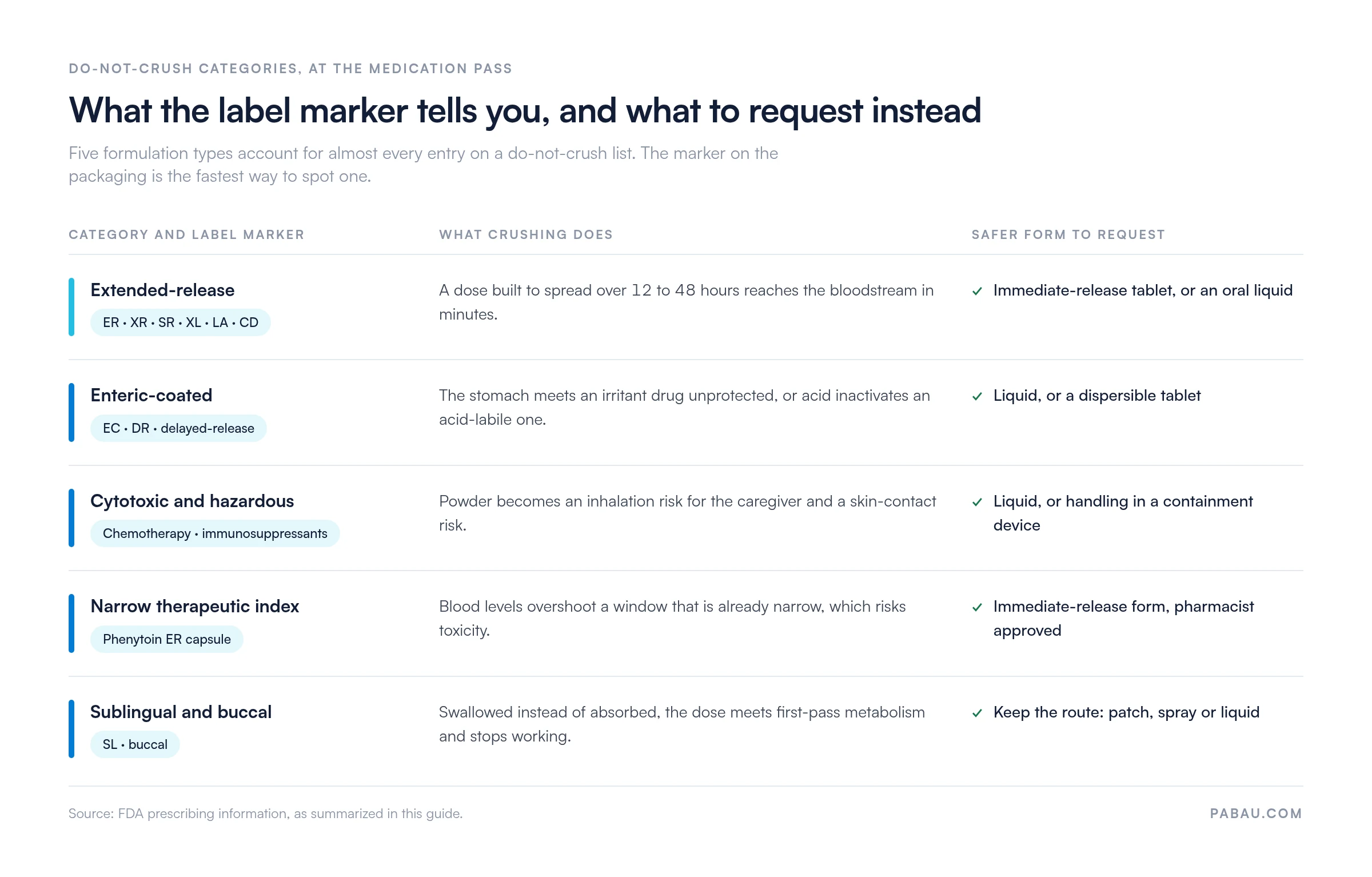
Extended-release drugs are engineered to dissolve slowly across 12, 24, or 48 hours. Crushing bypasses that mechanism completely, and the result is dose dumping. The bloodstream sees a concentration the body was never meant to handle in one go.
Crushing a 100 mg Toprol-XL tablet delivers in minutes what the release matrix would spread across a full day. Acute hypotension, bradycardia, or shock can follow.
Catching it depends on the formulation type being visible at the point of administration, which is why medical records management matters here. Client records that store the formulation beside the drug name give staff the warning before the crusher comes out.
An enteric coating is a polymer layer that dissolves in the neutral pH of the small intestine, not in the stomach. It protects two kinds of drugs.
The first group irritates the gastric lining, such as NSAIDs and aspirin. The second group is destroyed by stomach acid, such as pancreatic enzymes and certain antibiotics.
Crush one of these and the coating is gone instantly. NSAIDs then reach the gastric mucosa unprotected, which can cause ulceration or bleeding. Acid-labile drugs are simply inactivated, so the patient takes a dose with no effect. Note the instruction to swallow whole at each medication review, because it tends to be the detail a new caregiver misses.
Two high-risk groups sit slightly apart from the formulation categories above. One is about protecting the person giving the dose. The other is about how little room there is for error in the blood level.
Chemotherapy agents, immunosuppressants, and some antiretrovirals are hazardous to handle. Crushing them into powder creates an inhalation risk for the caregiver, plus a dermal absorption risk if particles reach skin or mucous membranes.
USP General Chapter <800> standards govern hazardous drug handling in healthcare settings, and crushing is prohibited outside a certified containment device.
Narrow therapeutic index (NTI) drugs leave a small margin between a therapeutic dose and a toxic one. That earns them close monitoring, but it does not automatically make them do-not-crush. The formulation decides, and it varies by drug.
The practical takeaway is to check the form rather than the drug class. A blanket ban on crushing every NTI drug sends staff to the pharmacist for doses that were never a problem.
Sublingual and buccal tablets dissolve under the tongue or against the inner cheek. The drug absorbs straight through the oral mucosa and skips first-pass metabolism in the liver. That is what makes the onset fast enough for acute symptoms.
A crushed sublingual tablet gets swallowed into the GI tract, where it meets first-pass metabolism and slower absorption. Onset is delayed, and peak levels may never reach the therapeutic range at all. With nitroglycerin for chest pain, that delay is the difference between relief and an emergency.
A patient who cannot swallow a tablet whole needs a different form, not a workaround. Five alternatives cover most situations, and the pharmacy or prescriber can arrange any of them.
One practical note on timing. Ask for the alternative when the swallowing problem is first documented, not at the next medication pass. Compounding and stock orders both take days.
Four steps, in order, every time the question comes up.
Where the swallowing difficulty is going to continue, tell the prescriber early. Prescription software that carries the administration flag through to the next refill saves the same conversation happening every month.
Nursing homes, assisted living, and skilled nursing facilities carry the highest concentration of at-risk residents. Swallowing difficulty, feeding tubes, and cognitive impairment are common, and medication rounds are long. Five controls do most of the work.
CMS compliance surveys look at medication administration safety directly. Documented do-not-crush reviews are the evidence that the program is working rather than written down somewhere.
The downloadable sheet is a pre-structured form, ready to customize and print. Six steps get it into daily use.
The list of oral dosage forms that should not be crushed is a widely used clinical reference. Pharmacist John Mitchell compiled the original, and the Institute for Safe Medication Practices (ISMP) circulated it for years. ISMP has since stated that it does not own, update, or review that list.
That matters for how much weight you put on a copy found online. ISMP still publishes medication-safety alerts and error-prevention guidance, and those remain worth following. For a specific crushing decision, the deciding source is the product’s FDA labeling, confirmed with your reviewing pharmacist.
Keep a written sheet of your own, review it on a schedule, and fold new safety alerts into your medication protocols. Three other sources carry authority here. FDA drug labeling specifies crushing restrictions product by product. USP standards for oral dosage forms and Joint Commission medication safety standards set the wider expectations.
A printed sheet only helps when someone stops to read it. Practice management software like Pabau puts the same warning on the patient’s own record, where the nurse is already working.
Swallowing difficulty, feeding tube status, and the pharmacist’s instructions are recorded once on the client card. Custom intake forms capture the dysphagia screen at admission. The medical record then holds the authorization for any alternative formulation, so the next shift inherits the decision instead of remaking it.
Recurring tasks keep the review on schedule. Assign the quarterly formulary check to your consultant pharmacist, and the reminder arrives without anyone tracking dates in a spreadsheet. The completed task stays in the record as evidence for a CMS survey.

Pabau records swallowing difficulty, feeding tube status and pharmacist authorizations on the patient’s own file, so the do-not-crush check reaches staff at the medication pass. Quarterly formulary reviews run as recurring tasks with an audit trail.

Knowing the five categories is the easy part. The hard part comes months later, on a busy round, when the warning has to reach the person actually holding the tablet. A laminated sheet does half that job. The patient’s record does the other half, telling staff at the moment of administration that this dose needs a different form.
Get the two working together and the pharmacist call stops being a delay and becomes routine. Download the sheet, trim it to the drugs your team actually gives, and set a quarterly review so it stays current as your formulary changes.
Would you rather the flag lived in the record than on the wall? Book a demo and see how Pabau keeps medication safety notes with the patient they belong to.

List Item #1
List Item #2
Only once the pharmacist has confirmed the drug may be crushed at all. Use a small amount of soft food, such as applesauce or yogurt, and give it straight away so none of the dose is left behind. Avoid hot food and large portions, because heat and volume both risk losing part of the dose.
Not necessarily. Splitting an extended-release or enteric-coated tablet breaks the same mechanism that crushing does. Only tablets marked as scored and approved for splitting should be divided, and the package insert confirms which ones qualify.
It carries the same risks. Many capsules hold coated beads that control the release rate, so emptying one can cause dose dumping just as crushing would. A few are licensed as sprinkle capsules, and the insert says so explicitly.
No. Altering a dosage form changes how the drug is delivered, so it needs pharmacist or prescriber authorization and a note in the record. Facility policy usually sets out who may approve it and how the approval is documented.
Look at the suffix on the product name first, since ER, XR, SR, XL, LA, CD and DR all signal a modified-release form. The package insert and the pharmacy label confirm it. When the packaging gives no suffix, treat the drug as unverified and ask the pharmacist.