Fertility clinic marketing: Strategies that attract & convert patients
Fertility clinic marketing is how a fertility practice attracts, educates, and c...

Last Updated: Oct 14, 2026
An anticoagulant medication list is a clinical reference that groups blood thinners by class, with generic and brand names, routes, monitoring needs and reversal agents. The core classes are warfarin, the direct oral anticoagulants (DOACs), the heparins and fondaparinux. All of them interrupt the coagulation cascade, which sets them apart from antiplatelets such as aspirin.
Practitioners treating atrial fibrillation (AFib), deep vein thrombosis (DVT), pulmonary embolism (PE) and mechanical heart valves use the list to keep prescribing and documentation consistent.
This guide covers each class and how to keep the list current inside the patient record. It also shows how US reversal options for factor Xa inhibitors changed in December 2025.
A ready-to-use reference listing the major anticoagulants by class, with generic and brand names, routes, indications, monitoring parameters and reversal agents. Adapt it for prescriber quick reference, patient documentation and compliance audits.
Download template
Anticoagulants interrupt the coagulation cascade, while antiplatelets block platelet aggregation, so the two classes work by distinct mechanisms.
Warfarin requires INR monitoring, while direct oral anticoagulants (DOACs) don’t need routine coagulation testing.
Specific reversal agents exist for warfarin (vitamin K), dabigatran (idarucizumab) and, in some markets, apixaban and rivaroxaban (andexanet alfa). They’re critical in bleeding emergencies.
Digital forms in Pabau, the practice management platform we build, capture anticoagulation history, current medications, bleeding risk factors and INR targets in one patient record.
It’s a reference table that catalogs approved anticoagulants by drug class, mechanism of action and clinical indication. Each entry gives the generic name, brand names and route (oral, injectable or IV). It also records the primary indication, such as AFib, DVT/PE or a mechanical valve. Each entry then notes the monitoring the drug needs (INR, a lab schedule or none).
The list does three jobs:
Anticoagulants work by blocking one or more steps in the coagulation cascade, the series of enzyme reactions that forms a clot. Antiplatelets such as aspirin and clopidogrel work differently. They stop platelets from sticking together and leave the cascade itself untouched.
Anticoagulants fall into five groups, based on their mechanism and route of administration.
Confusing anticoagulants with antiplatelets is a common clinical error, and the mix-up changes what gets prescribed. Anticoagulants block the coagulation cascade and fibrin formation. Antiplatelets inhibit platelet aggregation through the thromboxane A2 or ADP pathway.
Aspirin and clopidogrel (Plavix) are antiplatelets, not anticoagulants. A DOAC can’t be swapped for aspirin in AFib stroke prevention, although aspirin keeps a role after a coronary stent. Keep a separate anti-platelet medication list so the two classes never share a row in the patient record.
The template walks practitioners through anticoagulant selection, initiation and monitoring. Use it in five steps that match a typical clinical workflow.
Primary care practices managing AFib, cardiologists treating acute thrombosis and anticoagulation management services all rely on a structured list. Nurse practitioners and physician assistants in hospital anticoagulation clinics use it for protocol consistency.
Prescribers managing AFib also handle rate control, where diltiazem or verapamil is one option. Both drugs appear on the vasodilator medication list, which is worth checking at the same medication review.
Medical directors of multi-location practices use one standardized list, so every prescriber follows the same drug-monitoring framework. That reduces prescribing errors and improves documentation audit scores.
Medical weight loss programs need it too, because obesity raises the risk of AFib and some patients arrive already taking a blood thinner. For those programs, weight loss practice software can hold the anticoagulant entry on the same record as the treatment plan.
A structured list reduces prescribing errors by putting drug names, routes and monitoring thresholds in one document. It also supports compliance. The Joint Commission’s National Patient Safety Goal NPSG.03.05.01 requires documented anticoagulation management processes, and an auditable template strengthens inspection readiness.
Anticoagulants also sit on the ISMP list of high-alert medications, so this list pairs naturally with a high-alert medication list.
Documentation improves when the template captures INR targets, baseline renal function and reversal agents up front. Those fields then carry through every clinical note. For multi-location practices, one shared template keeps every practitioner on the same class protocols and monitoring intervals. That cuts variation and liability exposure.
Major adverse events with anticoagulants center on bleeding. Warfarin interacts with vitamin K (in diet and medications) and many drugs, and NSAIDs and aspirin add to bleeding risk. Interacting drugs can raise INR unpredictably. DOACs have fewer food-drug interactions but carry similar bleeding hazards, especially in older patients or those with renal impairment.
Those interaction checks depend on seeing every medication the patient takes. For a patient on HIV therapy, a documented antiretroviral medication list sets out the full regimen for that review.
Patients buy NSAIDs and aspirin without a prescription, so check their OTC medication list at every review. Minor bleeding, such as nosebleeds and easy bruising, is common. Major bleeding (gastrointestinal, intracranial or retroperitoneal) is rare but life-threatening.
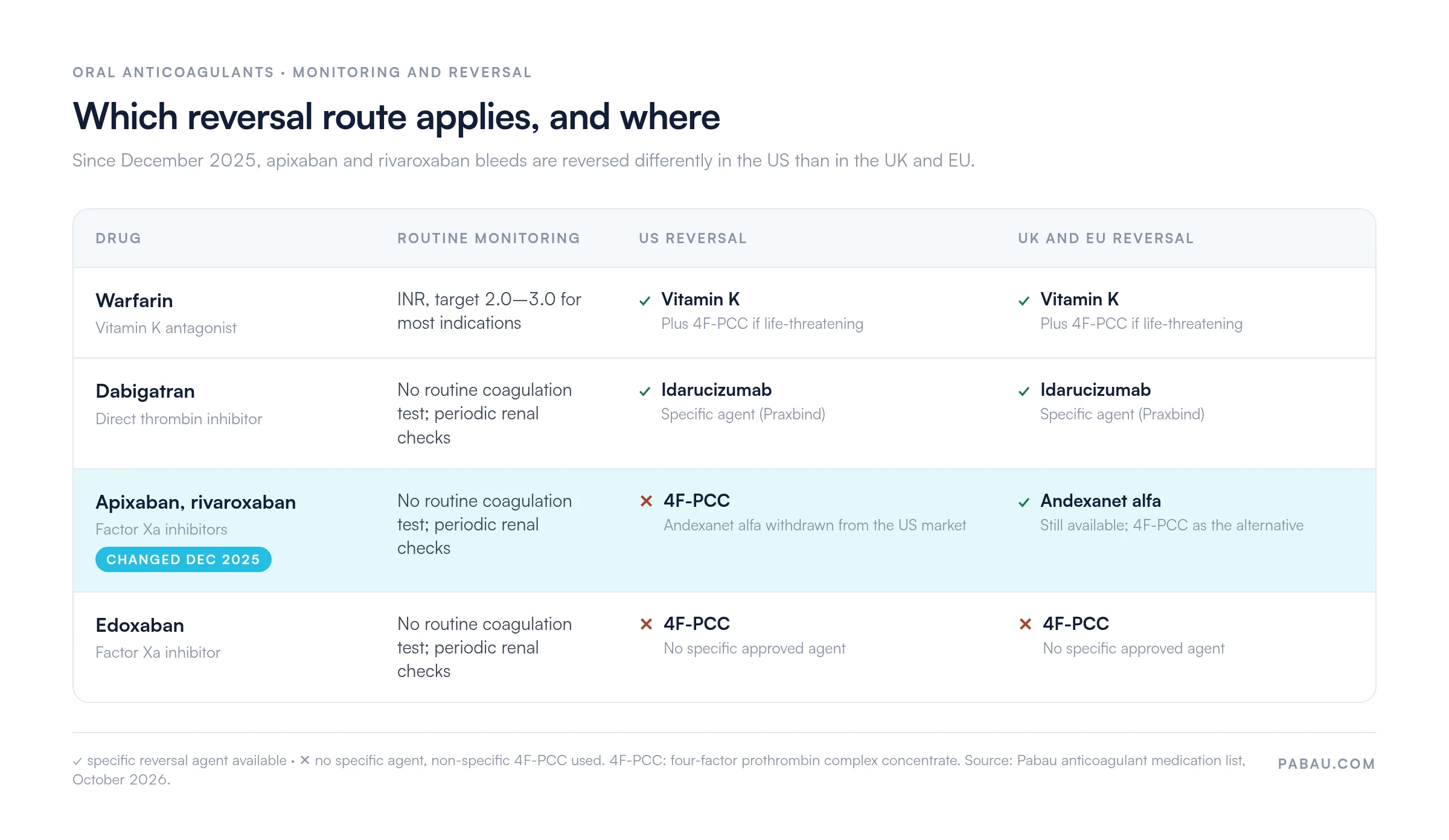
Reversal options must be immediately available when major bleeding occurs. They include vitamin K for warfarin and idarucizumab for dabigatran. For apixaban and rivaroxaban, andexanet alfa is used where available (withdrawn from the US market in December 2025; still available in the UK/EU). Otherwise, 4F-PCC is the alternative for factor Xa inhibitors, including edoxaban, which has no specific reversal agent.
The reversal route for the same bleed now depends on which side of the Atlantic the patient is treated, as the chart below shows.
Plenty of practices still keep the anticoagulant list on paper or in a shared drive, apart from the patient file. When a patient on apixaban books a procedure, someone has to find that list, check the dose and confirm when the drug was last held.
Pabau keeps the anticoagulant, dose, INR target and reversal plan in structured patient records. Every clinician on the team sees the current regimen, which matters most during emergencies, transitions of care and pre-procedure checks.
Pabau Scribe, our AI scribe, can draft notes from the consultation, which the practitioner reviews before saving to the patient record. Patients can also complete a medication history form before the visit, and their answers flow into the same record.
Anticoagulation records hold sensitive medication and clinical information, so HIPAA and data protection rules apply. Choose a system that encrypts data at rest and in transit, logs access and keeps audit trails. Confirm Pabau’s security documentation with our team before you move patient data across.

Pabau stores anticoagulation history, INR targets and reversal plans in one patient record, so prescribers see them before a procedure or a bleed. Book a demo to see it set up for your practice.

An anticoagulant medication list proves its worth before a procedure, during a bleed or at a handoff between clinicians. Those are the moments when a missing reversal plan costs time.
Start by checking that every patient record keeps anticoagulants and antiplatelets apart. Then confirm each entry names its reversal agent and monitoring rule, including whether that agent is available in your market. Those two fields address the mix-ups and delays this guide warns about.
The trade-off is upkeep. US reversal options changed in December 2025, and a printed list goes stale as guidance moves, so review it on a fixed schedule. Keeping it inside the patient record turns that review into one update rather than a hunt through paper copies. Book a demo to see how Pabau keeps anticoagulation history, INR targets and reversal plans together in one patient record.

Need the other half of the antithrombotic picture? Anti platelet medication list covers aspirin, clopidogrel, and the other agents patients often confuse with anticoagulants.
Managing patients on several heart medications? Cardiovascular medication list groups the main cardiac drug classes in one reference for prescribers.
Reviewing statins alongside blood thinners? Cholesterol medication list sets out lipid-lowering drugs by class for medication reviews.
Checking blood pressure medicines at the same visit? Free medication list of ACE inhibitors lists the ACE inhibitors used for hypertension and heart failure.
Double-checking your riskiest prescriptions? High-alert medication list flags the medicines, anticoagulants among them, that cause the most harm when an error slips through.
Anticoagulant medications are drugs that prevent blood clots by blocking steps in the coagulation cascade. They include warfarin, the DOACs (apixaban, rivaroxaban, dabigatran and edoxaban), heparin, low-molecular-weight heparin and fondaparinux. They’re used for atrial fibrillation, DVT/PE, mechanical heart valves and other thrombotic conditions.
No. Aspirin is an antiplatelet drug that blocks platelet aggregation via COX-1 inhibition. It doesn’t affect the coagulation cascade, so it isn’t an anticoagulant. Aspirin and anticoagulants work by different mechanisms and aren’t interchangeable.
Warfarin needs INR monitoring typically every 4 weeks once stable, more often when starting or when the dose changes. DOACs don’t require routine coagulation testing. Warfarin interacts with dietary vitamin K and many drugs, while DOACs have fewer food-drug interactions. DOACs are preferred for non-valvular AFib in most patients, and warfarin remains standard for mechanical valves.
Warfarin bleeding is reversed with vitamin K (phytonadione, 5 to 10 mg IV). If it’s life-threatening, add 4-factor prothrombin complex concentrate (fresh frozen plasma if PCC is unavailable). Dabigatran is reversed with idarucizumab (Praxbind). Apixaban and rivaroxaban are reversed with andexanet alfa (Andexxa) where available (withdrawn from the US market in December 2025; still available in the UK/EU). Otherwise, 4-factor prothrombin complex concentrate is the alternative for factor Xa inhibitors. Minor DOAC bleeding may resolve by holding the next dose.
DOACs are generally preferred over warfarin in older patients because they need no INR monitoring and have predictable pharmacokinetics. Renal function (creatinine clearance) still has to be assessed, because some DOACs need dose adjustment in renal impairment. Apixaban is often favored in frail older patients because of its lower bleeding risk.