Newborn assessment
A newborn assessment is a structured head-to-toe check of a baby’s health,...

4
Last Updated: Oct 9, 2026

Pack your hospital bag by weeks 35 to 36 of pregnancy, which leaves 3 to 4 weeks before your due date.
Mom needs two sets of items: labor essentials such as documents and comfortable clothing, plus postpartum supplies like a peri bottle and nursing bras.
Baby needs a going-home outfit in several sizes and an installed car seat, since most hospitals supply diapers and blankets.
Your support partner should pack snacks, a phone charger, comfortable clothes, and entertainment for a labor that can run 12 to 24 hours.
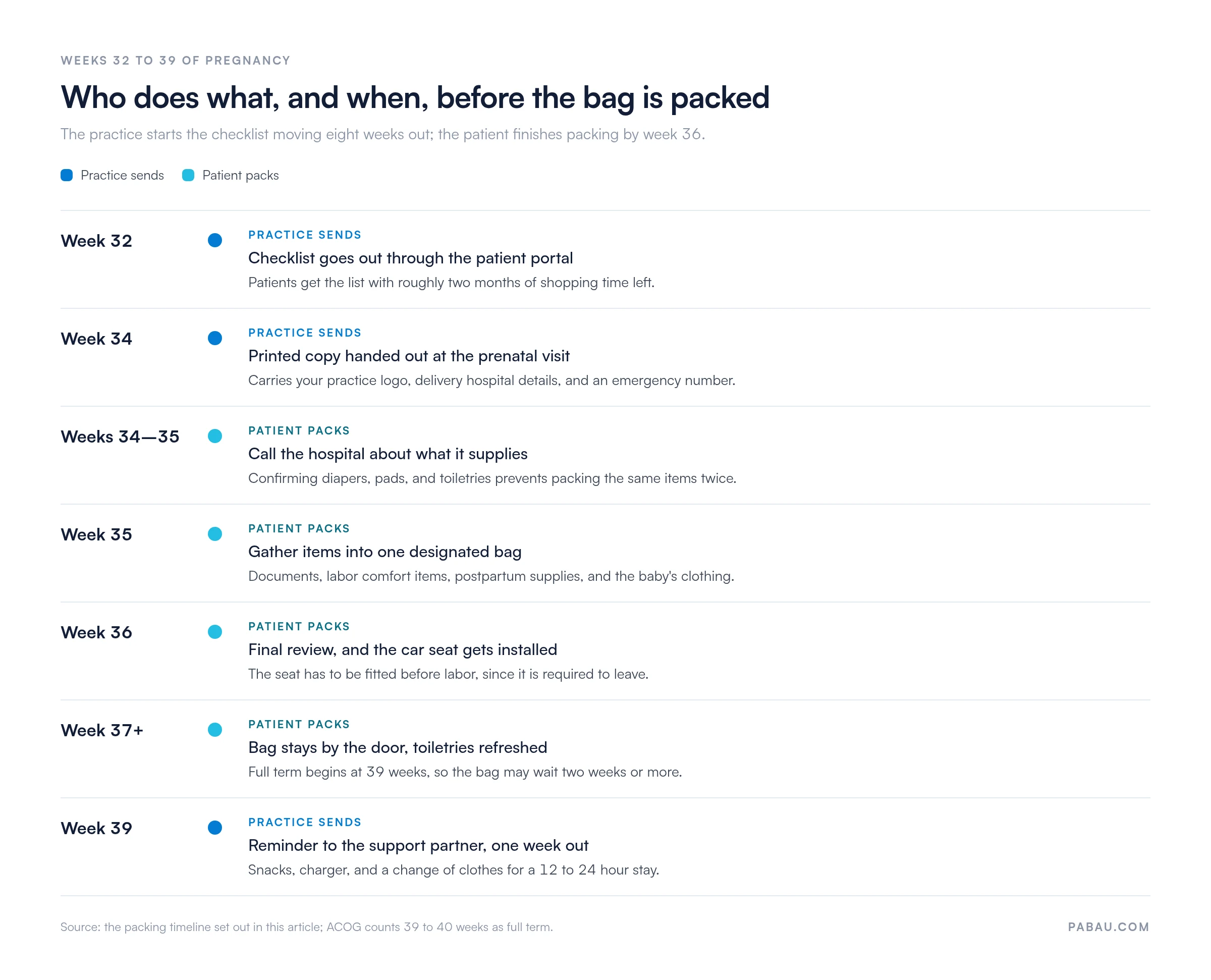
Practices can send the checklist through the patient portal at 32 weeks and hand out a printed copy at the 34-week visit.
A hospital bag checklist is a structured list of what to pack for labor, delivery, postpartum recovery, your newborn, and your support partner.
Pack it by weeks 35 to 36 of pregnancy, so early labor never catches you unprepared. This guide splits the list into four bags and hands you a printable template that OB/GYN practices give patients at their third-trimester visits.
The template lists every item by bag: labor and delivery, postpartum recovery, newborn care, and the support partner. Add your practice logo and your delivery hospital’s details before you hand it to patients.
Download templatePack by weeks 35 to 36 of pregnancy. At this stage, your baby is in the late preterm stage, with a much lower risk if born early. ACOG counts 39 to 40 weeks as full term, so an early bag simply covers the weeks in between.
Call your delivery hospital or birthing center around week 34 to ask what it provides and what you should bring. That one call prevents most overpacking. The timeline below shows how the work divides between your practice and you.
Labor can run for hours, so pack for comfort as well as paperwork. This half of the bag holds documents, comfort items, and the supplies a hospital may not stock in the quantity you want.
Make copies of every document. Keep the originals at home and pack only the copies. If the birth plan is still unwritten, this birth plan template gives you a structure to complete before the 36-week visit.
Recovery is the stretch first-time parents underpack for. These items cover the days after birth, when hospital supplies run thin.
Practices that run a patient portal can send this list at the 32-week visit, which leaves patients weeks to buy postpartum supplies. Pair it with a postpartum care plan, so recovery instructions and the packing list arrive together.
Newborns vary in size more than most parents expect, so pack a range. Most hospitals provide diapers, wipes, blankets, and mittens, and your own brands are about fabric and preference rather than necessity.
Ask your hospital whether it supplies diapers, formula, and bottles, because that answer decides half of this list. Many units stock specific brands for infection control, so your alternatives may stay in the bag.
Support partners often spend 12 to 24 hours in the room. Pack for them too, so they stay alert and present through the whole labor.
A reminder sent by SMS or through the portal one week before the due date gives support partners time to pack their own bag. It also keeps that job off the patient’s plate.
Overpacking clutters a small hospital room. Leave these at home and keep the space clear.
OB/GYN and midwifery practices hand out the checklist to cut third-trimester anxiety and reduce delivery-day phone calls. A downloadable template takes your logo, your delivery hospital’s contact details, and your own protocols. Practices running OB/GYN practice software can store the finished file against every prenatal record.
Print it for the 34-week prenatal visit, or send it by email and SMS to every patient in the third trimester. Either way, the list arrives while there is still time to shop for what is missing.
Update the file each year, so it matches current hospital policies and your birth center’s protocols. Add your practice phone number and an emergency contact, and the checklist becomes a page patients return to all trimester.
Download the printable checklist above and adapt it for your practice. Patients who want a second source can read Tommy’s guide to packing a hospital bag, which covers the same ground from a midwifery perspective.
Most practices hand the checklist over once, on paper, at a single prenatal visit. The copy goes into a folder with the ultrasound photos, and nobody opens it again until labor starts. The front desk then fields calls in the final weeks asking what to bring.
Pabau is practice management software that stores the checklist on the patient record itself. You attach the file once, then send it through the portal, an email, or an SMS at the week you choose. It covers the whole pregnancy pathway, from fertility clinic software through prenatal visits to postpartum follow-up.
Each send is logged on the record, so staff can check who already has the list before they call. Nurses stop reprinting handouts, and patients arrive with the right bag. Book a demo to see how Pabau handles patient communication and document distribution.

Pabau stores the hospital bag checklist on the patient record. It then goes out by portal, email, or SMS at the week you choose, so staff stop printing and chasing.

Pack early and pack light. A bag finished at week 36 covers the weeks when labor is least predictable. Most of what gets forgotten is already stocked on the ward.
For a practice, the checklist earns its place by moving up the calendar. Handing it out at the 34-week visit answers the questions your front desk would otherwise take by phone on the day of delivery.
Download the template, add your practice details, and set the reminder that sends it. Book a demo to see how Pabau schedules patient education and keeps every document on the patient record.

Supporting a patient planning a birth after a cesarean? VBAC birth plan template covers the monitoring and consent details a standard birth plan leaves out.
Tracking blood pressure through the third trimester? Blood pressure pregnancy chart gives patients a simple log to bring to every prenatal visit.
Need the newborn scoring sheet ready in the delivery room? Apgar score template records the five signs at one minute and five minutes.
Booking fetal monitoring before the due date? Nonstress test guide explains the procedure and how to read the results.
Asked for proof of pregnancy by an employer? Pregnancy verification letter gives your team a ready-made format to sign.
Pack your birth plan copies, insurance card, and photo ID. Add comfortable labor clothing, toiletries, a phone charger, snacks, and comfort items such as a massage ball or a playlist. For postpartum, add a peri bottle, nursing bras, maternity pads, and nipple cream. The template above sorts these items by category.
Pack by weeks 35 to 36 of pregnancy. That leaves 3 to 4 weeks before your due date and covers you if labor begins early. Call your delivery hospital around week 34 to confirm what it provides, so you do not overpack.
Pack going-home outfits in newborn, 0-3 month, and 3-6 month sizes, plus onesies, socks, a hat, mittens, and swaddle blankets. Install the car seat before labor, since you cannot leave without one. Most hospitals provide diapers, wipes, and blankets, but confirm it with your delivery center.
Yes. Your support partner should pack comfortable clothes, snacks, toiletries, a phone charger, and entertainment. Labor often lasts 12 to 24 hours, so they need enough to stay comfortable and present. The partner section of the template lists these items.
Most hospitals provide basic toiletries, diapers, wipes, and blankets, but quantity and brand vary. Confirm with your delivery center by weeks 34 to 35. Bringing backup pads, nursing bras, and your preferred brands keeps postpartum recovery comfortable. Use the checklist to note what your hospital supplies.