Despina Petrushevska
AIP autoimmune protocol diet template
What is an AIP autoimmune protocol diet template? An AIP autoimmune protocol die...

1
Last Updated: Oct 27, 2026
Free PDF 2 pages, print-ready Clinician-reviewed
A SIBO diet food list sorts foods by their fermentable carbohydrate (FODMAP) content, so patients with small intestinal bacterial overgrowth know what to eat. Safe staples include plain proteins, rice, oats, carrots, zucchini, spinach, berries and most fats. The main foods to avoid are onions, garlic, wheat, legumes, apples, pears and lactose-rich dairy.
A few foods, such as avocado and broccoli, are low-FODMAP only in small portions. This guide lists safe and trigger foods by group, with a quick-reference chart and a grocery list you can share with patients.
A ready-to-use chart of safe foods (proteins, vegetables, grains, fruits, fats) and high-FODMAP trigger foods. It includes a side-by-side table sorted by food group, for patient handouts and chart notes.
Start from scratch, or upload this PDF or any form you already use, and Pabau's AI Form rebuilds it with tick boxes, text fields and a signature. Attach it to the treatment once, and every patient gets it on time.
AI Form rebuilds the consent, history and aftercare forms you already use. You review each one, then publish.
Patients complete forms on their phone before they arrive, so the front desk stops retyping paper.
Every signed form is versioned and attached to the treatment record, ready when you need it.
Set how long a consent stays valid. Returning patients skip forms they have already signed.
Supports HIPAA and GDPR compliance AES-256 encryption 4.8 on G2 4.7 on Capterra Trusted by 4,000+ practices worldwide

A SIBO diet limits fermentable carbohydrates (FODMAPs) to ease symptoms. Its restriction phase usually lasts 2 to 6 weeks and is borrowed from IBS guidance, with few SIBO-specific trials.
Safe foods include plain proteins (chicken, fish, eggs), low-FODMAP vegetables (carrots, spinach, zucchini), rice, oats in moderation and low-fructose fruits like blueberries.
High-FODMAP triggers include onions, garlic, wheat, legumes, high-fructose fruits (apples, pears, mangoes) and lactose-rich dairy, which feed bacterial fermentation.
Some foods are low-FODMAP only in small portions, including avocado (about 1/8 fruit) and broccoli heads.
No trial shows that gas type calls for a different diet, though some clinicians cut carbohydrate further in methane-dominant SIBO (IMO).
The SIBO diet is a temporary eating plan that cuts fermentable carbohydrates (FODMAPs). These are the sugars and fibers that bacteria in the small intestine break down into gas. It does not treat SIBO itself. Antibiotics or herbal antimicrobials, directed by a clinician, do that job.
Limiting the bacteria’s food source may ease bloating, gas, belly pain, diarrhea or constipation while antimicrobial treatment is under way. The diet supports that treatment. It is also temporary, and foods come back in during reintroduction once symptoms settle.
Not according to current evidence. Hydrogen-dominant and methane-dominant SIBO (intestinal methanogen overgrowth, or IMO) both start from the same low-FODMAP framework. Some clinicians then restrict carbohydrate further in methane-dominant cases.
The two types come from different organisms. Hydrogen comes from bacteria, while methane comes from archaea called methanogens. No trial shows that gas type calls for a different diet, so any extra carbohydrate cut is a clinician’s judgment call.
Where a clinician does cut carbohydrate further, our low carb food list gives net carb counts to plan meals around. Patients vary a lot, so let your practitioner decide the plan.
Safe foods for SIBO are low in fermentable carbohydrates and usually well tolerated in both hydrogen- and methane-dominant SIBO. The lists below are sorted by group for meal planning. For serving cutoffs across a wider range of foods, see our FODMAP food list.
Unprocessed proteins are safe on a SIBO diet because they hold almost no fermentable carbohydrate.
Safe vegetables are low in fructans and galacto-oligosaccharides (GOS). Portion size matters, and each patient’s limit varies during the restriction phase.
Some starches ferment less because they hold fewer FODMAPs. Rice and oats are the main staples. Test other grains one at a time during reintroduction.
Safe fruits have a balance of glucose and fructose. Portion control is key. Whole fruit beats juice, which concentrates the sugars.
Pure fats and oils contain no fermentable carbohydrate, so they are safe in normal amounts. Whole-food fats such as avocado, nuts and seeds carry some FODMAPs, so portions matter. The Monash University FODMAP Diet app lists tested low-FODMAP servings for foods like these.
High-FODMAP foods feed bacterial fermentation and trigger symptoms. Knowing the FODMAP groups helps predict which foods cause bloating, gas and belly pain.
These vegetables are rich in fructans, GOS or polyols such as mannitol, all strongly fermentable by gut bacteria.
These fruits contain excess free fructose or polyols such as sorbitol, both fermentable by gut bacteria.
Wheat, rye, barley and legumes are major FODMAP sources. The fructans in these grains and the GOS in legumes drive bacterial fermentation.
Lactose is a disaccharide that is poorly absorbed when lactase is low, so bacteria ferment it. Hard cheeses are usually tolerated because the aging process breaks down lactose.
This side-by-side table lets patients and practitioners spot safe versus trigger foods across the major food groups.
Use this shopping list to stock your kitchen with SIBO-safe staples. Print it or save it to your phone for quick reference in the store.
The low-FODMAP approach is the most widely used plan. It is borrowed from IBS guidance, and few trials test it in SIBO. Some practitioners suggest other or add-on diets for particular cases.
The elemental diet replaces food with pre-digested formulas of amino acids, simple carbohydrates and fats. These are absorbed early in the small intestine, leaving little for bacteria to ferment. Some GI research supports it as another SIBO treatment. It needs close supervision by a GI or functional medicine clinician and is not suitable to try alone.
The SCD restricts grains, legumes and refined sugars to allow only single sugars (monosaccharides) that need little digestion. Some SIBO patients report fewer symptoms on SCD, but the evidence is mostly anecdotal. Tolerance varies widely, so a clinician should assess it.
The strict low-FODMAP phase usually lasts 2 to 6 weeks, run alongside antimicrobial treatment. That window is borrowed from IBS guidance, because few trials test it in SIBO. The protocol then moves through the three phases below.
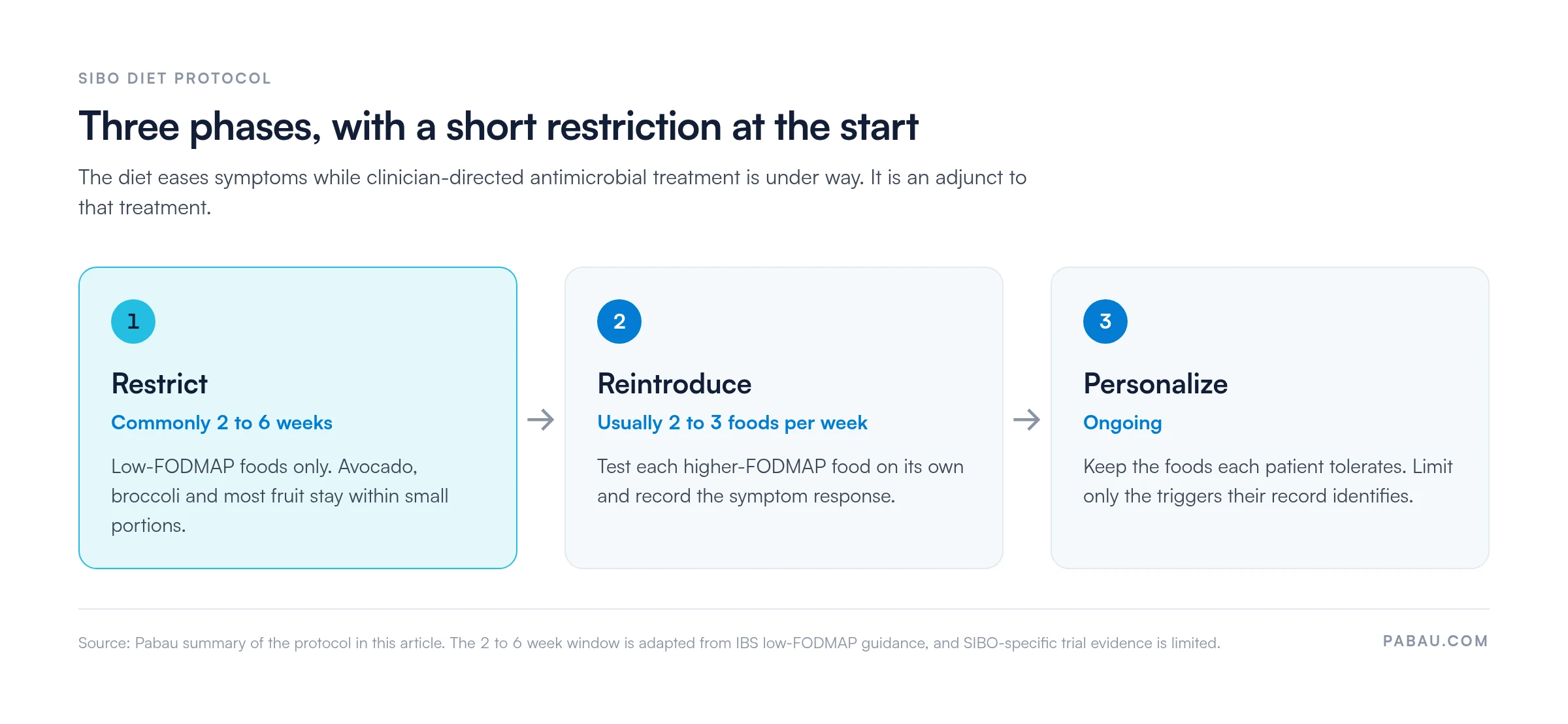
Reintroduction usually covers 2 to 3 higher-FODMAP foods per week, each tested on its own to find the patient’s limit. Some patients tolerate all FODMAPs after bacterial clearance. Others stay sensitive and do better on long-term low-FODMAP eating.
Record each reintroduced food, the portion and the symptom response. That record shows which foods trigger symptoms and explains each diet change. The exact length depends on your clinician’s view of how well the bacteria are cleared and symptoms have eased.
Without a shared system, dietary follow-up often runs on paper food diaries and emailed handouts. Symptom notes then sit in inboxes and folders, apart from the patient’s chart.
In Pabau, the practice management platform we build, you can send a diet questionnaire as a digital intake form before each visit. Answers land in the patient record, next to treatment notes and reintroduction results.
During the consultation, Pabau Scribe, our AI medical scribe, drafts the note so you spend less time typing. Practices that also run nutrition or weight programs use the same forms and records through Pabau’s weight loss clinic software.
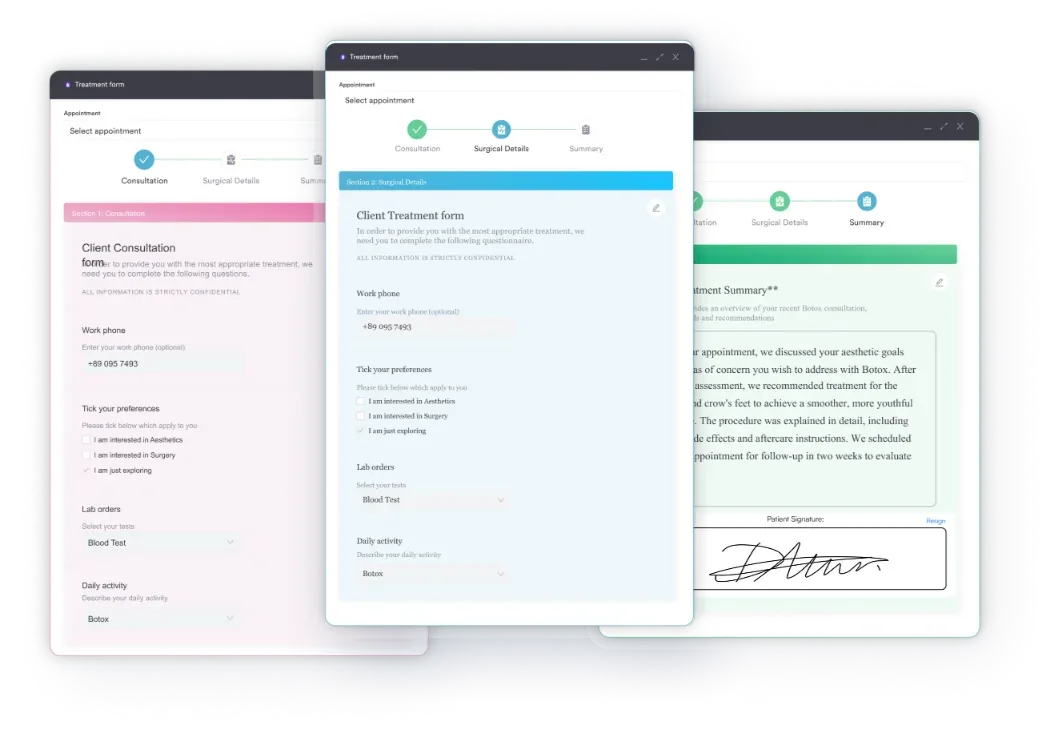

Pabau, our practice management software, lets practitioners send dietary questionnaires as digital forms and keep results in each patient record.

Keep the restriction short and the reintroduction careful. The 2 to 6 week window is widely used, but it is borrowed from IBS guidance, and few trials test it in SIBO. Treat the food list as a symptom tool that runs alongside antimicrobial treatment.
Portions deserve as much attention as the lists. Avocado, broccoli and several fruits move from safe to trigger once the serving grows, so write the serving next to the food on every handout.
Record what each patient eats, how they react and which foods return, and each diet change has a reason on file. Book a demo to see how Pabau keeps dietary questionnaires, notes and follow-ups in one patient record.

Need serving cutoffs for more foods? FODMAP food list sorts low and high FODMAP foods with the serving that keeps each one safe.
Managing a methane-dominant case? Low carb food list gives net carb counts for planning a lower-carbohydrate phase.
Patient needs gentler meals? Gastrointestinal soft diet food list covers easy-to-digest foods for sensitive digestion.
Want a simple stomach-friendly handout? Bland diet food list template sets out low-irritant foods to hand patients.
Safe foods on a SIBO diet include plain proteins such as chicken, fish and eggs, plus white rice and oats in moderation. Low-FODMAP vegetables (carrots, spinach, zucchini), low-fructose fruits (blueberries, strawberries) and fats such as olive oil and butter are also safe. Individual tolerance varies, so foods are tested one at a time during reintroduction.
Avoid high-FODMAP foods, which feed bacterial fermentation. The main ones are onions, garlic, wheat, rye, legumes, apples, pears, mango, lactose-rich dairy and processed foods with high-FODMAP additives. These foods commonly trigger bloating, gas and abdominal discomfort in SIBO.
The difference is the organism and the gas it produces. Hydrogen-dominant SIBO comes from bacteria, while methane-dominant SIBO, also called intestinal methanogen overgrowth (IMO), comes from archaea called methanogens. Both start from a low-FODMAP diet. No trial establishes different diets by gas type, though some clinicians restrict carbohydrate further in methane-dominant cases.
The restriction phase commonly lasts 2 to 6 weeks, a window adapted from IBS guidance and usually run alongside antimicrobial treatment. Reintroduction of higher-FODMAP foods then follows over several weeks. Some patients tolerate all FODMAPs again, while others do better on ongoing low-FODMAP eating. Duration depends on individual response and clinician guidance.