Stroke impact scale: Free PDF, scoring and MCID by domain
The stroke impact scale (SIS) is a 59-item questionnaire in which stroke survivo...

2
Last Updated: Oct 13, 2026

The pediatric balance scale is a validated 14-item assessment measuring functional balance in children aged 5-15 with mild to moderate motor impairments.
Each item is scored 0-4 on an ordinal scale, producing a maximum total score of 56 points — higher scores indicate better balance function.
Scores rise with age in typically developing children, with most reaching the scale’s ceiling by around age 7 — useful context for judging whether a result reflects typical development or a deficit.
Pabau, practice management software for therapy practices, logs each PBS score directly in the patient’s record so you can track progress across visits automatically.
Whether you work in a therapy practice management system or a paper-based practice, understanding the pediatric balance scale (PBS) scoring framework and normative trends ensures you can reliably assess motor function and track progress over time. See our med spa management software ranking if your therapy practice also offers cash-pay aesthetic services.
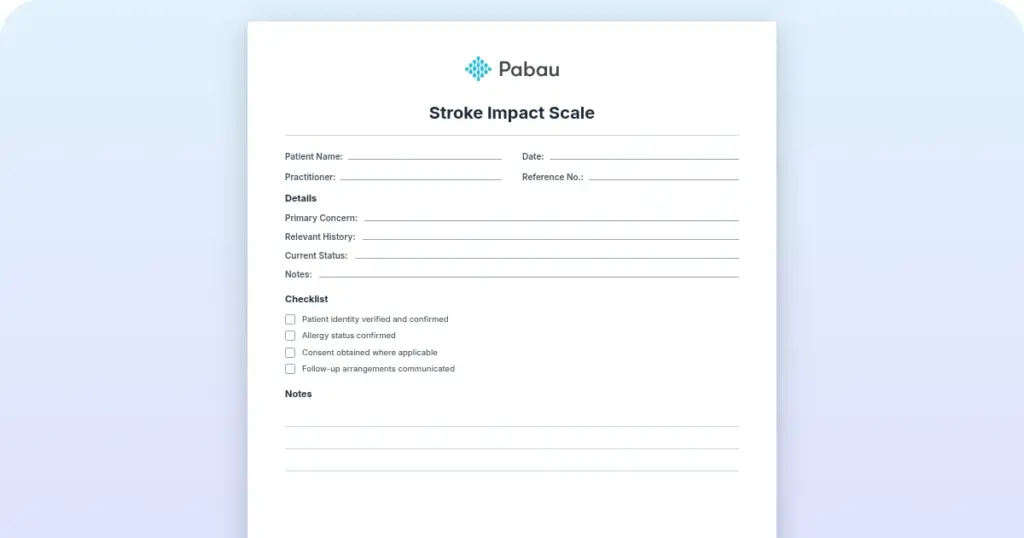
A standardized 14-item clinical assessment form for evaluating balance and functional mobility in school-aged children. Includes scoring instructions, normative reference data by age, and interpretation guidance for physical therapists, occupational therapists, and speech-language pathologists.
Download templateThe pediatric balance scale is one of the most widely used clinical assessment tools for evaluating balance and functional mobility in school-aged children. This guide walks you through administering the assessment, scoring each item, interpreting results, and using findings to guide treatment planning.
The pediatric balance scale (PBS) is a criterion-referenced functional outcome measure designed to assess balance skills in school-aged children with mild to moderate motor impairments. It was developed by Franjoine and colleagues in 2003 as a modification of the Berg Balance Scale (BBS), which was originally designed for older adults.
Unlike the adult Berg Balance Scale, the PBS reduces the number of items and adjusts task complexity to match the motor capabilities and attention span of children aged 5-15 years. It remains the gold standard in pediatric rehabilitation for identifying balance deficits and monitoring functional recovery in conditions ranging from cerebral palsy to post-surgical orthopedic patients.
The PBS is appropriate for physical therapists, occupational therapists, and speech-language pathologists working with school-aged children. It is validated for children aged 5-15 years with mild to moderate motor impairments affecting balance and functional mobility.
Common clinical populations include cerebral palsy, traumatic brain injury, spina bifida, Down syndrome, developmental delay, post-surgical orthopedic patients, and children recovering from stroke. The physical therapy practice management and occupational therapy documentation workflows often require outcome measures like the PBS to track functional progress and support treatment justification for insurance billing.
The pediatric balance scale consists of 14 functional balance and mobility tasks. Each item is scored on a 0-4 scale based on the child’s ability to complete the task independently or with minimal assistance.
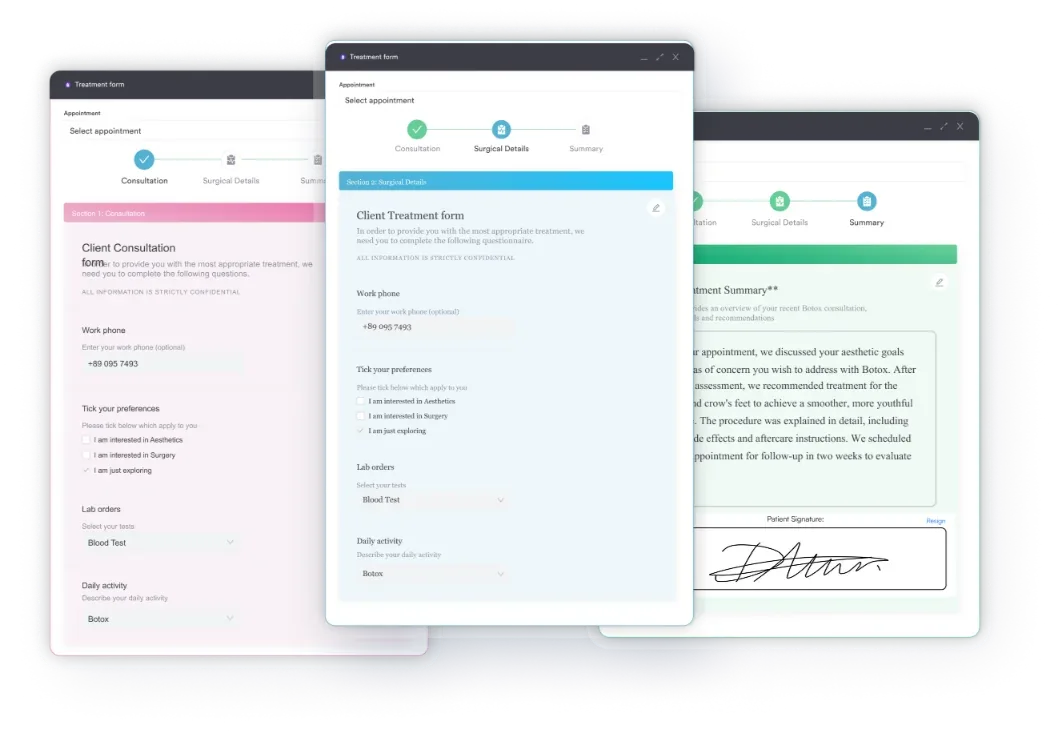
Clinical form capture tools let staff complete assessments like this on a tablet during the session itself.
Each of the 14 items is scored using a standardized 0-4 point scale. The scoring descriptor reflects the child’s performance quality and level of assistance needed to complete the task safely.
The total pediatric balance scale score ranges from 0 to 56 points. Recording your scoring decisions in digital intake forms lets you store results directly in the patient record and compare scores across multiple assessment visits.
Higher scores indicate better balance and a lower likelihood of falls, while lower scores point to greater functional impairment. Unlike the adult Berg Balance Scale, though, the PBS has no single universally validated fall-risk cutoff score.
Franjoine and colleagues designed the PBS as a criterion-referenced measure of functional ability rather than a pass/fail fall-risk screen, so a score that signals high risk for one child may be developmentally typical for another.
Interpretation should account for the child’s age and diagnosis, drawing on condition-specific validation studies (cerebral-palsy-specific analyses, for example) alongside clinical judgment rather than a generic cutoff.
A change of 4-5 points on the pediatric balance scale is often considered clinically meaningful, indicating true functional progress rather than measurement error.
Franjoine and colleagues’ 2010 normative study of 641 typically developing children found that PBS scores rise steadily with age as gross motor control and balance mature. Younger children scored lower and showed more variability, while scores climbed and clustered toward the top of the scale as children got older.
A strong ceiling effect shows up by around age 7: the majority of 7-year-olds in the study achieved the maximum possible score of 56, and nearly all scored in the low-to-mid 50s.
This is worth keeping in mind when testing older or higher-functioning children. Scores clustering near the top of the range can mean the assessment is no longer sensitive enough to detect further improvement, and a more demanding measure .
The pediatric balance scale has strong psychometric evidence supporting its use in clinical practice. Franjoine’s original 2003 study and subsequent research confirm its reliability and validity, and that same emphasis on rigorous validation is common across other standardized clinical measures.
Store your PBS results in a dedicated outcome measurement section of each patient’s record. Tracking scores across multiple visits allows you to objectively demonstrate progress to families and support insurance authorization requests — a critical component of therapy justification.
While the PBS is a robust assessment tool, it has some limitations worth understanding. The scale may reach a ceiling effect in higher-functioning children, meaning the highest scores cluster near 56 and become less sensitive to small improvements. Children with severe motor impairments may score very low, limiting the test’s ability to track subtle progress.
The PBS also requires children to understand instructions and cooperate with testing, making it less suitable for very young children (under age 5) or those with significant cognitive impairments, who may need simpler observational measures instead.
The PBS also focuses on static and dynamic balance but does not measure gait quality or reactive stepping, so it pairs well with other tools for comprehensive motor evaluation.
Manually tracking PBS scores across multiple visits on paper or disconnected spreadsheets wastes valuable data and slows your ability to identify progress. Pabau’s structured clinical notes system integrates assessment results directly into each child’s permanent record, making score trending automatic and transparent.
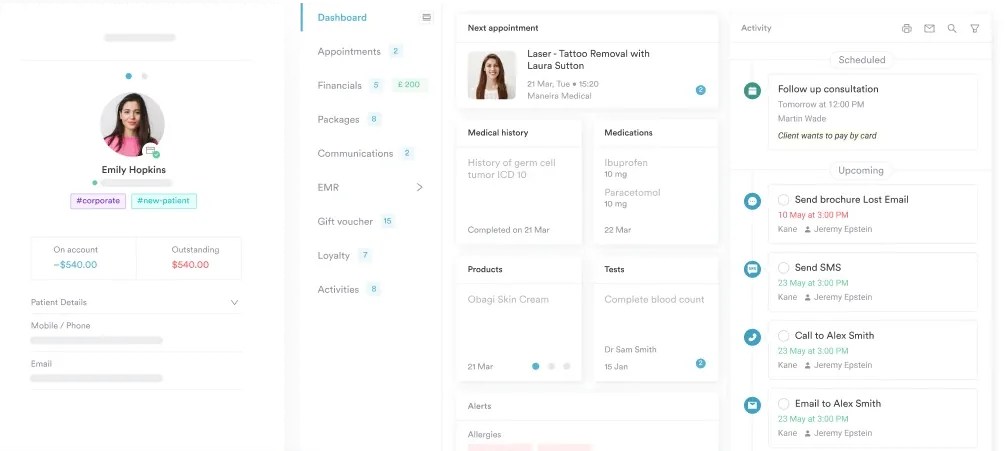
When you download the free pediatric balance scale PDF from this page and use Pabau’s outcome tracking and automation features, you can set reminders to re-administer the PBS at planned intervals, attach historical scores as a graph in session notes, and export trend reports for family conferences or third-party payer documentation.
This connects the assessment directly to your daily workflow, turning raw scores into treatment adjustments and clear progress updates for families and payers.


Discover how Pabau helps therapy practices store, trend, and communicate assessment results to families and payers.

The pediatric balance scale remains the gold standard for assessing functional balance in school-aged children with motor impairments. Its 14-item structure, strong psychometric properties, and availability of normative data make it an essential tool for physical therapists, occupational therapists, and speech-language pathologists. Clinicians tracking motor skills more broadly also use Beery VMI scoring to document visual-motor integration.
Download the free PDF form above to begin incorporating structured PBS assessment into your practice. When paired with outcome tracking software that preserves your assessment history, the pediatric balance scale becomes a powerful communication tool that demonstrates patient progress and guides treatment decisions.

Comparing osteopathy practice management software? osteopathy practice management software roundup compares nine tools on scheduling, SOAP notes, billing, and reporting.
Assessing knee stability in another patient? posterolateral drawer test guide walks through technique, grading, and common pitfalls for testing the knee’s posterolateral corner.
Want to see another standardized test documented step by step? Alar ligament test walks through how to perform, interpret, and record a comparable physical assessment.
The pediatric balance scale is a clinical assessment tool used to measure functional balance and mobility in children aged 5-15 years. Results help identify balance deficits, guide therapy planning, monitor progress, and support treatment justification for insurance purposes.
The PBS is validated for children aged 5-15 years with mild to moderate motor impairments. Children younger than 5 may not understand task instructions, while adolescents 16+ typically transition to adult balance assessments.
Each of the 14 items is scored on a 0-4 point ordinal scale, where 4 = independent completion, 3 = some loss of balance, 2 = moderate assistance required, 1 = significant assistance required, and 0 = unable to complete. Total scores range from 0-56 points.
The maximum score on the PBS is 56 points (14 items multiplied by 4 points per item). Higher scores indicate better balance and lower fall risk, but there’s no single validated cutoff score — interpretation should account for the child’s age and diagnosis.
The PBS is a child-friendly modification of the adult Berg Balance Scale, with simplified task instructions, reduced demand for sustained attention, and age-appropriate normative reference data. The BBS is designed for older adults; the PBS is optimized for school-aged children.
PBS scores rise with age in typically developing children. A 2010 normative study by Franjoine and colleagues found that most children reach the scale’s ceiling by around age 7, with the majority scoring in the low-to-mid 50s or achieving the maximum score of 56 by that age.