Seated flexion test
The seated flexion test is a palpation-based assessment of sacral motion at the ...

2
Last Updated: Oct 15, 2026
The PCS pain catastrophizing scale is a 13-item self-report questionnaire that measures how far a patient’s thinking about pain tips into catastrophizing. Patients rate each item from 0 to 4, which gives a total between 0 and 52. A score of 30 or above flags clinically significant catastrophizing.
Michael Sullivan and colleagues published the scale in 1995, and it remains one of the most widely used psychological pain measures. Clinicians in chronic pain, musculoskeletal injury, and surgical recovery use it to spot patients whose thinking is likely to slow rehabilitation. The free PDF template below covers all 13 items and the scoring key.
A practice-ready assessment form carrying all 13 Pain Catastrophizing Scale items, grouped by subscale. It includes the 0-4 response fields, the scoring key for rumination, magnification and helplessness, and the cutoff thresholds.
Download template
The PCS is a validated 13-item questionnaire rated on a 0-4 Likert scale, giving a total score from 0 to 52.
A total score of 30 or above is the threshold most often used for clinically significant pain catastrophizing in chronic pain populations.
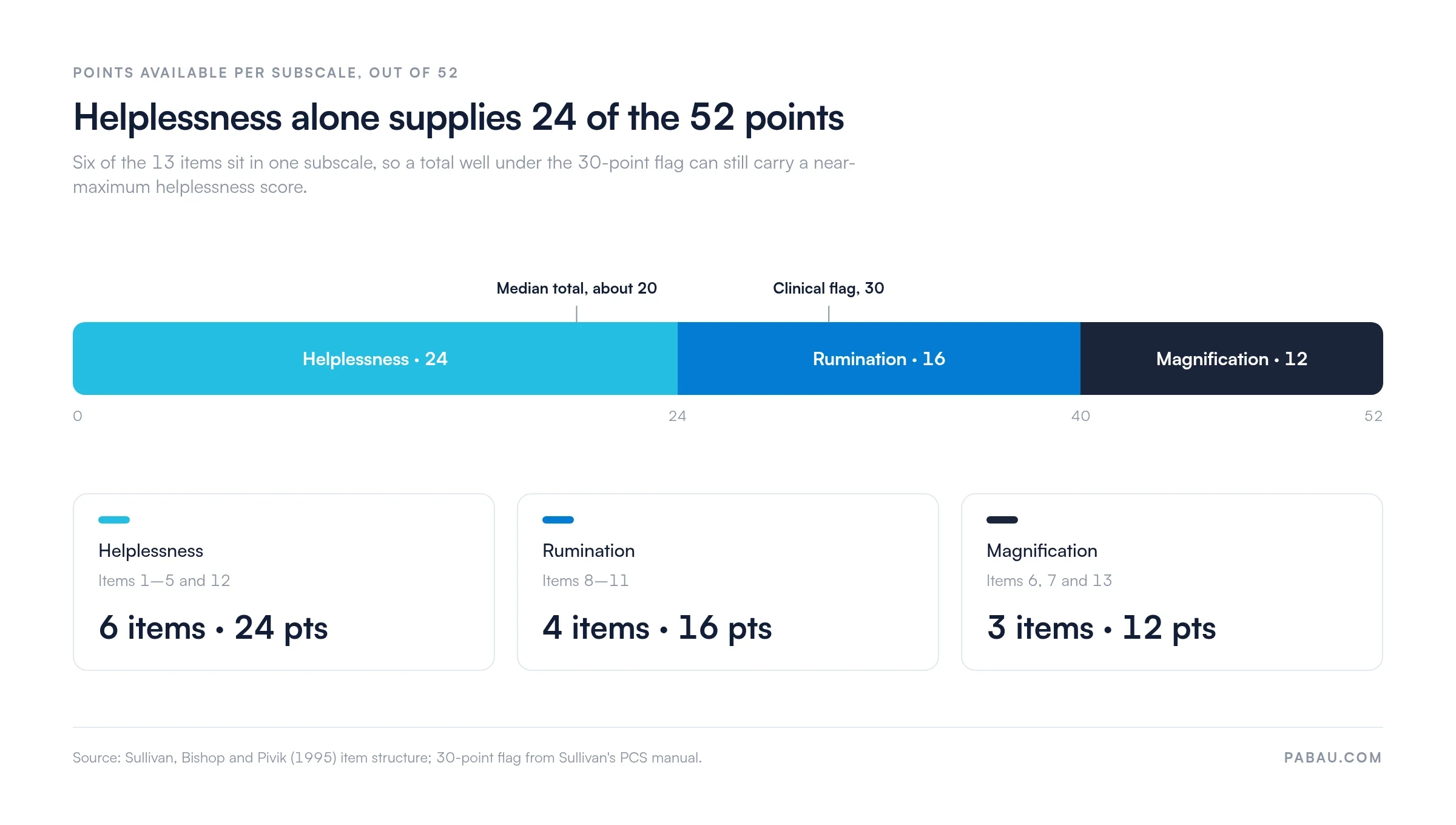
The three subscales measure rumination (4 items), magnification (3 items), and helplessness (6 items), each a distinct dimension of catastrophic thinking.
Helplessness supplies 24 of the 52 available points, so a mid-range total can still hide a near-maximum helplessness score.
Pabau’s digital forms and outcome tracking let practitioners administer the PCS digitally and monitor score changes across treatment episodes.
The PCS pain catastrophizing scale is a structured self-report measure of catastrophic thinking about pain. It covers three psychological dimensions: rumination, magnification, and helplessness. Sullivan, Bishop, and Pivik published the original validation in 1995, grounding it in a cognitive-appraisal model of pain.
Pain intensity and pain appraisal are separate measurements, and the PCS captures the second one. What a patient believes a sensation means predicts treatment adherence, opioid use, and return-to-work timelines. An intensity rating on its own leaves those outcomes unexplained.
The full instrument has 13 statements. Examples include “I keep thinking about how badly I want the pain to stop” and “I feel I can’t go on.” Patients rate how often each thought occurs during painful experiences, from 0 (not at all) to 4 (all the time).
Subscale scores are summed and then totaled. The Shirley Ryan AbilityLab RehabMeasures Database lists the PCS as a recommended outcome measure for musculoskeletal, neurological, and chronic pain populations.
Each subscale targets a distinct cognitive pattern. Understanding what they measure helps clinicians interpret scores and direct intervention.
Helplessness carries the most weight, contributing up to 24 of the 52 available points. Patients who score high on this subscale respond less well to standard physical rehabilitation. Adding psychological support to the plan changes that trajectory, and the split below shows how far one subscale can carry a total.
Scoring takes under two minutes once the patient has completed the questionnaire. Follow these steps:
Collecting PCS responses through digital intake forms removes transcription errors and calculates the subscales for you. In Pabau, the practice management platform we build, those scores post straight to the patient record. That matters most if you administer the scale at every follow-up appointment.
The 30-point cutoff comes from Sullivan’s PCS manual, where it sits at roughly the 75th percentile in chronic pain samples. The lower bands below are approximate guides based on chronic pain sample distributions, with a median around 20. They are not published clinical categories.
A total of 30 or above is the threshold cited most consistently in published literature for catastrophizing that impedes standard treatment. Treat it as a screening flag rather than a diagnostic criterion. Clinical judgment, patient history, and other assessments should inform the final care decision.
Track PCS scores at intake and at key clinical milestones rather than once only. A patient whose score drops from 38 to 21 over six weeks has made measurable psychological progress. That holds even if pain intensity scores have barely moved. The trajectory is useful evidence for justifying continued multidisciplinary care.
The PCS suits a broad range of clinical settings and populations. It was first validated in chronic pain samples. Since then it has been used widely in surgical, oncological, and acute musculoskeletal contexts.
The scale can be administered at first assessment, repeated at agreed intervals of four to six weeks, and used as a discharge measure. Patient burden is low, and most patients finish all 13 items in under four minutes.
The Pabau template is a practice-ready PDF covering all 13 items with response fields, subscale grouping labels, and a scoring summary section. Here is how it fits a standard clinical workflow:
The PCS has strong psychometric credentials. A 2022 Scientific Reports study followed 180 patients with chronic low back pain. It reported a Cronbach’s alpha of 0.90 for the full 13-item PCS. That paper, Measurement precision of the Pain Catastrophizing Scale and its short forms in chronic low back pain, also assessed the shorter versions.
A daily diary version was developed and validated in 2017 (PMC5581222). It enables momentary assessment of catastrophizing in everyday settings, mainly in research rather than routine clinical use.
A 6-item short form (PCS-6) was developed and validated by McWilliams and colleagues in 2015. The PCS-6 holds adequate psychometric performance for screening, where brevity matters more than subscale detail. Busy primary care consultations and large research studies are the usual settings.
Use the full 13-item PCS for a baseline clinical assessment, a referral decision, or tracking change across a treatment episode. Use the PCS-6 for population screening, for sessions already carrying several other measures, or for frequent repeat assessment. The short form should not replace the full scale where subscale profiles drive the decision.
The PCS occupies a distinct role in the pain assessment toolkit. Comparing it with other common measures clarifies when to use it and when to pair it with another instrument.
A practical intake battery for a chronic pain or rehabilitation patient combines three measures. Use the NPRS for intensity, the PCS for psychological response, and the PSFS for functional goals. Practices that prefer a mark-on-a-line format can swap the NPRS for the visual analogue scale, which records intensity on a 10 cm line.
Paper administration works until the scores need comparing. A handwritten total gets transposed incorrectly, filed against the wrong episode, or stored where nobody looks for it. Pulling the previous form mid-appointment takes longer than the comparison is worth, so clinicians skip it.
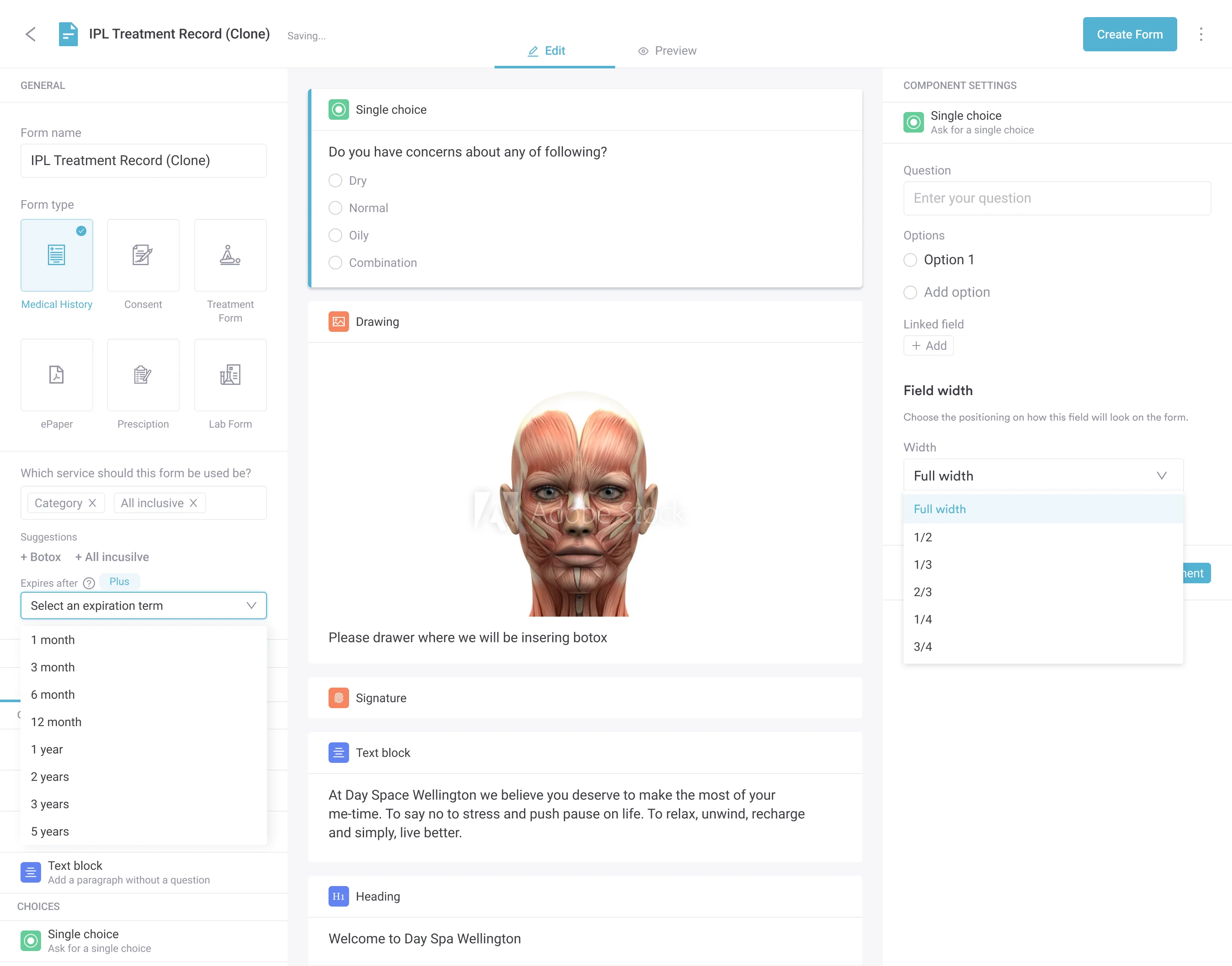
Pabau’s platform handles that workflow directly. Clinicians use patient capture forms to send the PCS before the appointment, so the score is ready at the start of the session. The clinical measurements tracking feature stores total and subscale scores against each appointment date, which makes longitudinal comparison straightforward.
Pabau Scribe, our AI scribe, writes the clinician’s interpretation of the findings and the clinical response into the structured note. The documented response then sits alongside the score that prompted it.

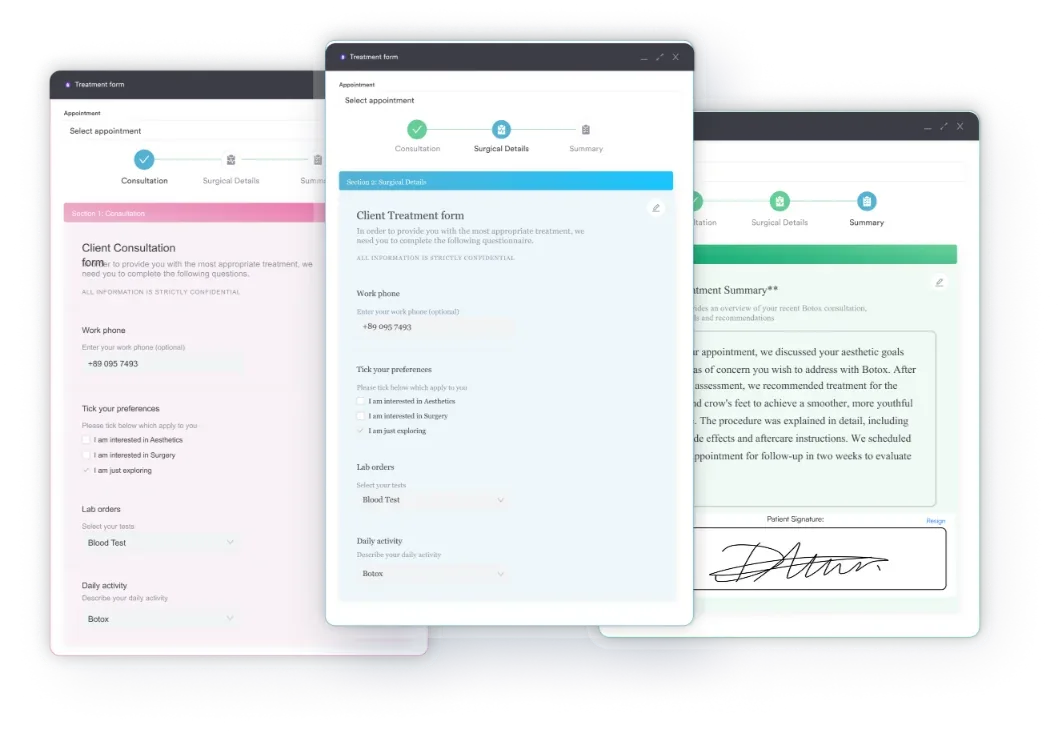
Pabau lets you administer the PCS digitally, store scores in the patient record, and monitor changes over time. No paper forms, and no manual calculation.

Pain catastrophizing is one of the strongest modifiable predictors of poor rehabilitation outcomes. The PCS quantifies it with a validated, freely available instrument. The 13 items, the three subscales, and the 0 to 52 scoring range carry enough detail to shape a care decision. The patient still finishes in four minutes.
The judgment worth keeping is that the total is a flag, not a finding. Read the helplessness items before you decide what the number means for this patient’s plan.
Download the free template above and build the PCS into your standard intake. Book a demo to see how Pabau administers the scale digitally and tracks each score against the treatment episode.

Want a structured way to take the pain history first? PQRST pain assessment form walks through provocation, quality, region, severity, and timing.
Need one intake form that captures the whole pain picture? Pain assessment intake form template gathers history, location, and functional impact in a single document.
Assessing a patient who cannot self-report? CPOT pain scale scores pain from observed behavior in critical care settings.
Treating children too young for the adult scales? FLACC pain scale rates pain from face, legs, activity, cry, and consolability.
The PCS measures how catastrophically a patient thinks about pain across three dimensions: rumination, magnification, and helplessness. Those patterns predict poor rehabilitation outcomes, delayed recovery, and higher risk of chronic disability. Clinicians use the scores to inform referrals, adjust treatment plans, and track psychological change over time.
A total of 30 or above is the threshold most consistently cited for clinically significant catastrophizing, and it comes from Sullivan’s PCS manual. The lower bands are approximate guides drawn from chronic pain sample distributions, where the median sits around 20. They are not published clinical categories.
Most patients finish all 13 items in under four minutes, and scoring takes under two minutes more. That makes the scale practical at intake, at agreed review points, and again at discharge.
Yes. McWilliams and colleagues developed and validated a 6-item short form, the PCS-6, in 2015. It suits population screening and sessions that already carry several measures. Use the full 13-item version where subscale profiles drive the clinical decision.
Michael Sullivan, with Bishop and Pivik, developed the scale and published its original validation in 1995. It has since been translated into many languages and validated across dozens of clinical populations. Sullivan’s manual remains the standard scoring reference.
The PCS is openly accessible for clinical and research use, and the template above gives you a practice-ready PDF. Commercial reproduction, or inclusion in a proprietary assessment product, may still require permission from the copyright holder.
No. Do not use the adult PCS with patients under 18. A separate pediatric version, the PCS-C, has been independently developed and validated. It carries age-appropriate language and its own normative data.
A 2022 Scientific Reports study of 180 patients with chronic low back pain reported a Cronbach’s alpha of 0.90 for the full PCS. Its three-factor structure has been confirmed repeatedly, and higher scores predict greater disability, longer sick leave, and poorer surgical outcomes.