Fun journal prompts for adults
Fun journal prompts for adults are short, open-ended questions that make sitting...

Last Updated: Oct 6, 2026
A medical source statement form is a document in which a treating clinician describes a patient’s functional limitations and ability to work. The Social Security Administration (SSA) uses it as opinion evidence when deciding Social Security Disability Insurance (SSDI) and Supplemental Security Income (SSI) claims.
The statements that hold up give measurable limits and match the clinician’s own treatment notes. They also come from an acceptable medical source, such as a physician or psychologist.
Below is a free template, plus the physical and mental versions and who qualifies to sign. We also walk through eight steps to complete it and the mistakes that weaken a claim.
A ready-to-use template covering patient identifiers, functional capacity assessment sections, treatment history, and SSA submission requirements. Customize the fields for your practice and use it to prepare complete, accurate medical source statements.
Download template
A medical source statement form records a treating clinician’s opinion of a patient’s functional limits and work capacity for SSA disability claims.
Acceptable medical sources are defined in 20 CFR 404.1502, and licensed clinical social workers are not on that list.
Examiners weigh each statement on supportability and consistency with your treatment notes, not on your status as the treating clinician.
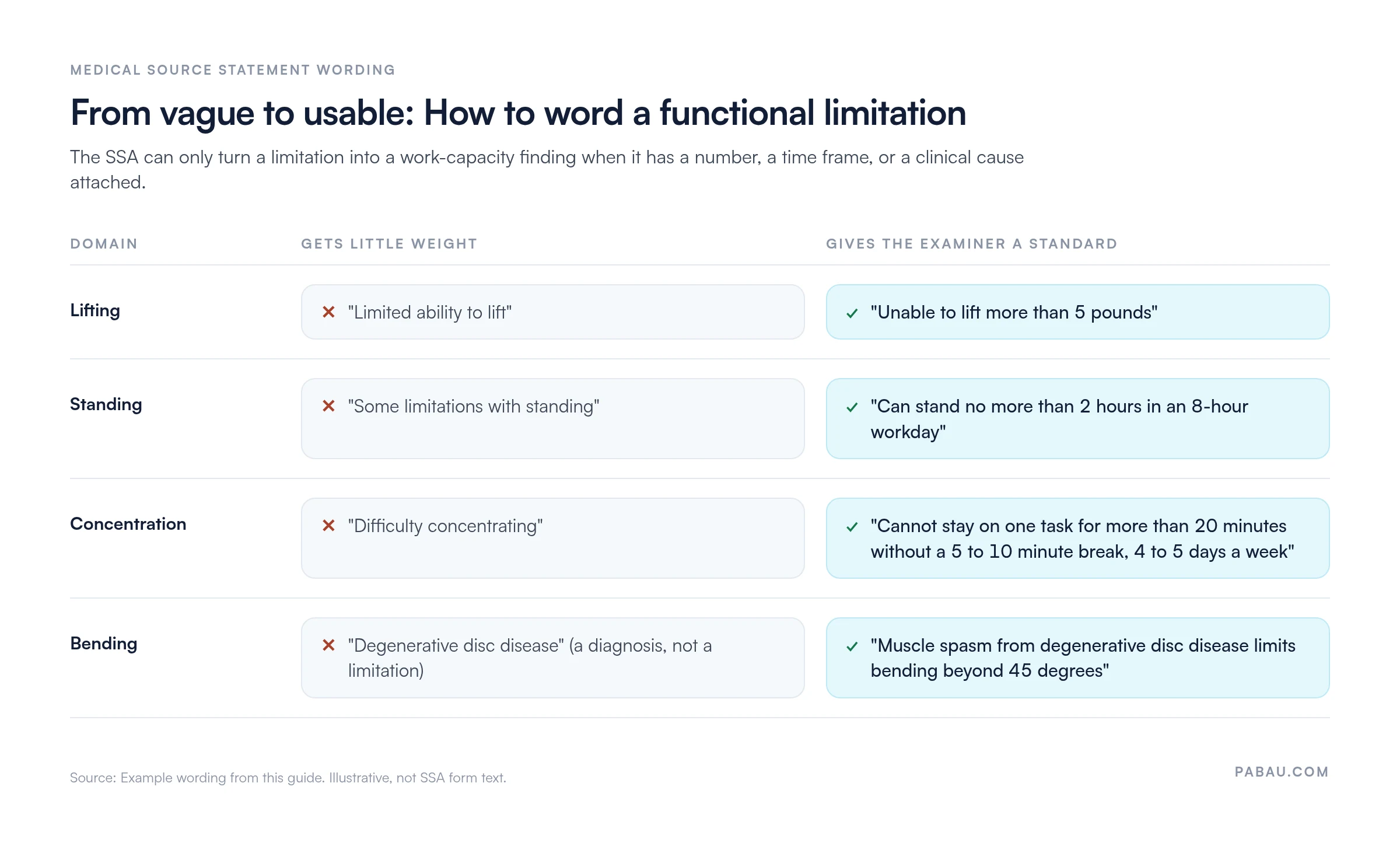
Measured limits, such as “unable to lift more than 5 pounds,” carry far more weight than “has some difficulty.”
Practice management software like Pabau keeps visit notes, authorizations, and submission dates on one record, so each statement can cite its evidence.
A medical source statement form is a structured questionnaire that asks a treating clinician to describe what a patient can and cannot do. It covers physical, cognitive, and emotional function, and whether those limits stop the patient from working.
The form is neither a diagnosis nor a prescription. It describes how a condition affects day-to-day functioning, which the SSA calls residual functional capacity (RFC). RFC is the most a patient can still do despite their impairment.
The statement carries weight because it comes from the clinician who knows the patient best, backed by months or years of treatment records. A well-completed form can move a case from denial to approval.
Intake, consent, and treatment-planning records all feed into the statement, so the medical forms your practice already uses shape how well you can support it.
The SSA uses a different statement for physical impairments than for mental health conditions. Each one focuses on the functional areas that matter for that type of condition. Long-term disability insurers often request the same information in their own format.
The physical statement asks about exertional limits, meaning how much a patient can lift, carry, sit, stand, walk, and climb. It also covers postural abilities, such as bending, reaching, and balancing, and tolerance for noise, temperature, and vibration. Physicians, physiatrists, orthopedists, and rheumatologists complete it most often.
The mental health statement assesses cognitive, emotional, and social functioning. It covers concentration, memory, getting along with others, following instructions, managing stress, and coping with a work setting. Psychiatrists and psychologists usually complete it. Social workers and counselors often do too, although the SSA does not class them as acceptable medical sources.
Any licensed clinician who treats the patient can complete a medical source statement. To establish that an impairment exists, though, the SSA needs objective evidence from an “acceptable medical source,” as defined in 20 CFR 404.1502.
Acceptable medical sources include:
Licensed clinical social workers (LCSWs) and counselors are not acceptable medical sources. The SSA still considers their statements as evidence, but it cannot rely on them alone to establish an impairment.
Whoever signs the form must have treated the patient and hold notes or test results that back each statement. Generic statements not tied to the patient’s treatment get little or no weight.
The SSA also checks whether the opinion falls within the clinician’s expertise. A dermatologist’s view of mental health functioning carries less weight than a psychiatrist’s.
Completing the form well comes down to specificity, consistency with your treatment notes, and a clear line from diagnosis to functional impact. Work through these eight steps.
Certain errors trigger closer scrutiny, a request for clarification, or a denial. Vague wording does the most damage, and the examples below show how to turn it into a measurable limit.
The SSA doesn’t take a medical source statement at face value. Examiners and judges test each opinion against set factors, and knowing them lets you write to them.
Supportability: Is the statement backed by clinical findings, test results, and treatment notes in your record? The more objective evidence you cite (lab values, imaging, standardized assessment scores, visit frequency), the better supported the opinion is. Statements without underlying clinical evidence are often disregarded.
Consistency: Does the statement match what you documented over time? If your notes describe the patient as “doing well on current medications” but the statement describes severe limitations, the conflict weakens it. Examiners cross-check the statement against your notes to catch this.
Specialization: Is your field relevant to the patient’s condition? A cardiologist’s detailed opinion on cardiac capacity carries more weight than a general internist’s view of the same limits. Both may still be acceptable medical sources.
For claims filed on or after March 27, 2017, 20 CFR 404.1520c removed automatic deference to treating sources. Supportability and consistency are now the two most important factors. Your opinion carries weight only when it is well reasoned and tied to specific evidence.
A statement request usually arrives with a deadline. Without one system, the clinician digs through paper notes, scanned PDFs, and separate tools to find visit dates, test results, and the signed release.
Practice management software like Pabau keeps that evidence on one patient record. It is captured at every visit instead of being pieced together when the request lands.

The result is a statement written from evidence you already hold, with notes that match what you wrote. Book a demo to see how clinical records, digital forms, and compliance tools fit together for disability documentation.

Pabau’s digital forms and medical records capture functional findings at every visit and keep signed authorizations on file. Your next medical source statement then cites evidence you already hold.

Treat the statement as a translation job. The examiner already has the diagnosis, so the form earns its weight through limits you can measure and notes that prove them.
If your notes rarely record function, fix that before the next request lands. A form written from sparse notes reads as advocacy, however sound your clinical judgment is. Notes that track lifting, standing, and focus at each visit let the statement write itself from the record.
Book a demo to see how Pabau keeps functional findings, signed authorizations, and submission dates on one patient record, ready for the next disability request.

Need the patient’s records from another provider? Medical record request form gives you a signed request for prior treatment records or disclosure to a third party.
Asked to confirm a diagnosis in writing? Diagnosis letter from a doctor lays out the sections a recipient expects, from patient details to the diagnosis statement.
Want visit notes that support future statements? Clinical progress notes shows how to record observations and interventions so each visit documents function.
Documenting a shorter absence from work? Doctor’s note for work provides a template for recording a patient’s fitness for work.
A medical source statement form is a structured document completed by a treating clinician that describes a patient’s functional limitations and ability to work. It is used by the Social Security Administration to evaluate whether a patient qualifies for disability benefits.
Any licensed clinician who treats the patient can complete one. Acceptable medical sources are defined in 20 CFR 404.1502. They include licensed physicians (MDs and DOs), psychologists, advanced practice registered nurses, physician assistants, optometrists, podiatrists, audiologists, and speech-language pathologists. The clinician must have treated the patient and have access to clinical records supporting the statement.
A physical medical source statement assesses exertional limitations (lifting, standing, sitting, postural ability). A mental health medical source statement assesses cognitive, emotional, and social functioning (concentration, memory, ability to interact with others, stress tolerance).
No. A medical source statement is completed by a treating clinician and reflects their opinion based on clinical observations. The RFC (residual functional capacity) assessment is made by the SSA’s medical consultants or a judge from the full claim file. The statement informs that assessment, but they are distinct documents.
The SSA weighs each statement on supportability, consistency with your treatment notes, and the clinician’s specialization. A detailed statement backed by clinical findings carries significant weight. Vague or unsupported statements receive little weight.
Include the diagnosis, onset date, treatment history, and findings. State each functional limitation in measurable terms, such as “unable to stand more than 2 hours per day.” Add the clinical basis for each limitation, how it compares with prior records, and your signature, credentials, and date. Every statement must be supported by your clinical notes.