Fun journal prompts for adults
Fun journal prompts for adults are short, open-ended questions that make sitting...

Last Updated: Oct 6, 2026
A DOT medication restrictions list is a reference guide to how federal rules treat a commercial driver’s medications. DOT itself publishes no official list of banned drugs. Under 49 CFR 391.41(b)(12), any Schedule I drug disqualifies a driver outright. A prescribed drug from Schedules II to V can be allowed when the prescriber advises it won’t affect safe driving.
That prescriber’s advice doesn’t decide the outcome on its own. The certified medical examiner weighs it, along with the driver’s condition and side effects, and makes the call case by case. Our free reference sorts medications into those tiers and gives examiners a review checklist for each DOT physical.
A printable reference that sorts a driver’s medications into Schedule I, prescribed scheduled drugs, and non-scheduled drugs. It includes a review checklist for medical examiners to use at each DOT physical.
Download template
DOT publishes no official medication list, so a DOT medication restrictions list is a reference guide to 49 CFR 391.41(b)(12).
Any Schedule I drug disqualifies a commercial driver, with no exception for a prescription or a state law.
Prescribed drugs in Schedules II to V can be allowed when the prescriber advises they won’t affect safe driving.
The medical examiner makes the final call case by case, and the optional MCSA-5895 collects the prescriber’s opinion in writing.
Pabau, the practice software we build, keeps each driver’s intake answers, medication history, and exam note in one record.
The DOT medication restrictions list is a working summary of one federal rule, not a document FMCSA issues. The Federal Motor Carrier Safety Administration (FMCSA) sets the standard in 49 CFR 391.41(b)(12) and leaves individual drugs to the examiner’s judgment. Lists you’ll find online, ours included, are reference guides built on that rule.
The rule itself has two parts. A driver is qualified if they meet either one:
Part (ii) carries two conditions. The prescriber must be a licensed medical practitioner who is familiar with the driver’s medical history. They must also have advised the driver that the drug won’t adversely affect safe commercial motor vehicle (CMV) operation.
Examiners who apply this rule are certified through FMCSA’s National Registry of Certified Medical Examiners. Only an examiner on the registry can issue a valid medical examiner’s certificate.
The DEA schedule tells you which part of the rule applies, but it doesn’t settle certification on its own. Only Schedule I is a fixed disqualifier. The table shows how the main controlled drug classes line up:
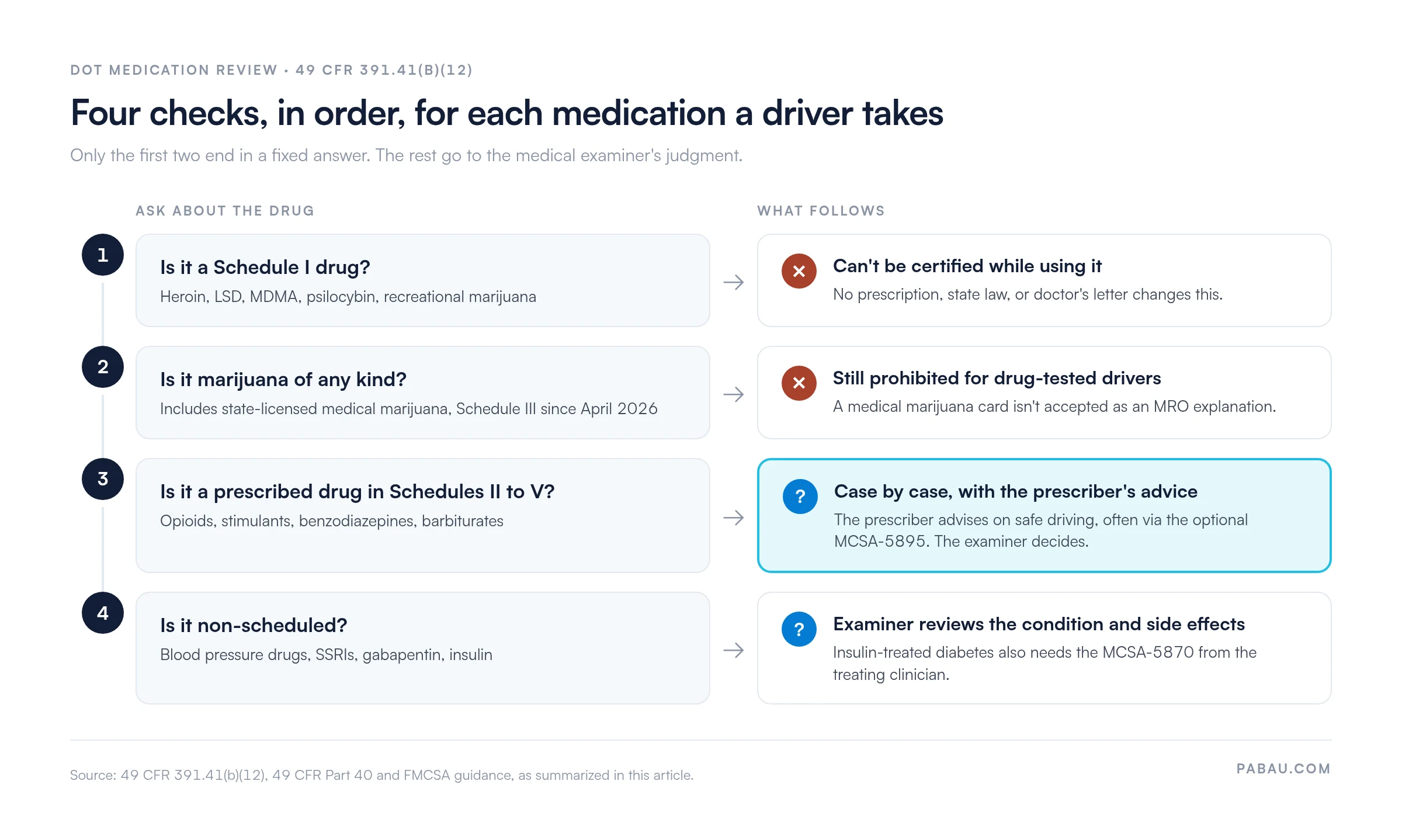
Schedule I is the hard line. A prescription, a state law, or a doctor’s letter can’t move a Schedule I drug into the permitted tier.
Marijuana sits in an unusual spot in 2026. Recreational marijuana stays in Schedule I. The DEA moved FDA-approved and state-licensed medical marijuana products to Schedule III in April 2026. DOT has said its drug testing rules haven’t changed, so marijuana use is still prohibited for drug-tested drivers.
For the opioid, stimulant, benzodiazepine, and barbiturate rows, a valid prescription opens the way to certification. The examiner can still decline to certify if the dose, the side effects, or the condition being treated make driving unsafe.
Taken together, the rule gives each medication a fixed order of checks. Only the first two end in an automatic answer.
Most medications a driver takes fall into one of two permitted-with-review groups. The examiner’s questions differ for each.
Prescribed scheduled drugs (Schedules II to V). Opioids, benzodiazepines, barbiturates, and stimulants qualify under part (ii) when they’re prescribed. The examiner looks at the prescriber’s advice, then decides whether the driver can operate safely on the drug.
Non-scheduled drugs. These don’t fall under the controlled substance rule, but the examiner still reviews them against the condition they treat:
The examiner records each finding and the certification decision on the Medical Examination Report Form, MCSA-5875. That report is the official record of the decision.
The CMV Driver Medication Form, MCSA-5895, is an optional tool for getting the prescriber’s view in writing. The examiner gives it to the prescribing provider, with the driver’s consent. The provider fills it in, signs it, and returns it to the examiner.
The prescribing provider uses the form to record:
The form doesn’t record the examiner’s certification decision. It’s evidence the examiner weighs, and part (ii) of the rule is often the reason to request it. A signed opinion that a scheduled drug is safe for driving is exactly what that part asks for.
Occupational health practices and medical examiners can work through the reference in five steps:
Three years is the federal floor. State medical record laws or employer policies may require you to keep records longer, so check the rule that applies to your practice.
A lab-positive result isn’t reported to the employer straight away. Under 49 CFR Part 40, a Medical Review Officer (MRO) verifies it first and asks the driver for any legitimate medical explanation.
The DOT urine test screens for five drug classes. If your practice also runs collections, our 5-panel drug test form covers that screen.
Return to duty starts with a Substance Abuse Professional (SAP) evaluation and the education or treatment the SAP recommends. The driver then needs a negative return-to-duty test, followed by unannounced follow-up testing the SAP sets.
A new medical certificate isn’t a Part 40 requirement. A driver’s existing certificate is a separate question for the examiner.
Medication histories often arrive on paper and get retyped into the exam notes. Each handoff is a chance to drop a dose, a second prescriber, or a supplement.
Pabau moves that history into digital intake forms. Drivers complete them before the visit, and their answers land in the patient record. You can build the form around this reference, with a field for each medication, dose, and prescriber.
During the exam, Pabau Scribe, our AI scribe, drafts the consultation note from your conversation with the driver. You review and sign it, so the medication discussion is written up without a second typing session.
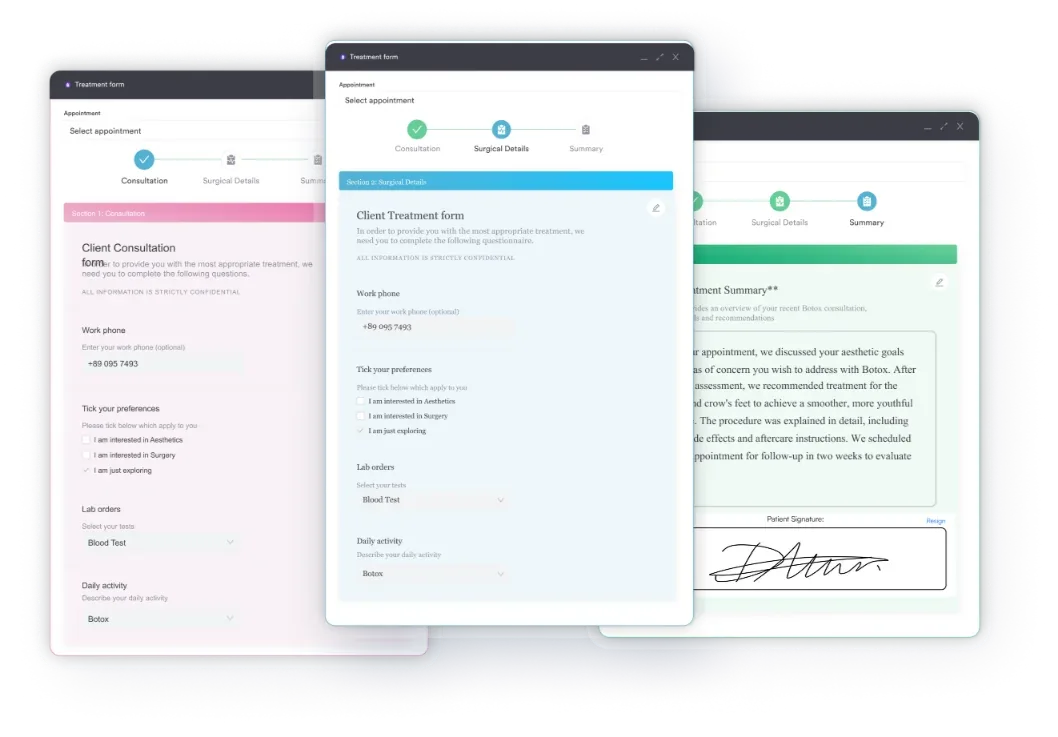

Pabau’s intake forms collect each driver’s medications before the visit, and Pabau Scribe drafts the exam note. Your team spends less time retyping histories.

Use the DEA schedule to sort a driver’s medications, then decide drug by drug. Schedule I is the only automatic no. Every prescribed scheduled drug needs the prescriber’s advice and your own judgment before a decision.
Getting that right protects drivers from losing work over a drug the rule allows. It also keeps an unsafe driver off the road when a prescription alone looks reassuring. Book a demo to see how Pabau keeps medication histories and exam notes together for DOT physicals.

Running the drug screen too? 5-panel drug test form records the DOT-style five-class urine screen for each donor.
Need drivers to list every drug? Medication log template shows what to record for each medication, dose, and prescriber.
Writing up the full exam? History and physical form structures the history and exam findings behind a certification decision.
Tracking when doses are taken? Medication schedule template sets out which drug is taken at what time of day.
Moving intake off paper? Best patient intake software compares tools that collect medication histories before the visit.
The DOT medication restrictions list is a reference guide to how 49 CFR 391.41(b)(12) treats a commercial driver’s medications. FMCSA doesn’t publish an official list of approved or banned drugs. Our free PDF sorts medications into Schedule I, prescribed scheduled drugs, and non-scheduled drugs. You can download it from the box at the top of this page.
Any Schedule I drug or substance disqualifies a CMV driver, including heroin, LSD, MDMA, and recreational marijuana. Prescribed drugs in Schedules II to V, such as opioids, benzodiazepines, barbiturates, and stimulants, aren’t automatic disqualifiers. The examiner decides case by case, informed by the prescriber’s advice that the drug won’t affect safe driving.
Prescribed ADHD medications can be allowed, though FMCSA doesn’t approve any drug by name. Adderall, Vyvanse, Dexedrine, and Ritalin are Schedule II stimulants, so they fall under the prescribed-use exception. The prescriber must advise that the drug won’t affect safe driving, and the examiner makes the final decision. Non-stimulants such as atomoxetine and guanfacine aren’t scheduled and are judged on symptoms and side effects.
Tramadol is a Schedule IV opioid, so it isn’t automatically disqualifying when it’s prescribed. The prescriber must know the driver’s medical history and advise that it won’t affect safe driving. The examiner then weighs the dose, timing, sedation, and the condition being treated. Tramadol taken without a prescription isn’t covered by the exception.
Gabapentin isn’t a federally scheduled controlled substance, so the scheduled-drug rule in 391.41(b)(12) doesn’t apply to it. Some states schedule it under state law. The examiner still checks whether it causes drowsiness or dizziness, and whether the underlying condition affects safe driving.
No, a driver covered by DOT drug testing can’t use medical marijuana. Recreational marijuana remains in Schedule I. State-licensed medical marijuana moved to Schedule III in April 2026, but DOT’s testing rules didn’t change. A medical marijuana card isn’t accepted as an explanation for a positive test.
Blood pressure medications don’t disqualify a driver by themselves. The examiner focuses on whether the driver’s blood pressure is controlled on treatment. FMCSA’s examiner guidance links a reading at or below 140/90 mm Hg to a two-year certificate, and higher readings to shorter certification periods. Side effects such as dizziness also count in the decision.
The MCSA-5895 is an optional form the medical examiner gives to the driver’s prescribing provider. The provider lists the driver’s medications and conditions, then states whether they would adversely affect safe CMV operation. The signed form goes back to the examiner. It doesn’t record the examiner’s certification decision.
A Medical Review Officer (MRO) reviews the result before it’s reported. If you have a legitimate prescription for the drug detected, the MRO can report the test as negative. The MRO may still raise a safety concern if the drug could make you medically unqualified. Return-to-duty steps under Part 40 Subpart O apply only to a verified positive or a refusal.
Yes, a driver has options. They can ask another certified medical examiner for a second opinion. If the driver’s examiner and the motor carrier’s examiner disagree, either party can ask FMCSA to resolve it under 49 CFR 391.47. The driver can also ask their prescriber about an alternative medication.
The text of 49 CFR 391.41(b)(12) hasn’t changed. The April 2026 marijuana rescheduling didn’t change DOT’s drug testing rules either. Check the eCFR before each review cycle, because examiner guidance can still be updated.