Tanja Lepcheska

Pabau vs Hyland OnBase: Healthcare document management software compared
Healthcare document management software captures, stores, and retrieves patient ...

Last Updated: Nov 2, 2026
Free PDF 4 pages, print-ready Clinician-reviewed
The McGill Friendship Questionnaire is a validated self-report measure of friendship quality for late adolescents and young adults, developed by Mendelson and Aboud (1999).
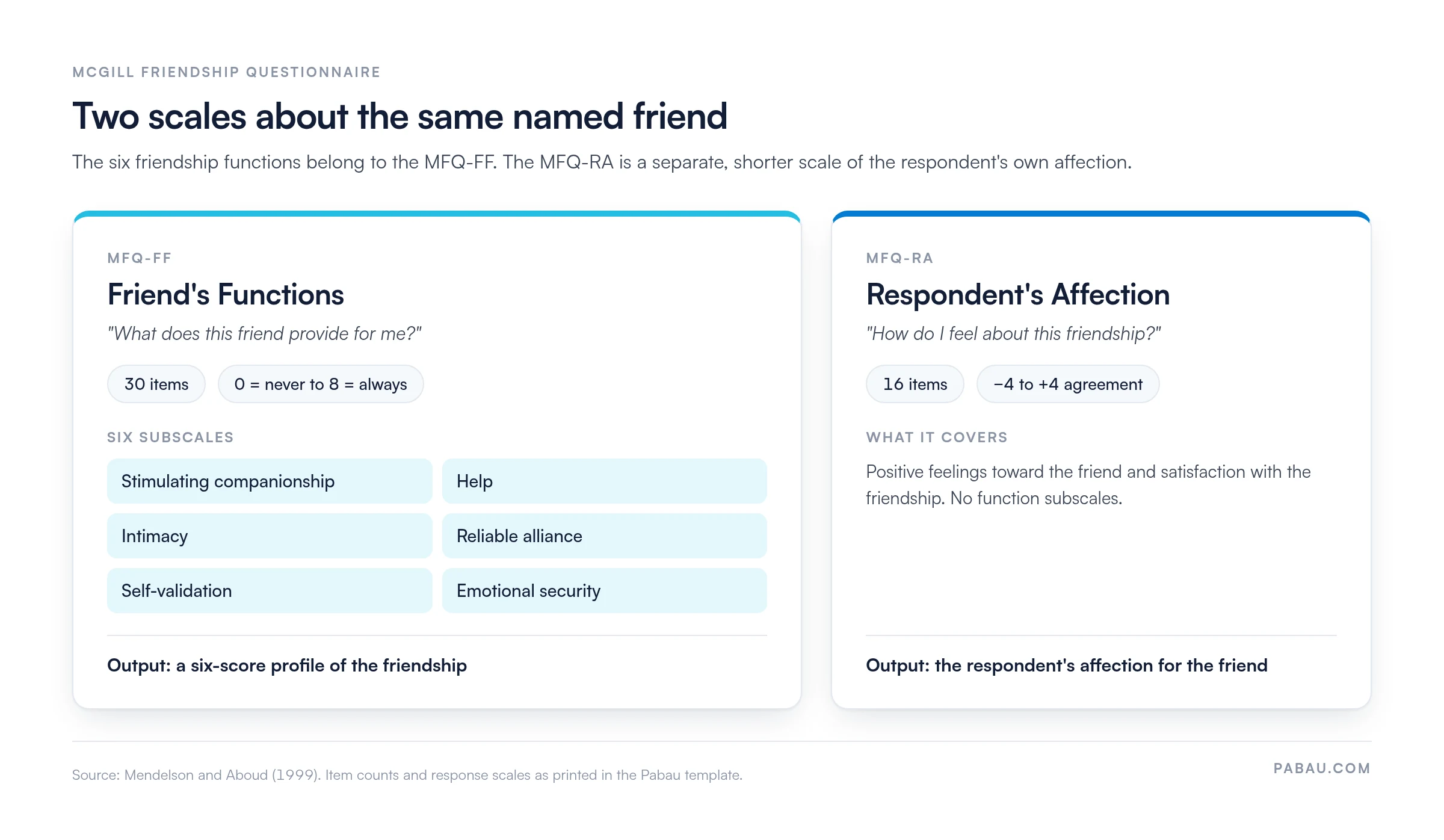
It has two scales. The MFQ-FF (Friend’s Functions) rates how often a named friend provides six functions, such as help and intimacy. The MFQ-RA (Respondent’s Affection) is a shorter scale of positive feelings toward that friend.
This page gives you a free PDF of both scales, plus how to administer, score and interpret them. Psychologists, counselors and researchers use it to see how well a young person’s friendships meet their needs. That matters because poor peer relationships are closely linked to well-being at this age.
Both scales in full: the 16-item MFQ-RA, rated from −4 to +4, and the 30-item MFQ-FF, rated from 0 (never) to 8 (always). Each item names one friend, so the respondent answers about the same friendship throughout.
Start from scratch, or upload this PDF or any form you already use, and Pabau's AI Form rebuilds it with tick boxes, text fields and a signature. Attach it to the treatment once, and every patient gets it on time.
AI Form rebuilds the consent, history and aftercare forms you already use. You review each one, then publish.
Patients complete forms on their phone before they arrive, so the front desk stops retyping paper.
Every signed form is versioned and attached to the treatment record, ready when you need it.
Set how long a consent stays valid. Returning patients skip forms they have already signed.
Supports HIPAA and GDPR compliance AES-256 encryption 4.8 on G2 4.7 on Capterra Trusted by 4,000+ practices worldwide

The McGill Friendship Questionnaire is a self-report measure of friendship quality for late adolescents and young adults.
Its six subscales (stimulating companionship, help, intimacy, reliable alliance, self-validation and emotional security) belong to the MFQ-FF scale.
The MFQ-FF (Friend’s Functions) asks what the friend provides, while the shorter MFQ-RA (Respondent’s Affection) measures the respondent’s positive feelings toward the friend.
It is a research and assessment tool, not a diagnostic instrument, so results should inform rather than determine clinical decisions.
Pabau stores completed forms against the patient record, so you can review responses side by side across sessions.
The McGill Friendship Questionnaire measures how well a young person’s friendships meet their needs. It captures the quality of one friendship rather than simply whether a friendship exists, and that distinction makes it useful in clinical and research settings.
Practitioners use it when they want a structured view of a patient’s peer support. Researchers use it to study how friendship quality relates to other outcomes, such as loneliness or emotional adjustment.
Mendelson and Aboud published the questionnaire in 1999 in the Canadian Journal of Behavioural Science (volume 31, pages 130–132). The paper’s full title is Measuring friendship quality in late adolescents and young adults: McGill Friendship Questionnaires. The authors built it around the idea that friendships serve several distinct functions, and that each one can be measured separately.
The plural in that title is deliberate, because the paper presents two questionnaires. One covers the friend’s functions and the other covers the respondent’s affection. Both were built for late adolescents and young adults, so neither is a general measure for younger children.
The six subscales belong to the MFQ-FF, the Friend’s Functions scale. Each one captures a different way a friend can meet a person’s needs, and each is rated with five items.
The MFQ-RA has no function subscales. It measures how the respondent feels about the friend instead, which the next section covers.
The MFQ-FF (Friend’s Functions) asks the respondent to rate what the friend provides. Its 30 items cover the six functions, and each item is rated from 0 (never) to 8 (always).
The MFQ-RA (Respondent’s Affection) is a separate, shorter scale. Its 16 items measure the respondent’s positive feelings toward the friend and satisfaction with the friendship, rated from −4 to +4. Seen side by side, the two scales answer different questions about the same friendship.
Use the MFQ-FF when you want to see which needs a friendship meets and which it meets less well. Add the MFQ-RA when the patient’s own attachment to that friend matters too. The template includes both, so you can give them in one sitting.
Administration works best when the respondent knows they are describing one specific friendship. Ask them to name one close friend before they begin. If you also need the wider picture of a young person’s history, run it alongside an adolescent intake questionnaire.
Higher scores on an MFQ-FF subscale mean the patient experiences that friendship function more often. Lower scores point to a function the friendship meets less well. Because this is a self-report research instrument, read scores alongside the patient’s account and other clinical information. No single number is a verdict.
Where a low subscale opens a conversation, a friendship worksheet gives the patient a structured way to work on it between sessions.
The questionnaire suits practitioners working with late adolescents and young adults. Psychologists, counselors, school-based practitioners and researchers are the most common users.
If you need to measure support across a patient’s whole network rather than one friendship, a social support scale covers that wider view.
Clinicians use friendship quality as one input when reviewing a young person’s social functioning. It can help explain why a patient struggles with isolation or low mood, and it can show whether support is improving over time.
How strongly a young person wants close connection varies, and a scale of belonging motivation measures that drive alongside the MFQ.
Researchers use the instrument to examine links between friendship and loneliness, adjustment and wider social functioning. Pairing it with the UCLA Loneliness Scale separates the quality of one friendship from how lonely the person feels overall. It is not designed to diagnose a condition, and it should not be used as a stand-alone diagnostic tool.
Several other instruments measure friendship and peer relationships. The right choice depends on whether you need to measure friendship quality, peer acceptance or general social skills. Our general friendship questionnaire template sets several of these instruments side by side.
A downloaded PDF covers a one-off need, but paper copies and email attachments are easy to lose. Pabau, the software for therapy practices we build, turns the questionnaire into a digital form you send before the session.
Patients complete the form ahead of their visit, and their responses flow into the patient record automatically. Your team doesn’t retype scores or chase paper copies.
Because each completed form is stored against the patient record, you can open responses from different sessions and review them side by side. That makes review meetings simpler and keeps a clear record of how a patient’s peer support changes.
Ask patients to complete the questionnaire about the same friendship at each review. Changing the friend between sessions makes the subscale scores impossible to compare.

See how Pabau’s digital forms send the questionnaire before a session and store each completed form against the patient record.

Start with the MFQ-FF, because its six-function profile shows you where a friendship falls short. Add the MFQ-RA when the patient’s attachment to that friend matters to your formulation.
Keep the same named friend at every review, and read the scores next to what the patient tells you. Treat a low subscale as a prompt for conversation, not a diagnosis.
Book a demo to see how Pabau sends the questionnaire before each session and keeps every completed form in the patient record.

Want to know whether a patient feels part of a group? Sense of Belonging Scale (SBS-16) measures belonging beyond a single friendship.
Is peer influence part of the picture? Peer pressure worksheet gives you a session plan for working through it with young patients.
Looking at how a patient bonds with others? Adult attachment scale (AAS) scores closeness, dependence and anxiety in relationships.
Does social anxiety get in the way of friendships? Social Interaction Anxiety Scale (SIAS) screens for anxiety in everyday social situations.
Worried that isolation has become long-term? Chronic loneliness test pairs a loneliness scale with a referral guide.
The McGill Friendship Questionnaire is a self-report measure of friendship quality for late adolescents and young adults, developed by Mendelson and Aboud in 1999. It has two scales, the MFQ-FF (Friend’s Functions) and the MFQ-RA (Respondent’s Affection).
Each MFQ-FF item is rated from 0 (never) to 8 (always), and the items are totaled for each of the six friendship functions. Read the subscale profile rather than a single overall total.
The MFQ-FF (Friend’s Functions) asks what the friend provides across six functions, such as help and intimacy. The MFQ-RA (Respondent’s Affection) is a shorter scale of the young person’s own positive feelings toward the friend.
No. It is a research and assessment instrument, so interpret results alongside other clinical information.