Antipsychotic medication list
An antipsychotic medication list is a structured reference that organizes psychi...

2
Last Updated: Oct 13, 2026

A friendship questionnaire measures what a client’s friendships actually do for them, not how many friends they have.
Three validated instruments cover most clinical needs: the Friendship Quotient, the McGill Friendship Questionnaire, and the Friendship Habits Questionnaire.
The McGill instrument scores six dimensions, so you get a profile of a client’s friendships rather than a single number.
Therapists use these forms at intake to spot isolation, then re-run them every eight to twelve weeks as an outcome measure.
Practice management software like Pabau can send the questionnaire before a session and file the results in the client record.
A two-page clinical form with 17 statements, each rated from 1 (not at all) to 7 (very much so). The items cover emotional openness, validation, boundaries, shared activities, handling conflict, and coping with time apart.
Download templateTherapists and counselors need a fast read on a client’s social world. Presenting symptoms only tell you part of it. What matters clinically is who the client can call, what happens when they do, and whether isolation is feeding the distress. A short rating form gives you those answers in five minutes, and it gives you a number you can compare against later.
This guide covers what the questionnaire measures and which validated instruments exist. It also shows you how to score the results, how to adapt the form by age, and where it fits in your intake workflow.
A friendship questionnaire is a structured rating form that measures how a client experiences their friendships. It replaces the open question about how many friends someone has. Instead it asks about specific functions of friendship, such as companionship, help, intimacy, and emotional security.
In clinical practice it does three jobs. It shows you whether social disconnection is feeding a client’s anxiety, depression, or low self-esteem. It shows you which parts of their friendships work and which parts do not. A client with plenty of company can still register as unsupported. And it gives you a baseline to revisit when you want evidence that therapy has moved something.
The format does most of the work. Rating statements on a fixed scale produces a number, and a number can be compared. Digital questionnaire forms sent before an intake session mean the baseline is waiting for you when the client walks in.
Three instruments dominate the research, and they measure different things. Knowing which is which stops you reaching for the wrong one.
The Friendship Quotient (FQ) came out of autism research at the Autism Research Centre in Cambridge, where Simon Baron-Cohen and Sally Wheelwright developed it. It measures how much value a person places on close, empathic friendship. A high score describes someone who wants intimacy, disclosure, and mutual support from their friends. A low score describes friendships built more around shared activity than shared feeling.
The McGill Friendship Questionnaire (MFQ) is the one most therapists reach for in general practice. It breaks friendship into six distinct dimensions: stimulating companionship, help, intimacy, reliable alliance, self-validation, and emotional security. That gives you a profile instead of a total, so you can see which function of friendship is failing the client.
The Friendship Habits Questionnaire (FHQ) is the newest of the three and was published in PLOS ONE in 2023. It asks whether a client socializes in groups or one to one. Neither answer is a deficit, which makes it a useful counterweight when a client’s social style looks unusual rather than impaired.
It measures the jobs a friendship performs for the client. The McGill instrument’s six subscales give the clearest breakdown:
Scoring each dimension separately gives you something specific to say back to the client, which is what drives patient engagement. Telling a client their self-validation subtotal sits at the bottom of their profile opens a better conversation than telling them they seem lonely.
The template above uses one seven-point scale throughout, where 1 means not at all and 7 means very much so. Its 17 statements cover the same ground as the longer instruments, in language a client can work through quickly. Here is a sample, with the dimension each item speaks to:
The validated instruments run longer, from 23 items in the FHQ to 35 in the FQ. Their scales differ too. The MFQ uses nine points and the FHQ seven, so scores from the two are not interchangeable. Pick one form and one scale, then stay with it, or your comparison across sessions falls apart.
Scoring differs slightly between instruments, but the sequence is the same one every time.
Medical forms in your practice software can carry the arithmetic for you. Build the subtotals into the form and the numbers arrive already added up, with a flag on any score you have marked as clinically significant.
The form earns its keep as a conversation starter and an outcome measure. It fits several therapy contexts:
Where the client is new to your practice, pair the form with a broader comprehensive assessment so the friendship scores sit in context. Patient portals that deliver forms ahead of the appointment let the client answer at home, unhurried, which usually produces franker ratings.
Friendship works differently at different ages, so the wording and the item count move with the client.
Psychology practice software with editable forms lets you keep one version per age band, so nobody hands a 14-year-old an instrument written for adults. When an adolescent’s ratings point to friendships that feel unsafe, a setting boundaries worksheet makes a natural follow-up exercise.
The download above is a ready-to-use clinical form, built along the lines of the Cambridge FQ. Here is how to get value out of it:
The form is deliberately modular. Four adaptations cover most caseloads:
Therapy practice management tools with editable form fields let you keep these variants side by side. You pick the right version when the appointment is booked, rather than hunting for it on the morning.
Most practices run this on paper. Reception prints the form, the client fills it in while the waiting room fills up, and someone totals the ratings by hand. The sheet goes into a folder afterwards, where nobody ever compares it to the previous one.
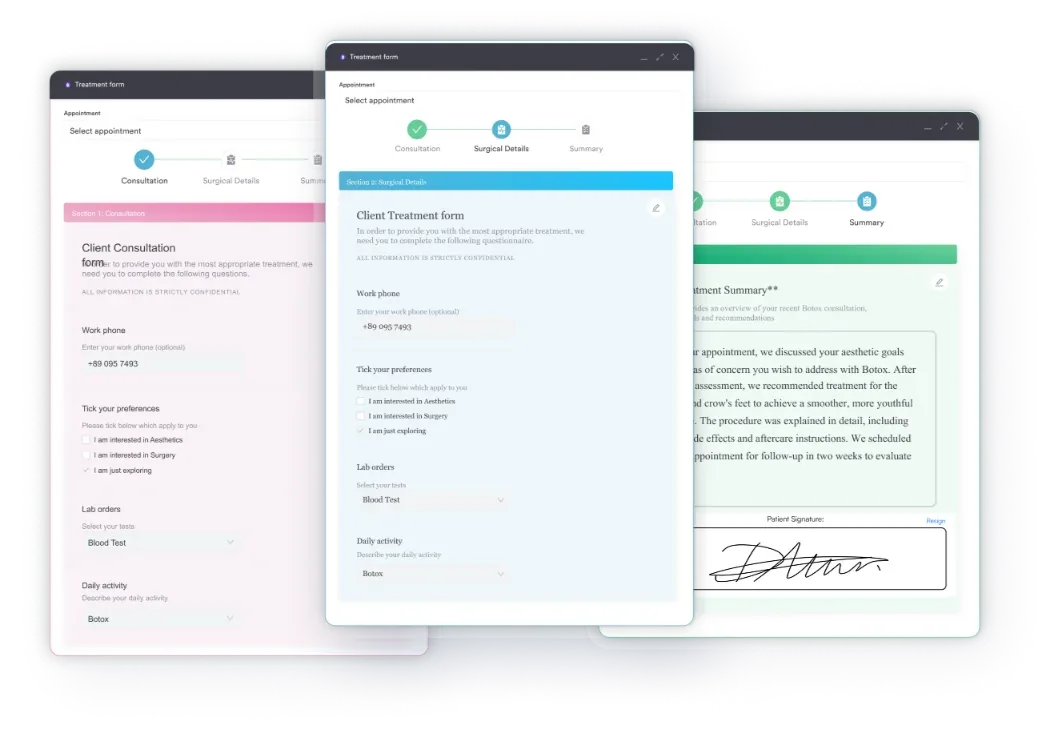
Practice management software like Pabau moves that loop into the client record. You build the questionnaire once as a digital form, then send it out through the client portal before the appointment. Every completed form is saved against the client with the date attached, so nothing depends on a filing cabinet.
Because the responses sit next to the treatment notes, the second administration lands beside the first. You can read the movement without opening a spreadsheet. Pabau Scribe, our AI scribe, can carry that change straight into the session note while you write it.
The result is a client who answers honestly at home, and a therapist who starts the session already knowing where the work needs to go.

Pabau’s digital forms and client records deliver assessments ahead of the appointment and store every response against the client. Repeat scores sit side by side, so progress is visible without a spreadsheet.

Which instrument you choose matters less than the discipline of using one twice. A single friendship score tells you where a client stands today. Two scores, 12 weeks apart, tell you whether the work you did between them changed anything.
One caution is worth carrying into every interpretation. A low score is a finding, not a diagnosis. Some clients keep a small social world on purpose, and neurodivergent clients often rate low on items written around group socializing. Ask before you conclude.
So download the form, run it at intake, and put a date in the calendar to run it again. Book a demo to see how Pabau sends questionnaires out before the session and files the scores in the client record.

Screening cognition alongside social functioning? MoCA score interpretation explains what each score band means and how education and age shift it.
Wondering if ADHD explains the social struggles? CAARS self report template is a standardized 66-item framework for assessing inattention and executive dysfunction in adults.
Working with a couple on their friendship? Gottman Method worksheets assess relationship dynamics and deliver consistent homework assignments between sessions.
Working with a teenager whose self-validation subtotal came back low? Self-esteem worksheet for teens gives you a follow-up exercise that targets the same dimension.
Turning a low subtotal into a therapy goal? Intention setting worksheet helps clients commit to specific social steps between sessions.
It works as an intake assessment and as an outcome measure. At intake it shows you how a client experiences companionship, help, intimacy, and emotional security. Across sessions it shows whether those scores move. That makes it useful for deciding whether isolation is feeding a client’s depression, anxiety, or low self-esteem.
The Friendship Quotient measures the value a client places on close, empathic friendship, and it came out of autism and gender research. The McGill Friendship Questionnaire breaks friendship into six dimensions: stimulating companionship, help, intimacy, reliable alliance, self-validation, and emotional security. Both are validated. Choose the FQ for a single overall reading and the MFQ for a subscale profile.
Run it at intake for a baseline, then every 8 to 12 weeks in ongoing therapy. Every four weeks is reasonable in an intensive social skills group, or where isolation is the main presenting problem. More often than that and normal week-to-week variation drowns out the signal.
Yes, with age-appropriate adaptations. Adolescents need simpler wording and a shorter form of 10 to 15 items. Children need concrete examples, and often a picture-based or parent-report version. Adult instruments are generally a poor fit below about age 16.
No. It screens and it measures, but it does not diagnose. A low score points to social isolation or relationship difficulty. It cannot establish social anxiety disorder, autism, or depression, which all need a full clinical interview. Use the scores to shape treatment planning and to track outcomes.
Low scores everywhere can point to severe isolation, depression, or past relational trauma. Assess for those first, along with attachment patterns. Friendship-building is premature while a client lacks basic emotional regulation or a sense of safety, so attachment and trauma work may need to come first.