Anja Dodevska

DASES: Drug Avoidance Self-Efficacy Scale
DASES at a glance and what it measures DASES stands for Drug Avoidance Self-Effi...

1
Last Updated: Oct 29, 2026
Free PDF 2 pages, print-ready Clinician-reviewed
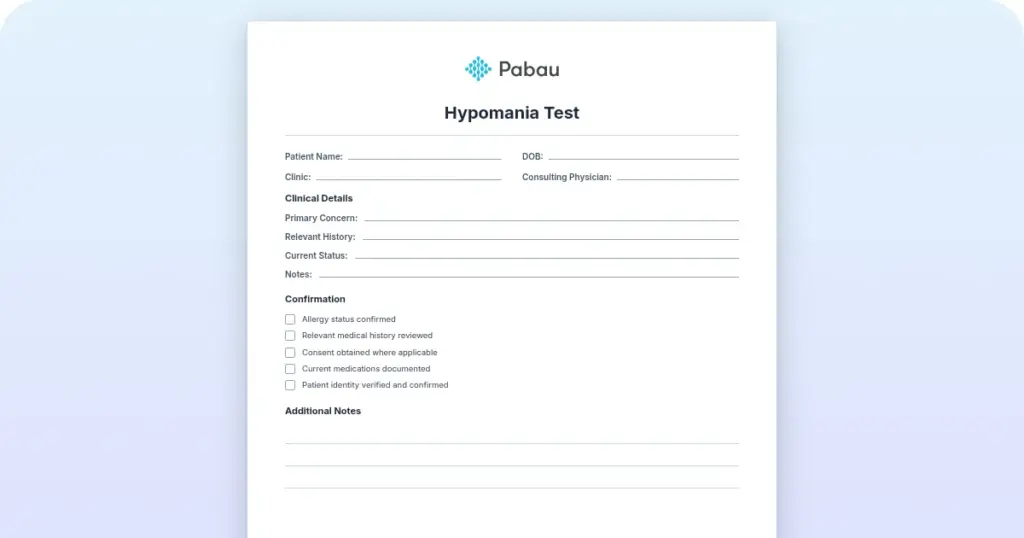
A mania test is a structured screening tool that checks for symptoms of a manic episode. It's a starting point for assessment, not a diagnosis. Mania screening matters in bipolar disorder work, because a manic or hypomanic history changes both the diagnosis and the treatment plan. This free template is an 11-item self-report scale. Patients rate how often each manic symptom occurred over the past month, from never (0) to always (4). The ratings add up to one total score.
An 11-item checklist that rates how often each manic symptom occurred in the past month, from never (0) to always (4). It ends with a total score line and a self-assessment disclaimer.
Start from scratch, or upload this PDF or any form you already use, and Pabau's AI Form rebuilds it with tick boxes, text fields and a signature. Attach it to the treatment once, and every patient gets it on time.
AI Form rebuilds the consent, history and aftercare forms you already use. You review each one, then publish.
Patients complete forms on their phone before they arrive, so the front desk stops retyping paper.
Every signed form is versioned and attached to the treatment record, ready when you need it.
Set how long a consent stays valid. Returning patients skip forms they have already signed.
Supports HIPAA and GDPR compliance AES-256 encryption 4.8 on G2 4.7 on Capterra Trusted by 4,000+ practices worldwide

A mania test is a screening aid, so a result supports clinical judgment rather than confirming a diagnosis.
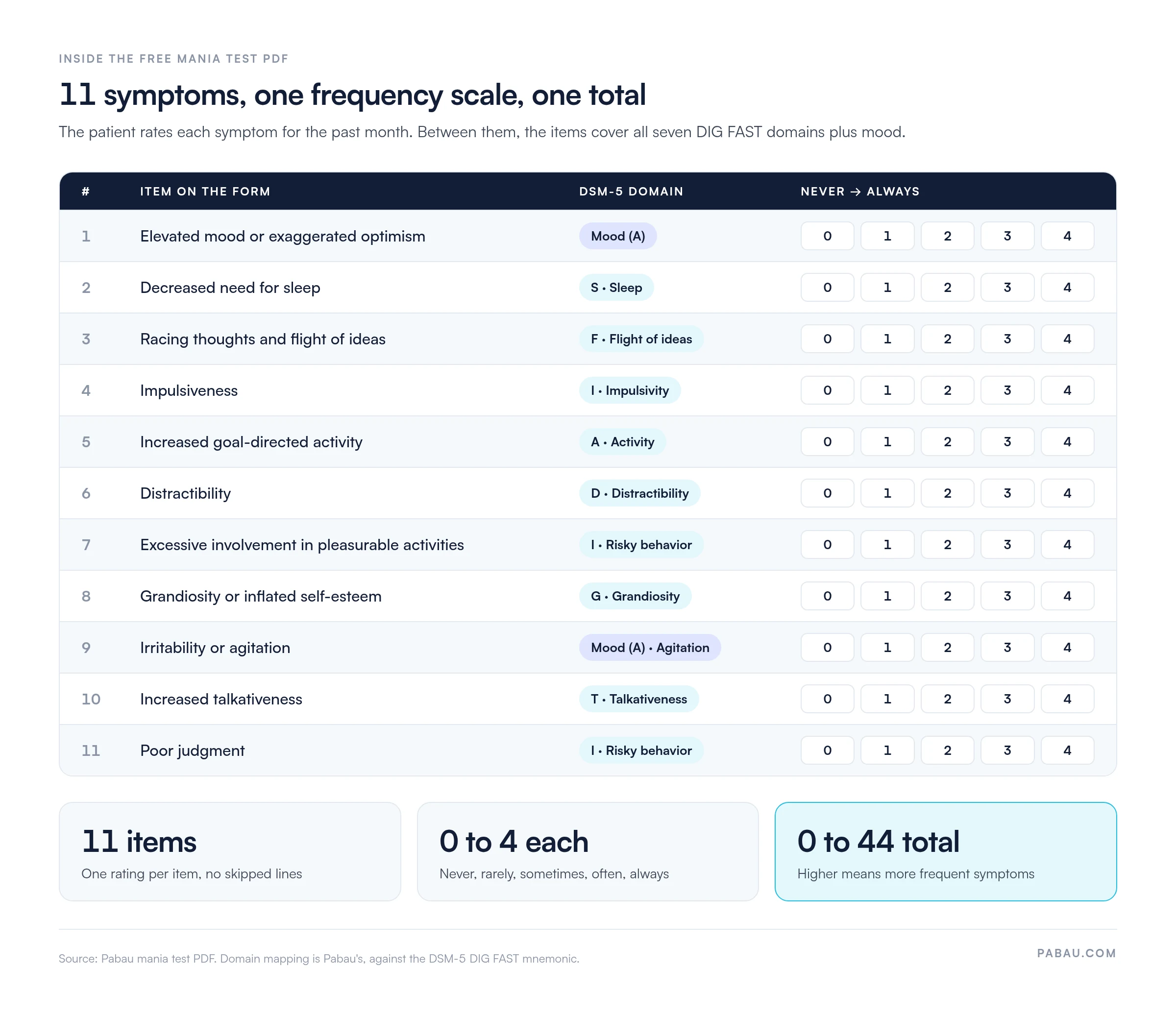
This template rates 11 manic symptoms from never (0) to always (4), for a total between 0 and 44.
The DSM-5 requires elevated mood plus specific symptoms for at least 7 days, or any duration if hospitalization is needed.
Validated tools such as the YMRS and ASRM give structured scores that can be tracked over time.
Pabau, the practice software we build, stores completed checklists in the patient record so totals can be compared across visits.
A mania test is a clinical screening instrument that structures the assessment of manic symptoms, so the same domains get checked every time. It is a screening aid, not a diagnostic instrument. A positive screen prompts a full psychiatric evaluation, and the diagnosis still rests on clinical interview and history.
Clinicians use mania screening in psychiatry, psychology and therapy settings, particularly where bipolar disorder is being considered. Many people who present with depression have a history of hypomania or mania. A depression-only workup can miss that history, which is why a structured check matters.
The template is a two-page self-report checklist. The patient adds their name and the date, then rates how often each of 11 statements applied to them over the past month.
Each item has five answers: never (0), rarely (1), sometimes (2), often (3) or always (4). Scoring takes three steps.
The form sets no cut-off score, and it closes with a disclaimer that it is a self-assessment tool, not a diagnosis. Mapped against the DSM-5 criteria, its items reach every DIG FAST domain plus elevated and irritable mood, as the table below shows.
A manic episode under DSM-5 requires a distinct period of abnormally elevated, expansive or irritable mood with increased energy or activity. The period must last at least one week, or any duration if hospitalization is required. Criterion B lists the symptoms, and at least three must be present (four if the mood is only irritable).
The DSM-5 text is published by the American Psychiatric Association, and clinicians should work from the full criteria rather than a summary.
DIG FAST is a memory aid for the seven Criterion B symptoms. It helps a clinician check each domain during the interview.
Mania symptoms cluster around mood, energy, thinking and behavior. A structured checklist makes sure each area gets asked about, rather than relying on the clinician’s memory.
Some presentations include dysphoric or mixed features, where manic symptoms occur alongside low mood. The checklist has no item for low mood, so ask about it directly and record it in the session notes.
Mania and hypomania share the same symptoms, but they differ in severity and duration. Hypomania lasts at least four consecutive days, while a manic episode lasts at least seven. Mania also causes marked impairment or leads to hospitalization.
A frequency checklist can’t make this call on its own. It records how often symptoms occurred over a month, not how long a single episode lasted, so duration comes from the interview.
Three instruments appear most often in clinical and research settings. Each suits a different setting and rater.
The Young Mania Rating Scale is an 11-item scale administered by a clinician. That makes it suited to inpatient and outpatient monitoring where a rater can observe the patient. Scores are used to track change over the course of treatment.
The Altman Self-Rating Mania Scale is a five-item self-report scale. A total score of 6 or above indicates probable mania, which makes it a practical outpatient check between appointments.
The PMQ-9 is a brief nine-item self-report questionnaire that some services use as an alternative patient-completed measure.
The checklist in this article is not one of these validated scales. Use it as a quick structured first check, then switch to the YMRS or ASRM when you need a score with a published cut-off.
The checklist works best when the patient completes it at the same point in every visit and you score it the same way each time. A typical first-session workflow runs like this.
A screen result guides the next step. It does not settle the diagnosis, and this form gives no threshold for a positive result.
A high total or a cluster of “often” and “always” ratings calls for a full psychiatric evaluation, with collateral history where it is available. A low total does not rule out bipolar disorder, particularly where the history suggests past episodes.
A mania test contributes to the bipolar picture, but it cannot separate bipolar I from bipolar II on its own. Bipolar I requires a full manic episode, while bipolar II requires hypomania alongside major depression. Clinicians need the longitudinal history to make that call.
Stand-alone mania tests have limits. Self-report tools can under-report symptoms during mania, and no screen should be used to confirm or exclude a diagnosis. The Mood Disorder Questionnaire helps here, because it asks about manic symptoms across the patient’s lifetime rather than the past month.
On paper, the checklist has to be printed, handed over, added up by hand and filed. Each of those steps is easy to skip on a busy day, and old totals end up in a folder nobody opens.
Pabau’s digital intake forms let your team send the checklist before the appointment. The completed answers land in the patient record, and medical records management keeps them beside the rest of the clinical history.
Because each completed checklist sits in the same patient timeline, comparing this month’s total with last quarter’s takes seconds. Pabau is built as software for therapy practices, so the same record also holds appointments, notes and invoices.

Pabau sends the mania checklist as a digital form before the appointment and files the answers in the patient record. You compare totals across sessions without digging through paper.

This checklist earns its place as a fast, repeatable first look at manic symptoms. It won’t give you a diagnosis, a duration or a cut-off, and it isn’t meant to.
Use it at the same point in every assessment and take the high-rated items into the interview. Move to the YMRS or ASRM when you need a validated score. The trade-off is simple: you gain consistency, and the clinical judgment stays with you.
Book a demo to see how Pabau sends, stores and compares mania screening results for your mental health practice.

Screening a younger patient? Teenage bipolar test adapts the screening questions for adolescents, with a scoring guide.
Need a broader bipolar screen? Bipolar Spectrum Diagnostic Scale checks for the softer, harder-to-spot end of the bipolar spectrum.
Moving from screening to a full assessment? Mental status exam template structures the observations you record during the clinical interview.
Planning care after a confirmed diagnosis? Bipolar treatment plan template sets out goals, interventions and review dates in one document.
Reviewing medication by mood phase? Manic depression medication list groups common medications by the phase they treat.
A mania test is a structured screening tool that checks for symptoms of a manic episode. It supports clinical judgment and does not confirm a diagnosis on its own.
Online self-tests can prompt a conversation but are not diagnostic. A result should be discussed with a qualified clinician who can take a full history.
A mental health professional trained in psychiatric assessment should administer or review it. Scope varies by jurisdiction and qualification.
No. A mania test screens for manic symptoms, while bipolar disorder is diagnosed through a full evaluation of mood history over time.