Journal prompts for mental health
Journal prompts for mental health are guided questions that help people process ...

Last Updated: Oct 13, 2026
A manic depression medication list is a structured clinical reference to the drugs prescribed for bipolar disorder, organized by class, FDA indication, and episode phase. Four classes do the work: mood stabilizers, atypical antipsychotics, anticonvulsants, and antidepressants used only as add-on cover.
Lithium remains the first-line agent for acute mania and for maintenance. Lamotrigine holds bipolar I maintenance, lurasidone and lumateperone treat bipolar depression, and quetiapine covers all three phases. No antidepressant is approved to run alone.
Bipolar disorder, historically called manic depression, affects 1-3% of the population and needs long-term medication management. This guide sets out every FDA-approved option by class and phase, the monitoring each one commits you to, and a downloadable PDF for your practice.
A structured reference listing every FDA-approved and clinically indicated bipolar medication by drug class, brand name, indication, and monitoring requirement. It also maps first-line choices to each episode phase, so the same prescribing logic applies across your whole caseload.
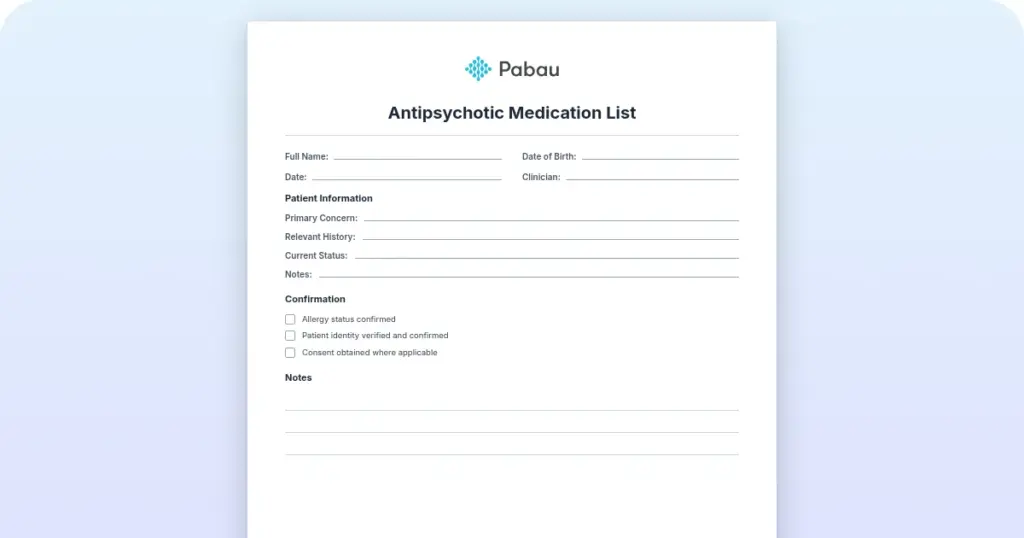
Download template
Mood stabilizers such as lithium, valproate, lamotrigine and carbamazepine carry bipolar maintenance, with the choice set by episode phase and comorbidities.
Atypical antipsychotics including quetiapine, olanzapine, aripiprazole, lurasidone and cariprazine are approved for acute episodes, and each one needs metabolic monitoring.
Antidepressants are never monotherapy in bipolar disorder, because they can trigger mania; they run only alongside a mood stabilizer or antipsychotic.
A structured medication list built on digital intake forms and AI-powered clinical documentation keeps tracking consistent across episodes.
Manic depression is the historical term for bipolar disorder, a mood disorder marked by alternating episodes of mania (or hypomania in bipolar II) and depression. The older name still appears in patient conversation and in pre-1990s literature. “Bipolar disorder” is the standard clinical nomenclature.
Bipolar I involves full manic episodes: high energy, decreased need for sleep, impulsivity, and risk-taking. Bipolar II involves hypomanic episodes, a milder mood elevation, combined with depressive episodes. Each subtype calls for a different medication strategy in acute and maintenance phases.
The table below organizes FDA-approved bipolar medications by class and indication. All entries reflect current labeling as of 2026. Verify current prescribing information with the FDA or your national regulatory body before you prescribe.
This table reflects FDA-approved indications documented in peer-reviewed literature. Topiramate and oxcarbazepine are used off-label. Weigh the risk and the benefit against your own regulatory body’s guidance before you prescribe either.
Mood stabilizers are the foundational class for bipolar treatment, with lithium as the gold standard. They are used mainly for maintenance and to prevent relapse.
Prescribing practice varies by region. National guidance such as NICE CG185 sets out first-line agent selection and monitoring frequency in more detail than a product label does.
Second-generation (atypical) antipsychotics now sit alongside mood stabilizers in acute and maintenance treatment. FDA-approved agents span acute mania, acute depression, and maintenance, with side-effect profiles that differ sharply between them.
Atypical antipsychotics are often paired with a mood stabilizer during an acute episode, then tapered or continued through maintenance depending on response.
Anticonvulsants overlap with mood stabilizers in both mechanism and clinical use. Lamotrigine and carbamazepine hold FDA approval. Topiramate, oxcarbazepine, and levetiracetam are used off-label.
Off-label anticonvulsant use needs a documented clinical rationale and the patient’s consent. Your prescription management software should flag an off-label indication at the moment of prescribing, not at audit.

Antidepressants (SSRIs, SNRIs, tricyclics) are used in bipolar depression, but they can trigger mania or rapid cycling. None of them should be prescribed as monotherapy.
Medication selection and dosing differ substantially by episode and by bipolar subtype. The table below maps evidence-based first-line choices across acute mania, acute depression, maintenance, and rapid cycling.
Phase transitions are worth documenting as they happen rather than reconstructing later. Psychiatry EMR software records which agent covered which episode, and a written bipolar treatment plan holds the first-line choice alongside the rationale for anything off-label.
Tolerability drives adherence in bipolar medication management. Side effects vary by drug class and by individual patient factors.
Those intervals, not the drug classes above, are what set your recall calendar. Collected in one place, they show how far apart two patients on different agents need to be booked.
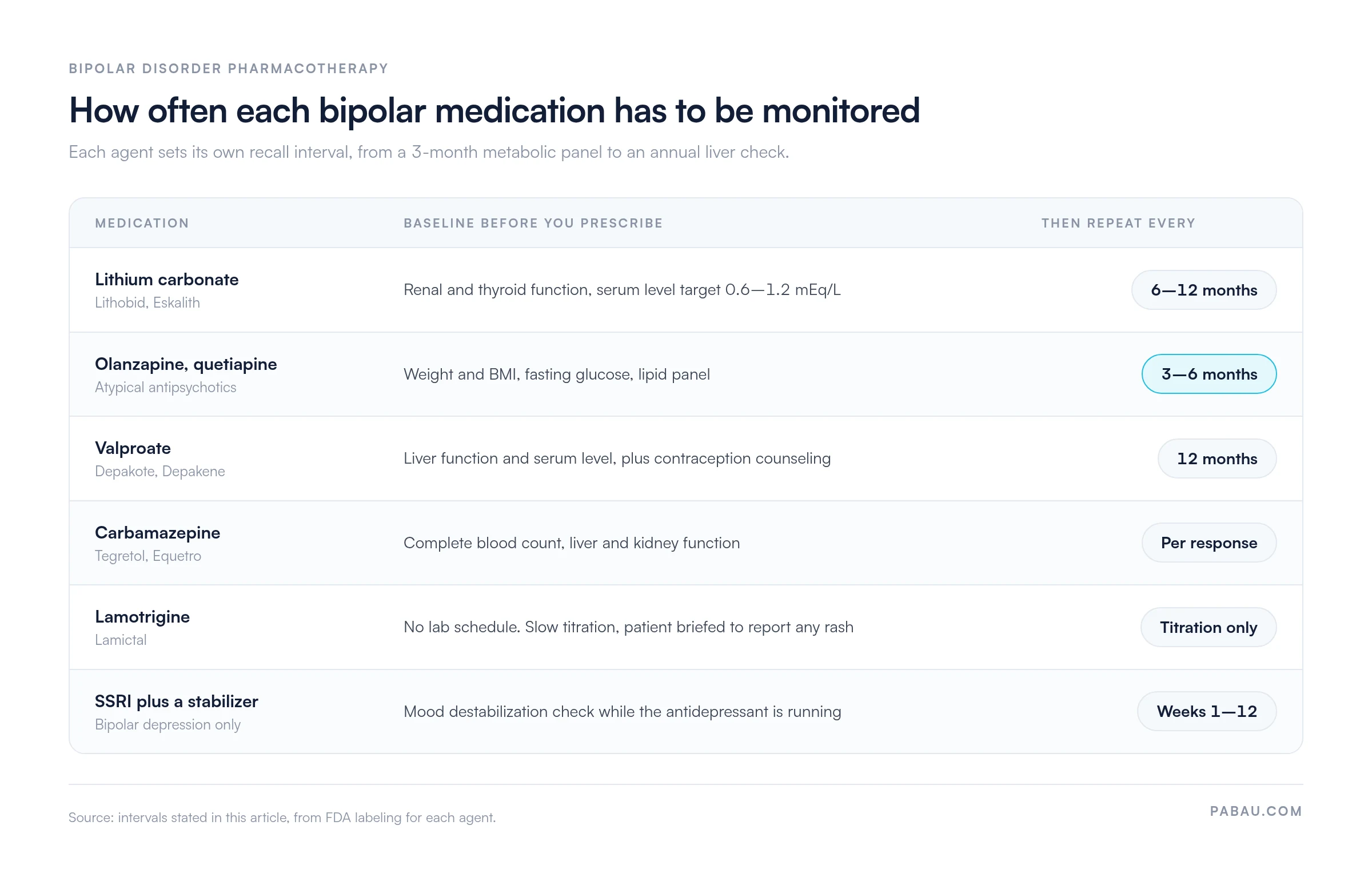
Screen for side effects at every visit rather than waiting for the patient to raise one. A structured psychiatric evaluation template puts the same prompts in front of you each time. That is what makes one visit’s record comparable with the last.
Every bipolar patient on your list carries four moving records. The current episode phase, the agent covering it, the labs due next, and the side effects raised at the last visit. Paper notes and spreadsheets keep those four in four different places.
Practice management software like Pabau holds all four against one patient record. A lithium level due in six months becomes a scheduled recall instead of a note someone has to remember to act on. Therapy practice management software does the same job for counseling caseloads, where the review cycle is the appointment rather than a lab.
Pabau Scribe, our AI scribe, structures the medication review itself. Phase notation, dose changes, and monitoring flags land in the note without retyping. Start dates, dose adjustments, side-effect events, and lab schedules then sit in one searchable audit trail, which is what a regulator asks to see.

Pabau schedules the recalls your monitoring intervals demand and keeps side-effect history against the patient record. Your whole bipolar caseload sits in one compliant audit trail.

Choosing the agent is the quick part of bipolar care. The monitoring that choice commits you to runs for years, and that is where a regimen quietly comes apart.
Two failures cause most of the trouble. A patient stops an agent because a side effect went unmentioned, or a due lab never got booked. Both are documentation problems before they become clinical ones.
Download the template to standardize how your practice records each agent, its phase, and its monitoring interval. Book a demo to see how Pabau turns those intervals into recalls that book themselves.

Need a structured psychiatric assessment? Psychiatric evaluation template gives you a framework for mental health history and baseline symptom documentation before medication starts.
Writing the plan behind the prescription? Bipolar treatment plan sets out goals, interventions, and review points so the rationale for each agent is on the record.
Tracking mood between appointments? Daily mood chart gives patients a simple log that turns into usable evidence at the next medication review.
Scoring a manic episode? Young Mania Rating Scale (YMRS) template scores severity consistently, so dose decisions rest on a number rather than an impression.
Lithium carbonate is the gold-standard first-line mood stabilizer, supported by decades of evidence. The best choice still depends on the patient. Valproate suits rapid-cycling bipolar, lamotrigine suits bipolar I maintenance where depression dominates, and carbamazepine is used when the others fail.
First-line acute mania treatment is lithium, valproate, or an atypical antipsychotic such as quetiapine, olanzapine, or aripiprazole. Maintenance first-line is lithium or valproate monotherapy, or whichever agent worked acutely. Bipolar II depression is treated with lamotrigine, lurasidone, or quetiapine plus a mood stabilizer, never an antidepressant alone.
Aripiprazole, lurasidone, and lumateperone carry minimal weight-gain risk, and lamotrigine and lithium are weight-neutral to mildly weight-reducing in some patients. Quetiapine and olanzapine carry the highest metabolic burden. Where metabolic risk is a concern, those weight-neutral alternatives are worth raising with the prescriber.
Yes, but only alongside a mood stabilizer or antipsychotic, and only during a depressive episode. Antidepressant monotherapy can trigger mania or rapid cycling in bipolar patients. An SSRI is preferred over other classes; monitor closely for mood destabilization and consider stopping once the depressive episode remits.
Yes. Bipolar I, with full mania, usually needs more aggressive acute treatment using lithium, valproate, or an antipsychotic. Bipolar II, with hypomania and depression, may respond to lamotrigine monotherapy or an SSRI plus a mood stabilizer without acute antipsychotics. Antidepressants are tolerated better in bipolar II.