Antipsychotic medication list
An antipsychotic medication list is a structured reference that organizes psychi...

2
Last Updated: Oct 13, 2026
The International Trauma Questionnaire (ITQ) is a free 18-item self-report measure of ICD-11 PTSD and complex PTSD. Twelve items cover symptoms across two scales, and six ask about functional impairment. Patients answer on a five-point scale from 0 to 4.
The measure has no total score and no cut-off. Diagnosis runs on an item-level algorithm, where a cluster counts only when one of its items reaches 2 with related impairment. Summing the 18 items produces a figure that carries no diagnostic weight.
What follows is the item map and the algorithm for each scale. You will also see how to read a result that meets one set of criteria but not the other.
A printable administration sheet with patient identifier fields, numbered response items, and a free-text box for the patient’s own notes. The office-use panel records the score, the interpretation, and the reviewer’s sign-off.
Download template
The ITQ has 18 items in total, covering 6 PTSD symptoms, 6 disturbances in self-organization, and 6 functional impairment questions.
Every item uses a five-point scale from 0 (Not at all) to 4 (Extremely), so each subscale runs from 0 to 24.
Diagnosis follows an item-level algorithm rather than a total score, and the developers advise against using cut-offs.
A patient receives either probable PTSD or probable CPTSD, never both, and DSO symptoms alone give no diagnosis.
Practice management software like Pabau sends the ITQ before the appointment and files the responses in the patient’s record.
The ITQ is a free, 18-item self-report measure built to match the ICD-11 definitions of PTSD and complex PTSD. Cloitre and colleagues published it in 2018, and it sits in the public domain for clinical and research use.
Only one version is current. The finalized measure carries 12 symptom items and 6 functional impairment items. Earlier drafts held extra candidate symptoms, and those were retired because they no longer matched the ICD-11 definitions.
Administration takes five to ten minutes. The questionnaire is free to copy and use, provided you credit the original publication. That keeps it practical for routine screening, whether you work on paper or inside psychology practice software.
Trauma services, psychological therapy teams, and clinicians running a psychiatric evaluation use it at intake and again at review. Occupational health and refugee health programs reach for it too, since it needs no license and no proprietary scoring software.
ICD-11 took a different route from DSM-5. It narrowed PTSD to three core symptom clusters, then added complex PTSD for people who also show disturbances in self-organization. The ITQ mirrors that structure item for item.
So the two systems ask different questions, and their measures are not interchangeable. The PCL-5 scores the 20 DSM-5 symptoms of PTSD, while the ITQ answers the ICD-11 question and covers complex PTSD as well.
That leaves six symptom clusters to measure, three for PTSD and three for disturbances in self-organization, plus functional impairment for each set.
ICD-11 PTSD covers three clusters, each carried by two items:
Disturbances in self-organization (DSO) covers three further clusters, again two items each:
Functional impairment is measured separately, and it does not form a seventh symptom domain. Three items ask what the PTSD symptoms have done to relationships, work, and other important activities. Three more ask the same about the DSO symptoms.
Complex PTSD is identified when a patient meets the PTSD criteria and the DSO criteria together. It follows prolonged or repeated interpersonal trauma more often than single-incident events, though the ITQ scores symptoms rather than trauma history.
Where that history needs recording, the Childhood Trauma Questionnaire covers five types of abuse and neglect, each scored for severity on its own subscale. Patients complete it themselves, reporting back on their own early life.
The form runs to 18 items in two parts. Each part holds six symptom items and three functional impairment items.
Part 1 (items P1 to P9) asks how much each problem has bothered the patient in the past month. P1 to P6 cover the three PTSD clusters. P7 to P9 ask whether those problems have affected relationships, work, or other important activities.
Part 2 (items C1 to C9) asks how true each statement is of the patient. The wording covers how they typically feel, think about themselves, and relate to others. C1 to C6 cover the three DSO clusters, and C7 to C9 ask about impact.
Every item uses the same five-point scale:
Before the items, the patient names the experience that troubles them most and marks how long ago it happened. That single line does a lot of work in the session, because it tells you which event the answers refer to.
The 18 items in the order they appear on the form, with the two subscales that carry a dimensional score.
The plain wording suits a wide range of reading levels, which is one reason the measure travels well across languages and settings. It works on paper, and it works in digital forms sent ahead of the appointment.
Scoring runs in two modes. The diagnostic algorithm decides whether the criteria are met, and dimensional scoring produces subscale totals for tracking change. Only the algorithm speaks to diagnosis.
Step 1: Confirm the index trauma. Check that the patient has described an experience and marked when it occurred. The answers only carry meaning when they point at an identified event.
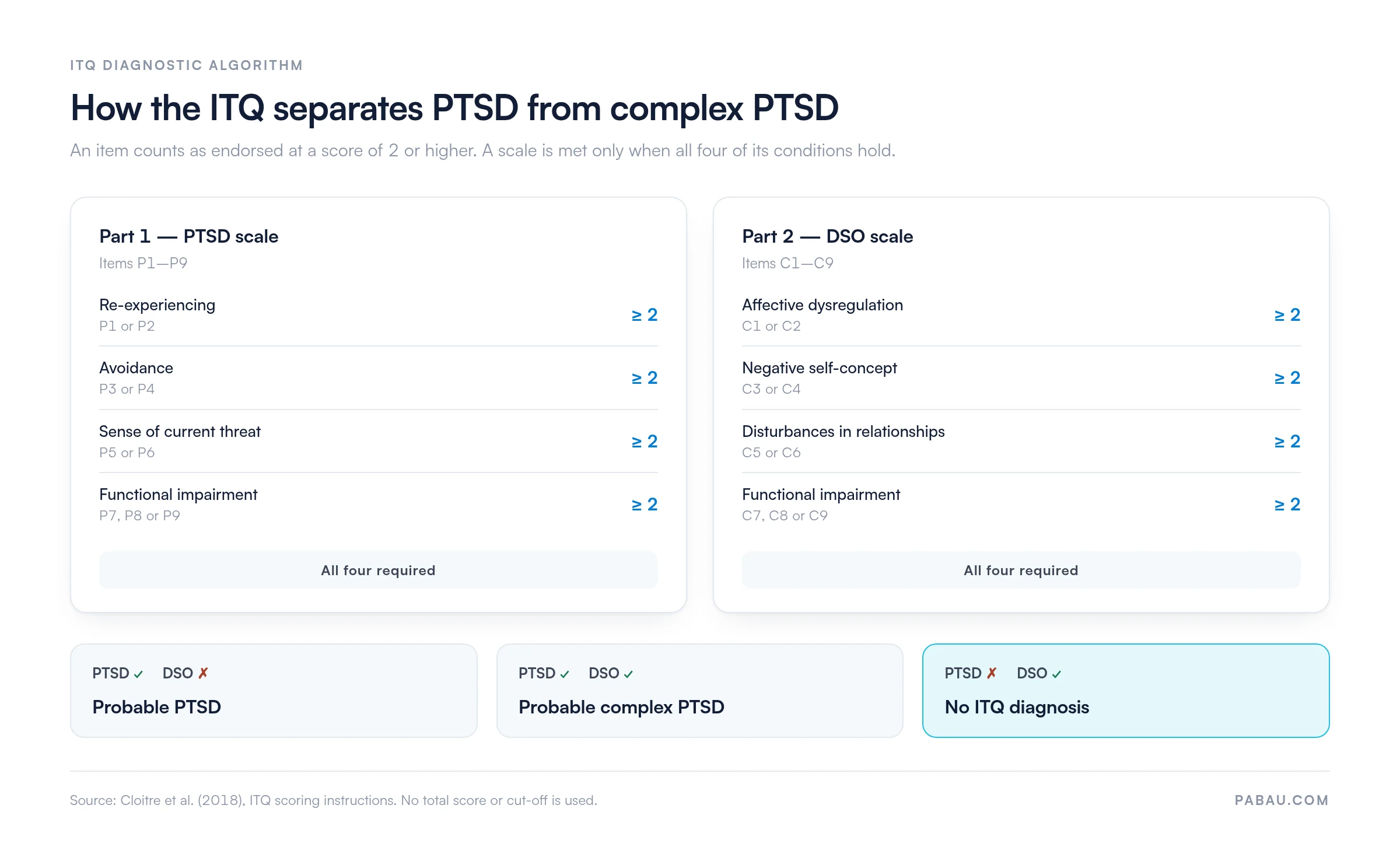
Step 2: Apply the PTSD algorithm. An item counts as endorsed at a score of 2 or higher. All four conditions below have to be met:
Step 3: Apply the DSO algorithm. The same endorsement rule applies to the C items:
Step 4: Decide the outcome. Meeting the PTSD criteria without the DSO criteria gives probable PTSD. Meeting both gives probable complex PTSD instead, because the two are mutually exclusive. Meeting only the DSO criteria gives no ITQ diagnosis.
Step 5: Calculate subscale scores if you are tracking change. Sum P1 to P6 for the PTSD score and C1 to C6 for the DSO score. Each runs from 0 to 24, and together they give a combined symptom score from 0 to 48. The functional impairment items stay out of these totals.
Both scales and all three outcomes fit on a single page, which is worth pinning up while the team learns the rules.
There is no official cut-off score. The developers state that cut-off scores should not be used to interpret ITQ responses, and that caseness should be decided by the algorithm. One Norwegian military study proposed a PTSD subscale threshold of 6 to 7. That was a study-specific finding rather than a scoring rule for general practice.
Manual arithmetic is where errors creep in, especially with two subscales and a four-part rule applied twice. Scoring inside therapy practice management software removes the rekeying step and keeps the outcome attached to the note.
An ITQ result is a structured summary of what the patient reported, not a diagnosis. It supports the clinical interview, the trauma history, and your own judgment rather than standing in for them.
No criteria met. Distress can still be significant. Screen for depression, anxiety, dissociation, and substance use, and note which clusters came close to the endorsement threshold.
DSO criteria met without PTSD criteria. The algorithm returns no diagnosis here, which surprises clinicians who expect a partial result. Record the pattern anyway, because emotional dysregulation and relational difficulties still shape the treatment plan.
Probable PTSD. Trauma-focused cognitive behavioral therapy, cognitive processing therapy, and EMDR are the usual first-line options. Document how the symptoms affect work and relationships, since the impairment items already point at the areas to track.
Probable complex PTSD. Phase-based work usually comes first. Stabilization, emotion regulation, and relational safety precede trauma processing. Watch for co-occurring depression, and keep the negative self-concept items in view at every review.
Re-administer every 8 to 12 weeks during active treatment and compare the two subscale scores. The measure has been shown to detect clinically significant change, which is what makes repeat administration worth the time.
The download is a printable record form for running and filing the questionnaire in session. It gives you:
Use it alongside the authorized ITQ item set, which the developers publish free of charge. Take the official wording of items P1 to P9 and C1 to C9 from the source document. That keeps your copy aligned with the version the validation studies used.
Cite the measure whenever you report or publish results. The reference is Cloitre, M., Shevlin, M., Brewin, C. R., Bisson, J. I., Roberts, N. P., Maercker, A., Karatzias, T., & Hyland, P. (2018). The International Trauma Questionnaire: development of a self-report measure of ICD-11 PTSD and complex PTSD. Acta Psychiatrica Scandinavica, 138(6), 536–546.
Five steps turn the form into a piece of the record that earns its keep at every review.
Storing completed questionnaires in a mental health EMR keeps the scores with the rest of the record. Outcome reporting for supervision or audit then becomes a matter of running a report rather than counting paper.
Track the PTSD and DSO subscale scores separately rather than as one number. A patient whose PTSD score drops while the DSO score holds steady is telling you something specific. The trauma-processing work is landing, and the self-organization work has not started yet. That pattern disappears inside a single combined total.
The measure was developed and validated against the ICD-11 criteria, and it has since been tested in clinical and community samples in many countries.
The measure is listed in the VA National Center for PTSD assessment inventory and distributed by NHS Wales traumatic stress services. The developers maintain the current version and its translations at traumameasuresglobal.com.
Three versions are in circulation, and each one is validated for a different respondent.
Translations are published on the official measure site, and those are the versions to use. A translation prepared in-house has not been validated, so scores taken from it are not comparable with published data.
If your caseload is multilingual, download the authorized translations you need in advance and store them in your forms library. Hunting for the right language version mid-session costs time you do not have. An improvised translation also makes the scores unusable.
Most trauma services still run the ITQ on paper. The form gets completed in the waiting room, scored by hand, and filed somewhere the next clinician has to go looking for it.
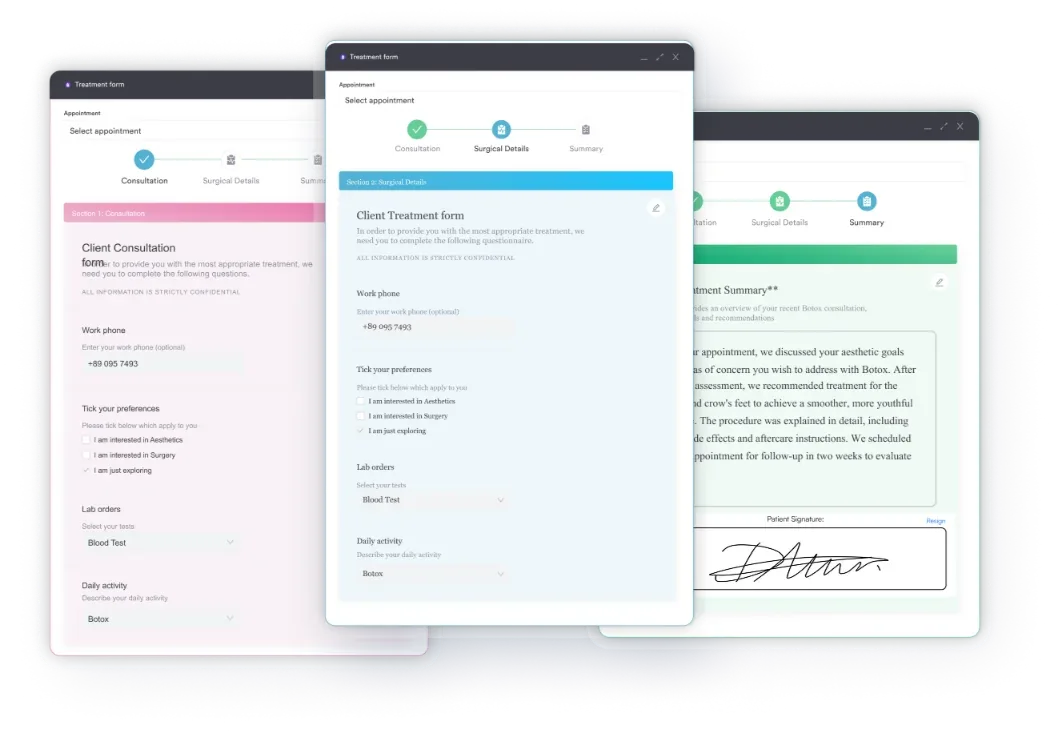
Practice management software like Pabau moves that work. The questionnaire goes out as a digital intake form before the appointment, and the answers land in the patient record. Scores then sit alongside the notes, the consent forms, and the appointment history.
Questionnaire scoring handles the arithmetic, so nobody adds up two subscales by hand between patients. The ICD-11 algorithm stays a clinical decision, and the clinician records the diagnostic outcome rather than the software generating it.
Repeat administrations then read as a trend rather than a stack of paper. Reporting pulls the scores for a whole caseload, which covers supervision, service audits, and the outcome data your payer or funder contracts ask for.

Pabau sends the ITQ before the appointment, files every response in the patient record, and keeps repeat scores together. Your team spends the session on the patient instead of on paperwork.

The ITQ earns its place because the rules are explicit. Eighteen items and a five-point scale feed an algorithm that either meets the criteria or does not.
The trap is the total. Read the ITQ as a sum and you get a number that looks diagnostic but carries no weight. That is why the developers rule cut-offs out.
Download the form, train the team on the algorithm, and use it at intake and at review. Book a demo to see how Pabau keeps ITQ responses, scores, and clinical notes in one patient record.

Need the trauma history behind the score? Trauma questionnaire template collects the background the ITQ assumes you already hold.
Mapping events onto a timeline? Trauma timeline worksheet helps a patient place the index trauma alongside the other events they describe.
Planning care after a PTSD diagnosis? PTSD nursing care plan sets out goals, interventions, and review points in one document.
Looking for work between sessions? ABCDE journal PTSD worksheet gives patients a structure for recording triggers and responses at home.
Weighing treatment options after the score? Accelerated resolution therapy explains where that approach sits alongside trauma-focused CBT and EMDR.
PTSD is measured by six items covering re-experiencing, avoidance, and sense of current threat, plus three functional impairment items. Complex PTSD requires those criteria and six more items covering affective dysregulation, negative self-concept, and disturbances in relationships, with three impairment items. A patient receives one diagnosis or the other, never both.
No. The PCL-5 scores the 20 DSM-5 symptoms of PTSD, while the ITQ follows ICD-11 and covers complex PTSD as well. Results from one do not convert to the other.
Any trained member of the team can hand out the form and apply the algorithm, because it is self-report. The diagnostic judgment stays with a qualified clinician who holds the trauma history and the interview.
Ask about it before the session ends. Each symptom cluster rests on only two items, so one blank answer can decide whether that cluster counts. Note any item you cannot recover.
No. ICD-11 keeps dissociative symptoms outside the complex PTSD definition, so no ITQ item asks about them. Screen separately when the presentation calls for it.
Yes. The ITQ is in the public domain and free for clinical and research use, with no licensing fee. Credit the original publication by Cloitre and colleagues when you report results.