Nitrates medication list
A nitrates medication list is a point-of-care reference that sets out the main c...

Last Updated: Oct 6, 2026
A risk for physical injury care plan is a structured NANDA-I framework for patients who are vulnerable to physical harm. NANDA-I renamed this diagnosis in its 2024-2026 edition, so older charts and textbooks still call it a risk for injury care plan. The plan sets out the assessment-to-evaluation pathway clinicians use to spot risk factors, agree measurable safety goals, and deliver evidence-based interventions. It works the same way in hospital, outpatient, and community settings.
This template suits elderly patients at fall risk, post-surgical patients with mobility limits, and cognitively impaired patients in acute care. It turns NANDA-I taxonomy into documentation your team can chart against.
This printable form covers the NANDA-I diagnosis 00035, with fields for assessment findings, nursing diagnoses, goals, interventions, and evaluation criteria. Its header still carries the pre-2024 label, Risk for Injury Care Plan.
Download template
Risk for Physical Injury is the NANDA-I nursing diagnosis (00035) for susceptibility to physical harm from environmental or physiological factors.
NANDA-I’s 2024-2026 edition renamed the diagnosis from Risk for Injury to Risk for Physical Injury, keeping code 00035 and leaving Risk for Falls (00155) untouched.
Related factors include impaired mobility, cognitive impairment, altered alertness, polypharmacy, and environmental hazards. The ones that apply to your patient drive the interventions you choose.
Expected outcomes have to be measurable and patient-centered, such as ‘patient remains free from falls and injuries’ within a stated timeframe.
Core interventions span risk assessment, environmental modification, medication safety review, and patient and family education. Pabau’s digital forms and care plan templates keep all four in one record.
Risk for Physical Injury is the NANDA-I nursing diagnosis for a patient who is susceptible to physical damage. That damage comes from environmental conditions interacting with the patient’s own adaptive and defensive resources. No injury has happened yet, which is what makes prevention the clinical priority.
NANDA-I carries the diagnosis as code 00035, in domain 11 (safety/protection), class 2 (physical injury). The 2024-2026 edition, the 13th, changed the label from Risk for Injury to Risk for Physical Injury. The code stayed the same, so plans written under the old wording map straight across to the current one.
The diagnosis applies across every care setting. Think of a hospitalized elderly patient on sedating medication, or a post-surgical patient transferring between bed and chair. A child with developmental delay in an unsafe home warrants it too. The care plan then addresses the specific injury mechanism and the risk factors that are present.
Getting the diagnosis right is the foundation of solid nursing documentation and clinical record management. Assessment findings, interventions, and outcome evaluation all have to trace back to the risk factors you identified.
Related factors explain why a patient is at risk. NANDA-I treats them as the underlying causes or conditions that raise the chance of physical injury.
Not every one of these can be fixed. The table below sorts the seven factors by what nursing can remove, what it can manage, and what it has to work around.
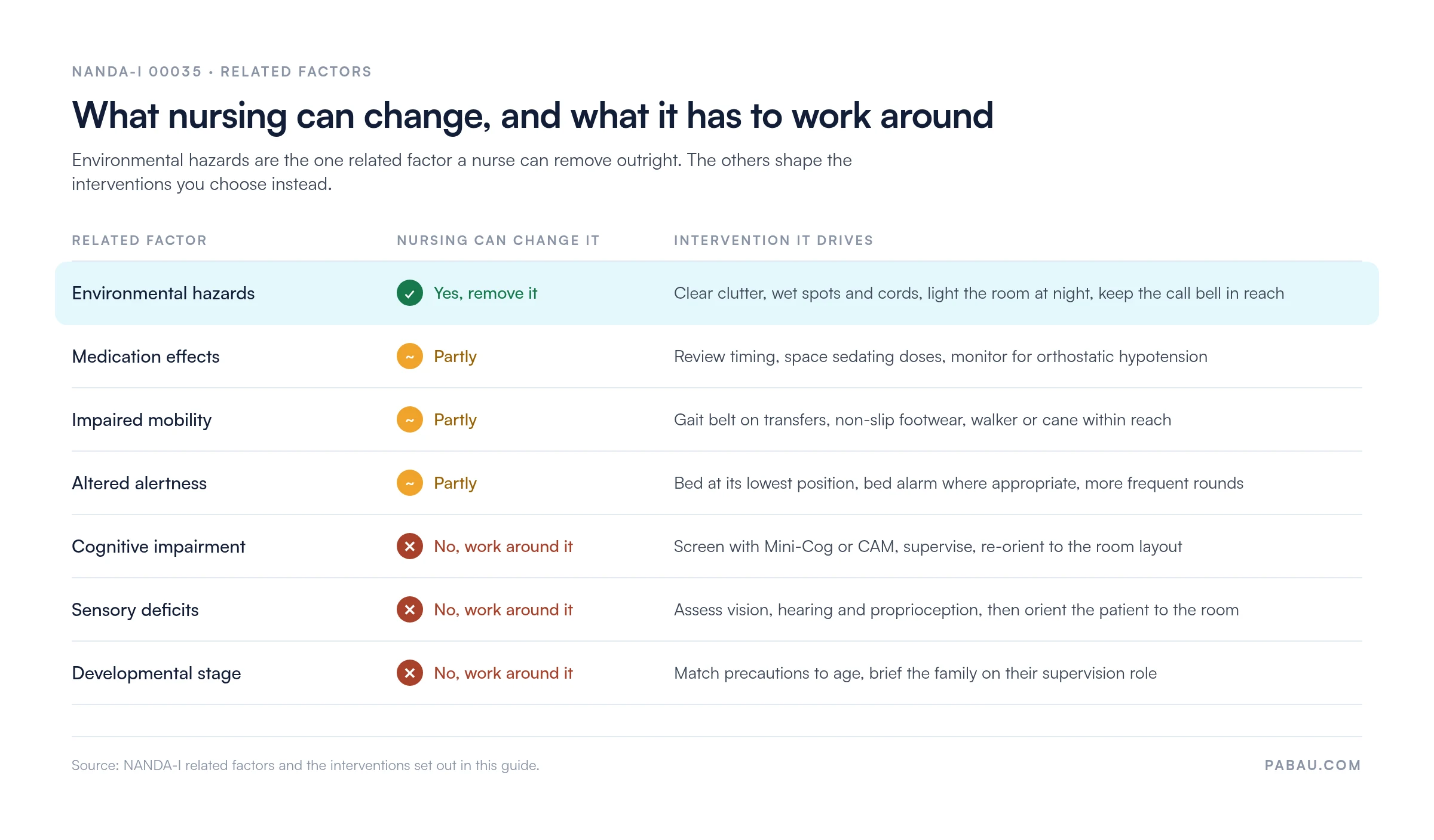
Separating modifiable environmental factors from non-modifiable physiological ones guides intervention selection. An 85-year-old with Parkinson’s disease cannot reverse a tremor. Nursing can still clear the environment and optimize the assistive devices around that tremor.
Risk factors are the clinical cues that raise injury likelihood. The at-risk populations framework helps clinicians recognize high-priority groups on sight.
Risk factors compound when they stack. An elderly post-operative patient on opioids in an unfamiliar hospital room needs the most intensive prevention strategies on the unit.
Nursing goals translate the diagnosis into measurable patient outcomes. Each one has to be specific, timebound, and observable at the bedside.
Outcomes should focus on preventing the injury rather than on awareness alone. “Patient will not fall” gives the next shift something to act on. “Patient will understand fall risk” does not. Set timeframes that match the clinical setting and the patient’s acuity.
Evidence-based interventions address the specific risk factors you identified. Organize them into three phases: Assess the risk, change the environment, then teach the patient and family.
Begin every care plan with a comprehensive risk assessment. The Morse Fall Scale remains the standard screening tool for hospitalized patients. It scores six factors: History of falls, secondary diagnosis, ambulatory aid use, IV therapy, gait, and mental status. The total sorts patients into low, medium, or high risk.
Rationale: Early assessment identifies individual risk factors and tailors the interventions to them. Structured fall risk assessment programs have been associated with injury reductions of roughly 20-30% in acute care.
Rationale: A large share of fall-related injuries trace back to environmental hazards. Removing the modifiable ones lowers injury incidence without asking the patient to change how they move.
Rationale: Patient and family engagement raises adherence to safety measures. An informed family becomes a second set of eyes between rounds.
Documentation is what connects the assessment to the care delivered. Use the standard sequence: Diagnosis statement, related factors, expected outcomes, interventions, rationale, and evaluation. Capturing the assessment on structured intake forms for clinicians keeps the first two components in the record from admission.
Diagnosis statement example: “Risk for Physical Injury related to impaired mobility and polypharmacy, as evidenced by a recent unassisted transfer attempt and altered gait.” Name the drugs the patient is taking, as the worked example below does.
Update the care plan daily, and again whenever the patient’s status changes. Record what each intervention produced. Did the patient accept fall precautions? Was the Morse Fall Scale rescored after the medication change? Did teaching land? Tie every entry back to a care plan goal.
Practice management software like Pabau can carry that load for you. Pabau’s automated care plan workflows flag when a reassessment falls due and attach safety alerts to the chart. The prevention pathway then stays visible to every shift that opens the record.
Both NANDA-I diagnoses address patient safety, and they differ in scope and focus.
A patient may warrant both: Risk for Physical Injury for broad safety, and Risk for Falls for targeted fall prevention. Physical therapy practices see this combination constantly, because mobility training works on both diagnoses at once.
Patient scenario: Mrs. Chen, 78-year-old admitted post-hip replacement surgery, on morphine and alprazolam, with history of stroke-related mild left-side weakness. Morse Fall Scale score = 75 (high risk).
The example shows how the NANDA-I components flow into a working document. A live chart adds vital signs, medication administration times, and shift-by-shift progress notes against each intervention.
Injury prevention carries a compliance weight in every care setting. The Joint Commission tracks falls and injuries through its National Patient Safety Goals. CMS treats a fall with injury as a hospital-acquired condition, which affects reimbursement. Keeping that evidence audit-ready is the job of compliance management software.
Adapt the template to your own protocol before anyone charts on it. Local policy decides the fall risk tool, the restraint rules, and who signs off each reassessment. Those decisions belong inside the plan, not in a separate binder.
The care plan and the evidence behind it usually live in separate systems. The Morse score is on a paper assessment. The teaching note is in the chart. The reassessment date is in somebody’s head, or on a whiteboard that gets wiped at handover.
Pabau keeps all three in the same patient record. Build the care plan as a custom medical form, and every field is timestamped against the patient and the clinician who completed it. Automated workflows raise a task when a reassessment falls due, so a change in status does not wait for the next shift to notice it.
The result is a plan the next clinician can read and act on without hunting for the assessment behind it. Audits get simpler too, because the record already shows which intervention was carried out, when, and by whom.

Pabau holds care plans, risk assessments and patient education records in one chart, and automates the reassessment reminders around them. Your team documents injury prevention once, then finds it instantly.

A risk for physical injury care plan is only as good as the documentation underneath it. Use the current NANDA-I label, name the related factors that apply to this patient, and write outcomes someone can measure at the bedside. A plan built from generic precautions will not change what happens at 3am.
If your team retypes the same safety plan into three different places, the charting is where the hours go. Book a demo to see how Pabau supports injury prevention workflows from the first Morse score to the discharge note.

Charting cognitive decline alongside injury risk? Nursing care plan for impaired memory covers the assessment and interventions behind the cognitive impairment factor.
Need a repeatable alertness check? Level of consciousness assessment gives you the scoring and the wording to chart altered alertness at the bedside.
Planning safety care after a stroke? CVA nursing care plan sets out the mobility and safety interventions for stroke-related weakness.
Wording your interventions consistently? List of nursing interventions gives you standard phrasing to chart against each goal.
Stuck on the evaluation step? Evaluation nursing care plan shows how to record whether a goal was met, partly met, or not met.
Not under that name. NANDA-I’s 2024-2026 edition relabeled diagnosis 00035 as Risk for Physical Injury, and the code itself did not change. A care plan written as Risk for Injury still maps to the current diagnosis. Update the wording in your templates so new charts match the current taxonomy.
Risk for Physical Injury is a risk diagnosis. The patient has not been injured yet but carries factors that increase vulnerability, so the plan is preventive. An actual injury diagnosis documents harm that has already happened and drives treatment instead. Impaired Skin Integrity after a fall is one example, and Acute Pain after trauma is another.
Rescore on admission, after any major status change, and before high-risk activities such as a first transfer or a shower. In acute settings, reassess at least daily. Post-operative patients often improve quickly, so a fresh score may lower the risk level and allow precautions to be stepped down safely.
Yes. Risk for Physical Injury (00035) is the broader diagnosis and can sit alongside the more specific Risk for Falls (00155). A patient with impaired mobility who is also on high-risk medications and has sensory deficits warrants both. One drives fall-specific prevention, the other covers the wider safety plan.
Impaired mobility, cognitive impairment, and polypharmacy are the three that recur in most settings, especially when sedating drugs are involved. Between them they account for a large share of preventable falls and injuries in hospitals. Work out which combination applies to your patient, then target the interventions at those factors.