Physician credentialing checklist
A physician credentialing checklist lists every license, certificate, verificati...

Last Updated: Oct 23, 2026

A visualization meditation script is a guided text that walks a client through structured mental imagery for calm, sleep, or focus.
The free PDF on this page holds three scripts you can read aloud: Forest Serenity, Oceanic Peace, and Morning Bliss.
Delivery decides the outcome, so read at about half your normal speaking speed and pause at every transition.
Mental imagery activates much the same neural pathways as physical experience, which is why a scene can ease stress and steady emotion.
Practice management software like Pabau stores each script as a reusable form, so the wording and the client’s response sit in one record.
Three scripts you can read aloud in session: Forest Serenity, Oceanic Peace, and Morning Bliss. The one-page form also carries name and date fields, a short instruction line, and a notes area for what the client reported afterward.
Download templateA visualization meditation script is the wording you read aloud to guide a client into a calm scene. Improvise it and the pacing rushes. The client then stays stuck in their own head, instead of the forest or shoreline you are describing.
A written script fixes the pace. It also repeats the same way in week six as in week one. That repetition is what lets a client return to the scene alone. Below are the three scripts in the free PDF, how to read them in session, and the mistakes that trip up a first attempt.
A visualization meditation script is a guided text that leads someone through structured mental imagery. The scene is chosen to calm the mind, ease tension, or rehearse a goal.
Unlike a meditation app, a script hands you the wording to deliver yourself. You set the pace, and the client hears the same session each time.
These scripts sit between mindfulness practice and therapeutic work. Psychologists, therapists, coaches, and wellness practitioners read them to clients working on stress, anxiety, sleep, and performance.
Many keep them inside their mental health practice software, so the script is on the screen they are already working in.
The calm is not only in the mind. Guided imagery switches on the parasympathetic nervous system, the body’s rest response, which can lower cortisol and blood pressure during a session.
Five effects show up most often in the research and in practice:
Mental imagery engages the same neural networks as physical experience. Functional MRI studies show that picturing an action lights up motor, sensory, and prefrontal regions in much the same pattern as performing it. The brain draws no sharp line between an imagined sensation and a felt one.
The National Center for Complementary and Integrative Health reports that mind and body practices such as guided imagery shift the autonomic nervous system. Those shifts turn up as measurable changes in heart rate variability and cortisol. That mechanism sits behind the calm a client describes at the end of a session.
Pacing does more for the listener than the words do. The six steps below hold whether you are leading a group, sitting with one client, or handing the script over for home practice:
Grounding is the step people skip when the hour is running late. Two minutes of breath awareness, or a short body scan meditation script, settles a client who arrives wired. It also tells you how much settling they need before the scene starts.
Six things are worth sorting out before the first guided session, and none of them take long:
The download holds three scripts, each written as continuous prose you can read aloud. The one-page form also carries name and date fields at the top and a notes area at the end. A short instruction line tells the reader to find a quiet space, work through one script, and reflect briefly afterward.
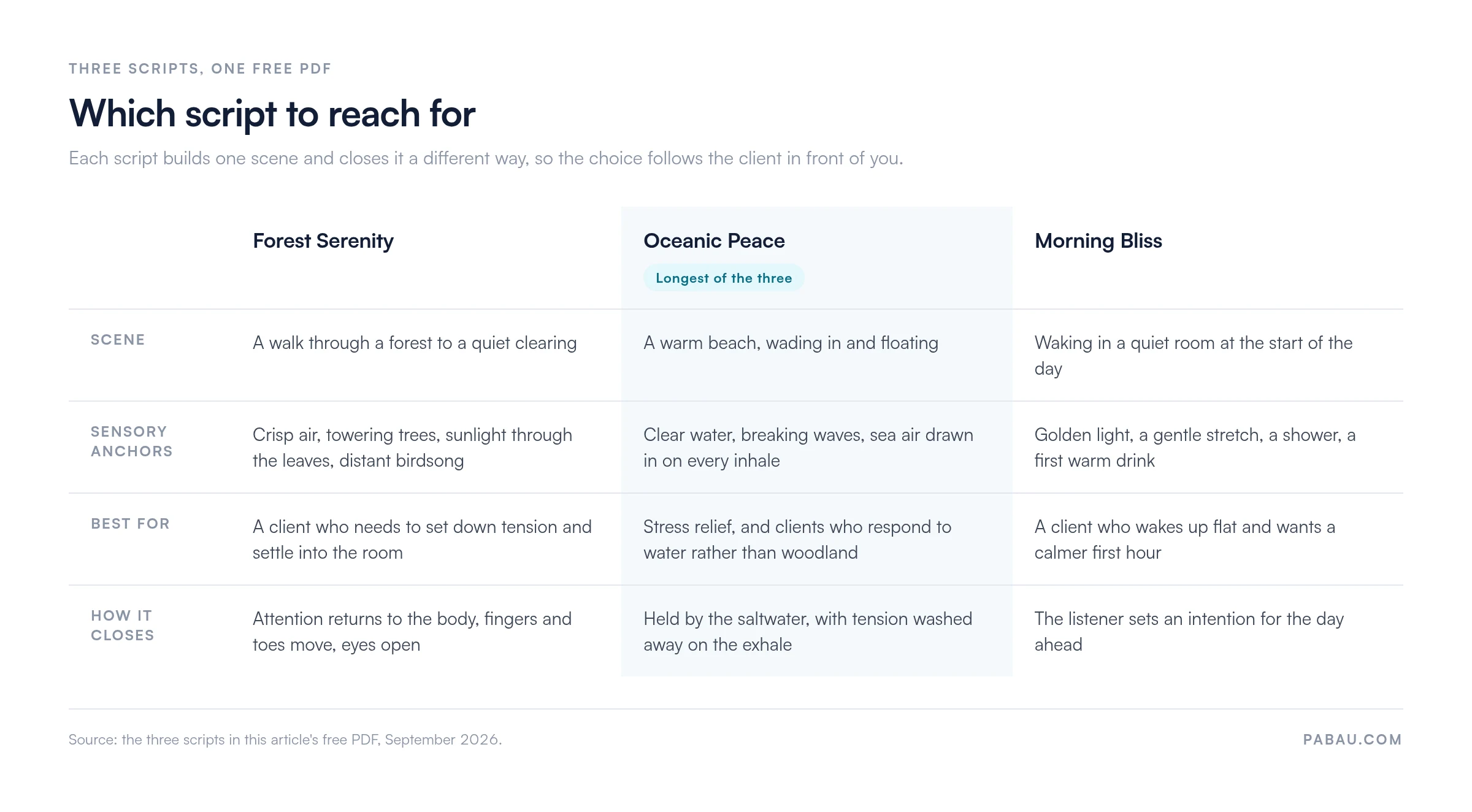
The scripts carry no pacing marks or breathing cues in the margin, so the timing is yours to set as you read. They differ mainly in scene, in the sense they lean on, and in the client state they suit.
A walk through a forest, from the earth underfoot to a clearing where the listener sits down and closes their eyes.
The imagery covers crisp air, towering trees, sunlight through the leaves, rustling branches, and distant birdsong. It closes by returning attention to the body, wiggling fingers and toes, and opening the eyes. Use it when a client needs to set down tension and settle into the room.
The longest of the three, set on a warm beach with clear water and breaking waves. The listener wades in, floats, and lets the saltwater hold them while tension washes away. Breath work runs through it, with each inhale drawing in sea air and each exhale releasing what the listener is holding.
It suits stress relief work, and clients who respond to water rather than woodland.
Morning Bliss is built for the start of the day rather than the end of it. It opens with a golden light around the body. From there it moves through waking in a quiet room, a gentle stretch, a shower, and a first warm drink. It finishes with the listener setting an intention for the day ahead.
Give it to clients who wake up flat and want a calmer first hour.
First attempts tend to go wrong in the same few ways. None of them are hard to correct once you know what to watch for.
A script becomes part of the clinical record once your note says which one you read and how the client responded. Two habits cover most of it.
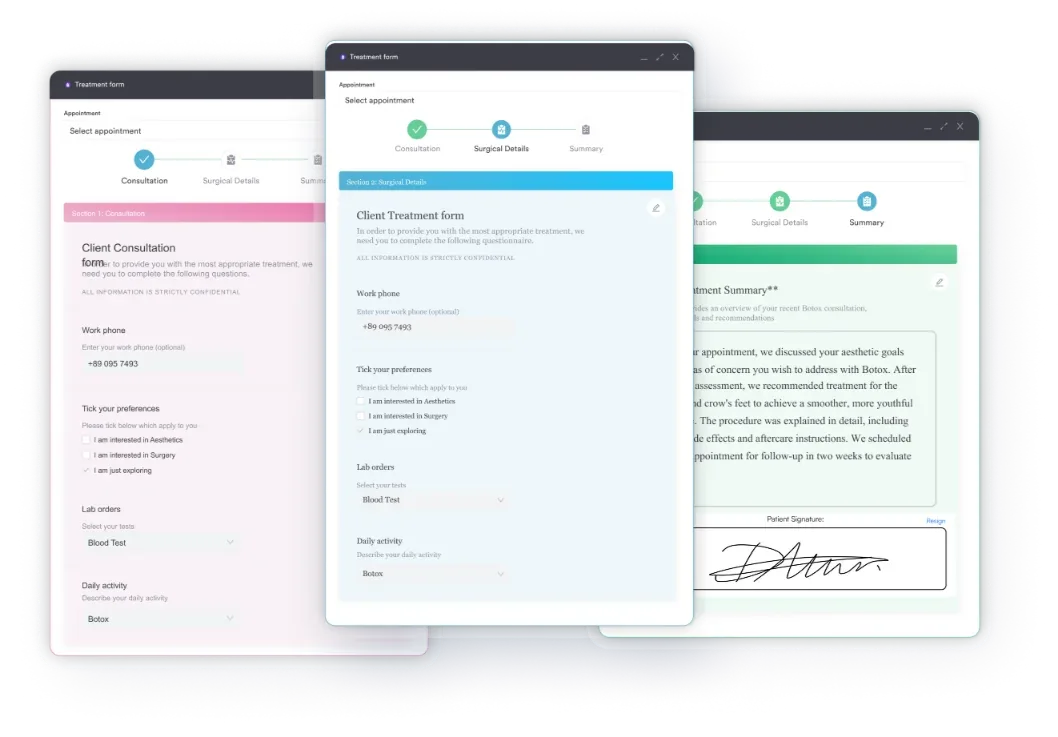
Scripts tend to live in a folder on a laptop, or printed in a drawer. The wording drifts between sessions, the notes land somewhere else, and nobody can say later which scene a client responded to.
Practice management software like Pabau, built for therapy and counseling practices, holds both in one client record. Save each script as a section in Pabau’s digital intake forms, so the same wording is on screen in every session.
Then log which script you read, how long it ran, and what the client said afterward. A few months in, the record shows which imagery works for whom, so you are not guessing at the start of a session.

Pabau stores each meditation script as a reusable form and tracks how the client responded. Both sit in the client record, so nothing lives in a separate folder.

Pick one script and stay with it for several sessions. A scene only becomes useful to a client once they can picture it without you reading.
Forest Serenity and Oceanic Peace both suit stress work in session. Morning Bliss fits the client who wakes up flat and needs a calmer first hour. Read the same one twice before you judge whether it landed.
The script gives you the words. What happens across sessions lives in your notes, and that is where the pattern shows up. Book a demo to see how Pabau keeps your scripts, session notes, and follow-ups in one client record.

Want the wider technique? Guided imagery script covers the structure behind any imagery session, with more scripts to download.
Only have five minutes? The 5-minute meditation script fits the end of a packed session without losing the close.
Need something for a client who gets overwhelmed? The grounding techniques worksheet gives them a practice they can use between appointments.
Want to open with breath work? The mindful breathing script settles a client before you start describing a scene.
Working with self-criticism? The self-compassion meditation script carries three versions you can match to the client.
Some people form no mental images at all, which is called aphantasia. Switch the wording from sight to sound, touch, and temperature, or ask them to remember a place rather than picture one. If nothing comes, a breathing or body-based practice will serve them better.
Almost. Guided imagery is the wider term for any facilitated imagery experience, and visualization is the act of forming the images. A script uses both, so practitioners tend to use the two words interchangeably.
Record it once the client knows the script and wants to practice at home. In session, read it live, because you can slow down or shorten a passage when their breathing tells you to.
For most people, yes. Trauma histories are the exception, since a scene can surface memories you did not plan for. Ask what imagery to avoid first, agree on a stop signal, and stop if distress builds.
Yes, and home practice is where the habit forms. Share the script or a recording, then ask what they noticed at the next appointment. Their answer tells you which lines to keep and which to reword.