Antipsychotic medication list
An antipsychotic medication list is a structured reference that organizes psychi...

2
Last Updated: Oct 13, 2026

A classical conditioning worksheet helps students and clinicians identify how a neutral stimulus becomes a conditioned stimulus through repeated pairing.
Every scenario asks you to label five elements: NS, UCS, UCR, CS, and CR.
The free download holds a definitions section, two written scenarios, and two free-response sections on applying the principles and analyzing behavior.
There is no answer key in the PDF, so the model answers in this guide are what you check your work against.
Extinction, generalization, and discrimination explain how a conditioned response fades or transfers, which is the reasoning behind exposure therapy.
Practice management software like Pabau turns the same five fields into a digital form, so answers save into the client record.
A free clinical form template for psychology students and mental health professionals. It opens with a definitions section for NS, UCS, UCR, CS, and CR. Two written scenarios follow, each with blank fields to label, plus free-response sections on applying the principles and analyzing a behavior.
Download templateLearning by association sits at the center of psychology training and a good deal of clinical work. A classical conditioning worksheet turns that idea into an exercise you can complete and keep. It gives you a framework for spotting a learned response and recording the trigger behind it.
This guide covers the five labels the worksheet asks for, both scenarios inside the PDF, and where a completed sheet belongs in the client file. It suits students studying for an exam and clinicians running a psychology practice.
A classical conditioning worksheet is an educational and clinical assessment tool for mapping how a learned response forms. It walks you through the moment a neutral stimulus becomes a conditioned stimulus after repeated pairing with an unconditioned stimulus.
Ivan Pavlov’s experiments with dogs established the principle. A bell means nothing to a dog on its own. Pair it with food often enough and the bell alone triggers salivation. At that point the bell is a conditioned stimulus, and the salivation is a conditioned response.
The worksheet format turns that theory into practice. It presents written scenarios and asks you to label each component in the blank fields provided.
Mental health professionals reach for this exercise during assessment, treatment planning, and therapeutic work. It shows how phobias, anxiety, and learned habits take hold. Digital intake forms record those patterns in the client file, and the findings feed into a psychology treatment plan.

The free PDF is a single clinical form with four sections. A name and date header sits at the top, and every answer field is left blank for handwriting or typing.
The file contains no answer key, no glossary page, and no flow chart. It is a blank form. An instructor, a supervisor, or the model answers further down this page are what you check the completed sheet against.
Before you tackle the scenarios, master the five terms the worksheet asks for. Each plays a distinct role in the conditioning process.
A neutral stimulus becomes a conditioned stimulus only after repeated pairing with a UCS. The response stays the same physiologically, but the trigger shifts from inborn to learned. Once you can label each component, the same reasoning applies to phobias, food aversions, and therapeutic interventions.
Work through each scenario in five steps, in the order the answer fields appear.
Log each completed sheet in the client’s file rather than a folder on the desk. Client records hold the labels beside the treatment notes, so your reasoning is visible at the next session. That habit also keeps clinical notes defensible if anyone audits them.
The download contains two scenario exercises. Both are written out in full, and each is followed by blank NS, UCS, UCR, CS, and CR fields. The PDF ships without an answer key, so use the model answers below to check your work.
Fill in the blank fields for both scenarios before you read the model answers. The worksheet also asks you to explain each label, which is where the reasoning gets tested rather than the vocabulary.
Scenario 2 carries a wrinkle worth raising in class. The tennis ball was never truly neutral, because it already signaled fetch. It was a conditioned cue for excitement, and the painful pairing reconditioned it into a cue for fear. Treat that as a teaching point about how one association overwrites another.
A conditioned response does not stay fixed once it forms. Three phenomena explain how it fades, spreads, or narrows.
Both are forms of associative learning, but the mechanisms differ. Knowing which one is at work tells you which therapeutic approach fits.
In your own scenarios, look for emotions, physiological responses, and reflexive reactions learned through stimulus association. Reward-driven behavior change belongs to operant conditioning instead, which is the model behind most work on patient compliance.
These principles shape modern treatment directly. Mental health professionals apply them to anxiety, phobias, PTSD, and learned emotional responses.
Automated therapy workflows record exposure hierarchies, track extinction across sessions, and log symptom scores. A conditioning-based intervention then becomes something you can evidence session by session.
Classical conditioning runs quietly through ordinary life. Spotting the pattern outside the consulting room makes it easier to spot inside it.
Identifying the CS and CR pairing is the first step toward changing it. That is also why a psychiatric evaluation template asks about triggers rather than symptoms alone.
The PDF is a blank form rather than a graded quiz. That makes it a written record of how a client understands their own trigger, in their own words. A client portal can deliver a simplified version to someone managing anxiety or a phobia between sessions.
In most practices a completed worksheet ends up as a scan, a photo, or a sheet of paper in a folder. The insight it captured is hard to find at the next session, and harder still to compare across a course of treatment.
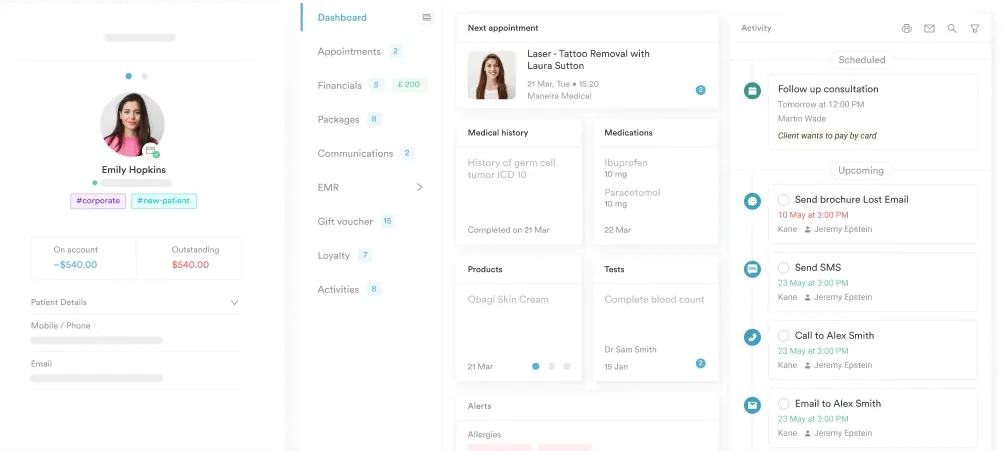
Practice management software like Pabau lets you rebuild the same five fields as a digital form. Send it to the client before the appointment, or fill it in together during the session. The answers save straight into the client record, next to the notes, consent forms, and appointment history.
That matters most when you are tracking extinction. You can pull up what a client wrote about their trigger in week one and set it beside their week eight ratings. Storing it in mental health practice software makes progress something you can show them, rather than something you describe from memory.

Pabau’s digital forms and client records capture classical conditioning assessments in the client file, so every completed worksheet stays searchable across sessions. Your team can track extinction progress without chasing paper.

Download the PDF, fill in both scenarios, then check yourself against the model answers above. The labels are the easy part. The explanation the worksheet asks for is where you find out whether you understand the mechanism or only the vocabulary.
One caution is worth carrying away. Neat textbook scenarios rarely survive contact with a client’s history, and Scenario 2 shows why. A stimulus that looks neutral has often been conditioned already, so ask what it meant to the person before the pairing began.
In session, what the client writes matters more than how accurately they label it. Keep the completed sheet where the rest of their record lives and it stays useful for months. Book a demo to see how Pabau keeps behavioral assessments and therapy notes in one client file.

Need to work out why a behavior keeps happening? Functional behavior assessment records antecedents, behaviors, and consequences on one form.
Working on the thinking behind the reaction? Thinking traps worksheet helps a client name the distortion driving their response.
Need a relaxation script for desensitization? Guided imagery script gives you wording that pairs calm with a feared cue.
Ready to challenge the conditioned thought itself? Reframing negative thoughts worksheet walks a client from the automatic thought to a balanced one.
Writing the session up afterward? Progress notes for psychotherapy keeps each session’s record consistent and audit-ready.
Classical conditioning is a form of associative learning. A neutral stimulus comes to trigger a response after repeated pairing with a stimulus that triggers it naturally. Ivan Pavlov demonstrated this with dogs. A bell paired repeatedly with food eventually produced salivation on its own.
UCS (unconditioned stimulus) is any stimulus that naturally triggers a response. UCR (unconditioned response) is that natural, unlearned reaction. CS (conditioned stimulus) is a previously neutral stimulus that has been paired with the UCS. CR (conditioned response) is the learned response to the CS. The worksheet also asks for the NS, the neutral stimulus before any pairing.
Extinction happens when the conditioned stimulus appears repeatedly without the unconditioned stimulus, so the conditioned response weakens and disappears. Exposure therapy relies on it. Repeated safe contact with a feared stimulus, without the feared outcome, extinguishes the learned fear response.
Classical conditioning links two stimuli, which produces reflexive or emotional responses. Operant conditioning links a behavior to its consequence, which shapes voluntary, goal-directed actions. In classical conditioning the learner is a passive receiver. In operant conditioning the learner’s own behavior drives the outcome.
Therapists apply it through exposure therapy and systematic desensitization to treat phobias, anxiety, and PTSD. Repeated exposure to a feared stimulus in safe conditions, without the feared outcome, weakens the conditioned fear response until it extinguishes. Avoidance drops and functioning improves.
Generalization happens when a conditioned response spreads to stimuli that resemble the original CS. One frightening encounter with a dog can produce fear of every dog. Discrimination is the opposite. The person learns to tell the CS apart from similar stimuli, so safe lookalikes stop triggering the response.
The free worksheet includes two written scenarios. Scenario 1 covers Sarah, a class bell, and a fire alarm. Scenario 2 covers Tom, his dog Max, and a tennis ball. Each is followed by blank NS, UCS, UCR, CS, and CR fields, and the PDF contains no answer key.