Fight or flight response worksheet
A fight or flight response worksheet is a two-page psychoeducation handout that ...

1
Last Updated: Oct 23, 2026
A getting along with siblings worksheet is a printable that helps children and teens talk through sibling conflict, find shared interests and practice resolving disagreements. Sibling conflict is a normal part of growing up, and most families with more than one child see it at some point.
The worksheet gives a counselor, parent or teacher a shared starting point. The conversation then stays on specific feelings and triggers instead of on who started the argument.
Download the free PDF below, then use the guide that follows to run it in a therapy session, at home or in the classroom.
A printable PDF with guided prompts on shared interests, feelings, conflict triggers and solution-finding. Children complete it alone or with a parent, counselor or teacher.
Download template
A getting along with siblings worksheet guides children through reflection on sibling conflict and shared interests.
Sibling conflict is a normal part of development, so the worksheet focuses on building the skills to handle it.
Use the worksheet in therapy sessions, at home or in the classroom, with age-appropriate facilitation.
Therapy sessions run 30 to 45 minutes, while home sittings work best at 15 to 20 minutes.
The worksheet complements professional therapy and does not replace it.
A getting along with siblings worksheet is a printable tool for children who clash with a brother or sister. Its prompts ask what they enjoy about their sibling, what causes friction and what they could try next time.
It’s designed for children and teens. Family therapists, school counselors, educators and parents use it as a shared structure for conversation.
Sibling conflict usually comes from competition for attention, differences in age or temperament, and disagreements over shared space or belongings.
The American Academy of Pediatrics describes sibling relationships as a normal part of family life, with disagreements expected as children learn to manage their emotions. So the worksheet sets a narrower goal: helping children name what happened and choose a different response next time.
The worksheet moves through four areas, each with prompts that a facilitator can read aloud or a child can complete alone.
The four sections keep the same order in every setting. What changes is who leads the sitting and how long it runs, as the overview below shows.
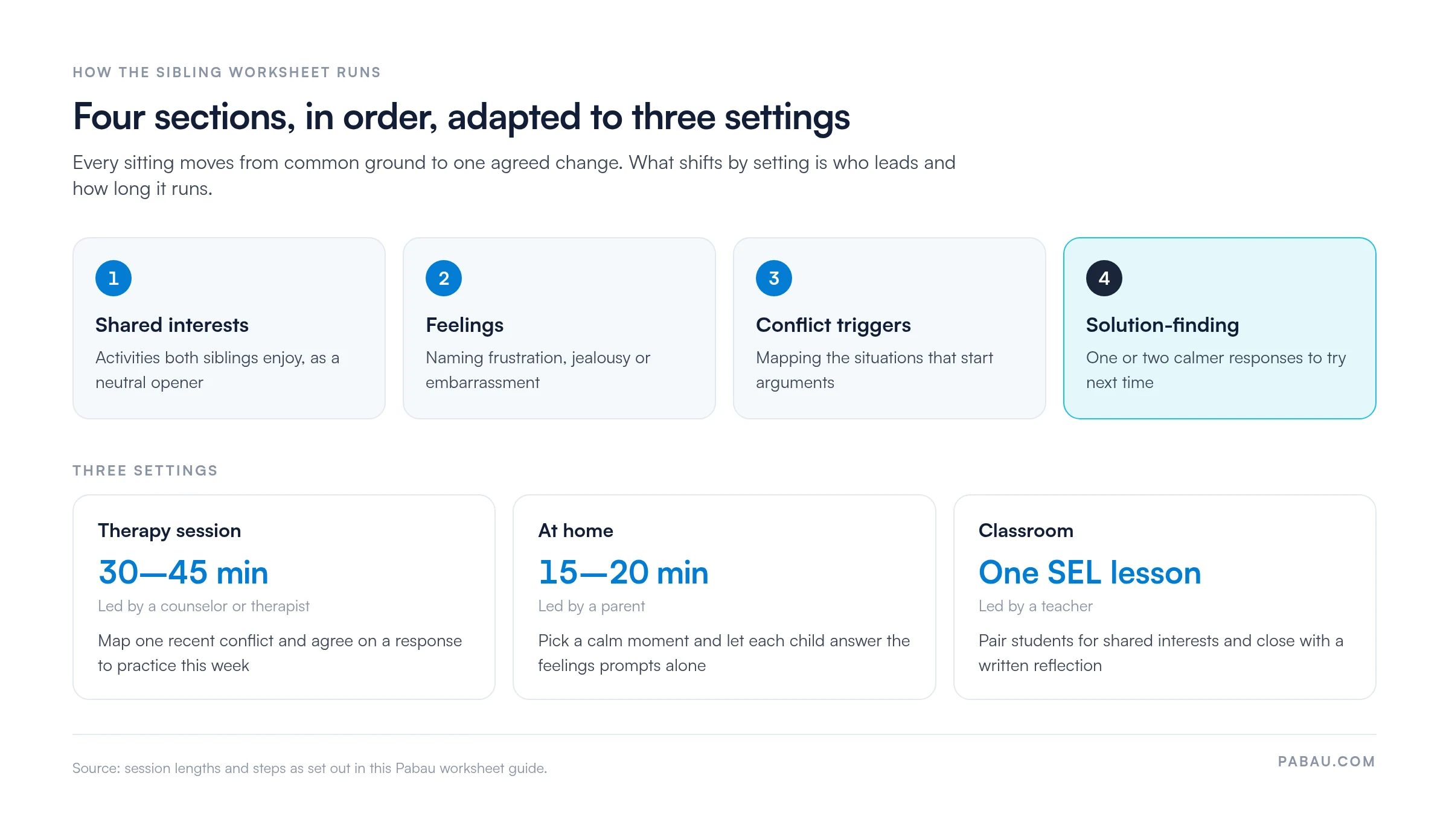
Counselors and therapists can run the worksheet as a structured part of a session, usually across 30 to 45 minutes. Keep the focus on the child’s own words rather than on who was right in a recent argument.
Younger children who struggle to name emotions can rate them first on a feelings thermometer. They then carry that word into the feelings prompts.
Parents can use the worksheet without professional support, as long as the tone stays calm and no child is put on the spot. A short sitting of 15 to 20 minutes works better than a long one.
If the same arguments keep coming back, parenting skills worksheets help adults plan how they respond in the moment.
Teachers can build the worksheet into social-emotional learning (SEL) lessons or advisory periods. The CASEL framework names self-awareness, relationship skills and responsible decision-making as core competencies. The worksheet maps onto each of them.
The worksheet targets a small set of skills that carry over beyond the sibling relationship. Each one is practiced in the prompts and then applied in everyday disagreements.
Children who need more practice at reflecting back can follow up with an active listening skills worksheet.
The shared-interests activity asks each child to list hobbies, places and shows they both enjoy. Research on common ground and positive interaction suggests that naming commonalities can make later disagreements easier to manage. Evidence specific to siblings is still limited. The table below shows how a completed section might look.
Siblings improve the relationship one agreed change at a time. This activity asks each of them to say how a recent disagreement felt, then agree on one change. It works best when each child speaks in turn and the facilitator keeps the language specific.
Short, practical activities reinforce the same skills between sessions. Choose one at a time so the child isn’t overloaded.
For older children and teens, a conflict resolution worksheet applies the same steps to disagreements outside the family.
The worksheet suits any setting where siblings get support together. Family therapy practices use it in sessions with children and parents. School counselors use it in one-on-one or small-group time. Educators use it in SEL lessons, and parents use it at home between professional appointments.
A shared structure cuts the time spent deciding what to talk about, so more of the session goes to the conflict itself. Written answers also give a facilitator something concrete to revisit next time. Because every child completes the same sections, tracking progress across weeks gets simpler.
Facilitators should keep language neutral and avoid taking sides. If a child discloses a safety concern, stop the worksheet and follow your child-protection and mandated reporting procedure. The worksheet complements professional therapy and doesn’t replace it.
Pabau, the practice software we build for therapy and health practices, publishes the worksheet free in its template library. It’s made for printing and use in sessions, classrooms or at home, and it needs no software to complete.
Keep each session focused on one conflict. Ask the child to describe what happened in their own words before suggesting a solution. Children are far more likely to try a change they chose themselves.
To look beyond the sibling pair, a family dynamics worksheet maps roles and patterns across the whole household.
Many therapy practices still print worksheets like this one. The completed sheet goes home with the family or into a paper folder, and it’s rarely on hand when the next session starts.
Pabau’s digital forms let you rebuild the worksheet as a form and send it before the appointment. Each completed copy is filed in the patient record. Our software for therapy practice management keeps those answers next to session notes and the next booking.
The result is a running record of each child’s chosen solutions. You can open the next session on last week’s agreement instead of starting from scratch.

Pabau’s digital forms let therapy practices send worksheets before a session and store completed copies in the patient record. Each family session builds on the last.

Siblings will keep arguing, but the arguments can become easier to talk about. Start with one recent conflict and one agreed change, and keep each sitting short enough that children stay engaged.
Over a few weeks, the written answers show which triggers keep returning and which solutions hold. That record is worth keeping, whether it sits in a family folder or a practice’s patient file. Book a demo to see how Pabau stores completed worksheets alongside each patient’s session notes.

Working with younger children? Therapy worksheet for kids offers age-friendly prompts for exploring thoughts and feelings in session.
Arguments turning into outbursts? Worksheet on anger management helps children spot early warning signs and plan a calmer reaction.
Need words for the feelings prompts? List of feelings gives children a vocabulary to describe what they felt during a conflict.
Teaching children to speak up calmly? Assertive communication worksheet practices stating needs without blaming the other person.
Checking perspective-taking skills? Empathy test measures how readily someone understands another person’s feelings.
A getting along with siblings worksheet is a printable tool that prompts children to reflect on shared interests, feelings, conflict triggers and solutions. It is used by parents, counselors and educators as a structured conversation aid.
It is suited to children and adolescents, with more facilitator support needed for younger children. Adjust the language and how many sections you cover in one sitting.
Yes, parents can use it at home with a calm tone and short sessions. It complements professional therapy rather than replacing it.
Therapy sessions typically run 30 to 45 minutes, and home sessions work well at 15 to 20 minutes.