Anja Dodevska
Ethical consent form: free template and what to add
An ethical consent form is a written record that a patient or participant agreed...

2
Last Updated: Oct 26, 2026
Free PDF 1 page, print-ready Clinician-reviewed
A consent form template for parents is a ready-made document a parent or legal guardian signs to authorize treatment for a patient under 18. It records that they understood the treatment’s risks, benefits, and alternatives.
It also lets your practice share the child’s protected health information (PHI) with them. Use it for every minor patient, file it in the patient record, and renew it at least once a year or whenever the treatment changes.
The harder question is who may sign. Custody orders, emancipated minors, and state confidential-care laws all change the answer, so this guide covers them alongside the fields every form needs.
The form covers the child’s and the parent or guardian’s details, treatment authorization, confidentiality consent, HIPAA authorization for sharing PHI, and parental signature blocks. Add your practice name and services, and it’s ready for intake.
Upload this PDF, or any form you already use, and Pabau's AI Form rebuilds it with tick boxes, text fields and a signature. Attach it to the treatment once, and every patient gets it on time.
AI Form rebuilds the consent, history and aftercare forms you already use. You review each one, then publish.
Patients complete forms on their phone before they arrive, so the front desk stops retyping paper.
Every signed form is versioned and attached to the treatment record, ready when you need it.
Set how long a consent stays valid. Returning patients skip forms they have already signed.
Supports HIPAA and GDPR compliance AES-256 encryption 4.8 on G2 4.7 on Capterra Trusted by 4,000+ practices worldwide

A parental consent form lets a provider treat a minor and share the child’s health information with the parent or guardian who signed it.
Under HIPAA, a parent is usually the minor’s personal representative and can access the child’s PHI. Exceptions cover emancipated minors and care a minor can legally consent to alone.
A compliant form names the guardian, describes the treatment and its risks, sets an expiry date, and carries a signature plus HIPAA release language.
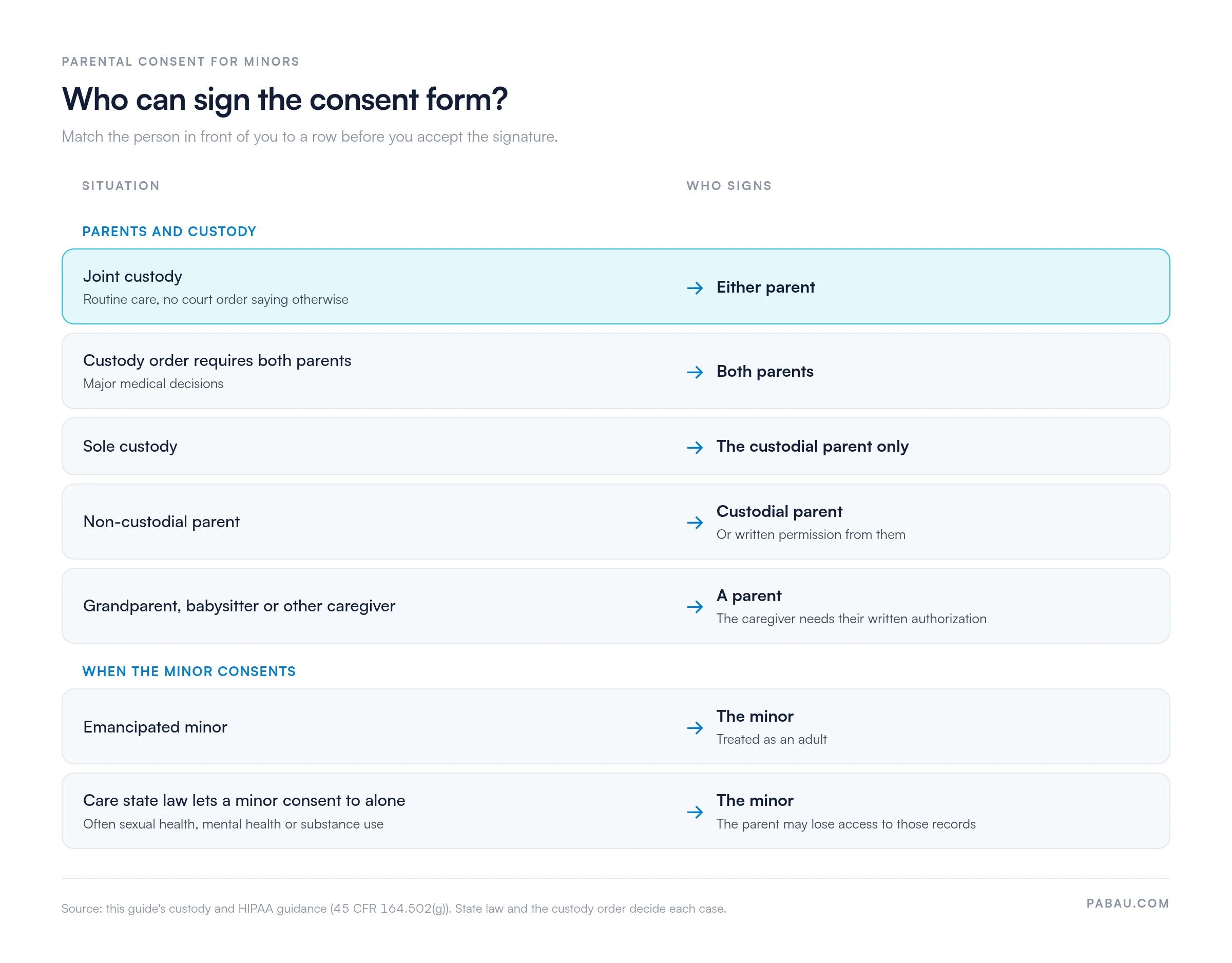
With joint custody, either parent can usually sign for routine care, unless a court order requires both signatures for major decisions.
Digital forms in Pabau, our practice management software, reach parents before the visit and file the signed copy in the patient record.
A parental consent form is a parent’s or guardian’s signed permission for a healthcare provider to treat a minor. It also covers access to, and sharing of, the child’s PHI. Adults consent for themselves, but minors usually lack the legal capacity to agree to medical care, so a parent signs on their behalf.
The form does two jobs. It records informed consent, meaning the parent understands the treatment, its risks, and the alternatives. It also authorizes your practice to share information with that parent. If anyone later disputes whether treatment was authorized, the signed form is the record you point to.
Collect parental consent for any patient below the age of majority, which is 18 in most US states. Common scenarios include:
Outside the exceptions covered below, a minor’s maturity doesn’t replace parental consent in most settings and jurisdictions.
A compliant parental consent form carries these nine fields:
Under HHS HIPAA guidance (45 CFR 164.502(g)), a parent is generally the minor’s “personal representative,” with the right to access the child’s PHI. In practice, this means:
Put clear HIPAA authorization language on the parental consent form, so the record shows the parent agreed to information sharing. To release records to a third party, such as a school or another provider, use a separate HIPAA authorization form.
Each specialty adds its own consent considerations for minors:
Mental health and therapy: Many jurisdictions let minors seek counseling without parental notification once they reach a certain age (often 13 to 14). Even so, collect parental consent at intake where you can. If the minor is at risk of harm or expressing suicidality, parental notification becomes mandatory regardless of consent preferences.
Photography and media consent: If your practice captures before-and-after photos or uses images for marketing, you need a separate media consent form. The parent or guardian signs it, and it should explain how the images will be used and stored, and whether they may be published.
Research and IRB studies: Research involving minors requires parental permission and, where the child is old enough, the child’s own assent. Research oversight bodies (IRBs) have strict requirements for parental permission and minor assent documentation that exceed routine clinical consent.
In most cases, one parent can sign a parental consent form for medical treatment. Custody arrangements decide the details:
Best practice: Ask about custody arrangements during intake. If you’re unsure whether the person signing has legal authority, ask for a copy of the custody order or a birth certificate showing parental rights.
A grandparent, babysitter, or other caregiver who brings the child in needs a parent’s written authorization, such as a signed babysitter consent form.
The chart below pulls the custody rules and the HIPAA exceptions into one check your front desk can run before accepting a signature.
Patient intake software replaces paper forms with an online workflow that sends, e-signs, and stores parental consent in the patient record.
When a minor’s appointment is booked, your practice sends the parent a consent link by email or SMS. The parent reads the treatment description, confirms they understand the risks and benefits, and signs electronically.
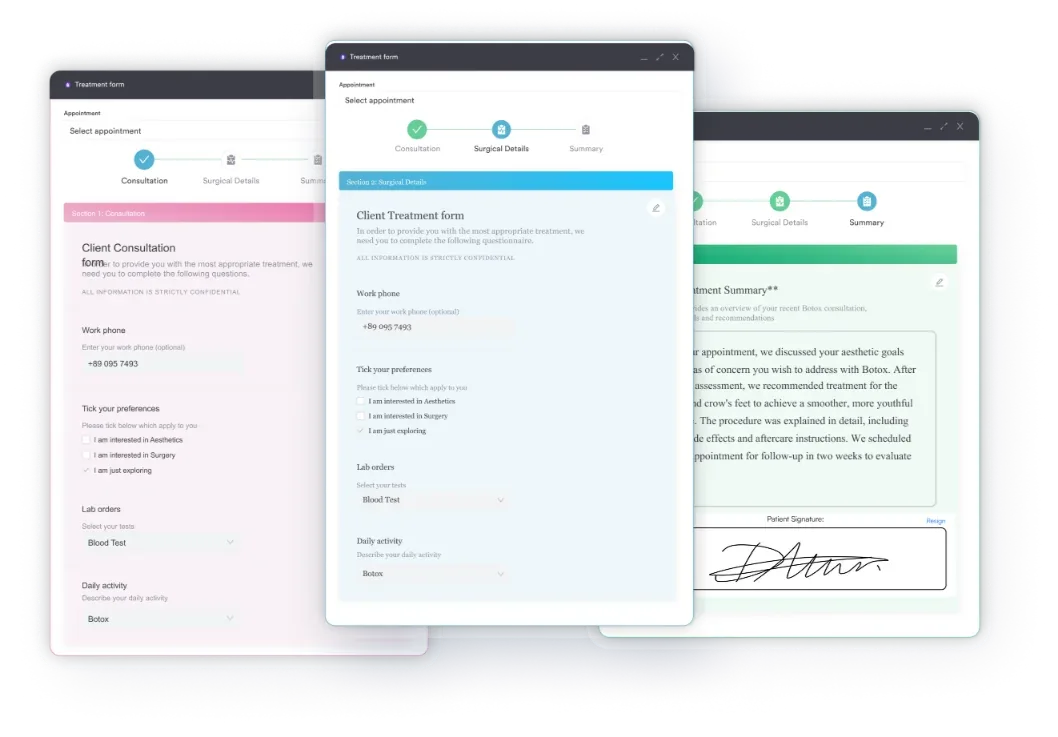
The signed form lands in the minor’s patient record with a timestamp and audit trail. Your front desk stops chasing missing signatures at check-in, and the documentation is ready when an audit or insurance claim calls for it.
The downloadable template is a starting point. Customize it for your practice by working through these steps:
Once it’s customized, save the form as your practice’s standard template, so every minor’s intake uses the same language and fields.
Document the consent conversation in the patient chart. Note what was discussed, any questions the parent asked, and the parent’s understanding of treatment. This narrative documentation complements the signed form and strengthens the legal record if a dispute ever arises.
Any healthcare practitioner treating patients under 18 needs a parental consent workflow. Common roles include:
Even if you mostly treat adults, keeping a parental consent template ready means you’re covered when a minor is referred or books an appointment.
Legal protection. A signed parental consent form is your practice’s primary defense against claims that treatment was unauthorized. It documents that the parent understood the treatment and agreed to it.
Regulatory compliance. CQC inspections (UK), state medical board reviews, and HIPAA audits all expect to see documented parental consent in minor patient records. A missing consent form is a compliance finding.
Better engagement and attendance. When parents sign a form describing the treatment and its benefits, they’re more invested in getting the child to appointments and supporting the plan.
Audit trail and documentation. A dated, signed consent form in the patient record creates an audit trail for insurance claims and future legal review. Digital forms add e-signature verification and timestamps for stronger evidence.
Consistency for the clinical team. When every staff member follows the same consent workflow, intake runs the same way whoever is on the front desk.
Using overly generic language. “I consent to medical treatment” is too vague. Be specific: “I consent to individual psychotherapy sessions using evidence-based cognitive-behavioral techniques.”
Forgetting to describe risks. A parent cannot give informed consent without understanding potential downsides. Spell out realistic risks in plain language.
Collecting consent once and never updating it. Renew consent annually or when treatment changes. A consent form signed three years ago is stale.
Leaving out HIPAA language. The form must explicitly authorize sharing PHI with the parent or guardian. Without it, you may be restricted from discussing the minor’s care with the parent.
Filing the form in a paper chart only. If your patient records are electronic, scan or store the signed consent in the patient’s digital record, so it’s accessible during appointments and audits.
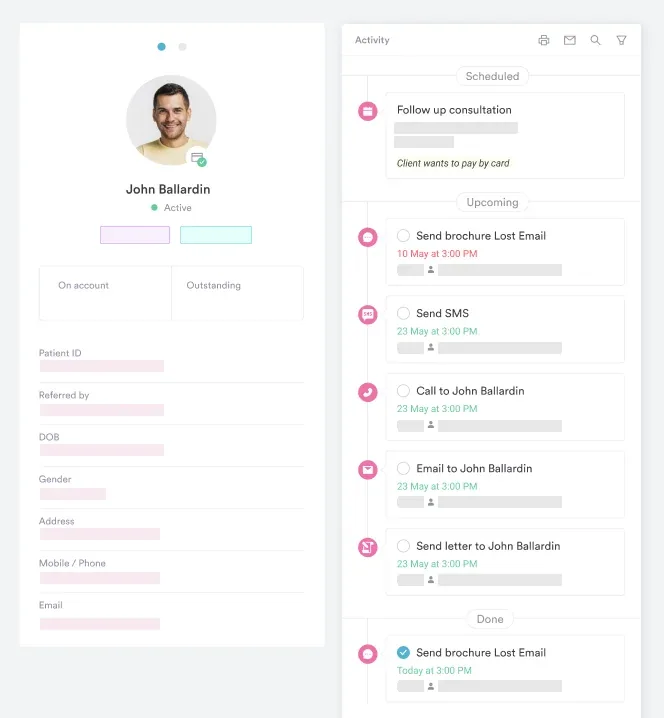
Many practices still email a PDF, print it at reception, and scan the signed copy into the chart. Each handoff is a chance for the form to go missing, or for a parent to sign an outdated version.
In Pabau, you save the parental consent form once as a template in the form builder. Pabau sends it to the parent ahead of the appointment as part of the pre-visit steps. The parent signs on their own device, and the signed copy goes straight into the child’s patient record.
Your team can see who has signed before the child arrives, so check-in doesn’t stall over a missing signature. Saved templates also keep the wording identical across staff members, with no data re-entered by hand.

See how Pabau’s digital consent forms automate parental authorization and store signed agreements directly in the patient record.

Start with the download, then make it yours. Name your services, list the risks that apply to them, and add the HIPAA release before any parent sees it.
The bigger decision is whose signature you’ll accept. Settle the custody, emancipation, and caregiver questions in your intake script, and your front desk won’t have to judge each case on the spot.
Paper works when minors are an occasional booking. Once you see them every week, a digital form that files itself is the more reliable record. Book a demo to see how Pabau collects and stores parental consent before the child arrives.

Running a pediatric vaccination clinic? Consent form for vaccination is a ready-made template for immunization consent.
Sharing confidential notes with another party? Authorization for release of confidential information documents exactly what may be shared, and with whom.
Starting therapy with a teenager? Counselor intake form captures the background details a first counseling session needs.
A parental consent form includes the minor’s name and date of birth, the parent or guardian’s details, and a clear description of the treatment. It also covers risks and benefits, alternatives, an authorization statement, a signature and date, HIPAA release language, and an expiration date.
Yes. A signed parental consent form is a legal record of the agreement between the parent and the healthcare provider. It shows the parent authorized treatment and understood the risks, which makes it your practice’s primary defense against unauthorized treatment claims.
Yes. A minor’s consent form must be signed by a parent or legal guardian, not the minor. Adult consent forms don’t fit minors, because minors usually lack the legal capacity to authorize medical treatment.
In most cases, yes. One parent can sign for routine medical care in joint-custody situations unless a court order requires both parents’ consent. Sole-custody parents have unilateral consent authority. Always clarify custody arrangements during intake.
No. Medical consent forms do not typically require notarization. However, some travel consent forms or legal guardianship consents may require notarization depending on jurisdiction. Check state or regional requirements for your specialty.
Parental consent is a parent’s or guardian’s permission to treat a minor. Informed consent is the broader process of making sure the person giving permission understands the treatment, risks, benefits, and alternatives. A parental consent form documents both: the parent consented, and they were informed.