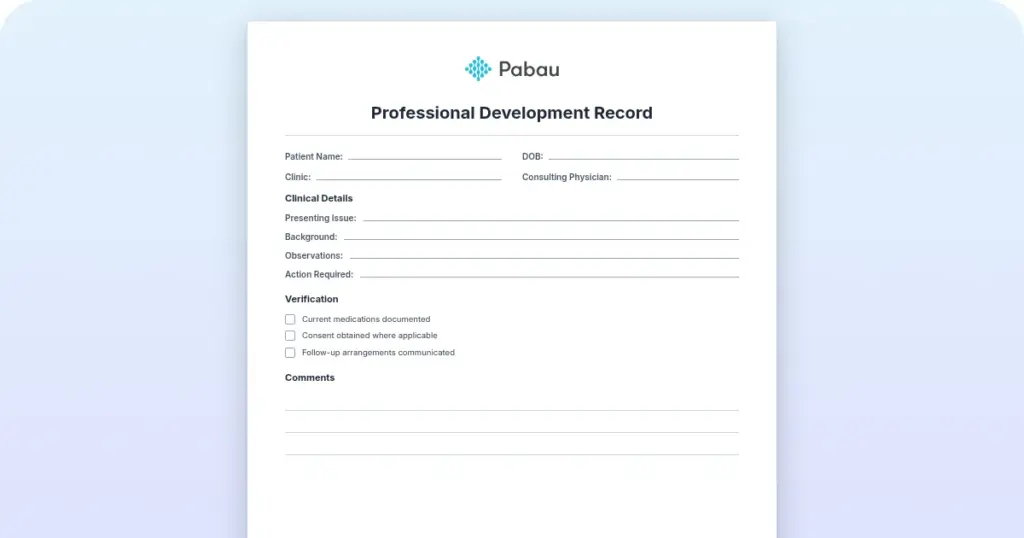
Professional development record
A professional development record is a structured log of a healthcare practition...

7
Last Updated: Oct 8, 2026

An emergency medical form captures patient identification, medications, allergies, medical conditions, emergency contacts, and treatment authorization in one document for first responders and healthcare teams
Healthcare practices, schools, and emergency care settings that treat complex patient populations all benefit from having this form on file and readily accessible
A complete emergency medical form includes patient demographics, current medication list with dosages, documented allergies, chronic conditions, emergency contact details, insurance information, and witnessed consent for emergency treatment
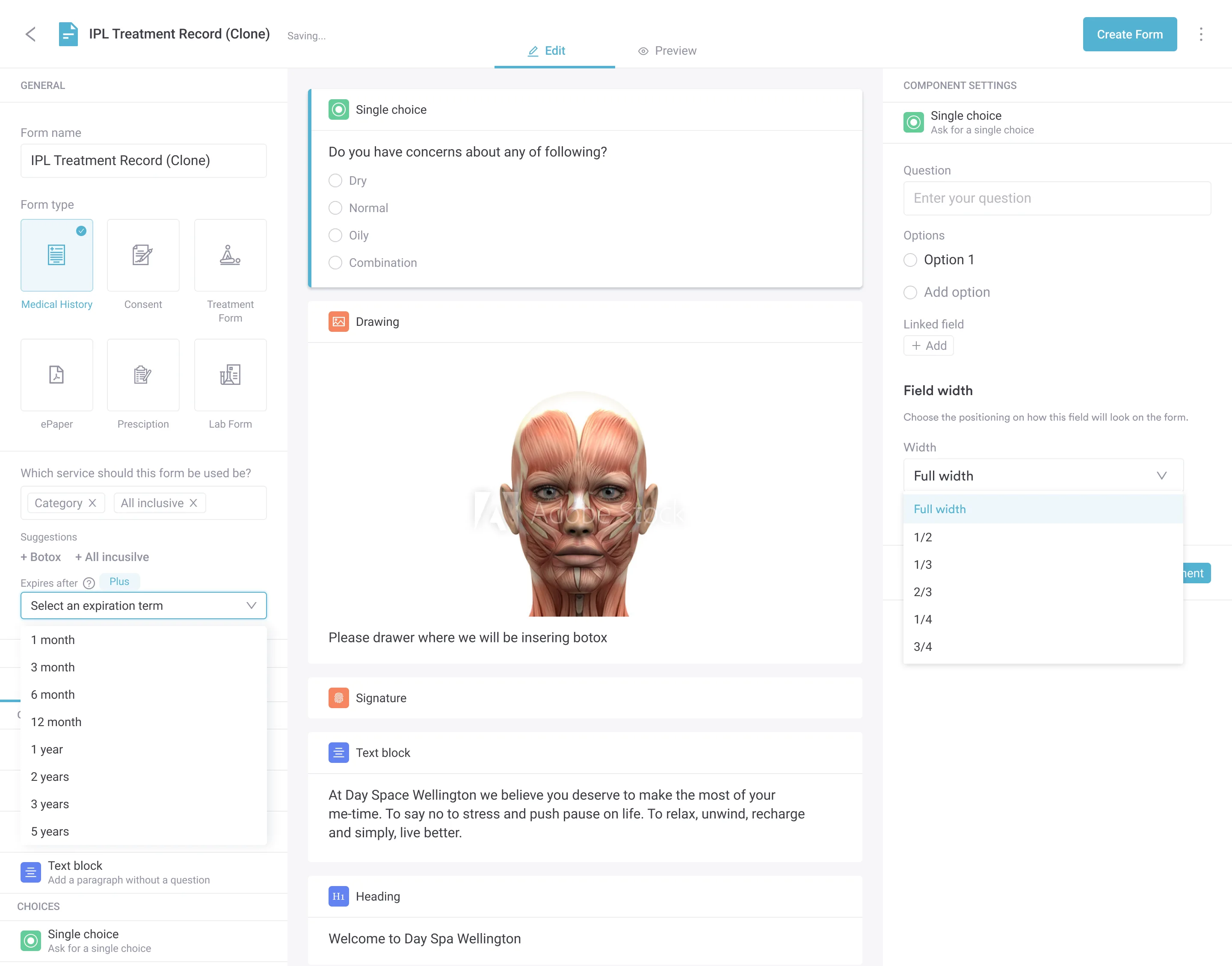
Practice management software like Pabau replaces paper-based emergency medical forms with digital intake forms, creating a single source of truth for allergies, medications, and patient history that’s instantly available during clinical workflows
A ready-to-use emergency medical form template covering patient identification, current medications, known allergies, medical conditions, emergency contact information, insurance details, and emergency medical authorization signature blocks.
Download templateAn emergency medical form is a one-page document that consolidates critical patient health information into a format that first responders and emergency department staff can scan in seconds.
When a patient arrives at an urgent care facility, emergency room, or requires paramedic assistance, having an emergency medical form completed and on file ensures the care team immediately knows allergies, current medications, chronic conditions, and any treatment authorizations or restrictions.
This single sheet bridges the gap between routine clinical care and emergency scenarios. It prevents medication errors and supports informed decisions when time is short.
The form serves two audiences: the patient, who documents their health status clearly, and the care team, who need rapid access to that information. Unlike a general intake form, an emergency medical form prioritizes the fields that matter most in acute care settings. A demographic information form captures the broader personal and contact details a general intake process still needs.
The clinical purpose is safety: reducing the risk that a first responder administers a treatment the patient is allergic to, or that the emergency team wastes critical minutes searching for medication histories.
Any patient population with complex medical needs, chronic conditions, or on multiple medications benefits from having an emergency medical form.
Pediatric patients with special healthcare needs, such as asthma, seizure disorders, severe allergies, or complex surgical histories, have been the traditional focus. The American College of Emergency Physicians (ACEP) and American Academy of Pediatrics (AAP) jointly developed the Pediatric Emergency Information Form (EIF) for this exact reason.
Beyond children, several settings routinely maintain emergency forms for their patient base:
Complementary therapy practices gather much of the same information before a first appointment. A Reiki intake form records medications and supplements alongside two emergency contacts.
A complete emergency medical form contains specific fields that emergency responders are trained to locate and interpret within seconds. Below is the core field structure shared across most standardized forms used in clinical practice and EMS settings.
Each of these fields must be legible and accurate. A single transcription error, such as misreading a medication dose or misspelling an allergy, can have serious consequences in an emergency room or paramedic setting. A structured shift report closes that same handoff gap between staff, cutting the missed medication doses that follow a rushed one.
The consent section of an emergency medical form is a legal component, not just administrative paperwork. By signing the form, the patient (or parent/guardian for minors) authorizes the healthcare provider or first responders to access and use the medical information during an emergency, and consents to emergency medical treatment based on that information.
Consent-form enforceability for emergency treatment authorization varies by state. Separately, HIPAA’s Privacy Rule already permits providers to share protected health information for treatment purposes, including in emergencies, without a signed authorization form. The signed section on this form documents the patient’s consent to treatment itself, not a HIPAA prerequisite for sharing information.
Forms covering treatment authorization, such as permission to intubate or authorize blood transfusions, may still need review by a qualified attorney or physician to confirm they meet state regulations. Do Not Resuscitate (DNR) orders, advance directives, and medical power-of-attorney designations are separate legal documents. Don’t conflate them with an emergency medical form.
Children with complex medical needs, such as developmental delays, congenital conditions, post-surgical status, or multiple medications, require specialized emergency forms because their care context differs from adults. The ACEP/AAP Pediatric Emergency Information Form (EIF) is the gold standard in US pediatric emergency care and is recognized by EMS protocols nationwide.
The pediatric form includes additional fields tailored to children: parent/guardian contact, school or daycare information, communication methods (sign language, AAC devices), behavioral triggers during medical procedures, and detailed medication dosing (often weight-based).
Schools serving students with medical complexity routinely keep copies of the pediatric EIF on file, and parents are encouraged to maintain a copy at home and in their car.
Completing an emergency medical form accurately requires clear communication between the patient (or caregiver) and a clinician who reviews each section for completeness and clinical accuracy. Follow these operational steps:
After completion, provide the patient with a copy for their records, keep a copy in the practice chart, and if the patient is in school or daycare, ensure a copy is filed with the appropriate institution.
Paper emergency medical forms, while effective when stored safely and accessible, have inherent limitations. They get lost, deteriorate, go out of date, and aren’t instantly available to the care team during a clinical visit.
When a patient completes an emergency medical form as a digital intake in Pabau, the data populates directly into the patient’s client record. Any clinician opening that record immediately sees a flagged allergy alert, current medication list, and emergency contact information, with no manual searching and no paper scans.
Digital intake forms and Care Pathways, within Pabau GO (our iOS app for practitioners), sync completed form data into the client record automatically, cutting out manual re-entry and the transcription errors that come with it.
The form is also accessible through the patient portal, allowing patients to update their emergency information between visits and ensuring the practice always has current data.
Witnessed digital consent is captured with timestamp, IP logging, and e-signature capabilities, meeting HIPAA and GDPR audit requirements. If the patient requires emergency transport or emergency room treatment, a printed or exported version of the digital emergency medical form can accompany them, or the receiving facility can request records directly from your practice’s system.
An emergency medical form is a critical safety tool that connects a patient’s everyday healthcare with urgent care decisions. Whether stored as a paper document in a car or on file as a digital patient record, the form ensures that allergies, medications, conditions, and emergency contacts are never lost when time matters most.
Practices that adopt emergency medical forms demonstrate a commitment to patient safety and workflow efficiency. To move beyond printable PDFs and ensure your emergency data is always current and instantly accessible, book a demo of Pabau’s digital intake forms and discover how to embed emergency medical information directly into your patient records system.

Track vitals alongside emergency data? Vital signs record template gives your practice a matching one-page format for routine observations, so emergency and vitals documentation stay consistent.
Treating burns in urgent care? Body burn percentage chart helps your team estimate total body surface area quickly during triage.
Assessing burns in children? Pediatric burn chart gives four age-banded diagrams, the Lund-Browder percentage table, and depth classification prompts.
An emergency medical form provides first responders, emergency room staff, and healthcare providers who are unfamiliar with the patient immediate access to critical allergy, medication, medical condition, and emergency contact information during an urgent medical situation, enabling safe and informed clinical decision-making under time pressure.
An emergency contact form records only names and phone numbers of people to notify in an emergency. An emergency medical form includes those contacts plus detailed health information (medications, allergies, diagnoses, consent for treatment) that emergency providers need to deliver safe care. The emergency medical form is clinical. The contact form is administrative.
Yes, if your practice treats patients with chronic conditions, complex medical histories, multiple medications, or anyone who might require emergency care. Schools, mental health practices, physical therapy practices, and primary care providers all benefit from maintaining emergency medical forms to ensure continuity of critical information if a patient requires urgent transport or emergency treatment away from your practice.
Yes. The American College of Emergency Physicians and American Academy of Pediatrics jointly developed the Pediatric Emergency Information Form specifically for children, especially those with special healthcare needs, developmental delays, or chronic conditions. Pediatric forms include additional fields such as communication methods, school information, and weight-based medication dosing.
An emergency medical authorization form grants explicit permission to first responders or emergency room staff to provide emergency treatment and access the patient’s medical history. It is a signed, witnessed consent document that protects both the patient (by documenting they authorized care) and the provider (by establishing informed consent).
You can download standardized emergency medical form templates from credible sources including the American College of Emergency Physicians (ACEP), your state EMS authority, or use the free template provided above. Alternatively, many practice management platforms like Pabau offer digital intake forms that can be printed or exported as PDF, ensuring the form stays updated and accessible from any device.
Yes. If your practice creates, stores, or shares an emergency medical form containing protected health information (PHI), HIPAA applies. HIPAA’s Privacy Rule already lets providers share PHI for treatment purposes, including emergencies, without a signed authorization first. What the signed form adds is documented consent to treatment itself and a record of who can access that information. Store the form securely, restrict access to authorized staff, and use encrypted storage and audit logging for digital versions.
An emergency medical form documents current health information and basic consent for emergency treatment. A DNR (Do Not Resuscitate) order or advance directive is a separate, formal legal document specifying end-of-life preferences and medical decision-making authority. While related, they serve different purposes and shouldn’t be conflated. Both may be referenced on a patient’s emergency medical form, but they are distinct documents.