Medication tracker template: Free PDF for clinicians and caregivers
A medication tracker is a form that records each medication a patient takes, whe...

2
Last Updated: Oct 12, 2026

A body burn percentage chart estimates total body surface area (TBSA) burned using the Rule of Nines (adults) or Lund-Browder method (children).
Accurate TBSA calculation determines fluid resuscitation volume, guides treatment protocols, and predicts patient outcomes in burn care.
Rule of Nines divides the adult body into zones of 9% each; Lund-Browder adjusts pediatric percentages by age, accounting for proportionally larger heads and smaller legs in children.
Practice management software like Pabau provides digital forms and structured documentation, so burn assessment charts are recorded accurately, stored securely, and accessible for care coordination.
A ready-to-use clinical reference chart for rapid TBSA estimation. Includes Rule of Nines (adult), Lund-Browder (pediatric with age bands), and step-by-step assessment instructions for emergency burn triage and fluid resuscitation planning.
Download templateBurn severity is determined by the percentage of body surface affected, a calculation that drives every clinical decision in burn care. Overestimate, and patients receive excessive fluid resuscitation. Underestimate, and they face organ failure and shock. Clinicians need a rapid, reliable tool to estimate total body surface area (TBSA) in the first minutes of assessment.
The body burn percentage chart provides this tool. Two evidence-based methods dominate clinical practice: the Rule of Nines for adults and the Lund-Browder chart for children.
This guide explains both methods, covers the procedural steps to apply them, and offers a free downloadable reference chart for your team.
A body burn percentage chart is a clinical tool that divides the human body into anatomical regions, each assigned a percentage of total body surface area (TBSA). By identifying which regions are burned, clinicians quickly calculate the total percentage affected, essential data for triage, treatment severity classification, and fluid resuscitation planning.
TBSA estimation follows American Burn Association (ABA) guidelines, and the Rule of Nines method itself is documented in peer-reviewed clinical references such as StatPearls’ clinical overview. In the UK, NHS burn units use these same methods alongside CQC compliance standards for documentation accuracy.
Why it matters: burns covering roughly 15-20% TBSA in adults, or 10-15% TBSA in children, are classified as “moderate” and typically require hospital admission. Above 40% TBSA, mortality risk increases sharply. Structured documentation in a clinical records system ensures no calculation error occurs during the critical first assessment period.

The Rule of Nines divides an adult’s body into zones of 9% or multiples thereof. This rapid estimation method is the standard first-pass assessment in emergency departments and burn centers.
How to use the chart: Identify which body regions are burned. Add the percentages. For example, a burn affecting one lower leg and the anterior abdomen equals 18% + 9%, or 27% total TBSA, within the 25-30% range typical of this injury pattern.
The Rule of Nines is fast and reliable for adults but has limitations. In obese patients, the Rule can overestimate TBSA because body fat distribution changes regional proportions.
Rule of Nines applies to adults 16 years and older; for children 15 years and under, use the Lund-Browder chart instead, since the Rule of Nines significantly overestimates burn surface area in pediatric patients.
The Lund-Browder chart is the gold standard for pediatric burn assessment. It accounts for the dramatic differences in body proportions between infants, children, and adults, particularly the proportionally larger head and smaller lower extremities in young children.
Worked example: a 5-year-old presents with burns on both lower legs (calves) and the anterior abdomen. Using the Lund-Browder chart for the 5-9 year age band, each lower leg (calf) is 5.5%, so both together equal 11%. The anterior abdomen is roughly half of the 13% anterior trunk region, or about 6.5%. Total: 11% + 6.5%, which is 17.5% TBSA.
Applying the adult Rule of Nines to the same regions instead gives 18% + 18% + 9%, or 45% TBSA, more than double the accurate pediatric figure. That 27.5 percentage point difference would translate directly into an oversized Parkland formula fluid volume, which is exactly why Lund-Browder, not Rule of Nines, is the standard for children.

An occupational therapy platform can store each completed scale beside the patient’s goals and session history.
Follow these five operational steps to estimate TBSA using either the Rule of Nines or Lund-Browder chart.
Special case: Palmar method. For burns affecting scattered, small areas (for example, a mosaic of fingertip burns), use the palmar method: the patient’s palm (including fingers) equals approximately 1% TBSA. Count how many palms would cover the burned area. This complements but does not replace the Rule of Nines for large burns.
TBSA percentage must be paired with burn depth classification. Degree determines healing trajectory and treatment intensity, the same percentage-of-body-surface principle used to classify conditions such as exfoliative dermatitis.
A 20% TBSA first-degree burn is treated as an outpatient. A 20% TBSA second- or third-degree burn requires hospital admission and specialist burn care.
The Parkland formula is the standard initial fluid resuscitation protocol for moderate-to-severe burns. TBSA percentage directly determines fluid volume.
Parkland formula: 4 mL multiplied by body weight (kg) multiplied by % TBSA burned equals total fluid volume in 24 hours. Half the volume is given in the first 8 hours; the remainder over the next 16 hours.
Example: A 70 kg adult with a 30% TBSA burn. Parkland calculation: 4 times 70 times 30 equals 8,400 mL (8.4 liters). First 8 hours: 4,200 mL at approximately 525 mL per hour. Remaining 16 hours: 4,200 mL at approximately 262 mL per hour.
Accuracy matters. Patient records management systems flag shifts in urine output or hemodynamics, triggering reassessment of fluid rates.
While no software makes the clinical assessment for you, accurate documentation of TBSA and burn characteristics is non-negotiable. Pabau enables burn specialists and emergency teams to document and store burn assessment charts within a secure, HIPAA-compliant system.
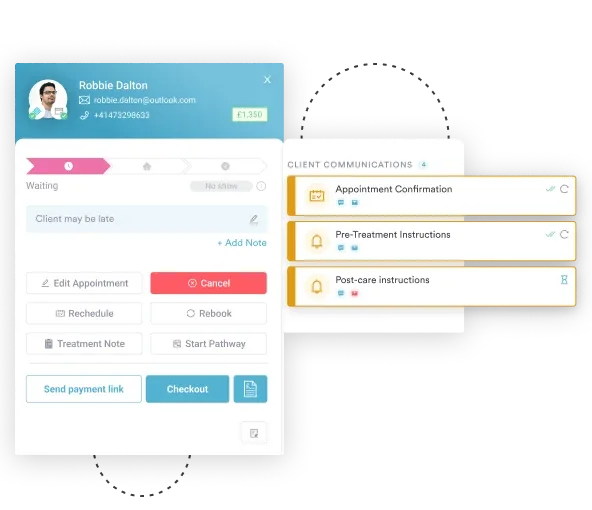
Burn assessment workflow: A clinician records the patient’s presentation (percentage TBSA, degree, location, mechanism of injury) in the patient record. This data triggers automated documentation workflows, including reminders for fluid resuscitation timing, specialist consultation flags, and wound dressing intervals. All updates are time-stamped and audit-logged for regulatory compliance and continuity of care across teams. Digital intake forms arrive before the appointment, so the clinical time is spent on the presentation instead.
The body burn percentage chart is the cornerstone of effective burn management. The Rule of Nines and Lund-Browder chart are evidence-based tools that clinicians trust in emergency settings. Pairing these charts with structured clinical documentation ensures no critical detail is lost during handoffs or transfers.
Storing assessment data, degree classification, and resuscitation parameters in one place keeps the full picture available to every team member. Book a demo to see how Pabau integrates burn assessment documentation into your team’s workflow.

Documenting a vascular scan? Doppler ultrasound report template structures spectral, color, and power Doppler findings across every vascular region.
Need contact details on file for an emergency? Emergency contact form template covers primary and secondary contacts plus medical notes and signature authorization.
Preparing for a medical emergency on site? Emergency medical form template records current medications, known allergies, and emergency authorization details.
A body burn percentage chart is used to estimate total body surface area (TBSA) affected by burns, which determines treatment intensity, fluid resuscitation volume, and whether a patient requires hospital admission or specialist burn center care.
Use Rule of Nines for adults aged 16 and older; use Lund-Browder for children aged 15 and under, as their body proportions differ significantly and the Rule of Nines overestimates pediatric burn surface area.
The Rule of Nines is accurate to within approximately 5% in most adult cases, making it reliable for rapid triage. Accuracy decreases in obese patients or those with extreme body habitus, and it is not recommended for pediatric patients, where Lund-Browder is the gold standard.
Burns exceeding 40% TBSA carry significantly higher mortality risk and require intensive burn unit care. Burns above 15-20% TBSA in adults or 10-15% TBSA in children are classified as moderate to severe and typically require hospital admission.
The Parkland formula calculates initial fluid resuscitation as 4 mL times weight (kg) times % TBSA burned over 24 hours. TBSA percentage is the critical variable; an error in TBSA estimation directly causes under- or over-resuscitation.
The palmar method (patient’s palm approximately equals 1% TBSA) is useful for small, scattered burns but should not replace Rule of Nines or Lund-Browder for large burns, as palm-by-palm estimation becomes impractical and error-prone above 10-15% TBSA.