Mental health self-care checklist
A mental health self-care checklist is a structured daily tool for tracking the ...

5
Last Updated: Oct 20, 2026

A drug and alcohol evaluation is a clinical assessment that uses standardized screening tools and structured interviews to identify substance use disorders and treatment needs.
Evaluations are required by courts after DUI/DWI charges, by probation officers, and clinically when patients present with suspected substance use concerns.
The AUDIT, DAST-10, and CAGE questionnaires are validated screening instruments used alongside clinical judgment and DSM-5 diagnostic criteria.
Pabau’s digital forms and clinical notes help evaluators structure assessments and keep records HIPAA compliant with controlled access.
A print-ready assessment form with sections for substance use history, clinical interview notes, AUDIT and DAST-10 scoring, and mental health screening. It closes with DSM-5 criteria checkboxes and a treatment recommendation summary you can hand to a court or payer.
Download templateA drug and alcohol evaluation is a clinical assessment conducted by a licensed counselor to determine whether a person has a substance use disorder. It also establishes the severity of that disorder and the level of treatment that fits.
The assessment combines clinical interview data, substance use history, validated screening instruments, and DSM-5 diagnostic criteria. The result is a documented report with treatment recommendations. Courts, probation officers, insurers, and treating clinicians all rely on that report.
The evaluation answers one clinical question: does this person meet diagnostic criteria for a substance use disorder, and what level of care is needed? A comprehensive assessment goes well beyond casual screening. The interview explores use history, consequences, family patterns, co-occurring conditions, and motivation for change.
Licensed substance abuse counselors (LSAC) and licensed professional counselors (LPC) conduct these assessments. They combine evidence-based tools with clinical judgment and current treatment standards. Structured patient intake is what makes that judgment defensible later.
The evaluation serves several audiences at once. Courts use it to assess DUI/DWI offenders and inform sentencing or diversion decisions. Employers and schools request it for fitness-for-duty or disciplinary processes. Insurers use it to authorize treatment and confirm appropriate placement.
Clinically, it matters most as a planning document. It tells you which risks to treat first and which co-occurring conditions, such as panic disorder treatment needs, have to run alongside substance use care.
Court orders are the most common trigger. A judge typically mandates an assessment after a DUI/DWI arrest, as part of a drug court diversion program, or following a substance-related charge. Probation officers may also require one as a condition of supervision.
Beyond the legal system, an evaluation is clinically indicated when a patient presents with:
A thorough assessment has eight core components. It opens with a clinical interview covering current use, past use, and failed attempts to cut back. The same interview covers family and social context, legal and occupational impact, and mental health symptoms. Current use is recorded by frequency, quantity, route, and consequences.
The evaluator then documents substance use history in detail. That means when use began, how it escalated, and any periods of abstinence. Keeping that history inside the patient record rather than a loose file matters when a court requests it months later.
Standardized screening tools come next. The AUDIT, DAST-10, and CAGE questionnaires provide validated data on severity and dependence risk. Mental health screening for depression, anxiety, and suicidality follows, because those conditions often accompany substance use and must be treated concurrently.
The evaluator then applies DSM-5 criteria, assessing all 11 items for substance use disorder. The count decides whether the person meets the threshold for mild, moderate, or severe SUD. The final step is a written report with treatment recommendations aligned to ASAM placement criteria.
Three validated instruments dominate substance use screening. The AUDIT (Alcohol Use Disorders Identification Test) is a 10-item WHO-endorsed questionnaire for hazardous and harmful alcohol use. Responses score 0-4, giving a total of 0-40. A score of 8 or above indicates use that needs intervention.
The DAST-10 (Drug Abuse Screening Test) is a parallel 10-item yes/no questionnaire for drug use. A score of 3 or above suggests possible substance use disorder. The CAGE questionnaire is a brief four-item tool for alcohol misuse, where 2 or higher is clinically significant. The NIAAA publishes scoring guidance for each.
These tools are not diagnostic by themselves. They complement clinical judgment and structured diagnostic assessment. A patient may score above the AUDIT threshold yet not meet full DSM-5 criteria, or the reverse. That is why the evaluation integrates screening results with interview data.
The DSM-5 defines substance use disorder using 11 criteria across four domains: impaired control, social impairment, risky use, and pharmacological criteria. A person must meet at least 2 criteria within a 12-month period to receive a diagnosis. Severity follows the count: 2-3 is mild, 4-5 moderate, and 6 or more severe.
The 11 criteria are:
This standardized framework keeps findings consistent across evaluators. It also aligns your documentation with insurance billing standards and published treatment guidelines, which is what payers look for when they review a placement request.
The recommendation rests on severity, co-occurring conditions, medical complexity, social support, motivation, and prior treatment history. The American Society of Addiction Medicine (ASAM) criteria guide placement across levels of care. Outpatient services suit mild-to-moderate SUD with stable housing and work.
Residential or inpatient care fits severe SUD, medical complexity, or repeated outpatient failure. Medically managed inpatient treatment addresses life-threatening withdrawal. A therapy practice management system helps you track which patients moved between those levels and when.
The evaluator records the recommended modalities alongside the level of care. Those usually include individual therapy, group therapy, medication-assisted treatment, and peer support. Between-session tools such as a DBT diary card or an AA step 7 worksheet give the plan something measurable to review.
Substance use treatment records carry two layers of legal protection. HIPAA sets the standard privacy and security rules for all health information. 42 CFR Part 2 goes further for substance use disorder records held by federally assisted programs.
Part 2 requires written patient consent before those records go to a third party. That includes other physicians and insurance companies. The rule reflects the sensitivity of a substance use diagnosis and the stigma that has long surrounded it. Good patient data security practice starts there.
Evaluators must document that patients understand these protections and hold signed consent before any disclosure. A Part 2 breach carries federal penalties independent of HIPAA violations. Choosing HIPAA compliance software that logs every disclosure is the cheapest way to prove you followed the rule.
The intake section of your psychiatric evaluation template captures the basics first. Required fields are patient name, date of birth, contact details, referring source, and urgency of assessment. The referring source matters, because a court referral changes what the final report has to contain.
Substance use history fields then document the clinical picture:
Social history fields cover living situation, employment, legal history, family substance use, and prior treatment episodes. Mental health screening asks about depression, anxiety, trauma, suicidality, and previous psychiatric diagnoses. This intake data is the foundation for the screening tools and DSM-5 assessment that follow.
Most evaluators still work across three places at once. The intake form is on paper, the screening scores sit in a spreadsheet, and the report is typed up afterwards from handwritten notes. Rekeying that material is where detail goes missing.
Practice management software like Pabau keeps the whole evaluation in one chart. Digital forms capture substance use history, family patterns, and co-occurring conditions in a fixed structure. Screening results, clinical notes, and DSM-5 findings then sit in the same searchable record, and workflow reminders flag any step still outstanding.
When the assessment is finished, you export a structured report as a PDF for the court, the payer, or the patient’s file. Records are encrypted and access-controlled, so your mental health EMR supports HIPAA-compliant record-keeping with a clear audit trail. The outcome is a shorter write-up and a report you can defend.
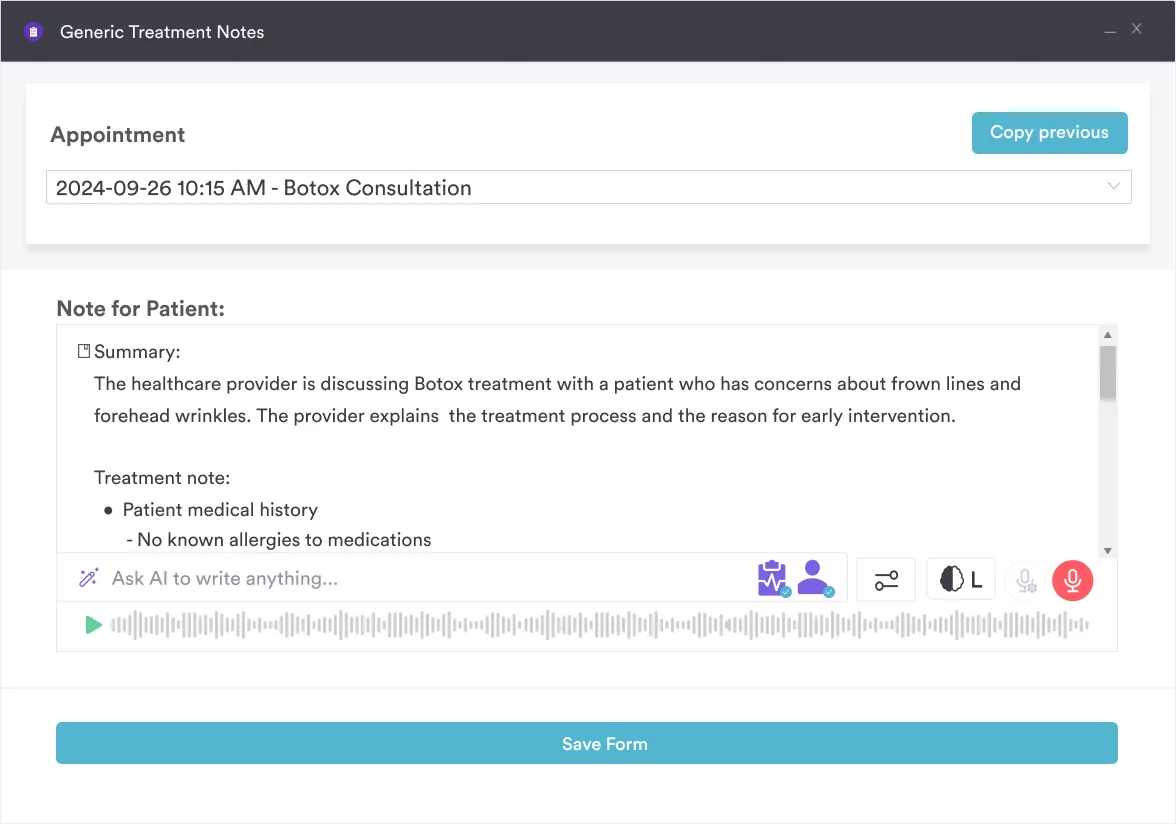

Pabau’s digital forms and clinical notes let you run the whole evaluation in one chart, then export a report a court or payer will accept. Records stay encrypted and access-controlled throughout.

The judgment in an evaluation is yours, but its credibility comes from structure. A court, a payer, or a colleague reading your report months later cannot see the interview. They can only see whether the screening scores, the DSM-5 count, and the recommended level of care line up.
So use the same form every time and score it the same way. Consistency is what makes two evaluations comparable, and it is what protects you when a recommendation is challenged. The trade-off is a little rigidity in the interview, which is a fair price for a defensible report.
Download the template above, then decide where the completed forms will live. Book a demo to see how Pabau keeps evaluations, consent records, and reports in one secure chart.

Need structured recovery work between sessions? The AA step 7 worksheet gives patients a guided exercise you can review at the next appointment.
Tracking urges and coping skills? The DBT diary card records daily urges and emotions, so progress is visible across weeks.
Running group counseling after the evaluation? 8-week group counseling plan sets session-by-session goals, modalities, consent, and progress notes for eight weeks.
Treating a co-occurring anxiety disorder? The panic disorder treatment covers the options that run alongside substance use care.
Assessing anger as a presenting problem? The clinical anger scale adds a scored measure to interviews where hostility keeps surfacing.
It is a clinical assessment by a licensed counselor or clinician. It uses standardized screening tools (AUDIT, DAST-10, CAGE) alongside a structured interview. The goal is to establish whether a person meets DSM-5 criteria for substance use disorder, and what level of treatment is needed.
A comprehensive assessment usually takes one to two hours. Complexity, comorbidities, and the amount of collateral information available all affect the length. Court-ordered evaluations often need extra documentation time on top.
Yes. Substance use treatment records are protected by HIPAA and by 42 CFR Part 2. Part 2 requires explicit written consent from the patient before any disclosure to a third party, which is stricter than standard medical record confidentiality.
Bring a valid ID, insurance information, and any court documents if the evaluation is court-ordered. Be honest about substance use history, family patterns, and mental health symptoms. Accurate information is what produces an appropriate treatment recommendation.
The evaluator produces a written report with recommendations aligned to ASAM placement criteria. Court-ordered reports go to the court. Otherwise the recommendations guide your clinician or treatment facility in choosing the level of care, from outpatient through to inpatient.