Antipsychotic medication list
An antipsychotic medication list is a structured reference that organizes psychi...

2
Last Updated: Oct 13, 2026

The Clinical Anger Scale is a 21-item self-report instrument that measures anger severity on a 0 to 63 scale.
Snell and colleagues published the CAS in 1995 and modeled its cutoffs on the Beck Depression Inventory.
The published severity bands are minimal (0 to 13), mild (14 to 19), moderate (20 to 28), and severe (29 to 63).
A score of 29 or higher signals severe clinical anger, so it calls for prompt intervention rather than routine monitoring.
Digital delivery lets you assign the form, score it automatically, and file the result in the patient record.
A printable 21-item self-report questionnaire with the 0 to 3 response anchors and a total-score box. It also carries the published severity key for minimal, mild, moderate, and severe clinical anger. Ready to hand to a patient at intake or at a review appointment.
Download templateMental health practitioners and primary care clinicians assess anger to set a baseline, track treatment response, and decide whether therapy or medication is warranted. Teams running mental health practice management increasingly collect those assessments digitally. Many practices still work from paper forms or from unstructured clinical impressions.
The Clinical Anger Scale (CAS) is a short, validated instrument that turns those impressions into a number from 0 to 63. This guide covers its structure, administration, scoring, and the published severity bands. It also shows how to file a result so it shapes the next appointment.
The Clinical Anger Scale is a 21-item self-report tool that measures the intensity of anger symptoms in adults. Snell, Gum, Shuck, Mosley, and Hite developed it in 1995 and published it in the Journal of Clinical Psychology. They modeled it on the Beck Depression Inventory (BDI), so the format and the severity cutoffs deliberately mirror that instrument. Comparing a result against earlier sessions is quicker when software for psychology practices holds the history.
Each item is rated on a 0 to 3 scale, where 0 reflects minimal agreement and 3 reflects maximal agreement with an anger-related statement. Total scores run from 0 to 63, and higher scores indicate greater anger severity. The items cover cognitive, behavioral, and physiological aspects of the anger experience.
The CAS works as a screening instrument and as a progress-tracking tool during treatment. It quantifies anger along a continuum rather than diagnosing a disorder. That helps you recognize when symptoms warrant intervention and whether treatment is reducing them.
The CAS presents 21 statements about anger-related thoughts, feelings, and behaviors. Patients rate each one on a four-point scale, from 0 for not at all to 3 for very much so. Running it through digital forms for patient intake lets you assign the questionnaire electronically, receive responses in real time, and calculate the total automatically.
Keep the patient instructions plain and supportive. Ask the patient to read each statement and select the number that best describes their level of agreement. Make clear that there are no right or wrong answers, and that an honest response helps you tailor treatment.
Scoring is straightforward and needs no reverse scoring. Follow these steps:
Example: a patient whose item responses sum to 42 has a CAS score of 42. That falls in the severe clinical anger band, which starts at 29.
Interpret the total using the severity bands published with the instrument. These are the cutoffs Snell and colleagues set, and they follow the BDI convention rather than an even split of the 0 to 63 range. Beck’s hopelessness scale is banded the same way, so its total is read against published cutoffs rather than a share of the maximum.
The four bands do not divide the 0 to 63 range into equal quarters. Severe clinical anger opens at 29, which is under half the maximum. A mid-range total is a serious result rather than a middling one.
Read the score alongside the patient’s presentation, environment, and symptom trajectory. A rising score points to worsening anger control and may justify escalating treatment. A falling score suggests the plan is working.
The original Snell et al. validation study, published in the Journal of Clinical Psychology in 1995, reported preliminary internal consistency and test-retest reliability. The instrument correlates moderately with related constructs such as state anger and trait anger. It also separates clinical from non-clinical samples.
Later research has replicated the factor structure and supported the CAS as a brief, valid measure of anger severity. Its 21 items compare well with longer instruments such as the 60-item Novaco Anger Scale. That brevity makes it practical for routine screening and progress monitoring in time-constrained outpatient settings.
Clinicians administer the CAS at intake to establish a baseline, then repeat it at set intervals to track treatment response. Psychology, counseling, and primary care teams use it to screen for anger problems. In psychiatry practices, the score also helps triage patients to the right level of care.
The CAS is validated for adults aged 18 and over. For children and adolescents, use an age-appropriate instrument instead.
Several anger instruments are in common use, and they trade depth against administration time. A short measure that patients finish in the waiting room often beats a longer one that stalls.
The CAS sits between brevity and depth. The Novaco Anger Scale gives you more detail but costs more session time. The PROMIS anger scale is faster and less granular. For routine clinical use and repeat assessment, the CAS is usually the practical pick.
Patients who struggle to name what they feel can also work from the 22-emotion guidance scale, a self-awareness aid that does not diagnose. It ranks anger above fear, grief, and powerlessness, and gives patient and clinician shared language for mood between sessions.
Paper anger assessments end up filed in a chart. A practice that runs the CAS with 100 patients a month builds 1,200 paper copies a year. Those copies are slow to retrieve, awkward to compare, and easy to misfile. That is the wrong shape for an instrument whose value lies in the trend.
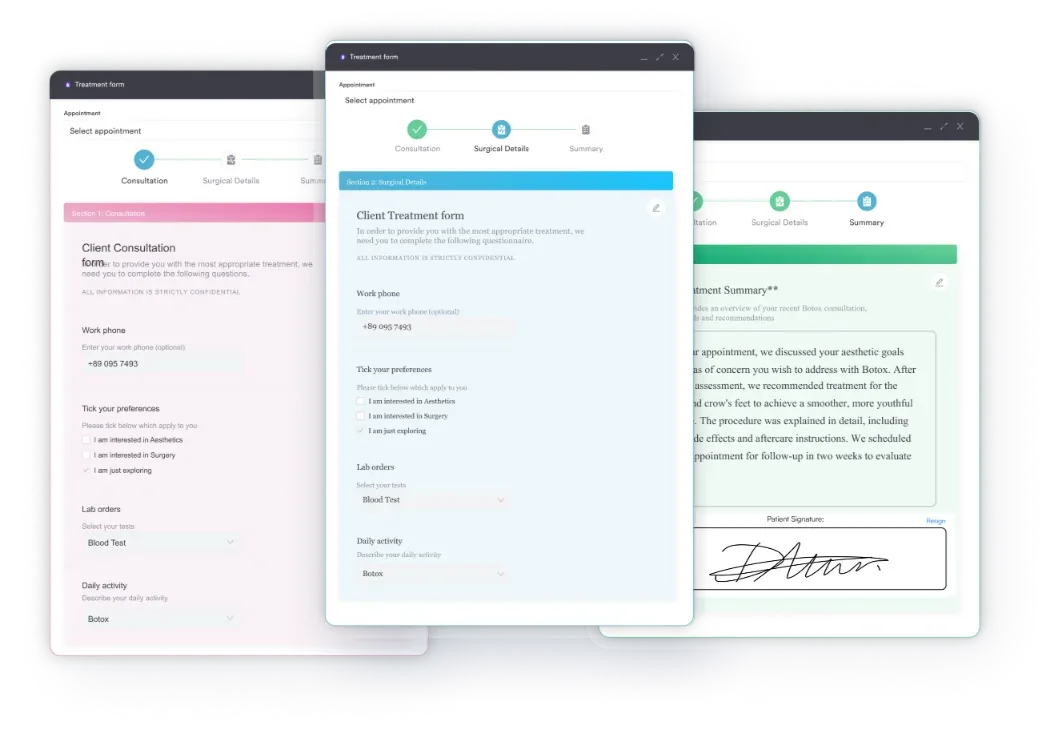
Practice management software like Pabau handles the CAS as a digital form attached to the patient record. You assign it through our online booking portal or on a tablet in the room. The patient completes it, the total is calculated on submission, and the score is stored with a timestamp beside appointment history and clinical notes.
A score of 29 or higher raises an alert for the treating clinician, rather than waiting for the next review. That removes manual data entry and gives you comprehensive practice management built on structured measurement. Over time you get a searchable record of anger scores across your caseload, which supports outcome reporting and audit.

Pabau sends the Clinical Anger Scale before the appointment, scores it on submission, and files the result against the patient timeline. Clinicians open the chart and see the trend without rekeying a single form.

The CAS earns its place because it is short, validated, and scored the same way every time. The part worth getting right is the scoring key. Severe clinical anger starts at 29, not at some point near the top of the 0 to 63 range. A practice working from an invented or evenly spaced band table will under-call the patients who most need attention.
Use the published bands, repeat the assessment on a set schedule, and read the direction of travel rather than a single total. The trade-off to remember is that the CAS measures severity only. It tells you how much anger is there, not why, so it belongs alongside a clinical interview rather than in place of one.
Download the template above to start using it this week. Book a demo to see how Pabau assigns, scores, and tracks assessments like the CAS inside the patient record.

Building the wider mental health intake pack? Adult counseling intake form covers the history and consent fields that sit alongside a severity measure.
Assessing a patient under 18? Adolescent intake questionnaire gives you an age-appropriate starting point, since the CAS was validated in adults.
Planning the work after a raised score? Self-control worksheet gives patients a structured way to practice pausing before they react.
Targeting the thinking behind the anger? Negative self-talk worksheet helps patients catch and challenge the thoughts that escalate an outburst.
Tracking mood between sessions? DBT diary card records daily emotion and urge ratings that add context to a CAS total.
The CAS is a standardized 21-item self-report measure that assesses anger severity in adults. Clinicians use it at intake to establish baseline anger, during treatment to track progress, and at closure to confirm symptom improvement. It measures severity rather than delivering a diagnosis, and it informs treatment planning and therapy goals.
Most patients complete the CAS in 5 to 10 minutes. There are no time limits, and patients may take as long as needed. Clinicians may read the items aloud to patients with reading difficulties.
Scores range from 0 to 63, and there is no single normal score. Minimal clinical anger runs from 0 to 13, which is what most non-clinical samples produce. Patients who present for anger treatment usually score 14 or above. Interpretation still depends on clinical context, so the trend across repeat assessments tells you more than any single number.
The CAS was validated for adults (18+). For children and adolescents, age-appropriate anger assessment instruments exist (e.g., the State-Trait Anger Expression Inventory for Children, STAXI-C). Using the adult CAS with minors is not recommended without further validation.
The CAS is published without licensing fees, so clinicians may print and administer it freely. Practice management software like Pabau includes digital forms, automatic scoring, and record integration in every subscription. There is no add-on charge for those features, and the instrument itself stays free in its PDF form.