Fun journal prompts for adults
Fun journal prompts for adults are short, open-ended questions that make sitting...

Last Updated: Oct 6, 2026

A supervision contract is a written agreement setting out the goals, session structure, evaluation method, and duties that a supervisor and supervisee both sign.
The template on this page is a general counseling supervision contract. It covers purpose and goals, supervision context, evaluation method, duties on both sides, and procedural terms.
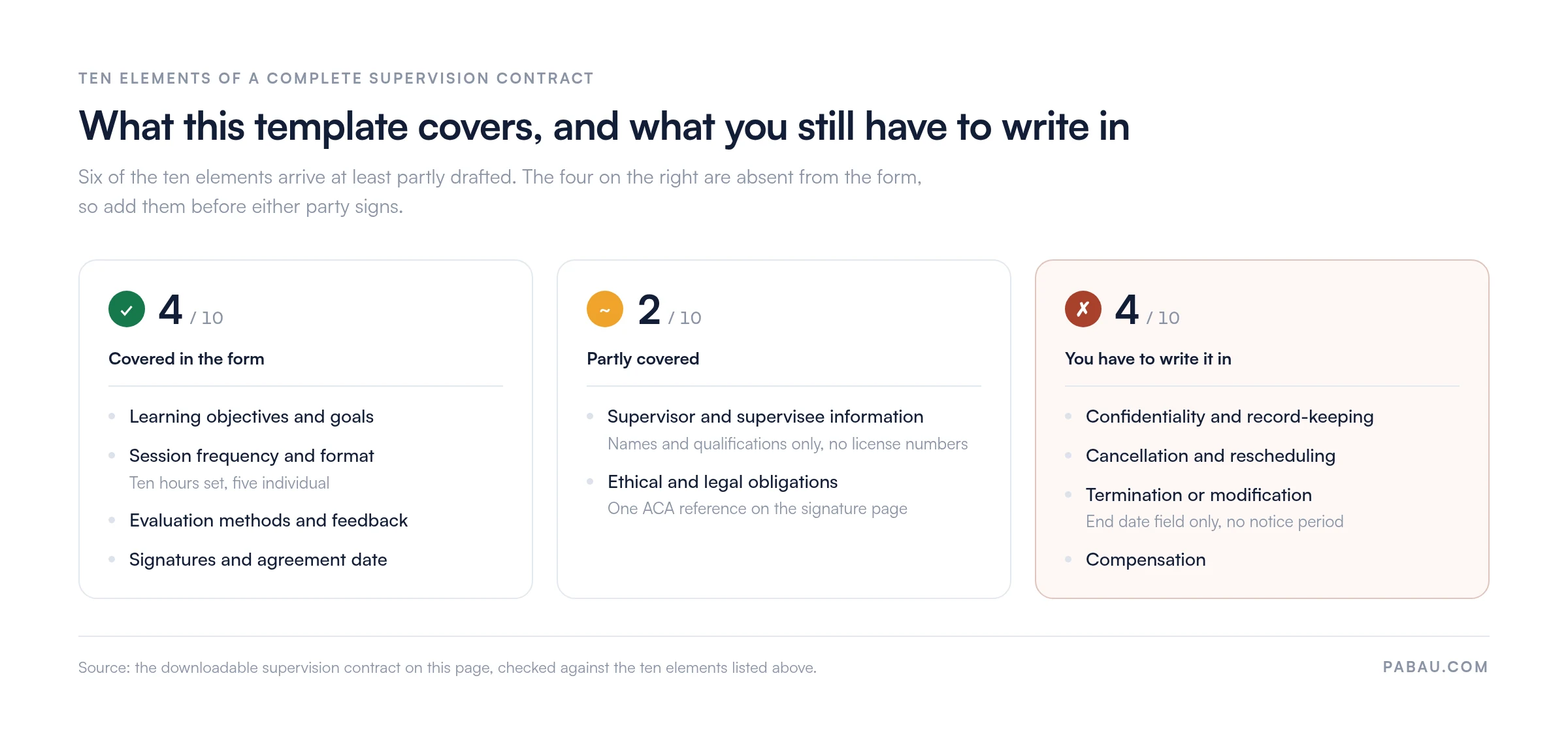
It carries no confidentiality clause, no fee schedule, and no termination conditions, so add those sections yourself before anyone signs.
The form is not built to BACB or California BBS specifications, and it will not satisfy their documentation rules on its own.
Pabau, our practice management software, stores signed contracts and supervision session records where your team can retrieve them for an audit.
The form covers purpose and goals, the context and content of supervision, the method of evaluation, and the duties of supervisor and supervisee. It closes with procedural considerations and a signature page carrying qualifications, contract start date, and contract end date.
Download templateA supervision contract turns a supervisory relationship into a documented one. It records who supervises whom, what the supervisee is working toward, how often you meet, and how you judge progress. Most licensing boards and certification bodies expect that document on file.
The template above gives you that structure. It is a general counseling supervision contract rather than a board-specific form. The file arrives with British spelling, day/month/year date fields, and an ethics reference to the ACA.
This page explains what the form contains and what it leaves out. It also covers how to bring it in line with BACB or California BBS expectations.
Open the file and you get five labeled sections, two name fields, and a signature page. Each section arrives partly pre-filled, so treat the wording as a starting draft rather than a finished agreement.
What the form leaves out matters just as much:
Two more edits are worth making for a US practice. Replace the day/month/year date fields, and swap the ACA reference on the signature page for the code that governs your license.
A supervision contract is a written agreement that sets the framework for professional supervision between a licensed supervisor and a supervisee. It defines expectations, roles, goals, and the ethical boundaries both parties work within.
The contract works as a roadmap and a safeguard at once. It protects the supervisor by documenting the agreed scope, fees, and cancellation terms. It protects the supervisee by naming the competency targets and the route to sign-off. And it gives a licensing board or certification body something to inspect.
Supervision contracts run across clinical disciplines. Licensed professional counselors supervise associates, marriage and family therapists oversee supervisees, board certified behavior analysts document candidate experience hours, and clinical social workers mentor interns. A therapy practice juggling several of those relationships benefits from one consistent document.
Without a written agreement, both parties work from assumptions. Disputes over session frequency, evaluation criteria, confidentiality limits, or how the relationship ends can sour the supervision and expose the practice to liability.
A signed contract earns its place four ways:
For a practice using compliance management tools, the signed contract becomes part of the institutional record and verifiable proof of how you ran supervision.
A complete supervision contract addresses ten areas. Use this list to check whatever draft is in front of you:
The downloadable template already addresses names, goals, supervision context, evaluation, duties, and signatures. Confidentiality, cancellation, termination, and compensation are the four you will need to write in yourself. The breakdown below scores the form against all ten.
Set the session frequency and format explicitly, then mirror it in the system your practice uses for patient scheduling and appointment management.
Behavior analysts pursuing BCBA or BCaBA certification carry documentation duties this template was not written for. The Behavior Analyst Certification Board (BACB) sets its own supervision requirements, and it publishes its own forms for recording them.
Supervisors must meet with the supervisee regularly, observe them working with a client, and supervise a minimum share of the fieldwork hours accrued each month. The Board’s paperwork records that activity rather than the supervision contract.
A BACB-ready supervision agreement should reference:
The template on this page carries none of that. Use it for the relationship terms if you like, then document fieldwork separately on the BACB’s forms. A practice running several supervisors at once can hold credentials, session records, and sign-offs together with team management tools.
The California Board of Behavioral Sciences requires a written supervisory agreement for registered associates. That covers marriage and family therapy, professional clinical counseling, and clinical social work. California supervisors need their own current BBS license and must meet the Board’s experience and training conditions.
A BBS supervisory agreement documents:
The BBS publishes its own supervisory agreement forms, and those are what the Board expects on file. Check the current version on the California BBS website before you rely on any generic contract, including this one.
As a supervisee, read the agreement closely before you sign it. Six problems come up often enough to check for by name:
Two of those apply to the template on this page. Write the confidentiality and termination language in yourself, and have both parties initial the additions.
Five edits take the form from a generic draft to something you can sign:
Once both parties sign, store the executed contract with your digital forms so it is retrievable during an audit.
Most practices manage supervision on the side. The signed contract sits in a shared drive, session dates live in someone’s calendar, and evaluation notes stay wherever the supervisor left them. When a board asks for evidence, somebody spends a day reassembling it.
Pabau, our practice management software, keeps those pieces together. Supervision sessions book into the same calendar as clinical appointments, so frequency becomes a matter of record rather than recollection. Signed contracts and evaluation forms attach to the staff member’s file through digital forms.
Team management and permissions control who can open a supervision record, and reporting shows how many sessions each supervisee had. Every subscription includes all of it, so no feature here sits behind a higher tier.

Pabau schedules supervision sessions in the same calendar as clinical work, and stores signed contracts and evaluations on the staff record. Your team can produce the evidence a board asks for in minutes.

Download the template, then edit it before anyone signs. It documents the relationship well and says nothing about confidentiality or how the arrangement ends. Those are the two clauses that matter most when something goes wrong.
If BACB fieldwork or a California BBS registration governs your supervision, this form is a supplement rather than a substitute. Use the Board’s own paperwork for the hours, and keep this contract for the terms you and your supervisee agreed.
Give each party a signed copy, and store yours where a board review can reach it. Book a demo to see how Pabau keeps supervision contracts, sessions, and sign-offs on one staff record.

Managing several supervisors? Pabau team management holds staff records, permissions, and session history in one place, so supervision evidence is easy to pull.
Running a multi-location practice? Compliance management tracks signed documents, certifications, and renewal dates across every site.
Need the contract signed digitally? Digital intake and consent forms capture signatures and file the completed document against the right record.
Looking for other practice forms? The Pabau template library covers intake, consent, treatment planning, and clinical documentation.
A clinical supervision contract is a written agreement between a supervisor and supervisee. It sets out expectations, goals, responsibilities, and the legal and ethical obligations that govern the relationship. It protects both parties by documenting session schedules, confidentiality limits, evaluation criteria, and termination conditions.
No. The form covers purpose and goals, supervision context, evaluation, duties on both sides, procedural considerations, and signatures. It has no confidentiality provision and no termination clause, only a contract end date field. Add both sections before either party signs.
Any supervisor-supervisee relationship in a regulated clinical field should have a written supervision contract. That includes BCBA supervisors, LPC and LMFT supervisors, clinical social workers, psychologists, and any clinician overseeing a pre-licensed or post-doctoral supervisee. Many state boards and certification bodies require one.
Yes. Once both parties sign, a supervision contract becomes a binding agreement. It establishes mutual obligations and can be used as evidence in a dispute or complaint. Have a healthcare attorney review the contract so it complies with the laws in your jurisdiction.
Yes. Both parties must agree to any change in writing. Common changes cover session frequency, delivery format, or the learning objectives. Record the amendment and re-sign the contract when the change is substantial.