Patient refund policy: What clinics need to know
A patient refund policy is a written document that sets out when your practice r...

Last Updated: Oct 5, 2026
Learning how to retain employees in healthcare starts with fixing the four reasons people leave. Those are burnout, slipping pay, a rough first 90 days and no room to grow.
The 2026 NSI National Health Care Retention Report puts the average cost of losing one bedside RN at $60,090. It also records RN turnover at 17.6% a year.
For a small practice, one resignation means weeks of covered shifts and a team running thin. Below, you’ll find why staff leave, the strategies that keep them, a 90-day onboarding plan and the numbers that warn you early.

Losing one bedside RN costs an average of $60,090, according to NSI’s 2026 report, which makes retention a financial priority for any practice.
Burnout, below-market pay, a weak first 90 days and limited career growth are the four exit drivers a practice manager can act on.
Mentoring pays off: in one program from a 2023 systematic review, 91% of mentored nurses stayed, against 66% without a mentor.
Track retention rate, cost per departure, time to productivity and engagement scores to spot trouble before a resignation.
Scheduling and team management software such as Pabau surfaces overtime and uneven caseloads early, before they turn into burnout.
Healthcare hiring can’t keep pace with departures. The Bureau of Labor Statistics projects about 189,100 openings for registered nurses each year through 2034. Many of those openings exist only to replace nurses who change careers or retire.
Private practices feel this sharply. Hospital systems offer signing bonuses and seniority ladders that a 10-person practice can’t match. So a smaller practice has to win on what it controls: workload, schedules, growth and how people are treated.
Retention strategies only work when they target the reasons people leave. Exit interviews in healthcare tend to return the same short list, so start there.
Healthcare worker burnout is one of the most common reasons clinical staff resign, and workload is the usual trigger. A nurse juggling a full patient list with no support isn’t making a lifestyle choice when she leaves. She’s making a safety call.
Compassion fatigue adds to the strain. Clinical staff absorb patient distress every day. Without regular debriefs and a manager who listens, that weight builds until people disengage or walk out.
Pay is rarely the only reason someone leaves, but it’s often the tipping point. Picture a nurse who already feels overworked. She learns a neighboring practice pays 15% more, and her last reason to stay disappears.
That’s why your offer has to cover the whole package. Base pay matters, and so do benefits, schedule flexibility and low-cost perks.
Healthcare workers invest years in their education. When a practice offers no training budget, no promotion path and no mentor, ambitious staff read that as a ceiling. They leave for places that match their ambition.
New hires are most at risk in their first months. A clinician who spends month one chasing unclear protocols and separate logins reaches competence later. She also feels less part of the team, and she leaves sooner. That makes onboarding a retention tool in its own right.
Each strategy below maps to one of those four exit reasons. They draw on peer-reviewed studies and workforce surveys, and none of them needs a hospital budget.
Start with a salary benchmark. The Medical Group Management Association publishes annual compensation data by specialty and region. Check your rates once a year, and you’ll spot pay drift before it becomes a resignation.
Beyond base pay, these benefits tend to carry the most weight with clinical staff:
Tight budget? Lead with non-cash benefits. A nurse whose dermal filler certification you fund, and whose Saturdays you protect, is less likely to leave for a 10% raise elsewhere.
Culture shows up in daily interactions far more than in a values statement. Psychological safety means staff can raise concerns without fear of blame, and it’s closely tied to whether clinical staff stay.
You build it through consistent behavior. Credit the team in public, act on complaints quickly and model the communication you expect from everyone else.
Recognition works best when it’s routine. Share team wins and kind patient feedback in your weekly huddle or team chat. That way, praise becomes part of the week instead of an annual event.
Development tackles two exit reasons at once. It lifts the career ceiling, and it builds skills that justify higher pay. A practice-level program usually includes these four parts:
Mentorship gives new hires a relationship that makes leaving a bigger decision. The 2023 systematic review cited above reported one program where 91% of mentored nurses stayed, against 66% without a mentor. A practice-level version doesn’t need to be complex.
Scheduling stress leads straight to burnout. A nurse whose Saturday off gets canceled three weeks running will update her resume. Good staff scheduling offers self-scheduling windows, set rest periods between shifts and schedules published well in advance.
How you book patients shapes staff days too. The patient scheduling methods you choose decide whether breaks survive a busy clinic day.
Workforce surveys commonly rank schedule flexibility among the leading retention factors. If your practice runs on appointments, try modeling a compressed week against patient demand. Four 10-hour days instead of five 8-hour days can work well.
Structured onboarding is one of the most under-used retention tools in small practices. Early exits often trace back to the same problems: unclear expectations, disconnected workflows and no proper welcome into the team.
A 30/60/90-day plan ties each stage to a milestone and a check-in, as the timeline below shows.
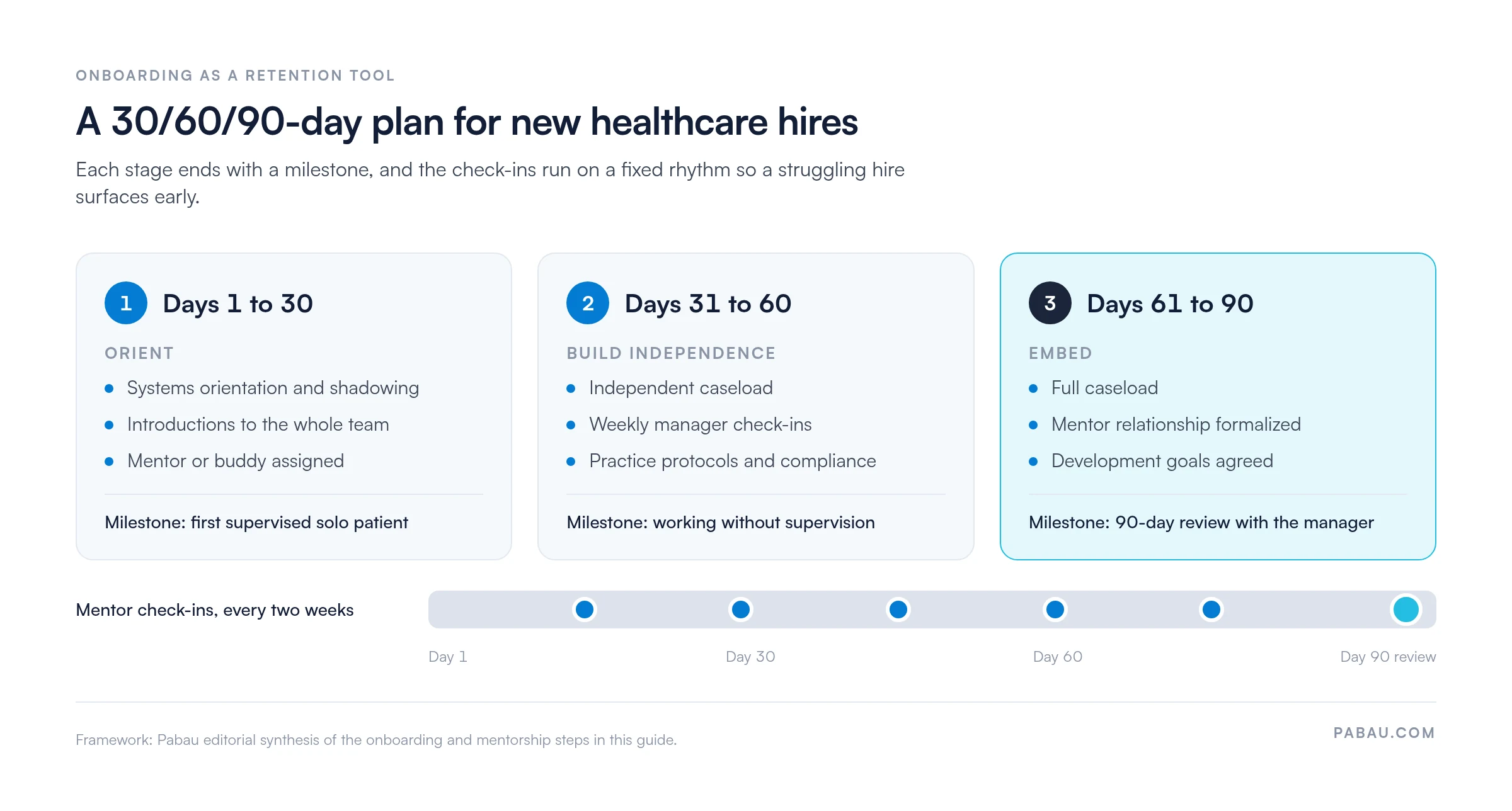
Carry that 90-day conversation into a yearly rhythm with an annual review template, so development goals keep moving after onboarding ends.
A buddy system helps too. Pair each new hire with a peer rather than a manager. The buddy answers the questions a new hire would never ask the boss.
Nurses leave for many of the same reasons as other healthcare staff, but the pressure runs higher. Staffing ratios, mandatory overtime and emotional labor hit nursing harder than most clinical roles.
Shared governance gives nurses formal input into scheduling, policy and practice standards. It appears often in the retention research. Magnet-designated hospitals report lower nurse turnover than non-Magnet peers. Shared governance is a core element of the Structural Empowerment component of the Magnet model.
At the practice level, shared governance can be light. Hold a monthly nursing forum where staff raise schedule concerns, flag safety issues or propose protocol changes. Then send a written response from leadership within two weeks.
Consistency matters more than format. Staff who see their input change outcomes stay longer than those who watch it vanish into a suggestion box.
Nurse residency programs are built specifically for first-year retention. HRSA funds nurse practitioner residencies through its Advanced Nursing Education program. A private practice can borrow the structure without running a full residency. Use structured preceptorship, competency-based milestones and cohort peer support.
Wellness programs reduce turnover by tackling the physical and mental drain that comes before a resignation. Burnout doesn’t appear overnight. It builds over months of unprocessed stress, poor recovery and a fading sense of purpose.
You don’t need a dedicated wellness budget. These low-cost options carry the most weight:
A fruit bowl and a yoga poster in the break room won’t keep anyone. Track sick days, watch overtime patterns and adjust schedules before burnout signs appear. That’s a wellness program staff can feel.
Track overtime patterns monthly. When any team member exceeds their contracted hours by more than 10% for two consecutive months, flag it as a burnout risk signal. Adjust schedules proactively, before that person starts looking elsewhere.
Plenty of practice managers know turnover hurts but can’t put a number on it. Without measurement, retention work is guesswork. Two formulas give you the foundation.
Retention rate: Divide the staff employed at the end of a period by the staff employed at the start, then multiply by 100. A practice that starts the year with 12 staff and ends with 10, with no new hires, has an 83% retention rate.
Cost of turnover: Add recruitment costs, onboarding costs and lost productivity during ramp-up. Across industries, the Work Institute puts the total at about one-third of annual salary. Clinical roles run higher, and NSI’s 2026 figure for one bedside RN is $60,090.
Exit interviews are your third lever. Structured questions reveal patterns that engagement surveys miss. Say three of your last four leavers cited unpredictable schedules. You have a clear priority, whatever the annual survey said.
If your practice management app holds schedules, timesheets and appointments together, these numbers take minutes to pull.
Ten minutes with these questions flags trouble months before a resignation letter:
Even well-run practices lose people to habits that seem harmless. Watch for these five:
Many of the warning signs in this guide live in scheduling data: overtime, uneven caseloads, skipped breaks and canceled days off. Too often, they’re scattered across spreadsheets, group chats and the appointment book.
Pabau, the clinic software we build, keeps staff shifts and patient appointments in one calendar. Its team management tools let you build shift patterns, approve time off and track commission in the same place. So when one clinician carries far more appointments than the rest, you see it before she burns out.
Automated workflows also take reminders and follow-up messages off your team’s plate. That returns hours to patient care, the work that drew most of your staff into healthcare.

Pabau shows shifts, time off and caseloads in one calendar, so you can rebalance workloads early. See how it works in a live demo.

Retention is won in small, repeated decisions. You publish the schedule on time, hold every 90-day review and raise pay before anyone has to ask.
Start with the number you can’t see today. Overtime by person is a good first pick, because it climbs well before anyone hands in notice.
The trade-off is time. Mentoring, one-to-ones and reviews take hours from a busy week. Replacing a nurse takes far more, at roughly $60,000 and 78 days of cover.
Want to see overtime, caseloads and time off in one view? Book a demo and we’ll show you how Pabau’s team tools fit your practice.

Want to tackle burnout at the source? Healthcare worker burnout solutions covers the warning signs and fixes that work without an HR department.
Need a fair way to address performance? Performance improvement plan template gives you a structured format for setting goals with a struggling team member.
Reviewing how you pay your clinicians? Physician compensation models explains how practices structure pay, from fixed salary to productivity-based models.
Hiring with retention in mind? Interview questions to hire your next LPN helps you test for team fit as well as clinical skill.
Planning yearly check-ins? Annual review template for healthcare practices keeps development goals moving after onboarding ends.
A stay interview is a short one-to-one with a current employee about why they stay and what might make them leave. Ask what they enjoy, what frustrates them and what they would change. Run one at six months, then once a year. Act on at least one answer, or the next interview loses its value.
Retention bonuses can hold staff through a short, high-risk period, such as a new service launch. On their own, they rarely fix burnout or a poor manager. Tie the bonus to a set term, often 12 to 24 months, and pay it in installments. Pair it with workload changes, or people leave once it pays out.
Front desk staff absorb patient complaints, phone volume and schedule changes, often for less pay than clinical roles. Give them clear call scripts, protected breaks and a say in how the schedule runs. Cross-train them on billing or patient coordination so the role has room to grow. Recognize their work in the same huddles as clinicians.
It can for roles that don’t need to be on site. Billing, coding, scheduling and follow-up calls can often run remotely or on a hybrid pattern. Clinical staff can’t work that way, so offer them flexibility through shift choice or compressed weeks instead. Set clear response times so remote staff stay connected to the team.