Free patient financial agreement template for practices
A financial agreement is the form a patient signs before treatment to confirm wh...

2
Last Updated: Oct 23, 2026
A patient refund policy is a written document that sets out when your practice refunds a patient and how fast the money goes out. It also says when you can keep a deposit.
The policy lists the refund triggers, the timeline, the refund method and your deposit terms, and patients sign it at intake.
Two deadlines shape it. A Medicare overpayment goes back to Medicare within 60 days of identification, while a patient’s own credit balance is governed by state law. This guide covers what the policy must include, both timelines, when you can keep a deposit, and a seven-step refund workflow.

A patient refund policy must put refund triggers, timelines and the refund method in writing, because verbal terms are hard to enforce in a dispute.
Medicare overpayments go back to Medicare within 60 days of identification, and a good-faith investigation can now suspend that deadline for up to 180 days.
Patient credit balances follow state law, which varies, so a 30-day internal refund standard is a conservative default to confirm with counsel.
Keeping a deposit without a signed forfeiture agreement is risky and often unenforceable, depending on state law and the contract.
Pabau, the practice management platform we build, matches every deposit to its booking and shows patients your cancellation terms before they confirm.
A refund policy earns its keep when it covers the situations your billing team meets every week. Vague wording such as “refunds issued at our discretion” invites disputes, while precise wording settles them. Your written policy should cover six elements.
A policy that covers all six points fits on a single page. Its strength comes from specific numbers and named owners, so cut any clause that leaves the outcome to someone’s judgment.
Refund obligations come from four main sources, and each needs slightly different documentation.
Billing errors and coding mistakes are the most frequent trigger in insurance-accepting practices. A misapplied modifier, a duplicate charge, or a code entered at the wrong fee schedule can leave the patient paying more than they owe. Once identified, correct the charge in the billing system and return the overpaid amount.
Point-of-service overpayments happen when patients pay an estimated copay or balance that turns out higher than the final adjudicated amount. They’re common in practices that collect before insurance has processed the claim. The difference between the estimate and the final explanation of benefits (EOB) becomes a credit balance that belongs to the patient.
Insurance adjustments after claim processing generate credits when a payer pays more than expected, or applies a contractual adjustment the practice hadn’t accounted for. These credits sit in accounts receivable and can age unnoticed without a regular credit balance review.
Prepaid deposits for canceled appointments are refundable when the patient cancels before the deadline in their signed agreement. After that deadline, the deposit may be kept, subject to the rules in the next section.
Treatment paid through patient financing changes who the refund is owed to. The lender pays your practice upfront and then collects from the patient, so your policy should say who gets the money back.
Run a credit balance report in your practice management system at least monthly. A Medicare overpayment left unreturned 60 days after identification is a compliance risk. An aging patient credit is an early sign your reconciliation workflow needs attention.
A practice can keep a deposit only when two conditions are both met. Deposit forfeiture is one of the most misunderstood areas of practice financial policy, so check both before you keep any money.
Without a signed agreement, keeping a deposit is risky and often unenforceable. Whether it holds depends on state law and the terms the patient accepted. A forfeiture clause with no clearly defined cancellation window may also fail in a chargeback dispute or a small claims action.
Some states’ consumer protection laws also limit how much of a prepayment a business can keep. Check your local rules with a healthcare attorney or your state medical board before you finalize forfeiture terms. Our appointment cancellation policy template gives you a starting point for the wording.
Federal and state law set separate refund obligations, and they apply to different money. Mixing them up is how a practice misses a deadline it thought it had met.
The federal Medicare 60-day rule is codified at 42 CFR 401.305. It requires Medicare providers and suppliers to report and return an identified overpayment within 60 days of identification. The rule covers overpayments received from Medicare, and that money goes back to Medicare, not to the patient.
Keeping a Medicare overpayment past the deadline can create liability under the False Claims Act.
The meaning of “identified” changed on January 1, 2025. An overpayment now counts as identified once you know about it, or act in reckless disregard or deliberate ignorance of it. That is the False Claims Act’s “knowingly” standard. The rule also lets you suspend the 60-day deadline for up to 180 days while you run a timely, good-faith investigation.
State law governs patient credit balances, meaning money a patient paid you that they don’t owe. The rules differ widely from state to state. Some set a fixed refund deadline, while others rely on consumer protection law and payer contracts. Confirm your state’s requirement with your state medical board or a healthcare compliance attorney before you set your timeline.
The diagram below puts the two clocks side by side, so your team logs the right deadline from the start.
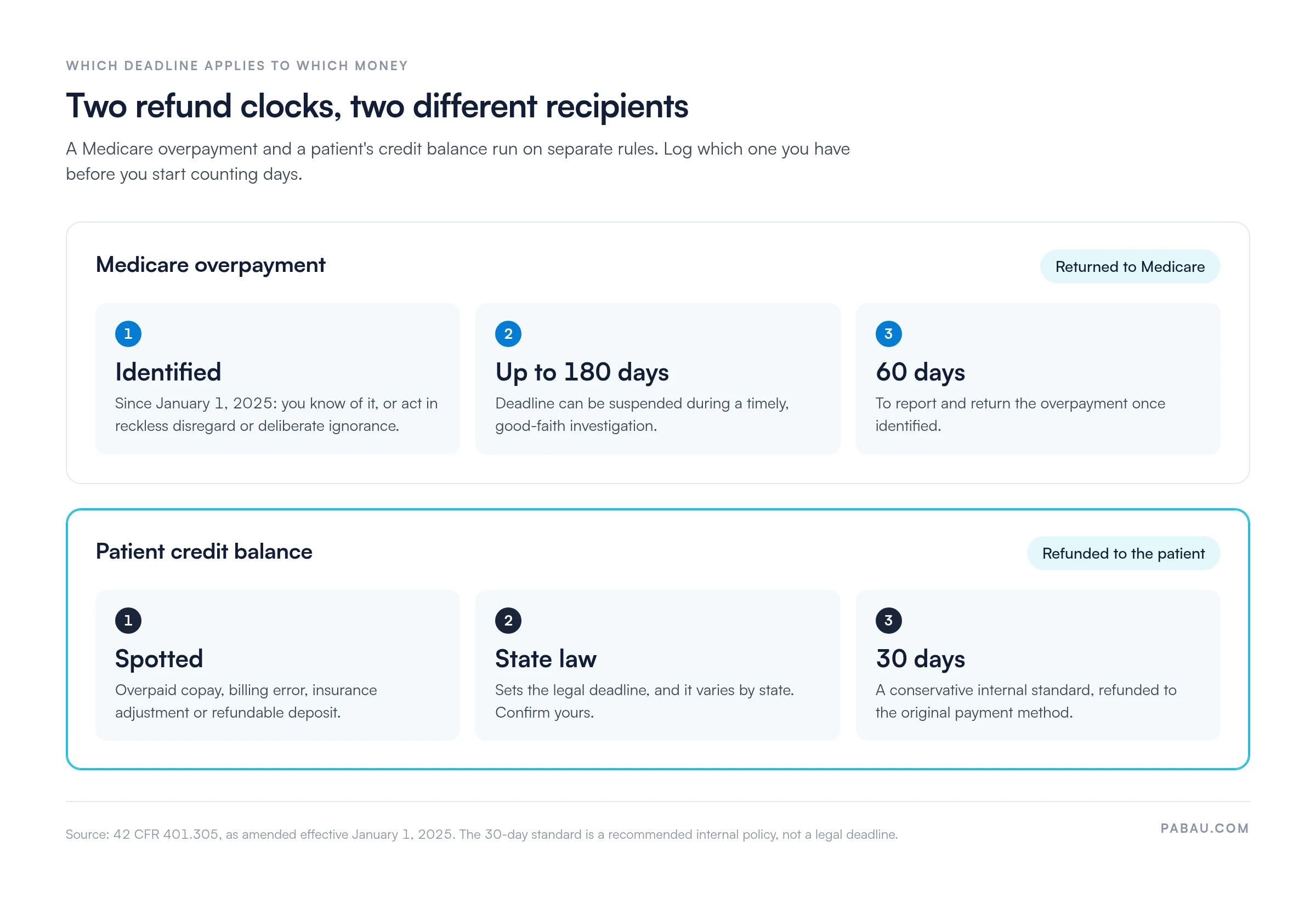
A doctor’s office has 60 days from identification to report and return a Medicare overpayment, and that money goes to Medicare. A refund of a patient’s own overpayment follows state law, which varies. Many practices adopt a 30-day internal standard for every patient refund, which gives the team one deadline to work to.
Identifying an overpayment and processing the refund are separate steps. The 60-day Medicare clock starts at identification, not when the billing team finishes its review. Spend three weeks reviewing an overpayment without a documented good-faith investigation, and you’ve used 21 of your 60 days before processing begins.
Train your team to log the identification date in the patient record the moment an overpayment is spotted.
Private-pay and commercial insurance overpayments fall outside the Medicare rule. Unresolved patient credit balances still draw complaints and can attract state scrutiny, so review them every month as part of your revenue cycle routine.
A consistent process protects the practice from errors, disputes and compliance failures. These seven steps run from identification to documentation.
Many practices still piece a refund together from a standalone card terminal, a spreadsheet of deposits and a paper cancellation form. Each handover between those tools risks losing the date a deposit was taken or the terms a patient agreed to.
In Pabau, deposit collection happens at the point of booking, and each deposit is matched to the right patient and appointment. The cancellation policy settings show patients your terms in the booking widget before they confirm, and apply the same rules every time.
Pabau’s financial reports keep invoices, outstanding balances, payments received and refunds in one place. Your monthly credit balance review starts from a single report instead of three separate exports.
Bookings, payments and patient records share one connected practice management system, so the history behind a refund decision is already in the patient’s file. When a patient disputes a forfeiture, your team can show what was paid, when, and against which booking.

Pabau matches every deposit to its booking and keeps payments, refunds and outstanding balances in one place. Refund decisions rest on records, not paper files. Book a demo to see how it works.

The best time to write your refund policy is before the next dispute lands. Start with the two clocks. Decide for each overpayment whether it belongs to Medicare or to the patient, and record the identification date the day it’s found.
Then get the deposit terms signed separately at booking. That one signature decides whether a forfeiture survives a chargeback, so it’s worth more than any clause you add later.
The trade-off is flexibility against simplicity. A 30-day internal standard may be stricter than your state requires. Still, one deadline is easier to train and audit than a different rule per payer. Book a demo to see how Pabau keeps deposits, payments and refunds on one record for your practice.

Want fewer late cancellations to refund in the first place? How to calculate your patient no-show rate shows how to measure missed appointments and bring the number down.
Chasing balances as well as refunding them? Patient collections: how to improve your collection rate covers getting paid at the billing desk without confusing statements.
Holding a card on file for no-show fees? Credit card authorization form gives you a free PDF and a checklist of the fields to include.
Processing card payments and refunds securely? HIPAA compliant payment processing explains what a processor needs to keep patient payment data compliant.
A patient refund policy is a written practice document that defines when patients are entitled to a refund and how quickly it’s issued. It also sets the payment method and when a deposit may be kept. It sets rules for billing errors, overpayments, insurance adjustments and canceled appointments. Patients should sign or acknowledge it at intake.
Medicare overpayments must be reported and returned to Medicare within 60 days of identification under 42 CFR 401.305. Since January 1, 2025, an overpayment counts as identified under the False Claims Act’s “knowingly” standard. A timely, good-faith investigation can suspend the deadline for up to 180 days. Refunds of a patient’s own overpayment follow state law, and many practices use a 30-day internal standard for them.
State rules on patient credit balance refunds vary, and no single federal rule covers non-Medicare credit balances. Some states set a fixed refund deadline, while others rely on consumer protection law and payer contracts. Confirm your state’s requirement with your state medical board or a healthcare compliance attorney. A 30-day internal standard is a conservative default while you check.
Yes, if the patient signed a written agreement stating the deposit is non-refundable for cancellations inside a defined window or for no-shows. Without a signed forfeiture agreement, keeping the deposit is risky and often unenforceable, depending on state law and the contract. Some state consumer protection laws also limit how much can be forfeited.
A complete patient refund policy names the refund triggers, such as billing errors, overpayments, insurance adjustments and canceled appointments. It also sets the refund timeline, the payment method and the deposit terms, which patients sign separately. Finally, it names a contact for disputes and says how patients receive the policy.
A credit balance is money in a patient’s account that the practice owes back to them. It comes from overpayments, billing corrections or insurance adjustments. A refund is the act of returning that credit by card reversal, check or cash. A credit balance left unrefunded past your deadline becomes a compliance liability.