How many med spas are in the US? America’s med spa map by state
The answer to how many med spas in the US is 42,622, according to the Orbital di...

Last Updated: Oct 16, 2026
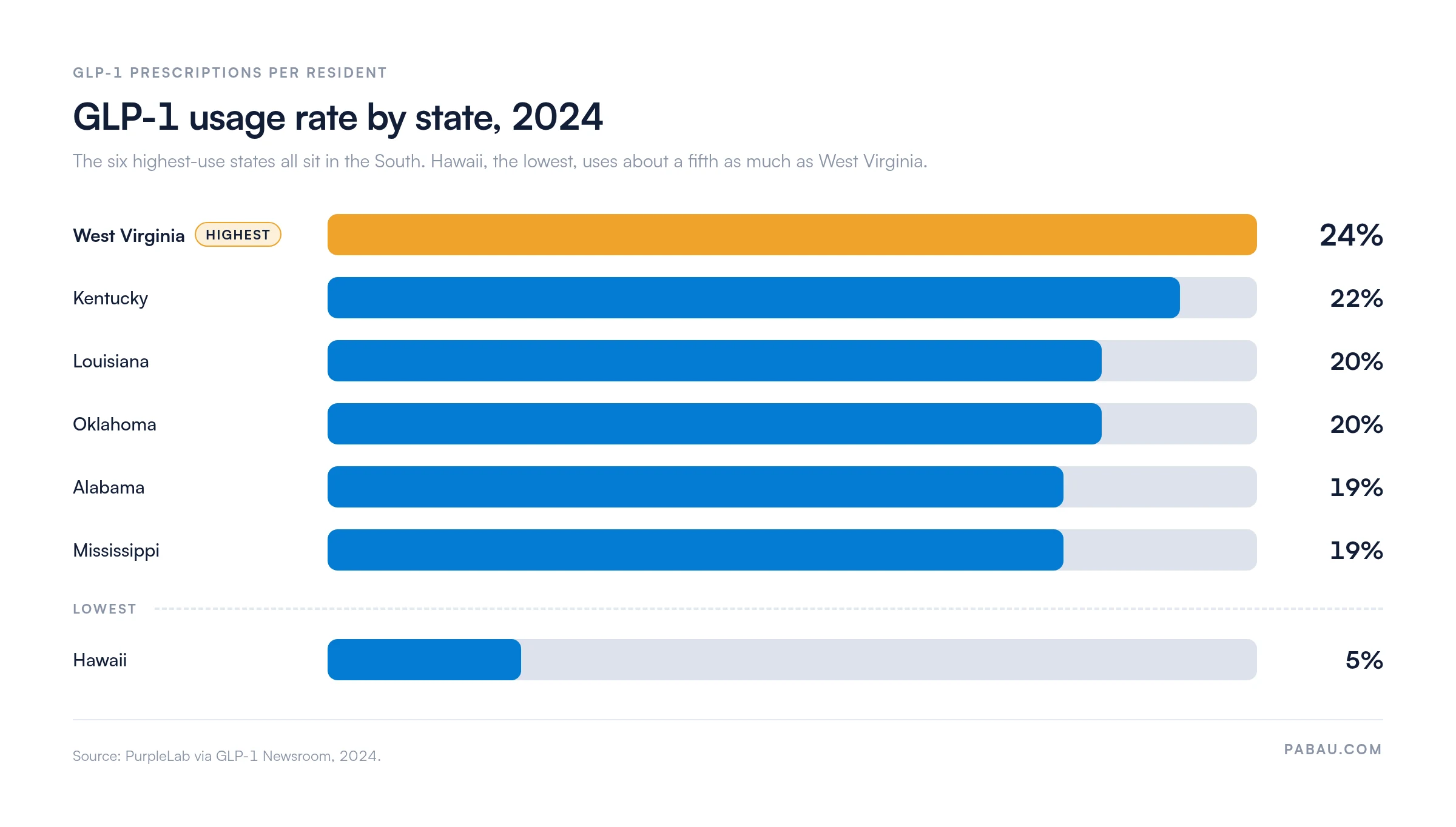
GLP-1 usage by state peaks in West Virginia, America’s GLP-1 capital, with a 24% usage rate1 and 24,217 prescriptions per 100,000 residents2 in 2024. Hawaii sits at the other end at 5%, yet it leads the country for Wegovy search interest3.
Below, the GLP-1 state scorecard sets each state’s use, growth, search interest and Medicaid coverage side by side. Two patterns stand out. Search interest runs opposite to use, and the Medicaid programs spending most on GLP-1s are the ones cutting coverage. For the national picture, see our roundup of GLP-1 statistics.

West Virginia leads GLP-1 use at a 24% usage rate in 2024, and it also tops the country for obesity and diabetes.
Hawaii uses GLP-1s least at 5%, yet it ranks first for Wegovy search interest.
Texas filled 4,664,860 GLP-1 prescriptions in 2024, more than any other state.
Rhode Island’s prescriptions grew 67.8% in 2024, while Louisiana, South Dakota and Idaho each fell about 11%.
Only 13 state Medicaid programs still cover GLP-1s for obesity after four states dropped coverage on January 1, 2026.
11% of US adults now take a GLP-1 for weight loss, up from 3% in 2024.
82% of American Society of Plastic Surgeons (ASPS) members received GLP-1-related consultation requests in 2025.
West Virginia uses GLP-1s the most, at a 24% usage rate in 2024, and Hawaii uses them the least, at 5%.
Those rates count GLP-1 prescriptions per resident, so they measure prescribing volume across Ozempic, Wegovy, Zepbound and the rest of the class. The six highest-use states all sit in the South, and the lowest sits in the Pacific.
West Virginia is America’s GLP-1 capital: nearly 1 in 4 residents’ worth of prescriptions (24% usage rate1; 24,217 Rx per 100k2) in 2024. The state is also #1 for obesity (41.4%)4 and diabetes (18.4%)5, both 2024 figures.
For practices there, GLP-1 demand arrives with type 2 diabetes attached. Intake needs diabetes status and current medications on file before anyone discusses a first dose of semaglutide or tirzepatide.
The GLP-1 belt: Kentucky 22%, Louisiana 20%, Oklahoma 20%, Alabama 19%, Mississippi 19%1 round out the top six (2024).
All six are Southern states, and West Virginia and Kentucky anchor the Appalachian end. For a weight-loss practice in the belt, GLP-1 patients are a core caseload. Each new start adds months of dose reviews, so clinician time for follow-ups needs planning from the first month.
Kentucky: 1.9% of ALL patients and 7% of patients with an obesity diagnosis6 are on a GLP-1, the highest share in the US. Kentucky Medicaid also spends the most per enrollee on GLP-1s ($1627).
The 1.9% figure counts every patient seen, whatever the reason for the visit. That makes Kentucky the state where a GLP-1 is most likely to turn up on a medication list at an unrelated appointment. Aesthetic and surgical practices there should ask about GLP-1 use at every intake.
Alaska has the highest GLP-1 uptake among patients diagnosed with obesity: 14.8%6.
Alaska’s rate is double Kentucky’s 7% on the same measure, even though only 1.8% of all Alaskan patients take one. Alaskans with an obesity diagnosis are more likely to be treated with a GLP-1 than patients anywhere else. Practices there can expect new patients who are already partway through a course.
Texas fills more GLP-1 prescriptions than any state: 4,664,860 in 20241, ahead of California (3.73M) and New York (2.82M).
Texas leads on volume because of its population, while its per-resident rate sits outside the top six. For practices, volume is the number that fills a calendar. Texas, California and New York hold the most GLP-1 patients in absolute terms, so they hold the most patients needing follow-up and post-weight-loss care.
Hawaii uses GLP-1s least of any state (5% usage rate1; 5,050 Rx per 100k2) yet is the #1 state for “Wegovy” Google Trends interest3.
Hawaii is the clearest case of interest running ahead of access. Residents rank first for Wegovy searches but last for GLP-1 prescriptions per resident. That mismatch is a demand signal for a Hawaii practice. Plenty of residents are interested in the drugs, and relatively few are on one yet.
The chart below ranks the six highest-use states against Hawaii, the lowest.
Rhode Island grew GLP-1 prescriptions fastest in 2024, up 67.8%, while Louisiana, South Dakota and Idaho each fell about 11%.
Tracked as GLP-1 usage over time, the national direction is still sharply up, even where individual states dipped in 2024.
11% of US adults8 now take a GLP-1 for weight loss (June 2026), up from 3% in 2024; 15% have ever used one.
Gallup’s figure counts weight-loss use only, so patients taking a GLP-1 solely for diabetes sit on top of it. The 4-point difference between ever-used and current use is a pool of patients who have stopped. Those lapsed patients already know the drugs, and some will come back for a restart or for aesthetic work after weight loss.
Rhode Island’s GLP-1 prescriptions grew 67.8% in 20241, the fastest in the nation, followed by Massachusetts (+48%) and New Jersey (+35.8%).
The fastest growth sits in the Northeast, far from the GLP-1 belt. For Northeast practices, that growth means new starts, and every new start adds months of follow-up visits to the schedule.
GLP-1 prescriptions actually FELL in Louisiana (-11.6%), South Dakota (-11.1%) and Idaho (-11%) in 20241.
Louisiana stands out because it also sits in the GLP-1 belt, at a 20% usage rate. The state still uses GLP-1s heavily, but it filled 11.6% fewer prescriptions than the year before. A falling count can mean patients stopping, losing coverage or switching to cash-pay sources, so practices there should track who drops off and why.
New York searches for Ozempic the most per resident, and Florida leads searches for weight-loss drugs in summer 2026.
Search maps measure curiosity, and they barely overlap with the prescription maps above. Search data is the better guide to where undecided patients are.
Search interest is the inverse of usage. New York leads Ozempic Google queries (159 per 100k)9 while Mississippi, a top-6 usage state, is dead last (33 per 100k).
New Yorkers search for Ozempic nearly five times as often as Mississippians, even though Mississippi sits in the top six for use. In high-use states, patients often arrive with a prescription history. In high-search states, more patients are still deciding, so consult content and clear pricing do more of the selling.
Floridians search for weight-loss drugs most in summer 2026: 1,964 per 100k per month10, 20% above the national average.
The national average in the same window was 1,636 searches per 100,000 people a month, measured from May to September. For Florida practices, summer is when weight-loss consult requests are most likely to land, so open extra consult slots ahead of it.
Washington leads per-capita searches for Ozempic SIDE EFFECTS (121+ per 100k11).
Washington’s figure measures search interest, so it shows how much residents worry about side effects rather than how often they happen. For practices, side-effect questions are the ones to answer before the first dose. A written aftercare sheet covering nausea and when to call the practice saves patients a late-night search.
Nebraska is the #1 state for “Zepbound” Google Trends interest3 (July 2025).
Zepbound, Eli Lilly’s tirzepatide for weight loss, has its strongest following in the Midwest. Wegovy interest peaks in Hawaii instead, so brand preference splits by region. Practices that prescribe both should expect patients to ask for a brand by name.
13 state Medicaid programs covered GLP-1s for obesity as of January 2026, down from 16 in October 2025.
If you’re checking which states’ Medicaid cover GLP-1 drugs for weight loss, these are the 13 on KFF’s January 2026 list12:
When covered, GLP-1s typically come with prior authorization, which limits access further. Rhode Island has since cut back. From October 1, 2026, Rhode Island Medicaid no longer covers Wegovy, Zepbound, Saxenda or Foundayo when prescribed solely for weight loss13.
Does Medicaid cover Ozempic? For type 2 diabetes, yes, in every state, because diabetes coverage is required while obesity coverage is optional. So Ozempic Medicaid coverage turns on the diagnosis on the prescription, and the drug name matters less.
Only 13 state Medicaid programs still cover GLP-1s for obesity (Jan 2026)12, down from 16. California, New Hampshire, Pennsylvania and South Carolina all dropped coverage on January 1, 2026.
North Carolina dropped coverage in October 2025 and reinstated it in December 2025, which is why it still appears on the list. Patients who were mid-course in the four cutting states now need another way to pay.
States are cutting GLP-1 coverage because of cost, with spending in the largest Medicaid programs passing $1 billion a year.
Across all programs, gross Medicaid spending on GLP-1s rose from about $1 billion in 2019 to almost $9 billion in 202412.
California Medicaid spent over $1.4 billion7 on GLP-1s in the year to October 2024 ($118 per enrollee, +235% YoY), then cut obesity coverage.
California’s total was the highest of any state Medicaid program. Kentucky spent more per enrollee, at $162, but California’s sheer enrollment produced the biggest bill. The program with the largest GLP-1 bill became one of the four to drop obesity coverage.
Pennsylvania Medicaid GLP-1 spending went from $233M (2022) to an estimated $1.3B (2025)14 before the state cut obesity coverage.
Pennsylvania’s spending rose more than fivefold in three years. The pattern matches California: the programs with the steepest bills made the deepest cuts.
West Virginia ended its public-employee GLP-1 subsidy ($25 copay pilot15) citing cost, in the state with the nation’s highest obesity and GLP-1 prescription rates.
When coverage ends, patients who still want treatment move to self-pay. Demand then shifts to cash-pay weight-loss practices, which price GLP-1 care as a program. If that’s your practice, see how weight-loss clinics make money on that model.
The GLP-1 boom is creating new aesthetic demand, from “Ozempic face” volume loss to body contouring after rapid weight loss.
82% of ASPS surgeons16 received GLP-1-related consultation requests in 2025 (“Ozempic face/body”).
For aesthetic practices, the state data shows where that demand will concentrate. West Virginia and Kentucky fill the most GLP-1 prescriptions per resident. That makes them the densest pools of future aesthetic patients. Check where facial fillers and body contouring sit among the most common cosmetic procedures.
Some med spas go further and add a GLP-1 program of their own. Prescribing and supervision rules vary, so check our guide to med spa laws by state first.
The GLP-1 state scorecard below puts GLP-1 usage by state next to growth, search interest and Medicaid coverage, one headline per row.
| State | Headline fact | Figure | Source |
|---|---|---|---|
| West Virginia | Highest GLP-1 use | 24% usage rate; 24,217 Rx per 100k (2024) | GLP-1 Newsroom1; ProBody2 |
| Kentucky to Mississippi | The GLP-1 belt | 22% to 19% usage rate (2024) | GLP-1 Newsroom1 |
| Kentucky | Highest share of all patients on a GLP-1 | 1.9% of all patients; 7% with obesity; Medicaid $162 per enrollee | Newsweek6; Real Chemistry7 |
| Alaska | Highest uptake among patients with obesity | 14.8% | Newsweek6 |
| Texas | Most GLP-1 prescriptions | 4,664,860 (2024) | GLP-1 Newsroom1 |
| Hawaii | Lowest GLP-1 use | 5% usage rate (2024) | GLP-1 Newsroom1 |
| US | Adults on a GLP-1 for weight loss | 11% (June 2026) | Gallup8 |
| Rhode Island | Fastest prescription growth | +67.8% (2024) | GLP-1 Newsroom1 |
| Louisiana, South Dakota, Idaho | Falling prescriptions | About -11% (2024) | GLP-1 Newsroom1 |
| New York | Most Ozempic searches | 159 per 100k | Becker’s9 |
| Mississippi | Fewest Ozempic searches | 33 per 100k | Becker’s9 |
| Florida | Most weight-loss drug searches | 1,964 per 100k a month (summer 2026) | CW3310 |
| Washington | Most Ozempic side-effect searches | 121+ per 100k | DeMayo Law11 |
| Nebraska | Top state for Zepbound interest | #1 (July 2025) | NowPatient3 |
| US Medicaid | Programs covering GLP-1s for obesity | 13 (January 2026) | KFF12 |
| California | Largest Medicaid GLP-1 spend | $1.4B+ (year to October 2024) | Real Chemistry7 |
| Pennsylvania | Medicaid GLP-1 spend surge | $233M to $1.3B (2022 to 2025) | The Rx Index14 |
| US surgeons | GLP-1 consultation requests | 82% (2025) | ASPS16 |
Read across the rows and two patterns appear. Mississippi, a top-six use state, ranks last for Ozempic searches, while low-use Hawaii leads on Wegovy interest. The biggest Medicaid spenders, California and Pennsylvania, are among the four that cut obesity coverage.
In the weight-loss practices we onboard, a GLP-1 program is rarely one visit. It runs as a series of check-ins and dose reviews, and each one is a booking, a reminder and often a payment.
Pabau, the all-in-one practice management system we build for medical and aesthetic practices, keeps that series on one patient record. Patients book follow-ups through online booking, and automated reminders go out before each check-in, so your front desk isn’t chasing confirmations by phone.
Digital intake and consent forms land on the record before the first consult, so the prescriber sees diabetes status and current medications up front. A ready-made weight-loss intake form gives you a starting point. Treatment notes sit alongside each dose review, so the next clinician sees the full history in one place.
As coverage cuts push patients to self-pay, payments and invoicing run in the same system, so cash-pay plans get billed without a separate tool. See how Pabau works as software built for weight-loss practices.

Pabau’s online booking, automated reminders and digital forms keep each GLP-1 follow-up booked and documented. Payments run in the same system, so cash-pay plans are simple to bill.

GLP-1 demand follows two maps: where patients already use the drugs, and where coverage still pays for them. Those maps are pulling apart.
As Medicaid and employer programs cut obesity coverage, patients in the biggest-spending states move to self-pay. Cash-pay weight-loss and aesthetic practices are where those patients land next.
If you run a practice in a high-use, low-coverage state, plan capacity now. Make room for monthly follow-ups, publish clear self-pay prices, and prepare for the aesthetic work that comes after weight loss. Book a demo to see how Pabau keeps GLP-1 check-ins, forms and self-pay billing on one patient record.

Want the national numbers? GLP-1 statistics covers how many Americans take a GLP-1, by drug and by reason.
Planning a weight-loss practice of your own? How to start a weight loss clinic walks through the setup steps, from licensing to your first patients.
Screening patients before a first dose? Ozempic questionnaire gives you a ready-made intake questionnaire for semaglutide patients.
West Virginia, with a 24% usage rate and 24,217 prescriptions per 100,000 residents in 2024.
13 state Medicaid programs covered GLP-1s for obesity in January 2026, down from 16 in October 2025. California, New Hampshire, Pennsylvania and South Carolina dropped coverage on January 1, 2026. The 13 are Delaware, Kansas, Massachusetts, Michigan, Minnesota, Mississippi, Missouri, North Carolina, Rhode Island, Tennessee, Utah, Virginia and Wisconsin.
Hawaii, at a 5% usage rate and 5,050 prescriptions per 100,000 residents in 2024.
Texas, with 4,664,860 in 2024, ahead of California at 3.73 million.
Rhode Island, where prescriptions grew 67.8% in 2024, followed by Massachusetts at 48%.
11% of US adults took a GLP-1 for weight loss in June 2026, and 15% have used one at some point.