Slocum test: How to perform, interpret and record it
The Slocum test is a knee drawer test performed with the tibia rotated. It check...

3
Last Updated: Oct 21, 2026

Balance exercises for seniors cut fall risk by training the muscles, vestibular system, and nerve pathways that weaken with age
The seven exercises here need no equipment, and each one has a chair-supported version for limited mobility
Adults over 70 should start with fewer repetitions and longer rest periods than generic adult guidelines suggest
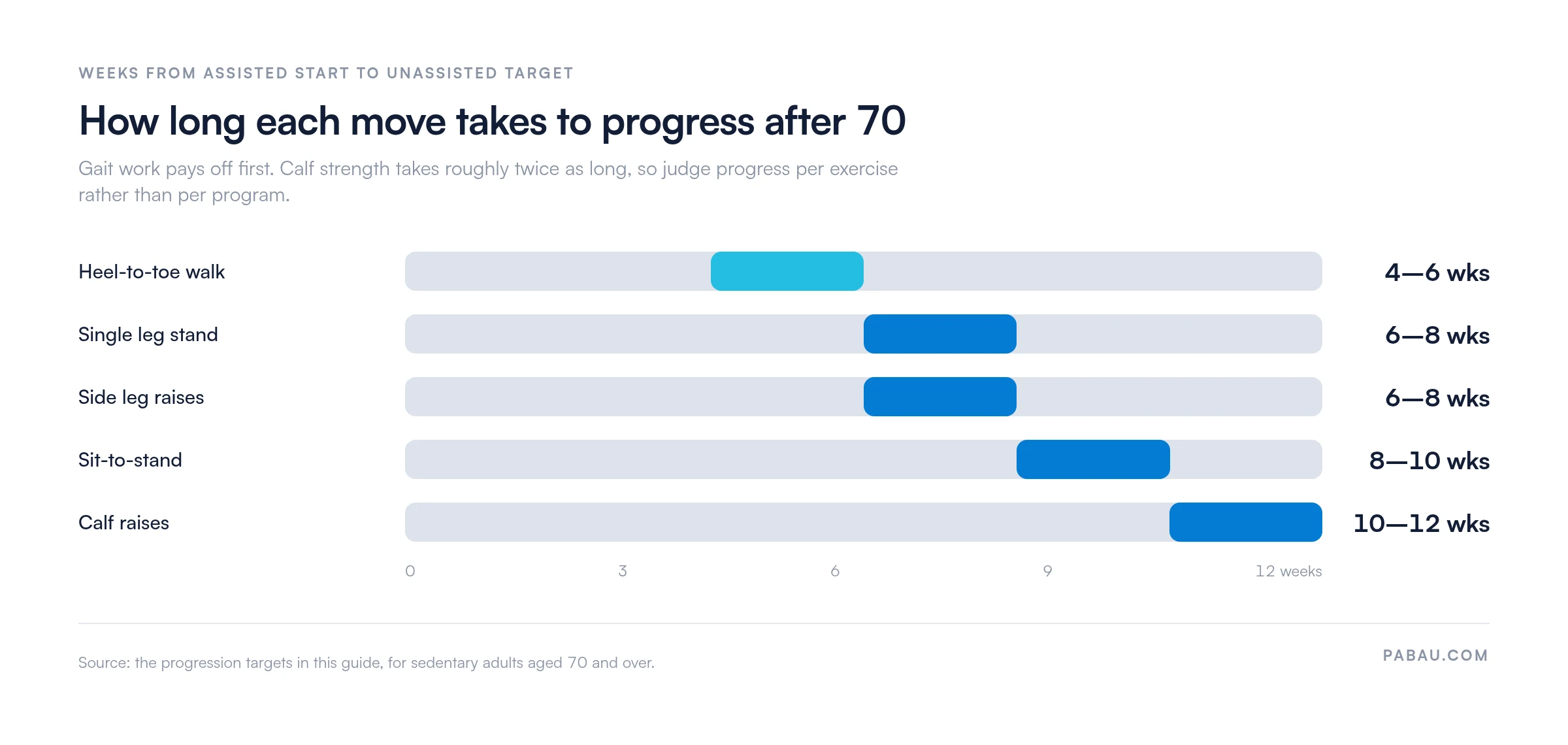
Gait work such as the heel-to-toe walk progresses in four to six weeks, while calf strength takes ten to twelve
Physical therapy practices can use Pabau to record balance test scores and send home exercise plans after every visit
Falls send more than 3 million older adults to US emergency departments each year, according to the CDC’s STEADI fall prevention program. Most of those falls are preventable. Regular balance exercises reduce fall risk, improve confidence, and support independence far longer than most people expect.
This guide covers seven evidence-based exercises, chair-based modifications, and the safety signals that warrant a doctor visit. It also sets out how fast an adult over 70 should expect to progress on each move. It is written for older adults, family members, and the physical therapy practices that support them.
Balance relies on four systems working together: muscle strength, the vestibular system, proprioception, and vision. Every one of them declines with age. Balance fails when all four weaken at the same time, so no single system carries the blame.
Muscle loss drives much of that decline, which is why balance work pays off fastest alongside resistance training. A weekly routine of strength exercises for seniors builds the leg and hip muscles these balance drills depend on.
All four systems respond to targeted training. Balance exercises work by creating controlled instability, which forces the brain and body to recalibrate those pathways. Consistency matters more than intensity. The World Health Organization advises older adults to do multicomponent activity that includes balance work on three or more days per week.
These seven exercises cover the balance library that appears across NHS and Mayo Clinic guidance. Every one can be done at home with no equipment. Keep a sturdy chair within reach until confidence builds.
This is the foundational single-leg stance drill. It targets hip stabilizers and ankle proprioception directly.
Progression: Release the chair once you can hold 30 seconds comfortably. For a harder version, close one eye or stand on a folded towel.
Also called tandem walking, the heel-to-toe walk retrains gait steadiness and activates ankle balance responses.
Keep a wall beside you for the first few sessions. The move trains gait stability with very little risk during the exercise itself, which is why nearly every fall prevention program includes it.
The sit-to-stand is one of the most functional movements in fall prevention. Getting up from a chair is where many falls happen, and this exercise trains that transition directly.
Modification: Place hands on the chair arms for assistance if needed. As strength increases, cross your arms over your chest to remove the arm assist.
Calf strength drives push-off power and the ability to correct forward when you stumble. Weak calves are a consistent predictor of fall risk in older adults.
Seated variation: Sit tall in the chair with feet flat. Press through the balls of your feet to lift your heels off the floor. This works equally well for anyone with standing limitations.
Side leg raises strengthen the hip abductors, the lateral muscles that prevent side-to-side stumbling during walking and stair use.
This drill targets proprioception more directly than most exercises. Imagining a clock face trains the brain to coordinate balance signals from several directions at once.
Research suggests tai chi is one of the most effective balance modalities for older adults. A 2019 systematic review in the British Journal of Sports Medicine found that tai chi reduced fall rates by roughly 19-20% in community-dwelling older adults. Its slow, deliberate weight shifts engage every balance system at once.
A beginner does not need a full class. The weight-shift practice alone delivers meaningful proprioceptive benefit, and you can do it while holding a chair. Community tai chi classes for seniors run at most local recreation centers, often free or low cost.
Not every older adult can stand unassisted. Chair-based exercises deliver measurable balance and strength benefits without that requirement. Physical therapy practices often start a patient on a seated program before progressing to standing work.
These exercises suit post-surgical patients, anyone with severe osteoporosis, and anyone whose standing balance is too compromised for weight-bearing drills. The NHS balance exercise guidance covers seated modifications in more detail.
Start every balance session near a wall or with a chair within arm’s reach. Progress to touching the chair with one finger, then hovering your hand over it without contact. The finger-touch method keeps you safe while still challenging the balance system.
Generic senior exercise guidelines underestimate the difference between a 62-year-old and a 75-year-old. Adults over 70, particularly those who have been sedentary, need lower starting points, longer rest periods, and a slower progression timeline. The table below sets a realistic pace for each move.
Rest for 60-90 seconds between sets, not the 30 seconds usually recommended for younger adults. Most falls during exercise happen once fatigue sets in. If a movement causes dizziness, joint pain, or shortness of breath, stop and consult a healthcare professional.
Those same timelines look different once you sort them by length. Gait work rewards a beginner first, and calf strength is the longest haul of the five.
Set a baseline before week one so the progress is measurable. The 4-stage balance test takes under two minutes and gives a score you can re-check at week six.
Three or more days a week is the floor. The WHO recommends multicomponent balance and functional exercise on at least three days per week, within 150-300 minutes of moderate activity. The National Institute on Aging names balance training as one of the essential exercise types for older adults, alongside endurance, strength, and flexibility.
Practically, this means:
Progressive overload matters. Increase the challenge every two to four weeks by adding repetitions, reducing chair support, or moving to an unstable surface. Without progression the balance system adapts, and improvement stalls.
Balance exercises are low-risk for most older adults, but some situations warrant a professional assessment first. Speak to a healthcare professional if you are unsure whether these exercises suit you.
Stop and seek medical advice if you experience:
See a doctor before starting if you have a recent hip or knee replacement, osteoporosis, Parkinson’s disease, a history of stroke, or peripheral neuropathy. Balance problems can also be a medication side effect. Sedatives, blood pressure medications, and antihistamines all affect vestibular function, so a pharmacist or doctor can review whether an adjustment is warranted.
Fall prevention is a clinical outcome that physical therapy and rehabilitation practices have to document, track, and report. Practice management software like Pabau makes that documentation sustainable without adding admin hours to a clinician’s day. Our physical therapy EMR software keeps the assessment, the plan, and the follow-up on one patient record.
Measurements tracking software lets clinicians record balance test scores at each visit and see progress over time. A Timed Up and Go result or a Berg Balance Scale score sits beside the treatment note on the same record. That makes it straightforward to show functional improvement, or to flag a patient who is not responding.
Digital intake forms capture fall history, medication use, and home hazards at the start of care, with no transcription step. After each session, pre- and post-care instructions go out by SMS or email carrying that patient’s own home exercise plan. Patients stay on track between appointments, and the practice keeps a record of what was sent.
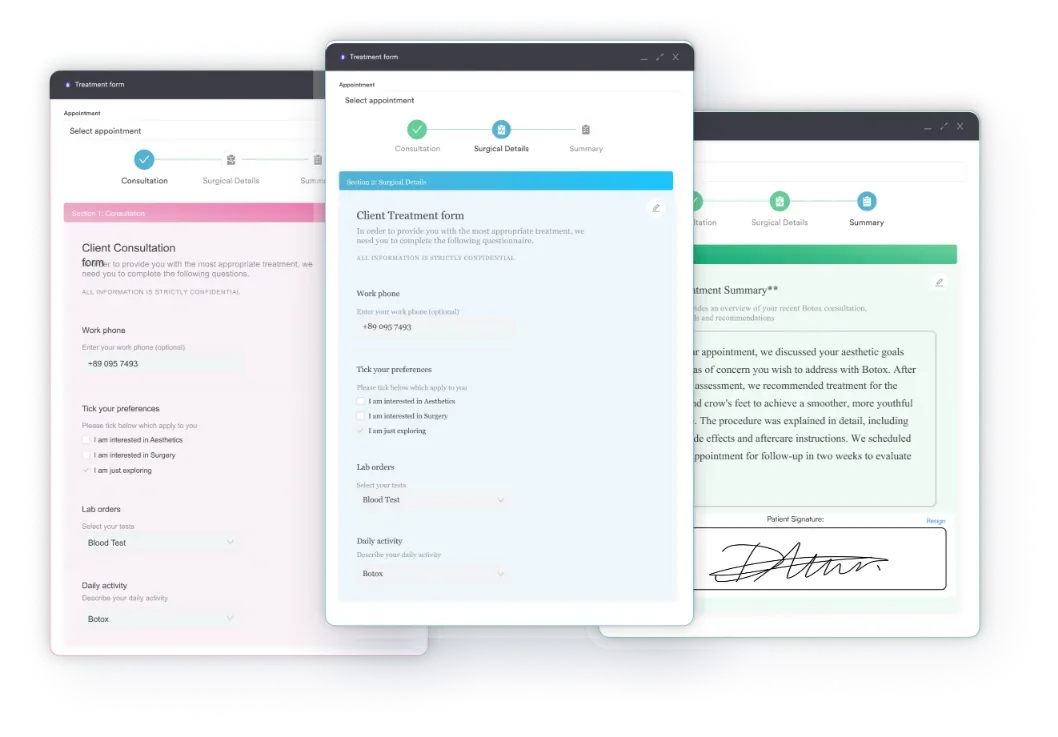

Pabau records balance test scores, stores fall risk assessments, and sends each patient’s home exercise plan after the visit. Your team keeps the outcome data without the extra paperwork.

Falls are not an inevitable part of aging. The barrier to starting is low: no equipment, no gym membership, seven minutes near a kitchen counter or a sturdy chair. What decides the outcome is whether the routine survives past week three.
For an adult over 70, the honest trade-off is patience. Heel-to-toe walking will feel steadier inside six weeks, while calf strength needs closer to twelve. Judge progress one exercise at a time, and keep the chair in reach until you stop reaching for it.
Practices running fall prevention programs need the same discipline in the record. Book a demo to see how Pabau keeps balance scores, home exercise plans, and follow-up on one patient record.

Running a physical therapy practice and need a compliance framework? Mandatory compliance for physiotherapy clinics covers the documentation and audit standards practices must meet.
Setting up a physical therapy practice from scratch? Opening a physiotherapy clinic walks through the clinical, legal, and operational steps involved.
Need a validated way to score balance at intake? Berg Balance Scale template gives you the 14-item scoring sheet for assessment and review.
Screening older patients for fall risk? Tinetti balance test template scores gait and balance together in one short assessment.
Sending patients home with a routine? Home exercise program template gives you a structured sheet for prescribing and tracking exercises between visits.
The best balance exercises for seniors are the single leg stand, heel-to-toe walk, sit-to-stand, calf raises, side leg raises, clock reach, and tai chi. These seven exercises address all four balance systems (muscle strength, vestibular function, proprioception, and vision) and can be performed at home without equipment. Most adults see measurable improvement within four to six weeks of consistent practice three or more times per week.
Seniors should do balance exercises at least three days per week, and five days per week is optimal. That follows WHO physical activity guidelines for older adults. Sessions of 10-20 minutes are enough when the exercises are done consistently. Building them into daily routines, such as single leg stands while making coffee, improves long-term adherence far more than scheduled gym sessions.
Yes. Multiple Cochrane systematic reviews confirm that balance and functional exercise programs reduce fall rates in community-dwelling older adults. The CDC’s STEADI program recommends balance training as a frontline fall prevention strategy. Results are strongest when the exercises run consistently over 12 or more weeks and include progressive challenge increases.
Yes, chair exercises improve balance, particularly for seniors with limited standing ability or significant deconditioning. Seated leg extensions, seated marching, and seated lateral weight shifts activate the same muscle groups as their standing equivalents. They build the foundation needed to progress to standing work. They are appropriate for post-surgical patients and for those with severe osteoporosis or neuropathy.
A senior should see a doctor immediately after new or sudden balance loss, recurring dizziness, or a fall that causes injury. Balance that worsens over several weeks warrants the same call. Balance problems can signal inner ear disorders, medication side effects, neurological changes, or cardiovascular issues. A doctor or specialist can identify the cause and refer to physical therapy or vestibular rehabilitation as appropriate.
Research suggests tai chi is one of the most effective balance interventions for older adults. A 2019 systematic review in the British Journal of Sports Medicine found it reduced fall rates by roughly 19-20% in community-dwelling seniors. Tai chi works by training slow, deliberate weight transfers that engage the vestibular system, proprioception, and leg muscle control at once.